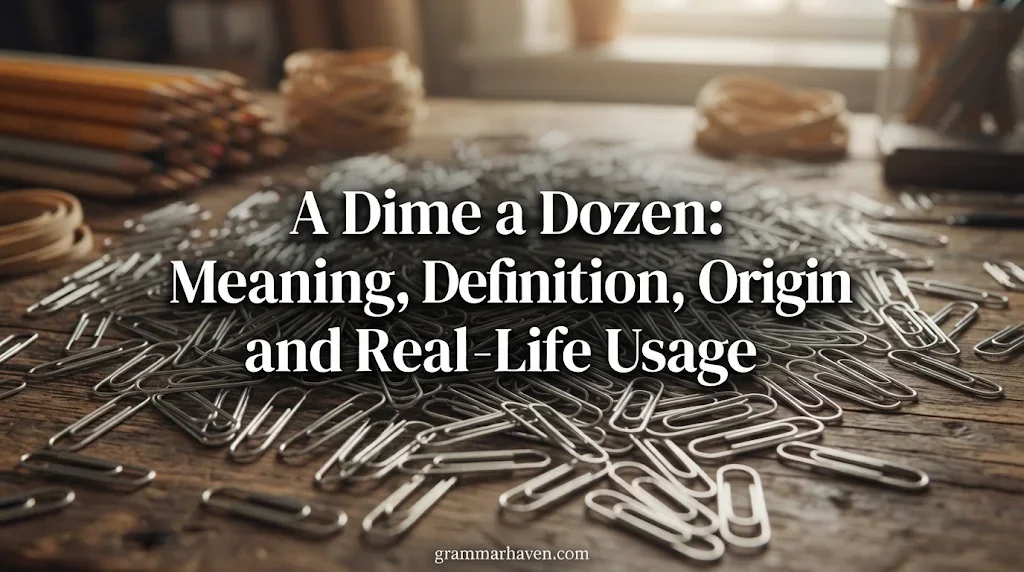
A Dime a Dozen describes things that are common, easy to find, and often seen as less special because so many are available everywhere today. This common expression in the English language is an idiom and saying with a clear figurative meaning. Its real meaning focuses on abundance, quantity, and availability rather than money, pricing, or shopping. Imagine visiting a market and seeing rows of apples that look shiny and identical. Their similarity creates a sea of sameness, making each item seem ordinary and less noticeable. This example explains why something plentiful, abundant, and easily available may not feel special or unique.
The origin of this sharp expression connects to affordable goods. A dime means ten cents and a dozen means twelve items. This comparison describes something cheap and available in large quantities. Its market value and affordability are not always important in modern usage. People use the phrase for things that are overly common, less unique, or lacking originality. Their value may seem lower because of their widespread availability, even when they still have practical worth. Recognizing this essence helps you understand why something can be not special without being completely useless or worthless.
You may have heard this expression in everyday speech, casual conversations, business meetings, social media posts, and movie dialogue. For example, romance novels can be called a dime a dozen because they are easy to find in almost every bookstore. Learn Language offers a practical guide to understanding expressions and using them naturally in real life. People sometimes use phrases without fully thinking about their meaning. A clear understanding improves communication when discussing ordinary items, repeated experiences, and things that hold little value because of their abundance. The main comparison is between something widely available and something that truly stands out.
A Dime a Dozen Meaning: What the Phrase Actually Tells You
At its core, “a dime a dozen” means something is extremely common and not unique enough to stand out.
If you call something a dime a dozen, you’re basically saying:
- “You can find this anywhere.”
- “Nothing special here.”
- “It doesn’t hold much value because there’s too much of it.”
But here’s the nuance most people miss. It doesn’t automatically mean something is bad. It just means it isn’t rare or distinctive.
For example:
- Good ideas? A dime a dozen.
- Viral content formats? A dime a dozen.
- Generic online stores? A dime a dozen.
The phrase carries a slightly dismissive tone, but it’s more about abundance than quality.
Think of it like walking into a street full of identical shops. Nothing stands out. That’s the feeling this idiom captures.
A Dime a Dozen Literal vs Figurative Meaning
To really understand this phrase, you need to separate its literal roots from its modern meaning.
Literal Meaning (Old Marketplace Language)
Historically, the phrase connects to old trade practices in the United States.
- A dime equals 10 cents.
- A dozen equals 12 items.
So “a dime a dozen” originally suggested something like:
You could buy 12 items for just 10 cents.
That signals extremely low cost and high supply.
Back in the 1800s and early 1900s, sellers often used bulk pricing language in markets. Common goods like eggs, nails, or produce were often sold cheaply in large quantities.
So the phrase grew from real economic conditions where abundance lowered value.
Figurative Meaning (Modern Usage)
Today, nobody thinks about actual pricing when they say it.
Instead, it means:
- Very common
- Not rare
- Easy to replace
- Lacking uniqueness
So when someone says:
“Writers like that are a dime a dozen,”
They don’t mean literal cost. They mean there are plenty of similar writers, and nothing makes that one stand out.
A Dime a Dozen Origin: Where the Phrase Comes From
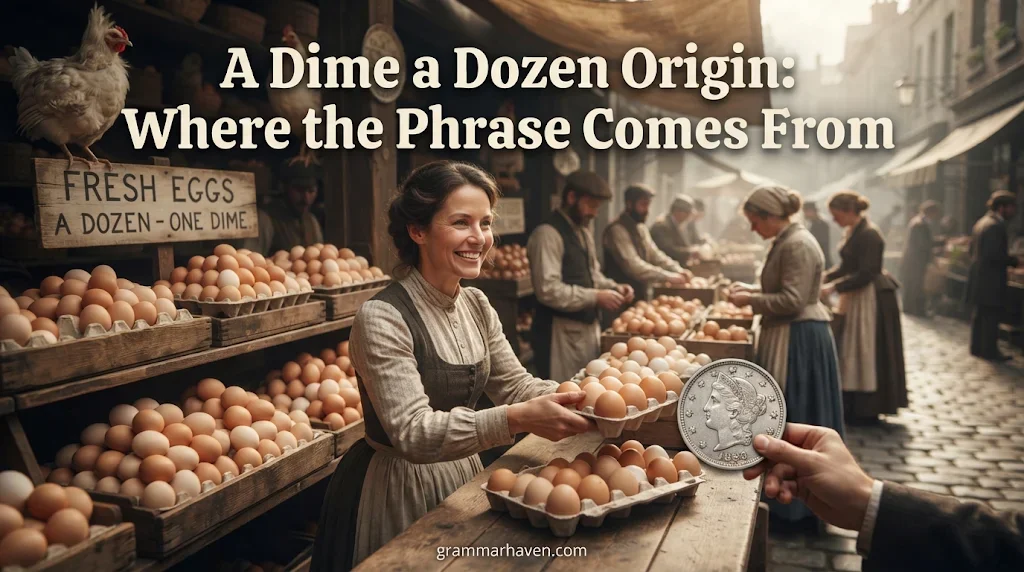
The phrase became popular in American English during the 19th century, a time when marketplaces shaped everyday language.
Why this specific wording?
Two simple ideas combined:
- Dime → A small amount of money, even in historical terms
- Dozen → A standard counting unit used in trade
Sellers often priced goods in dozens because it simplified bulk sales. When supply was high and value was low, phrases like this naturally entered everyday speech.
The cultural shift
Over time, the phrase stopped being about actual money. It became a metaphor for:
- Oversupply
- Low uniqueness
- Easy availability
That’s why it survived even after pricing systems changed.
Language experts often point out something interesting here:
Idioms like this survive because they outlive their original context but keep emotional meaning alive.
How to Use A Dime a Dozen in Sentences
This phrase works best in informal and conversational English. It adds personality and emphasis without needing a long explanation.
Basic sentence patterns
You’ll usually see it used in two ways:
- “X is a dime a dozen”
- “There are a dime a dozen X”
Practical examples
- “Cheap online courses are a dime a dozen these days.”
- “Freelance designers are a dime a dozen on job platforms.”
- “Basic marketing strategies are a dime a dozen, but execution matters.”
Natural spoken usage
People often use it when they want to sound blunt but not rude:
- “Those types of apps are a dime a dozen now.”
- “Ideas like that? Honestly, they’re a dime a dozen.”
It slips naturally into speech when you want to express mild criticism or realism.
Real-Life Examples of A Dime a Dozen in Everyday Contexts
This idiom becomes much clearer when you see it in real situations.
Business and Entrepreneurship
In business, competition is intense. So uniqueness matters.
- Basic startup ideas are a dime a dozen.
- Generic e-commerce stores are a dime a dozen.
- Cookie-cutter marketing agencies are a dime a dozen.
Insight:
What stands out isn’t the idea itself—it’s execution.
Jobs and Skills
In many industries, entry-level talent is plentiful.
- Entry-level applicants can be a dime a dozen.
- Basic resume templates are a dime a dozen online.
- General social media managers are a dime a dozen.
However, skilled specialists are not.
That’s where the phrase creates contrast:
Common skills = dime a dozen. Rare expertise = valuable.
Social Media and Content Creation
This is where the phrase really shines today.
- Recycled motivational quotes are a dime a dozen.
- Trend-based TikTok videos are a dime a dozen.
- Generic “how to get rich” posts are a dime a dozen.
Social platforms reward uniqueness, so this idiom fits perfectly in digital culture.
Products and Consumer Goods
- Low-quality phone accessories are a dime a dozen.
- Fast fashion T-shirts are a dime a dozen.
- Generic home décor items are a dime a dozen.
Mass production often creates oversupply, which connects directly to the idiom’s meaning.
Common Mistakes When Using A Dime a Dozen
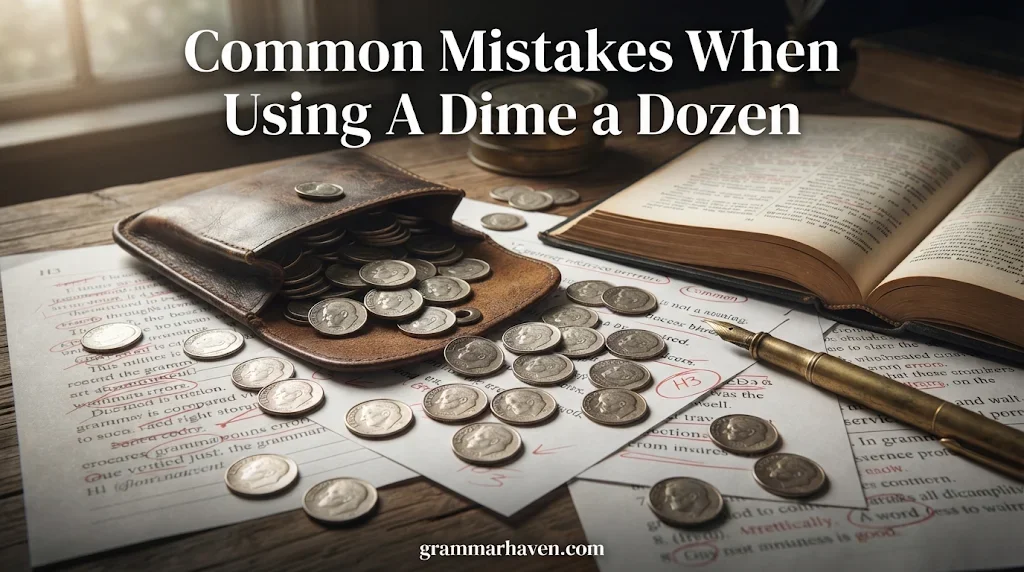
Even native speakers misuse this phrase sometimes. Here’s where things go wrong.
Mistake: Thinking it means “cheap and good”
This is the biggest misunderstanding.
- ❌ Wrong: “That product is a dime a dozen, so it must be a good deal.”
- ✅ Correct: It’s common, not necessarily valuable.
The phrase talks about quantity, not quality.
Mistake: Using it with singular nouns
The idiom usually refers to categories or groups.
- ❌ “That idea is a dime a dozen.”
- ✅ “Ideas like that are a dime a dozen.”
Plural or general forms sound more natural.
Mistake: Using it in formal writing
It feels casual, even slightly opinionated.
Avoid it in:
- Academic papers
- Legal documents
- Technical reports
But it works well in:
- Blogs
- Conversations
- Marketing copy
- Opinion writing
Synonyms for A Dime a Dozen
If you want to vary your writing, here are alternatives.
| Expression | Tone |
| Common as dirt | Strongly informal, slightly harsh |
| Two a penny | British English equivalent |
| Run of the mill | Neutral, average quality |
| Nothing special | Simple, neutral |
| Easy to find | Direct and factual |
Each phrase shifts tone slightly, so choose carefully.
Related Idioms You Should Know
Understanding related expressions helps you build stronger language intuition.
Run of the mill
Means something is average, nothing unusual.
Nothing to write home about
Means something is unimpressive.
Every Tom, Dick, and Harry
Refers to very common or ordinary people.
These idioms often overlap, but each carries a slightly different emotional weight.
Why People Still Use A Dime a Dozen Today
Even in a modern digital world, this phrase sticks around for good reasons.
- It’s short and punchy
- It paints a clear mental image
- It adds attitude without long explanation
- It fits both speech and writing
Most importantly, it communicates something instantly:
“Don’t get impressed too easily.”
That’s powerful in conversations where attention spans are short.
Comparison Table: Literal vs Modern Meaning
| Aspect | Explanation |
| Literal meaning | Very cheap bulk pricing in old markets |
| Modern meaning | Something extremely common |
| Emotional tone | Slightly dismissive |
| Usage style | Informal, conversational |
| Core idea | Lack of uniqueness |
Case Study: How Context Changes the Meaning
Let’s look at how the same phrase shifts depending on context.
Case 1: Business discussion
“App ideas are a dime a dozen.”
Meaning: The idea alone isn’t enough. Execution matters.
Case 2: Hiring conversation
“Entry-level developers are a dime a dozen.”
Meaning: There’s high supply, so competition is strong.
Case 3: Motivation talk
“Ideas are a dime a dozen, but action changes everything.”
Meaning: Encouraging focus on execution over planning.
Same phrase. Different emotional impact. Context does all the work.
See also: Hooplehead Definition, Meaning, Usage and Examples
FAQs:
1. What does a dime a dozen mean?
A dime a dozen means something is very common, easy to find, and not particularly special. People use this expression when something is available in large quantities.
2. Is a dime a dozen a positive or negative expression?
It is usually a negative or slightly dismissive expression. It suggests that something lacks uniqueness or has little value because it is so common.
3. Where did the phrase a dime a dozen come from?
The phrase comes from an older way of describing inexpensive goods. A dime was worth ten cents, and a dozen meant twelve items. The expression suggested that something was cheap and widely available.
4. How do you use a dime a dozen in a sentence?
You can use it when describing something common or easily available. For example: “Cheap mobile phone cases are a dime a dozen at this market.”
5. What is another way to say a dime a dozen?
Some similar expressions include common as dirt, two a penny, nothing special, readily available, and a dime a dozen. The best choice depends on the situation and tone.
Conclusion:
A dime a dozen is a useful English idiom for describing things that are common, easily available, and not particularly special. Its meaning goes beyond money or cheap products. It can describe ordinary items, repeated experiences, and things that lack uniqueness. Understanding this expression helps you recognize its meaning in everyday conversations, business discussions, and written communication. Use it naturally when you want to explain that something is widely available but doesn’t stand out from the rest.
Latest Posts:
- Result In or Result To: Which Is Correct? (With Examples)
- A Dime a Dozen: Meaning, Definition, Origin and Real-Life Usage
- Hooplehead Definition, Meaning, Usage and Examples
- Whole vs Hole: What’s the Difference?
- Acumen vs Acuity vs Acuteness: What’s the Difference?