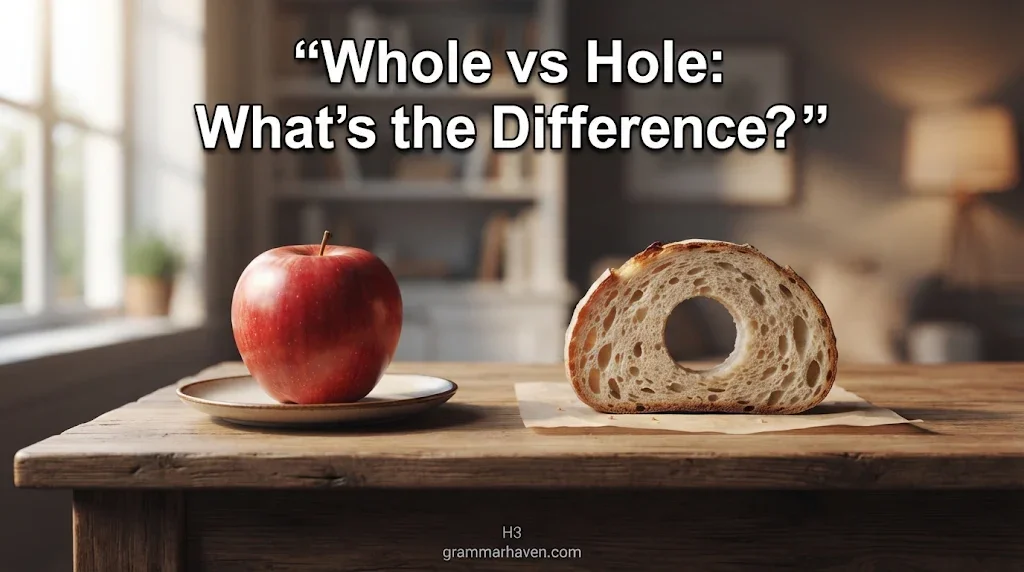
Whole vs Hole: These homophones sound alike but have different meanings, spellings, and uses in everyday English communication.
Whole describes something complete or entire, with nothing missing. It refers to everything as one complete object rather than a separate piece. For example, a whole pizza means the entire pizza, not just one slice. The word also applies to objects, materials, and situations that remain complete. Understanding its meaning helps language learners recognize the correct word in different contexts. Whole is commonly used in spoken language, professional writing, emails, and everyday communication.
Hole refers to an empty space, gap, or physical opening in something. It can describe a missing part of a material or a visible opening in an object. For example, a hole in your sock means part of the material is missing. The word can also describe an opening in the ground or another surface. Its meaning depends on the surrounding context and sentence structure. Recognizing this difference improves spelling, vocabulary, and grammatical accuracy.
Both words are homophones because they have the same pronunciation but different spellings and meanings. This similarity creates common confusion among English learners and even seasoned language learners. However, their definitions make them easy to distinguish. Whole relates to completeness and everything as one unit, while hole describes an empty space or opening. Context clues, practical examples, and simple tricks can help you remember the correct word. Choosing the right word improves sentence construction, writing accuracy, and communication clarity in everyday and professional content.
Whole vs Hole: The Core Difference Explained Simply
Let’s start with the cleanest breakdown possible.
- Whole means something complete, entire, or unbroken.
- Hole means an empty space, gap, or opening in something solid.
That’s it. Two ideas. Opposite directions.
Here’s a quick mental picture:
- Whole = everything is there
- Hole = something is missing
A quote that helps anchor it:
“A whole thing includes all its parts. A hole is where a part is missing.”
Now let’s break them down properly so you never confuse them again.
Understanding “Whole” in “Whole vs Hole” Grammar Usage
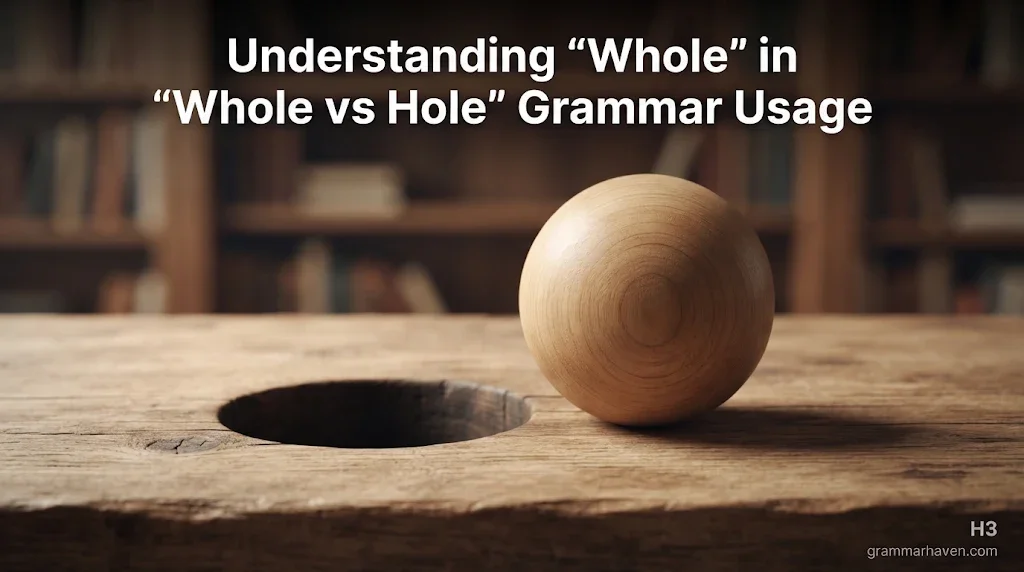
When you use whole, you’re talking about completeness. Nothing is left out. Nothing is missing. Everything is included in one unit.
Definition of Whole
Whole means:
- Entire
- Complete
- Not divided
- Fully intact
Think of it as “everything together as one.”
Real-Life Uses of “Whole”
You’ll see “whole” everywhere in daily English:
- Whole pizza (not slices)
- Whole family (everyone included)
- Whole day (all 24 hours)
- Whole story (every detail included)
- Whole number (mathematics term meaning no decimals)
Examples That Make It Stick
- I spent the whole day cleaning my room.
- She told me the whole truth, not just part of it.
- He ate the whole cake in one sitting.
Notice the pattern? “Whole” always protects the idea of totality.
Common Collocations with Whole
These word pairings appear frequently in natural English:
| Phrase | Meaning |
| Whole life | Entire lifetime |
| Whole point | Complete purpose |
| Whole amount | Full quantity |
| Whole system | Entire structure |
When you see these combinations, think “nothing missing.”
Quick Linguistic Fact About “Whole”
The word “whole” comes from Old English hāl, meaning “healthy” or “unhurt.” Over time, it shifted into meaning “complete or intact.” That’s why it still carries the idea of being “fully preserved.”
Understanding “Hole” in “Whole vs Hole” Usage
Now let’s flip the meaning completely.
A hole is what happens when something is missing.
Definition of Hole
Hole means:
- An opening
- A gap
- A hollow space in a surface or object
Unlike “whole,” it implies absence, not completeness.
Real-Life Uses of “Hole”
You encounter holes more often than you think:
- Hole in a shirt
- Hole in the road
- Hole in a wall
- Golf hole on a course
- Mouse hole in a corner of a room
Examples That Make It Clear
- There is a hole in my sock.
- The dog dug a hole in the garden.
- We found a hole in the fence.
Every example shows something missing or open.
Common Contexts for Hole
| Context | Example |
| Clothing damage | Hole in jeans |
| Construction | Hole in wall |
| Sports | Golf hole |
| Nature | Burrow hole |
Quick Linguistic Fact About “Hole”
The word “hole” comes from Old English hol, meaning “hollow place.” It has always described emptiness or depth.
Whole vs Hole Comparison Table (Simple Breakdown)
Sometimes your brain just needs a side-by-side view.
| Feature | Whole | Hole |
| Meaning | Complete, entire | Empty space, gap |
| Idea | Totality | Absence |
| Example | Whole pizza | Hole in pizza box |
| Emotion | Fullness | Missing piece |
| Usage type | Quantity or completeness | Physical opening |
This contrast is the key to mastering whole vs hole usage in English grammar.
Why People Confuse Whole vs Hole
You’re not imagining it. This confusion is extremely common.
Here’s why:
Same pronunciation
They sound identical in most accents. Your ears can’t help you here.
Typing speed issues
Fast typing leads to mistakes like:
- “hole day” instead of “whole day”
Autocorrect limitations
Autocorrect often misses context, especially in short phrases.
Context-free speech
When you hear the words without context, meaning becomes unclear.
Cognitive shortcut
Your brain relies on sound instead of meaning when rushing.
Memory Tricks to Never Confuse Whole vs Hole Again
Let’s make this easy to remember.
Trick 1: The “W = With Everything” Trick
- Whole starts with W
- Think: With everything included
So:
- Whole pizza = pizza with everything
Trick 2: The Shape Trick
Look at the word:
- “hole” has an opening in its shape visually (like O)
- That empty circle represents a gap
Trick 3: Replacement Test
Ask yourself:
- Can I replace it with “entire”? → Use whole
- Can I replace it with “gap” or “opening”? → Use hole
Trick 4: Real-Life Visualization
- Whole = a complete apple
- Hole = a bitten apple with a missing chunk
Simple. Visual. Memorable.
Common Whole vs Hole Mistakes (With Corrections)
This is where most learners improve fast.
❌ I ate the hole pizza
✔ I ate the whole pizza
Why? Because you didn’t eat a gap. You ate the entire thing.
❌ There is a whole in my shirt
✔ There is a hole in my shirt
Why? Shirts don’t have “entire spaces.” They have openings.
❌ He spent the hole day working
✔ He spent the whole day working
Why? You’re talking about time completeness.
❌ A whole appeared in the wall
✔ A hole appeared in the wall
Why? Walls don’t become “complete openings.” They get gaps.
Quick Grammar Check Method for Whole vs Hole
Use this simple 3-step method before you write:
Step 1: Read the sentence aloud
Does it sound natural?
Step 2: Replace the word mentally
Try these substitutes:
- “Whole” → try “entire”
- “Hole” → try “opening”
Step 3: Match meaning
Pick the word that fits logically.
This works better than memorization alone.
Edge Cases That Confuse Learners in Whole vs Hole Usage
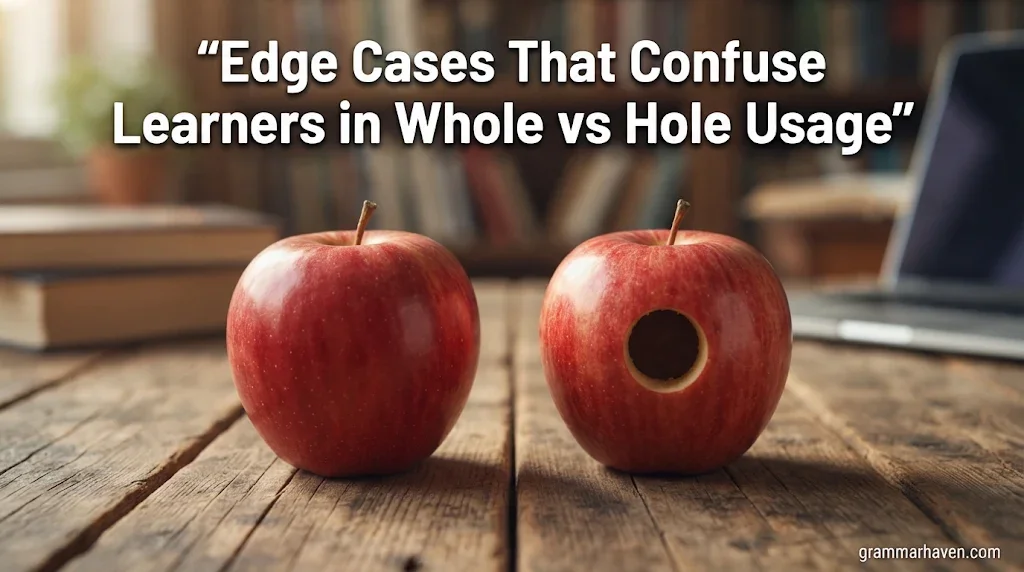
Some expressions look tricky but are actually easy once you break them down.
Hole-in-one (Golf)
- Refers to hitting the ball directly into the hole
- Always “hole,” never “whole”
Wholehearted
- Means sincere or complete emotion
- Always “whole” because it means full feeling
Whole grain
- Refers to grain containing all parts
- “Whole” = nothing removed
Hole punch
- A tool that creates holes in paper
- “Hole” = opening created
Mini Practice Section: Test Your Understanding
Try filling in the blanks:
- I found a ___ in my backpack.
- She ate the ___ cake.
- The fence has a ___ near the gate.
- He gave a ___ explanation of the problem.
- There is a ___ in my shoe.
Answers
- hole
- whole
- hole
- whole
- hole
If you got most right, you’ve already built strong intuition.
Real-Life Case Study: Why This Mistake Matters
Let’s make this practical.
A small business owner once wrote:
“We offer hole food meals prepared fresh daily.”
Customers laughed. Some thought it meant “empty food.”
What they meant was:
“We offer whole food meals prepared fresh daily.”
That single letter changed credibility.
In professional writing, whole vs hole mistakes can affect trust, especially in marketing, education, and business communication.
See also: Acumen vs Acuity vs Acuteness: What’s the Difference?
FAQs:
Is “whole” always about size or quantity?
Not exactly. It’s about completeness. It can refer to time, objects, or abstract ideas.
Can “hole” be metaphorical?
Yes. People say things like:
- “Emotional hole”
- “Financial hole”
It still means absence or lack.
Do native speakers mix them up?
Yes. Even native writers make mistakes when typing quickly.
What’s the fastest way to remember the difference?
Think:
- Whole = everything included
- Hole = something missing
Are they pronounced the same everywhere?
Mostly yes. That’s why confusion is so common.
Conclusion:
Understanding the difference between whole vs. hole helps you avoid common spelling and grammar mistakes. Whole refers to something complete or entire, while hole describes an opening, gap, or empty space. Although both words sound the same, their meanings and uses are different. Remembering their definitions and practicing them in everyday sentences can improve your vocabulary and writing skills. Choose the correct word according to the meaning you want to express.
Latest Posts:
- Result In or Result To: Which Is Correct? (With Examples)
- A Dime a Dozen: Meaning, Definition, Origin and Real-Life Usage
- Hooplehead Definition, Meaning, Usage and Examples
- Whole vs Hole: What’s the Difference?
- Acumen vs Acuity vs Acuteness: What’s the Difference?