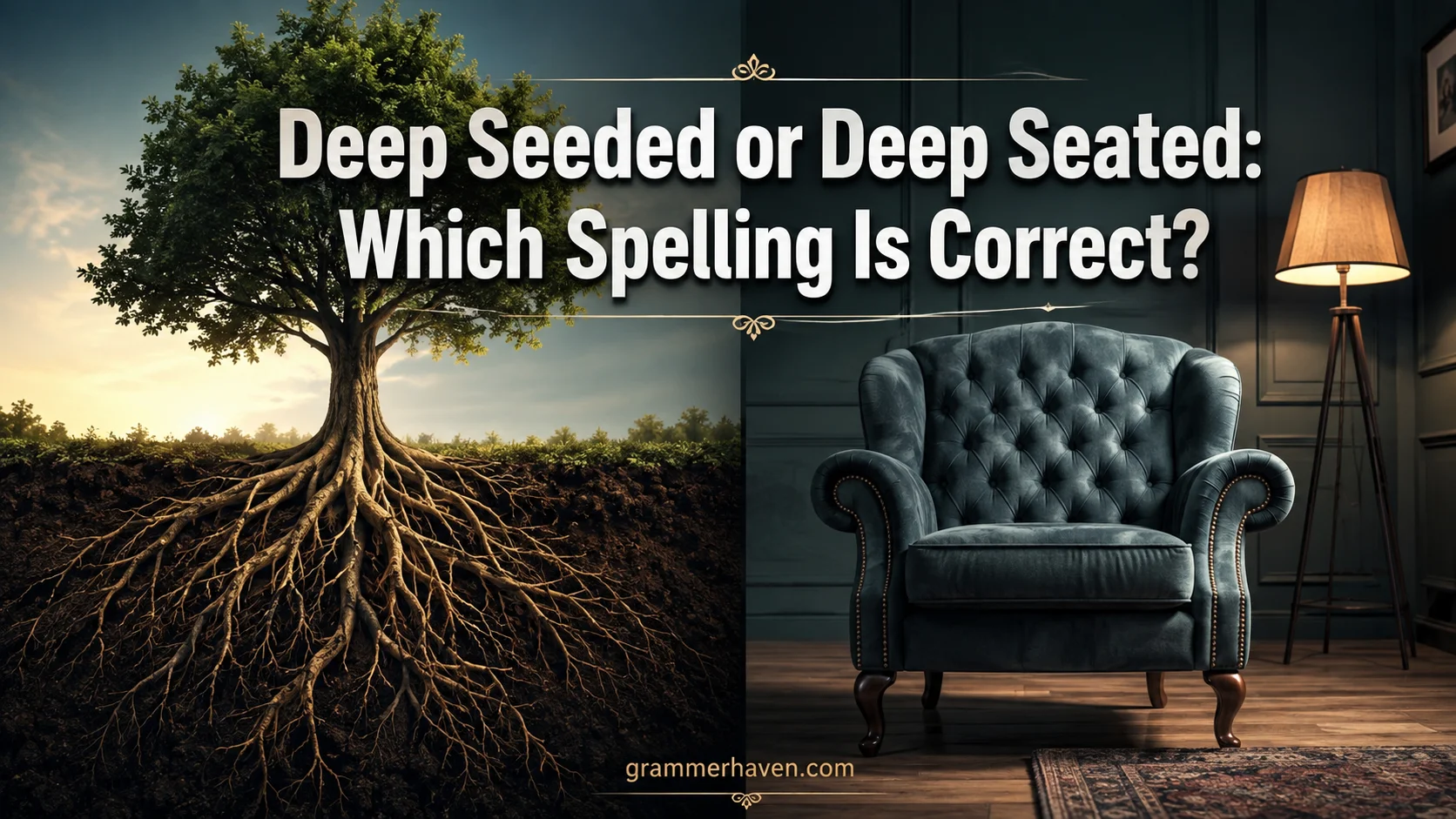
Deep Seeded or Deep Seated: Which Spelling Is Correct? The correct phrase is deep-seated, meaning firmly rooted, fixed, or deeply established.
Deep-seated describes something firmly established or deeply rooted in a person’s mind, feelings, habits, beliefs, or a situation. You can use it for a deep-seated fear, deep-seated belief, deep-seated habit, or deep-seated problem. The word seated connects to the idea of something being firmly settled in one place, similar to a person sitting firmly in a chair. Deep seeded isn’t the standard expression for this meaning.
The spelling doesn’t work for the common expression describing something firmly established. Seeded relates to seeds, planting, sports rankings, or removing seeds from something. Seated relates to being settled or positioned. The pronunciation of deep-seated and deep seeded can sound similar in speech, which causes confusion for many writers and English learners.
Picture a person sitting firmly in a chair. The person is seated, settled, and difficult to move. The same idea applies to a belief, fear, feeling, habit, or problem that has existed for a long time.
Quick Answer: Deep Seeded or Deep Seated?
Deep-seated is the correct phrase when you mean firmly established, deeply rooted, strongly felt, or difficult to change.
Deep-seeded is generally incorrect when you’re talking about emotions, beliefs, attitudes, habits, or problems. The confusion comes from the word “seeded,” which sounds logical because a seed can be planted deeply.
| Phrase | Correct for this meaning? | Meaning |
| Deep-seated | ✅ Yes | Firmly established or difficult to change |
| Deep-seeded | ❌ No | Usually a spelling mistake for deep-seated |
| Deep seeded | ❌ No | Not the standard expression for beliefs or feelings |
For example:
- ✅ She has a deep-seated fear of failure.
- ❌ She has a deep-seeded fear of failure.
- ✅ The company has deep-seated cultural problems.
- ❌ The company has deep-seeded cultural problems.
The easiest rule is:
Seeds grow. Seats hold.
If you’re talking about something firmly established in a person, group, organization, or situation, choose deep-seated.
What Does Deep-Seated Mean?
Deep-seated describes something that exists at a fundamental level. It usually refers to something that has become firmly established over time and is therefore difficult to change, remove, or overcome.
The expression commonly describes:
- Deep-seated fears
- Deep-seated beliefs
- Deep-seated emotions
- Deep-seated resentment
- Deep-seated habits
- Deep-seated assumptions
- Deep-seated problems
- Deep-seated conflicts
- Deep-seated social divisions
- Deep-seated cultural attitudes
Consider the difference between a temporary reaction and something deep-seated.
He was annoyed by the delay.
This describes a temporary feeling.
Now compare it with:
He had a deep-seated resentment toward his former employer.
The second sentence suggests that the resentment goes much deeper. It has existed for a long time and has become firmly established.
That distinction is important. Deep-seated doesn’t simply mean “very strong.” It often carries the additional idea that something has become firmly settled over time.
Why Do People Confuse Deep-Seated and Deep-Seeded?
The mistake is understandable because deep-seeded creates a powerful mental picture.
Imagine a seed being planted deep underground. As it grows, it develops roots and becomes increasingly established. It’s easy to transfer that image to an idea, emotion, or belief.
You might naturally think:
“A belief can be planted like a seed, so why wouldn’t it be deep-seeded?”
The metaphor makes sense. The problem is that standard English uses seated, not seeded, for this particular expression.
The expression is connected to the idea of something being firmly settled or positioned.
Think about these examples:
- A person is seated in a chair.
- Something can be firmly seated in a particular position.
- A belief can become deep-seated in someone’s thinking.
The word seated gives the phrase its sense of stability and permanence.
A Simple Memory Trick
Use this:
Seeds grow. Seats hold.
If you’re writing about a:
- Fear → deep-seated
- Belief → deep-seated
- Resentment → deep-seated
- Habit → deep-seated
- Problem → deep-seated
- Attitude → deep-seated
But if you’re discussing:
- Seeds
- Planting
- Crops
- Grass
- Agricultural processes
then seeded may be the appropriate word.
The Meaning Behind “Deep-Seated”
Understanding each part of the expression makes the phrase easier to remember.
What Does “Deep” Mean?
The word deep doesn’t always describe physical distance.
You can also use it to describe something intense, significant, or existing beneath the surface.
For example:
- Deep sadness
- Deep understanding
- Deep concern
- Deep connection
- Deep affection
- Deep regret
In deep-seated, “deep” suggests that something exists at a fundamental level rather than being superficial or temporary.
What Does “Seated” Mean?
Seated can mean placed, settled, or established in a particular position.
Although you probably first associate the word with sitting in a chair, its broader sense involves something being settled or positioned firmly.
That gives us the central idea:
Deep + seated = deeply settled or firmly established.
This is why the phrase works so naturally with things that are difficult to change.
The Combined Meaning of Deep-Seated
When you put the two words together, deep-seated describes something that has become firmly established beneath the surface.
For example:
- A deep-seated fear may take years to overcome.
- A deep-seated belief can influence important decisions.
- A deep-seated conflict may require serious negotiation.
- A deep-seated problem may need a structural solution.
The expression therefore suggests more than simple intensity. It points toward depth, persistence, and stability.
Deep-Seated vs. Deep-Rooted: What’s the Difference?
Deep-seated and deep-rooted are close in meaning, and in many sentences you can use either one. Both describe something firmly established.
However, they can emphasize slightly different ideas.
| Phrase | Main idea | Common uses | Example |
| Deep-seated | Firmly established internally | Feelings, fears, beliefs, attitudes | “She has a deep-seated fear of failure.” |
| Deep-rooted | Developed firmly over time from its origins | Traditions, systems, social issues | “The country faces deep-rooted inequality.” |
The distinction is useful when choosing precise wording.
Deep-seated often focuses on something that exists inside a person or within a particular situation.
Deep-rooted often emphasizes history, origins, foundations, or something that has developed over generations.
Compare these sentences:
He has a deep-seated distrust of strangers.
The focus is his internal feeling.
The community has deep-rooted traditions.
The focus is on traditions that have developed through history.
Neither phrase is automatically “stronger.” The best choice depends on what you want to emphasize.
Deep-Seated Examples in Everyday English
The best way to understand deep-seated meaning is to see how the expression works in real sentences.
Deep-Seated Emotions
The expression commonly describes emotions that persist over time.
Examples include:
- She carried a deep-seated fear of rejection.
- His deep-seated anger affected his relationships.
- The experience created a deep-seated sense of insecurity.
- She struggled with deep-seated resentment toward her former colleague.
These examples suggest that the emotions aren’t merely temporary reactions. They have become established patterns that can continue to influence behavior.
A useful contrast is:
Temporary: She was angry about the argument.
Deep-seated: She had a deep-seated resentment that had lasted for years.
The second sentence tells you that the feeling has greater depth and persistence.
Deep-Seated Beliefs
Beliefs can also become deep-seated through personal experience, upbringing, education, culture, and repeated exposure to certain ideas.
Examples:
- Her deep-seated belief in honesty guided her choices.
- He challenged his deep-seated assumptions about success.
- The organization has a deep-seated commitment to quality.
- His deep-seated beliefs influenced how he approached difficult decisions.
A deep-seated belief can be difficult to change because it isn’t simply an opinion someone formed five minutes ago. It has become firmly established in their thinking.
Deep-Seated Problems
You can also use the expression for problems that have developed beneath the surface.
Examples:
- The company discovered deep-seated financial problems.
- The conflict has deep-seated historical causes.
- The healthcare system faces deep-seated challenges.
- The organization needs to address its deep-seated cultural problems.
Calling a problem deep-seated suggests that a quick fix probably won’t solve it.
If a problem has existed for a long time and has become embedded in a system or situation, you may need to address its underlying causes.
Is “Deep-Seeded” Ever Correct?
This is where context matters.
If you mean firmly established, then deep-seated is the correct expression.
However, seeded itself is a perfectly valid English word. It simply has different meanings. You can use it when you’re actually talking about seeds, planting, crops, or similar contexts.
For example:
The farmer planted deep-seeded crops.
Here, the context involves seeds being planted deeply, so seeded relates literally to seeds.
You can also say:
The field was seeded with grass.
In this sentence, “seeded” means that seeds were spread or planted.
But this sentence is incorrect if you mean a deeply established emotion:
❌ She had a deep-seeded fear of failure.
The correct version is:
✅ She had a deep-seated fear of failure.
The Key Difference
| If you’re talking about… | Use |
| A fear | Deep-seated |
| A belief | Deep-seated |
| A resentment | Deep-seated |
| A habit | Deep-seated |
| A cultural issue | Deep-seated |
| A social division | Deep-seated |
| Seeds in soil | Seeded |
| A field planted with seeds | Seeded |
| Removing seeds from fruit | Seeded |
| Sports rankings | Seeded |
So the issue isn’t that seeded is an incorrect English word. It’s that deep-seeded isn’t the standard phrase for something that is deeply established.
Common Mistakes With Deep-Seated
Learning the correct phrase is only the first step. You also need to know how to use it correctly.
Writing “Deep-Seeded” Instead of “Deep-Seated”
This is the most common mistake.
Incorrect:
❌ The company has deep-seeded cultural issues.
Correct:
✅ The company has deep-seated cultural issues.
If you’re describing something firmly established, use seated.
Forgetting the Hyphen
When deep-seated appears directly before a noun as a compound adjective, the hyphen is important.
Correct:
A deep-seated belief shaped his decisions.
Incorrect:
A deep seated belief shaped his decisions.
The hyphen connects deep and seated, showing that they function together as a compound modifier.
What About “Deeply Seated”?
You may occasionally encounter deeply seated, but deep-seated is the established expression when you mean a firmly rooted belief, feeling, attitude, or problem.
For standard writing, especially when you’re using the familiar idiomatic expression, deep-seated is the safest and clearest choice.
Using Deep-Seated for Ordinary Physical Objects
The phrase usually describes abstract things rather than ordinary physical objects.
For example:
❌ The deep-seated table was made of oak.
That sounds unnatural because a normal table isn’t typically being described as a deeply established feeling, belief, or condition.
Instead, you could describe its physical position more directly:
The table was firmly placed in the ground.
The source material likewise emphasizes that deep-seated is normally used for abstract ideas, emotions, and conditions.
Deep-Seated in Different Contexts
One reason this expression is useful is its flexibility. You’ll find deep-seated in discussions involving psychology, business, society, culture, relationships, and personal behavior.
Deep-Seated in Psychology
In psychological contexts, the expression can describe long-lasting emotional patterns, beliefs, fears, and reactions.
Examples include:
- Deep-seated anxiety
- Deep-seated fears
- Deep-seated beliefs
- Deep-seated emotional patterns
- Deep-seated trauma responses
These expressions point toward patterns that operate beneath the surface and may influence how someone thinks or behaves.
For example:
Her deep-seated fear of failure affected the opportunities she was willing to pursue.
The phrase tells the reader that the fear isn’t simply a passing concern. It has become established enough to influence behavior.
Deep-Seated in Business
Businesses also use deep-seated to describe persistent organizational problems.
Common combinations include:
- Deep-seated leadership issues
- Deep-seated workplace conflicts
- Deep-seated cultural problems
- Deep-seated organizational challenges
For example:
The company discovered deep-seated problems within its management structure.
This suggests that the problem isn’t limited to one isolated incident. It may involve underlying organizational patterns that require more substantial changes.
Deep-Seated in Society and Culture
The expression also works well when discussing issues that have developed over long periods.
Examples include:
- Deep-seated traditions
- Deep-seated social divisions
- Deep-seated cultural differences
- Deep-seated attitudes
These expressions can describe patterns that have become firmly established within a community or society.
For instance:
The community’s deep-seated traditions have been passed down through generations.
Here, the expression emphasizes how firmly established the traditions are.
Case Study: Why “Deep-Seated” Changes the Meaning
Imagine a workplace where two employees have a disagreement.
You could write:
The employees were upset about the disagreement.
This describes the immediate situation.
Now imagine the disagreement is connected to years of mistrust, unresolved disputes, and competing expectations.
You could write:
The organization has a deep-seated conflict between the two departments.
That sentence communicates something much bigger.
The problem isn’t simply yesterday’s disagreement. It has become firmly established and may require a deeper solution.
This illustrates an important point: deep-seated adds depth and persistence to the noun it modifies.
Another Example: Fear
Compare:
She was nervous before the presentation.
with:
She had a deep-seated fear of public speaking.
The first sentence describes a specific moment.
The second describes a long-lasting fear that exists at a deeper level.
That’s why deep-seated is useful when you need to communicate that something is more fundamental than a temporary reaction.
How to Remember “Deep-Seated” Forever
If you keep confusing deep seeded and deep seated, don’t memorize the spelling as a random sequence of letters. Remember the idea behind it.
Remember the Chair
Picture someone sitting firmly in a heavy chair.
They’re:
- Settled
- Stable
- Firmly positioned
- Difficult to move
That gives you the idea of seated.
Now transfer that image to an abstract idea:
A deep-seated belief is firmly settled in someone’s mind.
Use the “Seeds Grow, Seats Hold” Rule
This is perhaps the simplest memory trick:
Seeds grow. Seats hold.
If you’re talking about a belief, fear, resentment, problem, habit, or attitude, it has seated itself firmly.
Therefore:
deep-seated
If you’re talking about actual seeds, planting, or crops, then seeded may be appropriate.
This simple distinction can prevent one of the most common spelling mistakes involving this expression.
Deep-Seated Synonyms
Depending on the context, you can replace deep-seated with several related expressions.
| Synonym | Meaning |
| Deep-rooted | Strongly established over time |
| Entrenched | Very difficult to change or remove |
| Firmly established | Securely established |
| Long-standing | Existing for a long time |
| Embedded | Fixed within something |
| Persistent | Continuing over time |
For example:
The organization has deep-seated problems.
You could also say:
The organization has entrenched problems.
or:
The organization has long-standing problems.
However, these alternatives aren’t always exact replacements. Deep-seated is particularly natural when describing feelings, beliefs, attitudes, fears, and other things that have become firmly established.
Deep-Seated vs. Deep Seeded: Quick Comparison
| Feature | Deep-Seated | Deep-Seeded |
| Standard expression for beliefs | ✅ Yes | ❌ No |
| Standard expression for fears | ✅ Yes | ❌ No |
| Standard expression for problems | ✅ Yes | ❌ No |
| Refers to something firmly established | ✅ Yes | ❌ No |
| Related to actual seeds | ❌ No | ✅ Potentially |
| Common spelling mistake | No | Yes |
| Typical meaning | Firmly established | Related to seeds |
Examples at a Glance
| Incorrect | Correct |
| ❌ A deep-seeded fear | ✅ A deep-seated fear |
| ❌ A deep-seeded belief | ✅ A deep-seated belief |
| ❌ Deep-seeded resentment | ✅ Deep-seated resentment |
| ❌ Deep-seeded problem | ✅ Deep-seated problem |
| ❌ Deep-seeded cultural issue | ✅ Deep-seated cultural issue |
How to Use Deep-Seated Correctly in a Sentence
The phrase usually appears before a noun as a compound adjective.
Before a Noun
She has a deep-seated fear of rejection.
He questioned his deep-seated assumptions.
The company has deep-seated cultural problems.
They need to address the deep-seated causes of the conflict.
The hyphen helps identify deep-seated as one compound modifier.
Common Nouns Used With Deep-Seated
Here are some of the most natural combinations:
- Deep-seated fear
- Deep-seated belief
- Deep-seated resentment
- Deep-seated anger
- Deep-seated distrust
- Deep-seated habit
- Deep-seated problem
- Deep-seated conflict
- Deep-seated issue
- Deep-seated assumption
- Deep-seated tradition
- Deep-seated attitude
- Deep-seated division
- Deep-seated challenge
Learning these common word combinations can make the expression much easier to use naturally.
Why “Deep-Seeded” Sounds So Convincing
There’s a useful lesson here about English spelling and vocabulary: logical word formation doesn’t always determine standard usage.
“Seeded” seems like a logical choice because people often describe ideas as seeds. We talk about planting ideas, nurturing ideas, and letting ideas grow.
But the established expression is still deep-seated.
English contains many expressions whose conventional forms don’t always match the first metaphor that comes to mind. That’s why relying solely on literal logic can sometimes lead you toward a nonstandard spelling.
In this case, remembering the traditional image of something being firmly seated gives you the right answer.
See also: Pliers or Plyers: Which is Correct Spelling?
FAQS:
Is “deep seated” or “deep seeded” correct?
Deep-seated is correct when you mean something firmly established, strongly felt, or deeply rooted. Deep seeded is not the standard expression for beliefs, feelings, problems, or attitudes.
Why is it called “deep-seated”?
The word seated suggests that something has settled firmly into a position. Therefore, a deep-seated belief or feeling is firmly established and difficult to change.
Is “deep-seeded” ever correct?
It can make literal sense in contexts involving seeds, such as seeds planted deeply in soil. However, it isn’t the standard expression for deeply established emotions, beliefs, or problems.
How do you use “deep-seated” in a sentence?
You can say:
She has a deep-seated fear of public speaking.
Other examples include deep-seated resentment, deep-seated beliefs, deep-seated problems, and deep-seated habits.
Does deep-seated mean deep-rooted?
They are very similar. Both can describe something firmly established. However, deep-seated often emphasizes something internal, such as a feeling, belief, fear, or attitude, while deep-rooted can emphasize historical development or foundations.
Does deep-seated need a hyphen?
Yes, when it appears before a noun as a compound adjective, write deep-seated with a hyphen.
For example:
a deep-seated belief
a deep-seated problem
Can I write “deep seated” without a hyphen?
In standard compound-adjective usage before a noun, deep-seated is the preferred form. The hyphen clearly connects the two words into one modifier.
What is the easiest way to remember deep-seated feelings?
Think of a person sitting firmly in a chair. They are seated, settled, and difficult to move. Then remember:
Seeds grow. Seats hold.
So a deeply established belief or fear is deep-seated, not deep-seeded.
What are some common examples of deep-seated?
Common examples include:
- Deep-seated fear
- Deep-seated belief
- Deep-seated resentment
- Deep-seated anger
- Deep-seated distrust
- Deep-seated habit
- Deep-seated problem
- Deep-seated conflict
- Deep-seated cultural issue
- Deep-seated social division
Is deep-seated formal English?
Yes. Deep-seated is a standard expression and works well in everyday, professional, academic, and formal writing. Its exact tone depends on the context, but the phrase itself is widely useful.
Conclusion:
When deciding between deep seeded or deep seated, the correct expression is deep-seated. Use it when you mean something is firmly established, deeply rooted, strongly felt, or difficult to change. It commonly describes fears, beliefs, emotions, habits, resentment, problems, conflicts, and attitudes. Although deep-seeded may seem logical because seeds can be planted deep in the ground, it isn’t the standard expression for deeply established feelings or ideas. Seeded should be reserved for contexts involving seeds, planting, crops, or similar meanings.
The easiest way to remember the difference is: “Seeds grow. Seats hold.” If something is firmly settled in your mind, feelings, or a situation, it is deep-seated.