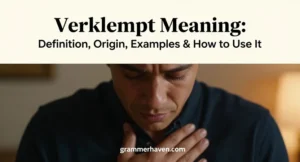
The Verklempt Meaning describes feeling so emotional that you struggle to speak or cannot find the right words. This familiar expression in American English comes from Yiddish and describes feelings that run so deep that speaking becomes difficult. Happiness, sadness, gratitude, and other powerful emotions can leave you temporarily speechless. The word helps you describe emotional moments precisely and adds depth to your English vocabulary. English learners can picture it as having a full heart but an empty mind when they try to speak.
You might feel verklempt when someone surprises you with a thoughtful gift, delivers a heartfelt speech, or shares news that touches you deeply. At a friend’s wedding, you might smile while tears gather in your eyes and you struggle to speak. A heartfelt goodbye or touching movie scene can create the same intense feeling. People typically use the term when someone feels overcome by strong emotions after a moving experience or upon hearing excellent news. It describes a deep reaction or powerful reaction that leaves someone temporarily lost for words. These meaningful situations show how emotions run high when feelings become difficult to express.
Learning where the word comes from, how to pronounce it, and how to use it naturally can improve your everyday conversation, text messages, and writing. This expressive word helps you explore the emotional side of meaningful experiences when ordinary descriptions fail to capture your feelings. In this article, the language-learning resource svgLearna Language can serve as a reference for understanding the term. Verklempt offers a concise way to describe moments when words seem to escape you.
Quick Answer: What Does Verklempt Mean?
Verklempt means emotionally overwhelmed or choked up, often to the point that you struggle to speak. It usually describes a strong emotional reaction to something touching, moving, joyful, or sad.
For example:
- “I felt verklempt when my daughter thanked me in her graduation speech.”
- “He became verklempt while remembering his late father.”
- “That surprise reunion left everyone a little verklempt.”
The word comes from Yiddish and is commonly used in American English. It’s an adjective, so you can use it to describe how someone feels during an emotional experience.
Verklempt Definition and Part of Speech
The definition of verklempt centers on being overwhelmed by emotion, especially when those feelings make it difficult to speak. It often describes a person who feels deeply moved and struggles to keep their composure.
According to Dictionary.com, the word is an informal adjective meaning overly emotional and unable to speak.
That definition captures its most common meaning in American English.
Consider these examples:
- She felt verklempt after reading the heartfelt letter.
- He became verklempt while thanking his family.
- I get verklempt whenever I watch that final scene.
- They were too verklempt to speak after the surprise announcement.
In each sentence, verklempt describes an emotional state rather than an action. The person might cry, pause, smile, or struggle to find words. Crying isn’t required, though.
Common Ways to Use Verklempt
| Expression | Meaning | Example |
| Feel verklempt | Experience strong emotions | I felt verklempt after the reunion. |
| Get verklempt | Become emotional | She gets verklempt during farewell speeches. |
| Become verklempt | Enter an emotional state | He became verklempt when he saw his daughter. |
| A little verklempt | Somewhat choked up | I’m a little verklempt right now. |
| Too verklempt to speak | So emotional that speaking becomes difficult | She was too verklempt to finish her speech. |
These expressions work in everyday conversations and personal writing. The phrase a little verklempt is especially useful when you want to acknowledge your feelings without making the moment sound overly dramatic.
Where Does the Word Verklempt Come From?
The word verklempt has Yiddish roots. It is associated with farklemt, a Yiddish form connected with being distressed, depressed, or emotionally weighed down. Its linguistic history also connects to the idea of gripping, squeezing, or becoming choked up.
Yiddish is a language with a long history among Ashkenazi Jewish communities. It draws heavily on Germanic elements and also incorporates Hebrew, Aramaic, and Slavic influences. Over time, many Yiddish words entered American English through everyday speech, literature, entertainment, and cultural exchange.
However, the history of verklempt involves an important distinction. Its modern English meaning doesn’t perfectly match every historical use of its Yiddish source.
An analysis published by Tablet Magazine explains that the popular English sense expanded to include positive emotions, while the Yiddish expression could carry more serious associations with distress and grief.
Today, an English speaker might describe feeling verklempt after receiving a wedding toast or hearing a moving tribute. The word can convey tenderness, joy, sadness, or a mixture of emotions.
How Verklempt Became Popular in American English
Popular culture helped introduce the word to a much wider American audience.
Comedian Mike Myers popularized verklempt through his Coffee Talk sketches on Saturday Night Live. His character, Linda Richman, used the expression in an exaggerated, emotional style and often invited people to “talk amongst yourselves.”
The sketches helped make the word recognizable beyond the communities where people had already encountered it.
That cultural association also gave verklempt a playful quality in some English-speaking contexts. Someone might use it sincerely to describe a heartfelt experience or humorously to exaggerate a reaction to a favorite movie.
The word’s history shows how language changes. A borrowed expression can acquire new shades of meaning as different communities use it in new settings.
How Do You Pronounce Verklempt?
The standard American English pronunciation is commonly represented as /vərˈklɛmpt/. The stress falls on the second syllable.
The word has two syllables, and the final consonants form a firm ending. You don’t need to add another vowel after the final t.
Keep these tips in mind:
- Stress the second syllable. The emphasis falls on KLEMPT.
- Keep the ending short. Finish with the pt sound rather than adding an extra syllable.
- Say it naturally. The word should sound like part of an ordinary sentence, not a theatrical performance.
For example, say, “I got a little verklempt during the speech.” The pronunciation should flow naturally within the sentence.
What Does Verklempt Mean in Different Contexts?
Although people often associate verklempt with sadness, the word can describe several kinds of emotional experiences. Context tells the reader what triggered the reaction.
Verklempt When You’re Happy
Sometimes good news creates such a strong reaction that you struggle to respond. You might feel this way when a loved one announces exciting news, a family member returns home, or someone gives you an unexpected gift.
For example:
“She became verklempt when her children surprised her with a birthday celebration.”
The sentence conveys more than happiness. It suggests that the moment touched her deeply enough to leave her briefly speechless.
Verklempt When You’re Sad
Grief, separation, and painful memories can also leave someone emotionally overwhelmed. In these situations, verklempt describes the struggle to express feelings that seem too strong for words.
For example:
“He grew verklempt while sharing memories of his childhood friend.”
The word doesn’t necessarily mean the person is crying. He might pause, lower his voice, or need a moment before continuing.
Verklempt When You’re Grateful
Gratitude can create powerful emotions, especially when someone offers unexpected kindness or recognizes an effort that took years to complete.
For example:
“I was verklempt when my former students returned to thank me.”
Here, the word communicates appreciation mixed with surprise and affection. It fits a moment when a simple “thank you” doesn’t seem sufficient.
Verklempt During an Emotional Speech
Public speaking can become difficult when the subject carries personal meaning. A wedding toast, retirement speech, graduation address, or memorial tribute may bring the speaker close to tears.
For example:
“The coach became verklempt while thanking the players who had stood by him.”
The expression captures the moment when emotion interrupts a person’s usual ability to speak confidently.
How to Use Verklempt in a Sentence
The easiest way to use verklempt is to place it after a linking verb such as feel, become, or get. You can also use it after seem or alongside an intensifier such as a little or completely.
Here are eight natural examples:
- I felt verklempt when my grandmother gave me her old family photographs.
- She became verklempt while reading the message from her childhood best friend.
- His retirement speech left several colleagues verklempt.
- We all got a little verklempt when the reunion came to an end.
- The singer looked verklempt as the audience applauded.
- I get verklempt whenever I remember how much my parents sacrificed for me.
- He was too verklempt to finish his thank-you speech.
- The heartfelt tribute made even the usually composed host verklempt.
Notice that the examples cover different situations. Some describe sadness, while others express gratitude, pride, affection, or nostalgia.
A Short Dialogue Using Verklempt
Here’s how the word might appear in an everyday conversation:
Maya: “Did you see your family’s video message?”
Daniel: “Yes. I got completely verklempt when my little sister started talking.”
Maya: “I can imagine. She must have said something special.”
Daniel: “She did. I couldn’t even finish my dinner afterward.”
The dialogue demonstrates how verklempt can sound natural in informal conversation. It expresses an emotional reaction without requiring a long explanation.
Verklempt in Text Messages and Social Media
Written conversations often need concise ways to express feelings. Verklempt can help when words such as happy, sad, or grateful feel too broad.
Verklempt in Text Messages
You might use the word after receiving a thoughtful message or hearing meaningful news.
Examples:
- “That message from you left me verklempt. Thank you.”
- “I’m honestly a little verklempt after reading everyone’s birthday wishes.”
- “Your surprise was so thoughtful. I’m verklempt!”
These examples sound conversational and communicate more emotional depth than a simple reaction such as “Wow.”
Verklempt in Social Media Posts
On social media, the word can describe emotional moments involving friends, family, achievements, or reunions.
For example:
- “Seeing everyone together again has me completely verklempt.”
- “That graduation speech left the whole room verklempt.”
- “Feeling verklempt after reading all these beautiful messages.”
The word can also carry a touch of humor. Someone might say they’re verklempt after a beloved television character returns or their favorite sports team wins an emotional final.
However, the expression works best when the situation involves a noticeable emotional response. Using it for every minor inconvenience can weaken its impact.
Is Verklempt Formal or Informal?
Verklempt is an informal adjective that works best in conversational English, personal writing, and expressive storytelling. It can also appear in journalism, reviews, essays, and speeches when the writer wants to capture an emotional reaction precisely.
The word’s playful sound makes it memorable. However, not every reader will recognize it, particularly if they haven’t encountered much Yiddish-influenced American English.
Choose your wording based on your audience:
| Situation | Is verklempt appropriate? | Alternative |
| Talking with friends | Yes | Choked up |
| Sending a heartfelt text | Yes | Deeply moved |
| Writing a personal blog | Yes | Emotionally overwhelmed |
| Writing a formal business report | Usually less suitable | Emotionally affected |
| Giving a wedding speech | Yes | Moved to tears |
| Writing an academic paper | Depends on the subject | Emotionally distressed |
For example, you might write, “I became verklempt during my sister’s wedding toast” in a personal blog. In a formal report, “The speaker became visibly emotional” may communicate the same idea more clearly.
Neither expression is inherently better. The right choice depends on the tone you want to create.
Verklempt vs. Overwhelmed vs. Choked Up
Although verklempt, overwhelmed, and choked up share similar meanings, they aren’t interchangeable in every situation. Each expression emphasizes a slightly different aspect of an emotional experience.
| Word or phrase | Main meaning | Emotional focus | Example |
| Verklempt | Overcome with emotion and possibly unable to speak | Strong feelings that are difficult to express | I felt verklempt during the tribute. |
| Overwhelmed | Affected by something too intense or difficult to manage | Emotions, responsibilities, stress, or sensory input | I felt overwhelmed by all the responsibilities. |
| Choked up | So emotional that speaking becomes difficult | A tight throat or the urge to cry | She got choked up while saying goodbye. |
| Moved | Deeply affected by an experience | A meaningful emotional response | I was moved by his generosity. |
| Touched | Emotionally affected by kindness or thoughtfulness | Warmth, affection, and appreciation | We were touched by their kindness. |
| Speechless | Unable to find words | Surprise, shock, admiration, or emotion | I was speechless when I saw the gift. |
When Should You Use Verklempt Instead of Overwhelmed?
Use verklempt when you want to emphasize an emotional reaction that makes speaking difficult. Use overwhelmed when the situation involves a broader range of feelings or pressures.
For example:
- Verklempt: “I became verklempt when my daughter thanked me during her graduation speech.”
- Overwhelmed: “I felt overwhelmed by the amount of work I needed to finish.”
The first sentence describes an emotional moment. The second describes a demanding situation that may cause stress.
When Should You Use Verklempt Instead of Choked Up?
These expressions come very close in meaning. However, choked up is a familiar English phrase that emphasizes difficulty speaking because of emotion.
Verklempt can sound more expressive or playful, depending on the context.
Compare these sentences:
- “I got choked up when I heard my mother’s voice.”
- “I got verklempt when I heard my mother’s voice.”
Both sentences work. The second may sound more colorful, especially in informal American English.
Synonyms and Related Words for Verklempt
Several English words describe the emotions associated with verklempt. Still, each synonym has its own shade of meaning.
- Choked up: Use this when strong feelings make speaking difficult.
- Moved: Choose this when an experience affects you deeply.
- Touched: Use this for emotional responses to kindness or affection.
- Overcome: This emphasizes the strength of an emotion that becomes difficult to control.
- Tearful: Choose this when someone has tears in their eyes or appears ready to cry.
- Emotional: This is a broad term for experiencing or showing strong feelings.
- Speechless: Use this when surprise, shock, or emotion leaves you without words.
- Sentimental: This describes feelings connected with affection, memories, or nostalgia.
- Affected: This is a more neutral way to describe being influenced emotionally.
- Distraught: Use this for severe distress, worry, or emotional upset.
For example, a person might feel touched by a friend’s thoughtful gift but become verklempt when that friend explains the personal meaning behind it.
The distinction matters because verklempt describes more than the emotion itself. It often suggests that the feeling has become difficult to express.
Common Mistakes When Using Verklempt
Although the word is easy to understand once you know its meaning, a few mistakes can make your writing less precise.
1. Assuming Verklempt Always Means Sad
This is one of the most common misunderstandings. Although grief and sadness can make someone verklempt, the word can also describe joy, gratitude, affection, and pride.
Incorrect assumption: “She was verklempt, so she must have been unhappy.”
Better understanding: “She was verklempt because her family surprised her with a celebration.”
The surrounding context explains the emotion.
2. Treating Verklempt as an Exact Synonym for Crying
Someone who feels verklempt might cry, but crying isn’t necessary. They could pause, struggle to speak, or simply feel a strong emotional reaction.
For example, a person might become verklempt during a speech yet regain composure before shedding any tears.
3. Using Verklempt for Ordinary Stress
The word generally works best when an emotional experience affects someone deeply. Ordinary busyness or routine frustration usually calls for a different term.
Instead of writing, “I’m verklempt because I have three emails to answer,” consider saying, “I’m overwhelmed by my workload.”
Use verklempt when the emotional response is central to the situation.
4. Assuming Verklempt Isn’t an English Word
The word originated in Yiddish, but it has an established place in American English. Dictionaries record its meaning, pronunciation, and usage.
English contains many words borrowed from other languages. Their origins don’t prevent them from becoming part of everyday English vocabulary.
5. Overusing the Word
Verklempt stands out because it expresses a specific kind of emotional experience. Repeating it several times in a short paragraph can make your writing sound forced.
Instead, vary your language with expressions such as moved, touched, choked up, and speechless. Choose each term according to the situation.
Is Verklempt a Real English Word?
Yes. Verklempt is an established English word, particularly in informal American usage. Reputable dictionaries document it as an adjective describing someone who is overcome with emotion or unable to speak because of strong feelings.
Its Yiddish background doesn’t make it any less valid in English. Borrowing words is a normal part of how languages develop.
The word’s history also illustrates how meanings can shift as expressions move between languages and communities. Its modern English use often includes positive emotions, even though its Yiddish source has been associated with distress and grief.
If you’re writing for an audience unfamiliar with the word, you can define it on first use:
“She felt verklempt, or so emotionally moved that she struggled to speak.”
After that, you can use verklempt naturally throughout the piece.
See also: Collaborate vs. Corroborate: Meaning, Differences and Examples
Frequently Asked Questions
What Does Verklempt Mean in Simple Words?
Verklempt means feeling so emotional that you may struggle to speak. It often describes being deeply moved by something touching, joyful, sad, or meaningful.
For example, you might feel verklempt when someone gives you a heartfelt gift or delivers a moving speech.
Does Verklempt Mean Crying?
No. Someone who feels verklempt may cry, but the word doesn’t require tears. It describes being overcome with emotion, often to the point of struggling to speak.
A person might feel verklempt while smiling, pausing to collect their thoughts, or trying to finish a speech.
Is Verklempt a Yiddish Word?
Yes, the word has Yiddish roots. Its modern English spelling and meaning developed through language contact and popular usage. It became especially recognizable in American culture through Saturday Night Live sketches featuring Mike Myers as Linda Richman.
What Is Another Word for Verklempt?
Common alternatives include choked up, moved, touched, and emotionally overwhelmed. The best choice depends on what you want to emphasize.
Use choked up when speaking becomes difficult. Choose touched when kindness affects you deeply. Use overwhelmed when the feeling is intense but doesn’t necessarily involve emotion alone.
How Do You Use Verklempt in a Sentence?
You can use verklempt after linking verbs such as feel, become, and get.
For example: “I became verklempt when my best friend thanked me for standing by her.”
Here, the word describes an emotional response that makes the moment difficult to express in ordinary words.
Conclusion:
The word verklempt describes the feeling of being so emotionally moved that speaking becomes difficult. It can capture moments of joy, grief, gratitude, nostalgia, and affection without requiring someone to cry.
With roots in Yiddish and a familiar place in American English, the word offers a colorful way to describe emotions that are difficult to put into words. Its popularity in American culture has also given it a conversational, sometimes playful tone.
When you use verklempt, think about the feeling you want to convey. If someone struggles to speak after a heartfelt moment, the word may fit perfectly. If you’re describing ordinary stress, overwhelmed will usually be more accurate.
Ultimately, learning the verklempt meaning gives you another useful way to express the complicated feelings that simple words sometimes fail to capture.