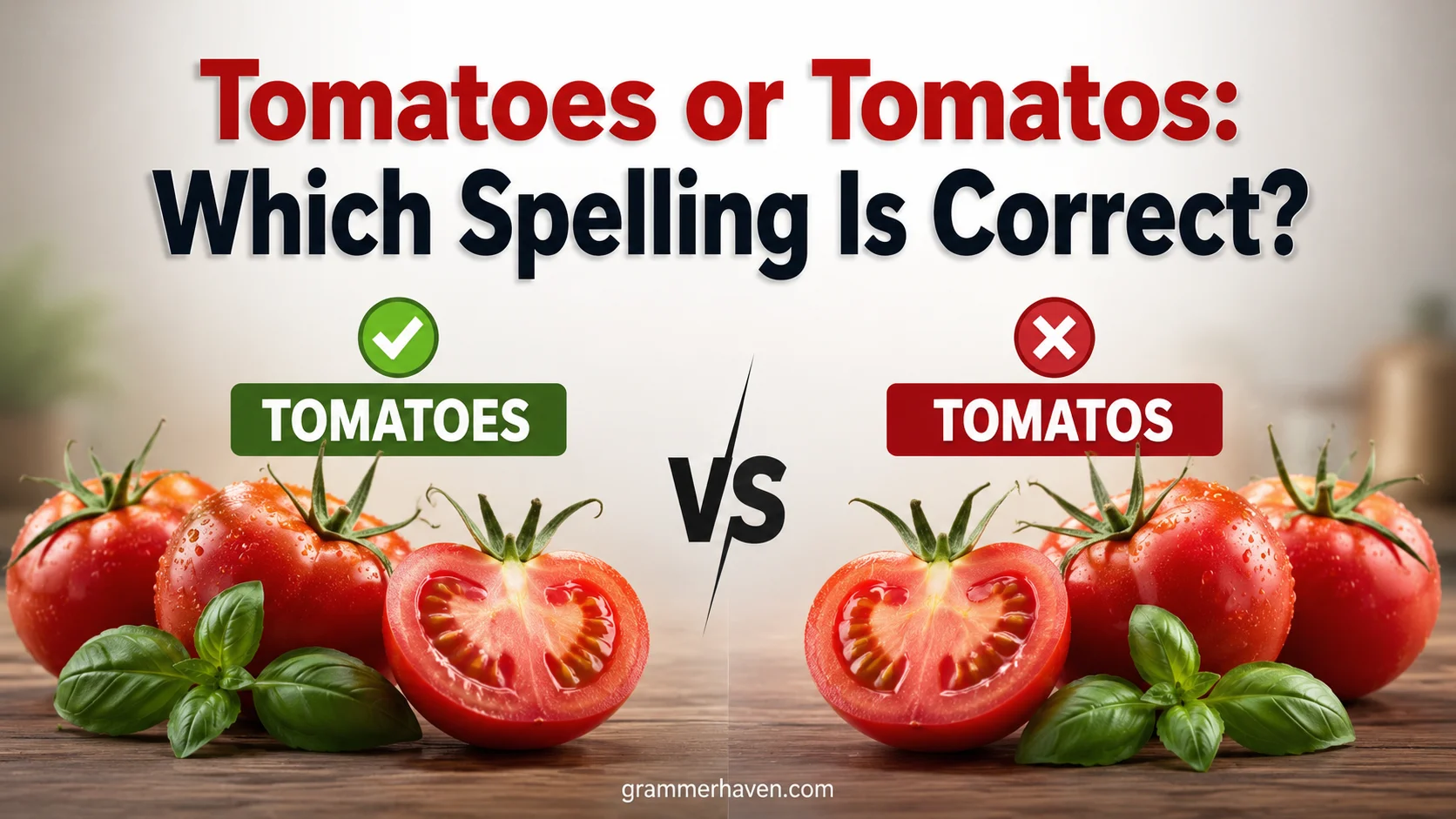
Tomatoes or Tomatos: Which Spelling Is Correct? is a common English question, and tomatoes is the correct plural form, not tomatos. The correct spelling follows an important English pluralization pattern. While many nouns simply take -s, words such as tomato can take -es because the word ends in -o after a consonant. Therefore, tomato becomes tomatoes, while Tomatos is an incorrect spelling. Understanding this small grammatical pattern can help learners, students, professionals, and writers avoid a common spelling mistake and become more confident with English pluralized words.
In everyday usage, tomatoes remains the standard and widely accepted form in both American English and British English. Tomatos usually appear as a common error caused by overgeneralization, when speakers apply the familiar -s plural rule too broadly. You might notice this mistake while typing, writing a shopping list, drafting an email, or posting on social media. It’s also important not to confuse tomato’s with tomatoes because the apostrophe normally shows a possessive meaning, not a plural. Choosing the right form improves clarity, precision, and professional communication.
For example, you’d write, “I bought three tomatoes,” because you’re referring to more than one tomato. This simple rule can prevent embarrassment, save time, and make your writing sound more professional. The core difference is straightforward: tomatoes is the grammatically correct plural, while Tomatos is a spelling mistake. Once you understand this pattern, you can apply it to other English nouns and strengthen your overall spelling and writing accuracy. The extra -es may look like a tiny detail, but learning it makes the English language easier to understand.
Tomatoes or Tomatos: The Correct Spelling Explained
The correct spelling is tomatoes.
The word tomatoes refers to more than one tomato. It follows the common English pattern where certain nouns ending in consonant + o add -es to form the plural.
| Singular Word | Correct Plural | Incorrect Form |
| Tomato | Tomatoes | Tomatos |
| Potato | Potatoes | Potatos |
| Hero | Heroes | Heros |
| Echo | Echoes | Echos |
A simple way to remember this rule is:
If a word ends in consonant + o, it often takes -es in the plural form.
For example:
- One tomato → Two tomatoes
- One potato → Five potatoes
- One hero → Several heroes
However, English loves exceptions. Some words ending in -o only take -s, which is why people sometimes hesitate.
For example:
- Photo → Photos
- Piano → Pianos
- Radio → Radios
That difference creates confusion, but tomatoes remains the only accepted spelling.
Why “Tomatos” Is Incorrect
The spelling “tomatos” looks logical because many English nouns simply add -s when they become plural.
A learner might think:
Tomato + s = Tomatos
The problem is that English spelling does not always follow the simplest pattern.
The word tomato belongs to a group of nouns where adding only -s creates an incorrect plural spelling. Standard English requires -es after the final o.
The correct transformation is:
Tomato
↓
Remove nothing
↓
Add -es
↓
Tomatoes
The extra e helps create the correct pronunciation and matches traditional English spelling patterns.
Why Adding “-S” Does Not Work
When you write tomatos, the pronunciation becomes unclear because English readers expect certain endings to follow established patterns.
Compare these:
❌ I bought three tomatos.
✅ I bought three tomatoes.
The second sentence immediately looks natural to an English speaker.
The first sentence feels like a spelling mistake because it breaks the standard plural rule.
Why the Plural of Tomato Is Tomatoes
The word tomato comes from Spanish tomate, which originally came from the Nahuatl word tomatl, used by the Aztecs.
As the word entered English, it followed English spelling conventions.
Over time, English speakers commonly formed the plural as:
tomato → tomatoes
This follows a broader pattern where many nouns ending with a consonant followed by -o add -es.
Examples include:
| Singular | Plural |
| Tomato | Tomatoes |
| Potato | Potatoes |
| Hero | Heroes |
| Echo | Echoes |
| Volcano | Volcanoes |
Although language changes over time, tomatoes has remained the accepted spelling in modern English dictionaries.
Tomato Plural Rule Explained Simply
English plural rules can feel confusing because they are not perfectly consistent. However, you can remember a few useful patterns.
Words Ending in Consonant + O
Many words ending in a consonant followed by o add -es.
Examples:
| Singular | Plural |
| Tomato | Tomatoes |
| Potato | Potatoes |
| Hero | Heroes |
| Mosquito | Mosquitoes |
| Echo | Echoes |
The pattern looks like this:
Consonant + O
+
ES
=
Plural form
So:
Tomat + o
+
es
=
Tomatoes
Is There Ever a Time “Tomatos” Is Correct?
In standard English, no.
The spelling tomatos is considered incorrect in:
- Academic writing
- Professional documents
- News articles
- Books
- Formal communication
- School assignments
If you are writing an essay, article, report, or email, always use:
✅ Tomatoes
Not:
❌ Tomatos
What About Brands or Creative Names?
Sometimes companies, usernames, websites, or fictional names intentionally use incorrect spellings.
For example, a brand might choose a creative spelling because it wants to sound unique.
In that situation, Tomatos could appear as a name. However, it would not change the grammar rule.
A company name can break spelling rules. Standard English cannot.
Tomato vs. Tomatoes: Understanding the Difference
The difference between tomato and tomatoes is simply the difference between singular and plural.
Tomato
A tomato means one individual fruit.
Examples:
- I sliced one tomato for the salad.
- This tomato looks fresh.
- The tomato is ripe.
Tomatoes
Tomatoes means more than one tomato.
Examples:
- I bought five tomatoes from the market.
- These tomatoes taste sweet.
- The farmer grows organic tomatoes.
| Word | Meaning | Example |
| Tomato | One fruit | The tomato is red. |
| Tomatoes | More than one fruit | The tomatoes are ready. |
Examples of “Tomatoes” in Everyday Sentences
Seeing the word used naturally helps you remember the correct spelling.
Cooking Examples
- I added fresh tomatoes to the pasta sauce.
- These roasted tomatoes give the dish a rich flavor.
- The recipe requires three chopped tomatoes.
Gardening Examples
- My garden produced dozens of tomatoes this summer.
- Cherry tomatoes grow well in small spaces.
- Farmers protect their tomatoes from pests and disease.
Shopping Examples
- The grocery store sells organic tomatoes.
- I bought a kilogram of tomatoes for the weekend.
- These tomatoes are cheaper than last week.
Scientific Examples
- Researchers study how tomatoes develop different colors.
- Some tomatoes contain higher levels of antioxidants.
- Scientists examine tomato plants to improve crop production.
Tomatoes or Tomatos: A Quick Comparison
| Feature | Tomatoes | Tomatos |
| Correct spelling | ✅ Yes | ❌ No |
| Standard English | ✅ Accepted | ❌ Incorrect |
| Used in dictionaries | ✅ Yes | ❌ No |
| Suitable for formal writing | ✅ Yes | ❌ No |
| Plural of tomato | ✅ Yes | ❌ No |
Why People Confuse Tomatoes and Tomatos
The mistake happens because English plural rules are inconsistent.
When people learn English, they usually learn:
Add -s to make a word plural.
That rule works most of the time.
Examples:
- Dog → Dogs
- Chair → Chairs
- Flower → Flowers
So when someone sees tomato, their brain naturally applies the same pattern:
Tomato + s = Tomatos
Unfortunately, English has exceptions.
Common Reasons for the Mistake
Applying a Simple Rule
Many learners use the easiest pattern they know:
Singular noun + s = plural noun
That works for many words but not all.
Pronunciation Confusion
When people hear the word spoken quickly, they may not notice the -es ending.
Tomatoes is pronounced:
tuh-MAY-tohz
The extra sound helps separate the plural form
Typing Quickly
Online conversations often encourage speed over accuracy.
Someone might type:
I bought some tomatos today.
The meaning remains clear, but the spelling is still incorrect.
Confusion With Other “-O” Words
People see words like:
- Photos
- Videos
- Radios
and assume:
Tomato should work the same way.
But English does not treat every -o word equally.
Case Study: Tomato vs. Potato
One of the easiest ways to remember tomatoes is to connect it with another familiar word.
Most people already know:
✅ Potato → Potatoes
The same pattern applies:
✅ Tomato → Tomatoes
Think of them as spelling twins.
| Singular | Plural |
| Potato | Potatoes |
| Tomato | Tomatoes |
If you remember one, you can remember the other.
Read also: Flys or Flies: Which Spelling Is Correct?
FAQS:
1. Is Tomatoes or Tomatos correct?
Tomatoes is the correct spelling. Tomatos is an incorrect plural form of the noun tomato.
2. Why is tomato pluralized as tomatoes?
English commonly adds -es to some nouns ending in a consonant followed by -o. Therefore, tomato becomes tomatoes, not tomatos.
3. Is tomatoes correct in American English?
Yes. Tomatoes is the standard plural spelling in American English. The same spelling is also standard in British English.
4. Is tomato’s the plural of tomato?
No. Tomato’s usually shows possession, such as “the tomato’s color.” The correct plural form is tomatoes.
5. How can I remember the spelling of tomatoes?
Remember that tomato + es = tomatoes. The extra e helps you avoid the common mistake of writing tomatos.
Conclusion:
Tomatoes is the correct plural spelling of tomato, while Tomatos is incorrect. Although the difference looks small, remembering the -es ending can help you avoid a common spelling error and write with greater confidence.