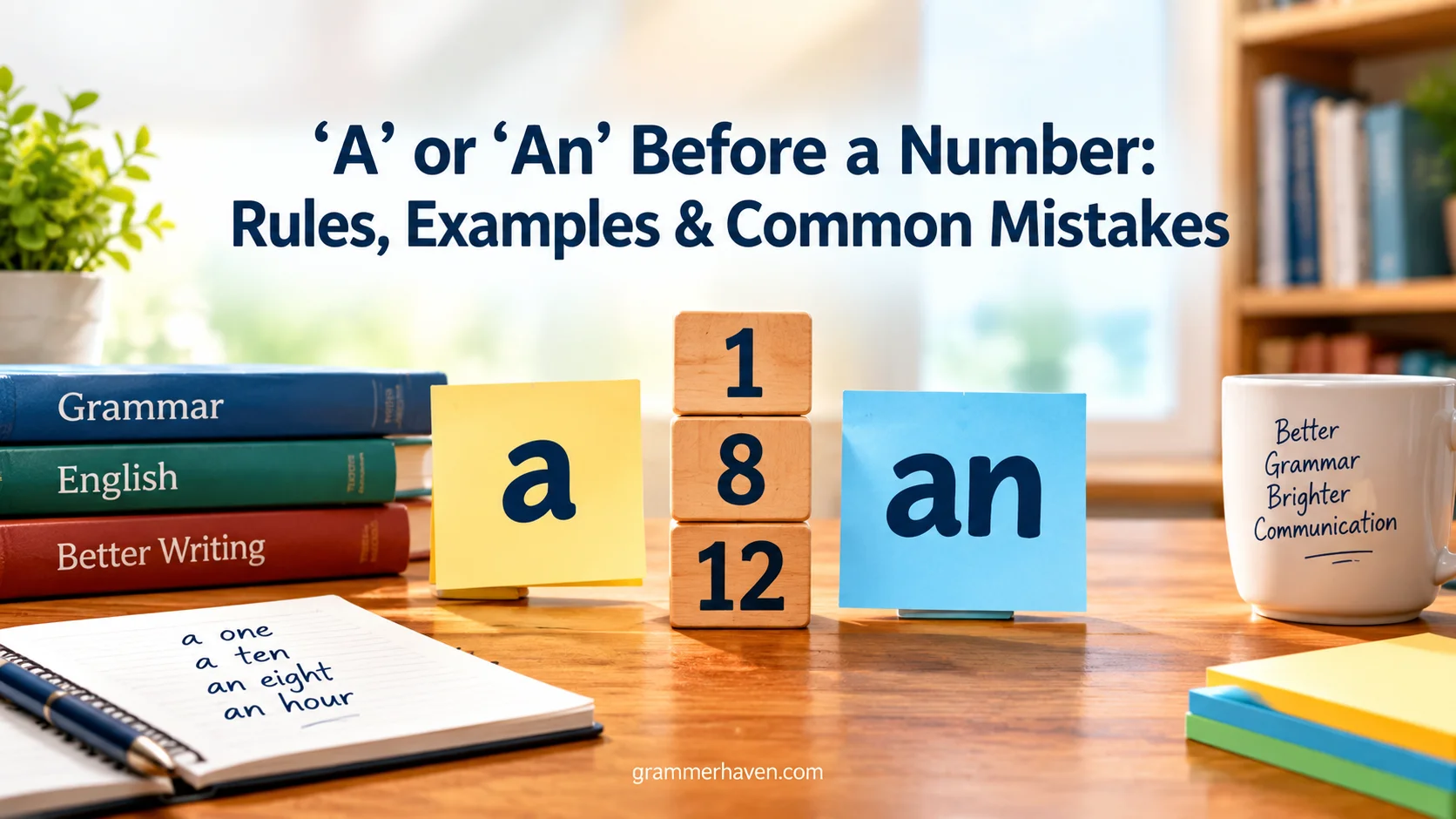
‘A’ or ‘An’ Before a Number depends on the first sound you hear, not the first digit you see, when choosing the correct article in English writing. The simple rule depends on pronunciation, spoken English, and the initial sound of the number. Write an eight-year-old child because eight begins with a vowel sound. Write a hundred or a 100-page book because hundred begins with a consonant sound. Say the number aloud to determine the correct article choice. This grammatical rule applies to number words, numeric expressions, ages, measurements, and other expressions containing numbers.
A number beginning with a vowel sound takes an, while a number beginning with a consonant sound takes a. The vowel letter or first written digit does not determine the answer. Understanding the difference between the spoken form and written form prevents a common mistake in English writing, email writing, social media writing, and tweet writing. Correct article selection improves grammar understanding, language accuracy, writing clarity, and accurate writing. Reading an English sentence aloud is a practical grammar tip that strengthens English grammar skills, grammar knowledge, and English fluency. Regular language learning and practice can reduce hesitation, moments of doubt, and grammar confusion.
This article rule also relates to linguistic context, semantic meaning, contextual relevance, and NLP-related terms used to study language patterns. Consistent rule application builds writing confidence, correctness, and naturalness in spoken communication, written communication, and natural speech. Focus on English pronunciation, vowel pronunciation, consonant pronunciation, and word pronunciation to develop better grammar learning habits and improve correct usage in everyday English. Pay attention to punctuation, use the indefinite article before numbers correctly, and apply this grammar explanation whenever you need to choose between a and an while speaking, writing an email, or composing a tweet.
Quick Answer: Should You Use ‘A’ or ‘An’ Before a Number?
Use a before a number whose spoken form begins with a consonant sound. Use an before a number whose spoken form begins with a vowel sound.
| Number | Correct expression | Explanation |
| 1 | a 1-year-old child | One begins with a /w/ consonant sound. |
| 3 | a 3-day trip | Three begins with a consonant sound. |
| 8 | an 8-year-old child | Eight begins with a vowel sound. |
| 11 | an 11-page report | Eleven begins with a vowel sound. |
| 18 | an 18-month contract | Eighteen begins with a vowel sound. |
| 20 | a 20-minute break | Twenty begins with a consonant sound. |
| 80 | an 80-mile drive | Eighty begins with a vowel sound. |
| 100 | a 100-page book | One hundred begins with a consonant sound. |
| 800 | an 800-meter race | Eight hundred begins with a vowel sound. |
| 1,000 | a 1,000-word essay | One thousand begins with a consonant sound. |
Remember this simple test: say the number aloud before choosing the article. If its first sound is a consonant, use a. If its first sound is a vowel, use an.
The same principle applies whether you write the number as a numeral or spell it out.
The Grammar Rule Behind ‘A’ and ‘An’ Before Numbers
The words a and an are called indefinite articles. They introduce a singular countable noun when the writer doesn’t identify a particular person, object, or thing.
For example:
- I bought a book yesterday.
- She ate an apple after lunch.
- We planned a three-day trip.
- He completed an eight-week course.
Notice that the article doesn’t depend on whether the noun is important, long, or short. It depends on the sound immediately following the article.
This distinction matters because English spelling and pronunciation don’t always match. A number may begin with a digit that looks unfamiliar in this context, but you still choose the article according to the words you would say.
When to Use ‘A’ Before a Number
Use a when the spoken form of the number starts with a consonant sound.
Several common number words begin with consonant sounds, including one, two, three, four, five, six, seven, and twelve. Consequently, number-based expressions beginning with these words often take a.
Examples include:
- A one-hour delay disrupted our schedule.
- A two-week vacation sounds wonderful.
- A three-bedroom apartment costs more than a studio.
- A five-page report is due tomorrow.
- A 12-month subscription includes free updates.
- A 100-dollar bill fell from his wallet.
- A 1,000-word essay is required for the assignment.
The expression a one-hour delay might seem surprising because hour begins with a vowel letter. However, the article comes before one, not directly before hour. Since one begins with a /w/ sound, a one-hour delay is correct.
The same logic applies to a one-time offer, a one-way ticket, and a one-year contract.
When to Use ‘An’ Before a Number
Use an when the spoken form of the number begins with a vowel sound.
Words such as eight, eleven, eighteen, and eighty begin with vowel sounds. Therefore, expressions starting with these numbers generally require an.
Examples include:
- An eight-hour shift left her exhausted.
- An 11-page document needs careful editing.
- An 18-month contract offers some flexibility.
- An 80-mile drive separates the two cities.
- An 800-meter race requires speed and endurance.
- An 8-inch screen fits comfortably on the desk.
Pay attention to the first spoken word, not the number of digits. For instance, 800 begins with eight when read aloud. That vowel sound makes an 800-meter race correct.
However, a different reading can change the article. If someone reads a numerical label digit by digit rather than as a complete number, the appropriate article may differ.
Why Pronunciation Matters More Than the First Digit
English uses sound to determine the choice between a and an. This rule explains why numbers that begin with the same digit can require different articles.
Consider these examples:
- A 1-hour meeting: The number is read as one, which begins with a consonant sound.
- An 8-hour meeting: The number is read as eight, which begins with a vowel sound.
- A 100-page book: The number begins with one hundred when spoken.
- An 800-page book: The number begins with eight hundred when spoken.
The written digits alone don’t tell you which article to choose. You must consider how the expression is actually pronounced.
This principle also applies to words beginning with silent letters. For example, you write an hour because the h is silent and the word begins with a vowel sound. In contrast, you write a hotel in standard American English because the h is pronounced.
Numbers follow the same sound-based principle.
‘A’ or ‘An’ Before Numbers Written as Numerals
Writing numbers as digits is common in news articles, business reports, academic papers, and online content. Fortunately, the rule for choosing a or an stays the same when you use numerals.
The key is to identify how the number would normally be pronounced in the sentence.
Single-Digit Numbers
Single-digit numbers are easy to handle once you know their spoken forms. Most begin with consonant sounds, but 8 begins with a vowel sound.
| Number | Spoken form | Correct example |
| 1 | One | A 1-page form |
| 2 | Two | A 2-week course |
| 3 | Three | A 3-step process |
| 4 | Four | A 4-door car |
| 5 | Five | A 5-minute break |
| 6 | Six | A 6-month plan |
| 7 | Seven | A 7-day trial |
| 8 | Eight | An 8-hour shift |
| 9 | Nine | A 9-year plan |
For example, you might write, “We offer a 7-day free trial.” However, you would write, “We offer an 8-day free trial.”
The digit changes, but the underlying rule doesn’t.
Numbers Between 10 and 99
Numbers between 10 and 99 require the same sound-based approach. Some begin with consonant sounds while others begin with vowel sounds.
| Number | Spoken form | Correct expression |
| 10 | Ten | A 10-minute break |
| 11 | Eleven | An 11-page report |
| 12 | Twelve | A 12-month plan |
| 18 | Eighteen | An 18-month contract |
| 20 | Twenty | A 20-minute meeting |
| 80 | Eighty | An 80-mile drive |
| 90 | Ninety | A 90-day agreement |
Notice the difference between a 90-day agreement and an 80-day agreement. Although both numbers have two digits, their opening sounds differ.
When you encounter a number you’re unsure about, pronounce it naturally. That small step usually settles the question.
Numbers With Three or More Digits
Larger numbers follow the same rule. The first word in the number’s spoken form determines the article.
Consider these examples:
- A 100-page novel: Read 100 as one hundred.
- An 800-meter race: Read 800 as eight hundred.
- A 1,000-word essay: Read 1,000 as one thousand.
- An 11,000-person audience: Read 11,000 as eleven thousand.
- A 250-mile journey: Read 250 as two hundred fifty in common American English.
- An 18,000-dollar investment: Read 18,000 as eighteen thousand.
In American English, people commonly omit and when reading whole numbers such as 250. Other English varieties may include it. That difference doesn’t affect the article because two begins with a consonant sound in either reading.
Numbers With Decimals, Fractions, and Percentages
Decimals and fractions deserve special attention because writers may pronounce them in different ways.
For decimals, use the first sound of the complete expression as you intend to read it.
| Written expression | Spoken form | Correct article |
| 0.5-mile walk | A zero-point-five-mile walk | A |
| 0.8-mile walk | A zero-point-eight-mile walk | A |
| 8.5% increase | An eight-point-five-percent increase | An |
| 11.5% reduction | An eleven-point-five-percent reduction | An |
| 1/2 share | A one-half share | A |
| 1/8 share | An one-eighth share is incorrect; use an eighth share or a one-eighth share? | Depends on the wording |
The last example highlights an important distinction. When you say a one-eighth share, the expression begins with one, so a is correct. When you say an eighth of the share, the first word is eighth, so an is correct.
Similarly, you would write an 8.5% increase when reading the number as eight-point-five percent. The article agrees with the opening sound of eight, not with the percent symbol.
For percentages, the noun phrase also matters:
- An 8% increase surprised the finance team.
- A 5% decrease followed the price change.
- The rate increased by 8%.
- The rate fell by 5%.
The last two examples don’t need an indefinite article because the percentage follows a preposition rather than introducing a singular countable noun.
‘A’ or ‘An’ Before Numbers Written in Words
Spelling out numbers doesn’t change the rule. Whether you write 8 or eight, you must still choose the article according to pronunciation.
Numbers Beginning With “One”
The word one begins with a consonant sound, even though its spelling starts with a vowel letter.
Therefore, these expressions are correct:
- A one-year contract
- A one-time payment
- A one-way ticket
- A one-bedroom apartment
- A one-hour delay
- A one-sided argument
The expression a one-hour delay deserves another look. The article agrees with one, not hour. Even though hour begins with a vowel sound, it isn’t the first spoken word after the article.
Compare these sentences:
- We experienced a one-hour delay at the airport.
- We waited for an hour at the airport.
Both are correct. The first begins with one, while the second begins with hour.
Numbers Beginning With “Eight”
The word eight starts with a vowel sound. Consequently, use an before expressions that begin with eight.
Examples include:
- An eight-hour shift
- An eight-page essay
- An eight-person team
- An eight-week course
- An eight-lane highway
- An eight-year-old child
For example, “She completed an eight-week course in digital marketing” is correct.
Writing a eight-week course would be incorrect because the article doesn’t match the opening sound of eight.
Numbers Beginning With “Eleven” and “Eighteen”
The words eleven and eighteen also begin with vowel sounds.
Use an in expressions such as:
- An eleven-day trip
- An eleven-year-old student
- An eighteen-month lease
- An eighteen-page document
- An eighteen-wheeler truck
By comparison, twenty, thirty, and forty begin with consonant sounds.
Therefore, you write a twenty-minute meeting, a thirty-day trial, and a forty-page report.
The number’s spelling gives you a useful clue, but pronunciation remains the deciding factor.
Special Cases: Measurements, Ages, Money, and Time
Numbers frequently appear alongside units and quantities. Although these expressions may look different, they follow the same article rule.
Ages and Age-Related Expressions
Age expressions often combine a number with year-old before a noun.
Correct examples include:
- An 8-year-old athlete
- A 1-year-old puppy
- An 11-year-old student
- A 12-year-old bicycle
- An 18-year-old applicant
When the age appears before a noun as a compound modifier, year stays singular and the expression uses hyphens.
For example:
An 8-year-old child entered the classroom.
However, when the age appears after a linking verb, the construction changes:
The child is 8 years old.
The second sentence doesn’t need a or an before the age because the number isn’t introducing a singular countable noun.
Remember these two patterns:
- Before a noun: an 8-year-old child
- After a linking verb: the child is 8 years old
Measurements and Distances
Measurements use a or an according to the number’s spoken form.
Examples include:
- A 3-mile hike
- An 8-inch screen
- A 1-hour drive
- An 80-pound bag
- A 12-foot ladder
- An 18-meter pool
Consider the sentence, “We bought an 8-inch tablet for travel.” The number 8 is read as eight, which begins with a vowel sound.
Now compare it with “We bought a 12-inch tablet for travel.” The number 12 is read as twelve, which begins with a consonant sound.
The measurement unit doesn’t change the choice. The number’s opening sound does.
Money and Percentages
Money expressions also follow the same rule.
- A 100-dollar bill
- An $8 fee
- A $20 ticket
- An $80 deposit
- A $1,000 payment
In standard American English, you read $8 as eight dollars, so an $8 fee is correct. You read $20 as twenty dollars, so a $20 ticket is correct.
The same applies to percentage changes:
- An 8% increase in revenue
- A 10% reduction in costs
- An 11% rise in demand
- An 80% completion rate
However, don’t insert an article automatically before every percentage. In a sentence such as “Revenue increased by 8%,” the percentage follows by, so no indefinite article is needed there.
Time Periods and Durations
Time expressions appear in schedules, reports, instructions, and everyday conversations.
Examples include:
- A 1-minute warning
- An 8-hour workday
- A 15-minute break
- An 18-hour journey
- A 30-second advertisement
- An 11-week training program
Compare these two sentences:
- The speaker gave a 10-minute presentation.
- The speaker gave an 11-minute presentation.
The article changes because ten begins with a consonant sound while eleven begins with a vowel sound.
‘A’ or ‘An’ Before Ordinal Numbers and Number-Based Expressions
Ordinal numbers describe position or order rather than quantity. Examples include first, second, eighth, and eleventh.
The same pronunciation principle applies when you use them with indefinite articles.
Ordinal Numbers
Use a before ordinal expressions that begin with consonant sounds and an before those that begin with vowel sounds.
| Ordinal | Correct expression | Reason |
| First | A first attempt | First begins with /f/. |
| Second | A second chance | Second begins with /s/. |
| Eighth | An eighth-place finish | Eighth begins with a vowel sound. |
| Eleventh | An eleventh-hour decision | Eleventh begins with a vowel sound. |
| Twelfth | A twelfth-place finish | Twelfth begins with /t/. |
For example, “She earned an eighth-place finish in the competition” is correct.
However, remember that the article can depend on the full expression. In a first-place medal, the word first begins with a consonant sound, so a is correct.
Fractions and Number-Based Labels
Fractions can be expressed in several ways, so consider the exact wording.
- A one-third share of the property belongs to her.
- An eighth of the cake remained on the plate.
- A one-half portion is enough for me.
- An 8-bit system can represent values using eight binary digits.
The last example follows the pronunciation of eight. However, abbreviations and technical labels may have established readings that differ from their appearance.
If you’re writing about a specific product, scientific term, or technical label, check how readers commonly pronounce it. Don’t assume every numerical code is read as a whole number.
Numbers in Titles, Names, and Technical Terms
Numbers in product names, model labels, and titles can be pronounced in different ways. Some people read the number as a complete value, while others pronounce each digit separately.
The correct article depends on the actual pronunciation of the expression.
Use these guidelines:
- Check the established pronunciation of a product or technical name.
- Determine whether the number is read as a whole number or digit by digit.
- Apply the normal sound-based rule to the resulting expression.
- Follow an established style guide when writing specialized material.
This approach avoids mistakes when a numeral doesn’t have one obvious spoken form.
Common Mistakes When Using ‘A’ or ‘An’ Before Numbers
Even experienced writers sometimes choose the wrong article when a numeral interrupts their usual writing rhythm. These are the mistakes worth watching for.
Choosing the Article Based on the Digit
The digit alone doesn’t determine whether you need a or an.
Incorrect: A 8-year-old child won the race.
Correct: An 8-year-old child won the race.
The number 8 is read as eight, which begins with a vowel sound.
Assuming Every Number Beginning With 1 Takes “An”
The opposite mistake also occurs. Writers sometimes use an because the numeral begins with 1.
Incorrect: An 100-page report is due tomorrow.
Correct: A 100-page report is due tomorrow.
The number 100 is read as one hundred, which begins with a consonant sound.
Forgetting the Difference Between “One” and “Eight”
The words one and eight begin with different sounds even though their written forms may seem similar at first glance.
- A one-time opportunity
- An eight-time champion
The second example is correct when eight-time champion means someone who has won a title eight times. The article agrees with eight, not with the hyphenated expression as a whole.
Using an Article Where None Is Needed
Not every number requires an indefinite article.
Compare:
- She bought an 8-page notebook.
- She bought 8 notebooks.
- She waited an hour.
- She waited for 8 hours.
The first and third sentences contain singular noun phrases that use an indefinite article. The second and fourth sentences use plural nouns or a different grammatical construction.
Before choosing an article, check the sentence structure as well as pronunciation.
How to Choose the Correct Article Before Any Number
You don’t need to memorize every possible number expression. A simple process works for most situations.
Follow these steps:
- Read the number aloud. Convert the numeral into the words you would naturally say.
- Identify the first sound. Focus on the opening sound rather than the first written digit.
- Choose the article. Use a before a consonant sound and an before a vowel sound.
- Check the complete phrase. Make sure the number is functioning as part of a noun phrase that needs an article.
- Confirm unusual pronunciations. Check established readings for abbreviations, product names, and technical expressions.
Here’s the decision rule at a glance:
| First spoken sound | Article | Example |
| Consonant | A | A 1-year plan |
| Vowel | An | An 8-year plan |
| Consonant | A | A 100-page report |
| Vowel | An | An 800-page report |
For a reliable reference on the general rule, consult the Cambridge Dictionary guide to a/an usage. It explains why pronunciation, rather than spelling, determines the correct indefinite article.
Practice Exercises: Choose ‘A’ or ‘An’ Before the Number
Test your understanding by filling in each blank with a or an. Pay attention to how the number is pronounced.
- She works an eight-hour shift.
- We booked ___ 10-minute appointment.
- He wrote ___ 11-page report.
- They adopted ___ 1-year-old puppy.
- The company announced ___ 80% increase in sales.
- I need ___ 20-dollar bill.
- We watched ___ 800-meter race.
- She signed ___ 18-month contract.
- He took ___ 5-mile walk.
- The teacher assigned ___ 1,000-word essay.
- She earned ___ eighth-place finish.
- We discussed ___ 11th-hour change.
Answer Key With Explanations
| No. | Answer | Explanation |
| 2 | A | Ten begins with a consonant sound. |
| 3 | An | Eleven begins with a vowel sound. |
| 4 | A | One begins with a /w/ sound. |
| 5 | An | Eighty begins with a vowel sound. |
| 6 | A | Twenty begins with a consonant sound. |
| 7 | An | Eight hundred begins with a vowel sound. |
| 8 | An | Eighteen begins with a vowel sound. |
| 9 | A | Five begins with a consonant sound. |
| 10 | A | One thousand begins with a /w/ sound. |
| 11 | An | Eighth begins with a vowel sound. |
| 12 | An | Eleventh begins with a vowel sound. |
The first exercise sentence is already correct: an eight-hour shift. Use it as a reminder that the number’s spoken form controls the article.
See also: Verklempt Meaning: Definition, Origin, Examples & How to Use It
Frequently Asked Questions
Do You Use ‘A’ or ‘An’ Before a Number?
Use a before numbers that begin with consonant sounds and an before numbers that begin with vowel sounds. For example, write a 10-minute break but an 11-minute break. The pronunciation of the number determines the choice.
Is It ‘A 8-Year-Old’ or ‘An 8-Year-Old’?
An 8-year-old is correct because 8 is pronounced eight, which begins with a vowel sound.
Example: An 8-year-old child entered the competition.
Is It ‘A 1-Year-Old’ or ‘An 1-Year-Old’?
A 1-year-old is correct because 1 is pronounced one, which begins with a consonant sound.
Example: A 1-year-old puppy needs careful attention.
Do You Use ‘A’ or ‘An’ Before 100?
Use a before 100 when it’s read as one hundred. For example, write a 100-page book or a 100-dollar bill.
Does the Rule Change When Numbers Are Written as Words?
No. The rule remains the same whether you write 8 or eight. Both forms begin with the same spoken sound, so you write an 8-hour shift or an eight-hour shift.
Conclusion:
Choosing a or an before a number becomes simple once you focus on pronunciation. Use a when the number begins with a consonant sound, as in a 1-year contract or a 100-page book. Use an when the number begins with a vowel sound, as in an 8-hour shift or an 800-meter race.
The rule applies to ages, measurements, money, percentages, fractions, and ordinal numbers. You don’t need to memorize every possible expression. Just say the number aloud and listen to its first sound.
When a numerical label has an unusual pronunciation, check how it’s normally read. That small habit will help you write more accurately and confidently.