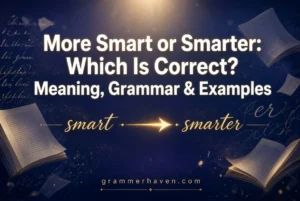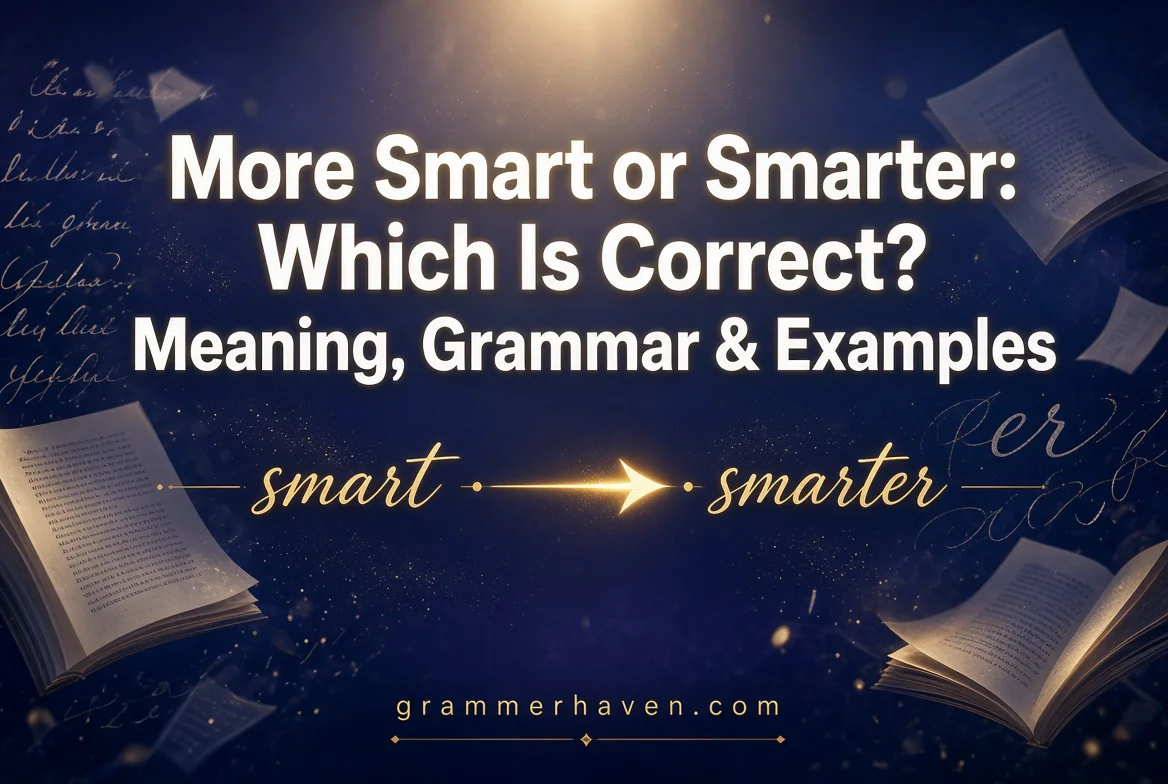
The phrase More Smart or Smarter often confuses English learners when comparing intelligence, people, or ideas. The correct form is smarter because smart is a one-syllable adjective that usually takes the -er suffix. This rule helps improve grammar understanding, word choice, sentence construction, and everyday communication.
The difference between more smart and smarter depends on comparative adjective patterns. English usually uses more with adjectives containing two or more syllables. The word smarter remains the natural choice in standard English because it follows established grammar rules. When comparing intelligence, decisions, or ideas, the correct adjective usage improves sentence clarity, grammatical accuracy, and effective communication. For example, “Mia is smarter than Alex” sounds more natural than “Mia is more smart than Alex.” Understanding adjective comparison, comparative meaning, and degree of comparison helps you avoid common mistakes.
Correct adjective usage matters in academic assignments, professional emails, academic writing, and spoken English. Strong word usage, natural phrasing, and clear expression make written communication more confident. The simple rule is easy to remember: use smarter when comparing intelligence. This choice supports language learning, English proficiency, professional communication, and overall grammatical correctness.
Quick Answer: More Smart or Smarter?
“Smarter” is the standard comparative form of “smart” in American English. Use it when comparing two people, ideas, choices, or things.
- Correct: Emma is smarter than her brother.
- Correct: This is a smarter way to solve the problem.
- Usually unnatural: Emma is more smart than her brother.
- Incorrect in standard usage: Emma is more smarter than her brother.
The reason is straightforward: smart is a one-syllable adjective that normally forms its comparative by adding -er.
| Form | Grammatical use | Example |
| Smart | Base adjective | Emma is smart. |
| Smarter | Comparative adjective | Emma is smarter than Jake. |
| Smartest | Superlative adjective | Emma is the smartest student in her class. |
| More smart | Usually unnatural in an ordinary comparison | Use smarter instead. |
| More smarter | Incorrect double comparative | Use smarter instead. |
Remember this pattern: smart → smarter → smartest.
Although more smart can appear in unusual or deliberately contrastive constructions, smarter is the best choice for everyday conversation and polished writing.
What Does “Smart” Mean?
The adjective smart has several meanings. Its exact meaning depends on the situation and the quality you’re describing.
Definition of Smart
Smart commonly describes someone who is intelligent, learns quickly, understands difficult ideas, or makes good decisions. It can also describe something practical, stylish, or technologically advanced.
Here are its most common meanings:
- Intelligent: Able to learn, understand, or solve problems.
- Clever: Good at finding effective or creative solutions.
- Sensible: Showing good judgment when making decisions.
- Stylish: Neat, polished, or attractive in appearance.
- Advanced: Designed to respond intelligently or perform sophisticated tasks.
For example, a smart student may understand difficult concepts quickly. A smart business decision may reduce costs without sacrificing quality. A smart outfit may look polished and professional.
These meanings matter because smarter compares the quality expressed by smart, not just a person’s intelligence.
Examples of “Smart” in Sentences
Consider how the meaning changes across these examples:
- Mia is a smart student who enjoys solving puzzles. Here, smart refers to intelligence.
- Buying a reliable used car was a smart decision. Here, smart means sensible or practical.
- He wore a smart jacket to the interview. Here, smart describes appearance.
- The company installed smart sensors to monitor energy use. Here, smart refers to advanced technology.
Understanding the context helps you interpret smarter correctly when you encounter it in a sentence.
What Does “Smarter” Mean?
Smarter is the comparative form of smart. It describes someone or something that has a greater degree of intelligence, good judgment, style, or another quality associated with being smart.
A comparison doesn’t always need to involve intelligence. For example, a smarter plan might save time, while a smarter device might respond more effectively to changing conditions.
Definition of Smarter
When you use smarter, you generally compare two people or things, or you compare something with its earlier state.
For example:
- Lena is smarter than she was last year. This describes personal improvement.
- Our team needs a smarter strategy. This compares the proposed strategy with other possible approaches.
- The new phone has smarter security features. This suggests more advanced or adaptive features.
- A smarter outfit would suit the formal event. This refers to a more polished appearance.
Notice that smarter doesn’t always mean having a higher IQ. Depending on the context, it can mean wiser, more efficient, more practical, or more sophisticated.
Examples of “Smarter” in Everyday English
Here are some natural examples you can use as models:
- Education: Daniel found a smarter way to organize his study notes.
- Work: We need a smarter approach to managing customer requests.
- Technology: The updated software makes smarter recommendations.
- Personal finance: Saving a little each month is a smarter habit than relying on credit.
- Daily decisions: Taking the train was smarter than driving through heavy traffic.
Each sentence uses smarter to express a comparison. Sometimes the alternative is stated directly with than. In other cases, the reader understands the comparison from the context.
Is “More Smart” Grammatically Correct?
The answer depends on what you mean by grammatically correct. In an ordinary comparison, “more smart” is nonstandard or unnatural compared with “smarter.” However, English sometimes allows unusual adjective constructions for emphasis or contrast.
For example:
- Less natural: This approach is more smart than the previous one.
- Standard: This approach is smarter than the previous one.
Both sentences communicate a similar idea. However, the second follows the established comparative pattern and sounds more natural to American English readers.
Why “Smarter” Is the Standard Comparative
English commonly forms the comparative of a one-syllable adjective by adding -er. Because smart has one syllable, its normal comparative form is smarter.
Consider these examples:
| Base adjective | Comparative form | Example |
| Fast | Faster | This computer is faster than mine. |
| Tall | Taller | Marcus is taller than his brother. |
| Bright | Brighter | The room looks brighter now. |
| Strong | Stronger | This material is stronger than plastic. |
| Smart | Smarter | Your solution is smarter than mine. |
These forms allow you to compare qualities without adding another word.
The -er ending already communicates the comparison. Therefore, adding more before smarter creates an unnecessary double comparative.
Can “More Smart” Ever Be Used?
You may occasionally encounter more smart in conversation, creative writing, or a sentence that emphasizes a particular contrast. However, you shouldn’t treat it as an interchangeable alternative to smarter.
For example, someone might write:
The proposal needs to be more smart in its design and less focused on appearance.
This wording is understandable, but most editors would revise it for clarity and naturalness:
The proposal needs a smarter design that focuses less on appearance.
The revised version communicates the same idea more smoothly.
The key distinction is between possible wording and preferred standard usage. Just because readers understand a phrase doesn’t mean it’s the best choice for polished writing.
“More Smart” vs. “Smarter”: Key Differences
Although both expressions suggest a greater degree of smartness, their grammatical patterns differ.
| Feature | More Smart | Smarter |
| Basic meaning | A greater degree of smartness | A greater degree of smartness |
| Standard comparative form | No | Yes |
| Natural in everyday American English | Usually not | Yes |
| Suitable for professional writing | Generally avoid | Yes |
| Common sentence pattern | More smart than | Smarter than |
| Recommended for ordinary comparisons | No | Yes |
The main difference isn’t the intended meaning. It’s the way English normally forms the comparative adjective.
Choose “smarter” when you want your sentence to sound natural, clear, and grammatically standard.
Why Do We Say “Smarter” Instead of “More Smart”?
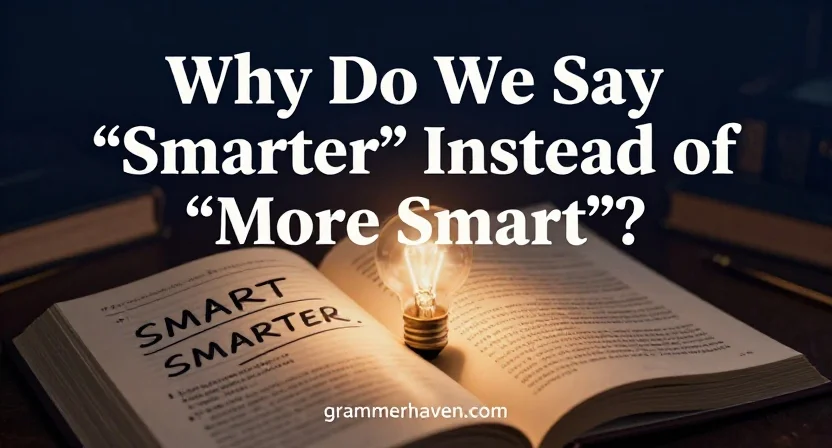
The answer becomes clearer when you understand the two common ways English forms comparative adjectives.
The Comparative Rule for Short Adjectives
A comparative adjective describes a greater or lesser degree of a quality when comparing people, objects, situations, or ideas.
Many one-syllable adjectives form their comparatives by adding -er.
For example:
- Short → shorter
- Long → longer
- Quick → quicker
- Slow → slower
- Smart → smarter
Some adjectives require spelling changes. For example, big becomes bigger and hot becomes hotter because the final consonant doubles.
However, smart follows the straightforward pattern. You simply add -er to form smarter.
When English Uses “More” Instead
English often uses more with longer adjectives. This pattern is common when the adjective doesn’t naturally take the -er ending.
Consider these examples:
| Base adjective | Comparative form | Example |
| Intelligent | More intelligent | Ava is more intelligent than I expected. |
| Beautiful | More beautiful | This painting is more beautiful than the other one. |
| Careful | More careful | Be more careful when handling the glass. |
| Expensive | More expensive | This laptop is more expensive than mine. |
| Interesting | More interesting | The second book is more interesting. |
| Smart | Smarter | He is smarter than his opponent. |
Notice that English doesn’t follow one mechanical rule for every adjective. Some two-syllable adjectives can use either pattern depending on the word and context.
For smart, however, the established comparative is smarter. You don’t need to add more.
Examples of “Smarter” in Different Contexts
The word smarter works in everyday conversation, education, business, technology, and professional writing. Its meaning shifts slightly depending on what you’re comparing.
Comparing Intelligence
When you’re comparing people’s ability to understand information or solve problems, smarter is a natural choice.
Examples:
- Olivia is smarter than she was in high school.
- The teacher explained the problem so everyone could work smarter.
- My younger brother is smarter than I initially thought.
- Practice helped him become smarter about solving complex problems.
Keep in mind that calling someone smarter doesn’t prove that they have a higher IQ. The word can refer to knowledge, experience, reasoning, or performance in a particular situation.
Comparing Decisions and Strategies
Sometimes, smarter describes a decision rather than a person’s intelligence.
For example:
Taking the earlier train was a smarter choice because it avoided rush-hour traffic.
Here, smarter means more sensible or practical. The sentence evaluates the decision based on its likely outcome.
Other examples include:
- Creating a monthly budget is a smarter way to manage your money.
- We need a smarter strategy to reduce unnecessary expenses.
- Checking the instructions first would be a smarter move.
- The team adopted a smarter approach to handling customer complaints.
These examples demonstrate how smarter can describe efficiency, planning, and good judgment.
Comparing Appearance or Style
In American English, smart most commonly describes intelligence or good judgment. However, it can also refer to a neat or polished appearance, particularly in certain contexts.
For example:
- He wore a smarter outfit for the job interview.
- A darker jacket would create a smarter appearance.
- She chose a smarter look for the formal dinner.
In these sentences, smarter refers to style rather than intelligence.
Comparing Technology and Products
Technology companies often use smart to describe devices or systems that automate tasks, respond to information, or connect with other devices.
Examples:
- The updated app offers smarter search suggestions.
- This device provides smarter energy management.
- The new system gives employees a smarter way to organize files.
Here, smarter suggests an improvement in design, responsiveness, or efficiency. It doesn’t necessarily mean the technology possesses human intelligence.
Using “Smarter” in Professional and Academic Writing
Smarter is appropriate in both formal and informal English. You don’t need to replace it with more smart to sound professional.
Consider these examples:
- Business: The company needs a smarter approach to inventory management.
- Academic: The researchers developed a smarter method for analyzing the data.
- Workplace communication: A smarter solution would reduce delays and improve accuracy.
- Technical writing: The updated system uses smarter automation to handle routine tasks.
When writing an academic paper, choose a more specific term if the context requires it. For instance, more efficient, more accurate, or more intelligent might express your intended meaning more precisely.
“Smarter” vs. “More Intelligent”: Are They the Same?
The expressions “smarter” and “more intelligent” overlap in meaning, but they’re not always interchangeable.
Smarter is often conversational and flexible. It can describe intelligence, practical judgment, cleverness, or an effective decision.
More intelligent usually places greater emphasis on intellectual ability or capacity, although the context still determines its exact meaning.
| Expression | Typical emphasis | Example |
| Smarter | Intelligence, judgment, or practical ability | She made a smarter decision. |
| More intelligent | Intellectual ability or understanding | The test measures whether one model is more intelligent than another. |
| More efficient | Better use of time or resources | This process is more efficient than the old one. |
| More practical | Greater usefulness in real situations | The second solution is more practical. |
Both smarter and more intelligent can be correct in the same context:
- Nora is smarter than her competitor.
- Nora is more intelligent than her competitor.
The first sentence may suggest better judgment or quick thinking. The second more directly emphasizes intelligence.
The grammatical patterns differ, too:
- Smart → smarter
- Intelligent → more intelligent
Choose the adjective that communicates your intended meaning most accurately.
“Smarter” in Comparative and Related Sentence Structures
Understanding the surrounding sentence can help you use smarter correctly.
Smarter Than
The structure smarter than is the standard way to compare two people, things, or ideas.
Examples:
- Daniel is smarter than his older brother.
- This plan is smarter than the previous one.
- Taking the bus is smarter than driving during rush hour.
The basic structure is:
Subject + smarter + than + comparison
You can also use smarter than me in everyday American English or smarter than I am in a more explicit, formal construction.
For example:
- Conversational: She is smarter than me.
- More formal: She is smarter than I am.
Both are established forms in modern English.
Getting Smarter
The phrase getting smarter describes a change over time. It can refer to learning, gaining experience, improving judgment, or becoming more capable.
Examples:
- I’m getting smarter about managing my time.
- The students are getting smarter at solving these problems.
- The company is getting smarter about using its resources.
This construction doesn’t necessarily mean that someone’s innate intelligence has increased. It may describe improved knowledge, skills, or decision-making.
The Smartest
Smartest is the superlative form of smart. Use it when identifying the highest degree of a quality within a group or relevant comparison.
Examples:
- Maya is the smartest student in the class.
- This is the smartest solution available to our team.
- He made the smartest decision under pressure.
The standard progression is:
| Degree | Form | Example |
| Positive | Smart | Maya is smart. |
| Comparative | Smarter | Maya is smarter than Leo. |
| Superlative | Smartest | Maya is the smartest student in the class. |
Use smarter to make a comparison and smartest to identify the highest degree within a group.
Common Mistakes When Using “More Smart” and “Smarter”
Even simple adjectives can cause confusion when you apply the wrong comparative pattern. Here are the most common mistakes and their corrections.
Using “More Smart” Instead of “Smarter”
Incorrect or unnatural: This is a more smart solution.
Better: This is a smarter solution.
Why? Smart normally takes the -er ending to form its comparative.
Using “More Smarter”
Incorrect: She is more smarter than her friend.
Correct: She is smarter than her friend.
This mistake is called a double comparative. The word smarter already expresses comparison, so adding more duplicates the comparative marking.
The same principle applies to these examples:
- More faster → Faster
- More stronger → Stronger
- More brighter → Brighter
- More smarter → Smarter
Confusing “Smarter” With “Smartest”
Incorrect: He is smarter student in the class.
Correct: He is the smartest student in the class.
The first sentence incorrectly combines a comparative form with a group-ranking structure. If you’re identifying the person with the highest degree of smartness in a group, use smartest.
If you’re comparing two students, use smarter:
He is smarter than his classmate.
Assuming Every Adjective Uses “More”
Incorrect or unnatural: This option is more smart than the alternative.
Better: This option is smarter than the alternative.
However, don’t overcorrect by adding -er to every adjective. English uses different comparative patterns, so learn the conventional form of each adjective.
For example:
- Smart → smarter
- Beautiful → more beautiful
- Intelligent → more intelligent
- Good → better
The last example is irregular. English doesn’t always form comparatives by simply adding -er or placing more before the adjective.
A Practical Case Study: Choosing Between Two Sentences
Imagine that a manager must choose between two customer-support systems.
The first system requires employees to sort every request manually. The second system automatically organizes routine requests and sends complicated cases to specialists.
Which sentence describes the second system more naturally?
Option A: The second system is more smart because it saves time.
Option B: The second system is smarter because it saves time.
Option B is the standard choice. The adjective smart takes the comparative ending -er, and the sentence clearly explains why the system is better designed.
This example also highlights an important point: smarter doesn’t necessarily mean more intelligent in a human sense. Here, it means more efficient and better suited to the task.
When choosing between comparative forms, consider both the grammar and the meaning you want to express.
“More Smart” vs. “Smarter” at a Glance
| Expression | Meaning or function | Recommended usage |
| Smart | Base adjective describing intelligence, judgment, or another quality | Use when describing someone or something. |
| Smarter | Standard comparative form | Use when comparing two people or things. |
| Smartest | Superlative form | Use when identifying the highest degree within a group. |
| More smart | Usually unnatural in ordinary comparisons | Prefer smarter. |
| More smarter | Double comparative | Avoid in standard English. |
| More intelligent | Comparative construction with intelligent | Use when emphasizing intellectual ability. |
See also: Into or Onto: Meaning, Differences and Correct Usage
FAQs:
Is “More Smart” or “Smarter” Correct?
Smarter is the standard comparative form of smart. Use it when comparing two people, things, ideas, or decisions. More smart is generally unnatural in an ordinary comparison.
Is “More Smart” Grammatically Incorrect?
In standard everyday English, more smart is not the preferred comparative construction. It may appear in unusual or deliberately contrastive wording, but smarter is the natural choice for ordinary comparisons.
Can I Say “More Smarter”?
No. More smarter is incorrect in standard English when both words mark the same comparison. Use smarter because the -er ending already makes the adjective comparative.
Is “Smarter” More Formal Than “More Smart”?
Smarter is natural in both formal and informal writing. It’s the established comparative form, so it works well in professional emails, academic discussions, reports, and everyday conversations.
Should I Use “Smarter” or “More Intelligent” in Academic Writing?
Both expressions can be appropriate. Use smarter when discussing intelligence, judgment, or practical problem-solving. Choose more intelligent when you want to emphasize intellectual ability more directly.
What Is the Comparative Form of “Smart”?
The comparative form is smarter. The base adjective is smart, while the superlative form is smartest.
What Is the Difference Between “Smarter” and “Smartest”?
Smarter compares people or things, while smartest identifies the highest degree within a group.
For example, Ella is smarter than Ben compares two people. Ella is the smartest student in the class identifies her position within the group.
Conclusion:
When deciding between “more smart” and “smarter,” remember that “smarter” is the standard comparative form of smart in American English. Use it when comparing intelligence, decisions, skills, or ideas. For example, “She is smarter than her brother” sounds natural and follows standard grammar rules.
Although you may occasionally encounter more smart in unusual or deliberate expressions, it isn’t the preferred choice for everyday communication. Also, avoid “more smarter” because it uses two comparative markers unnecessarily. Keep the basic pattern in mind: smart → smarter → smartest. Once you understand this simple rule, you’ll find it easier to make accurate comparisons in conversations, academic assignments, and professional writing.