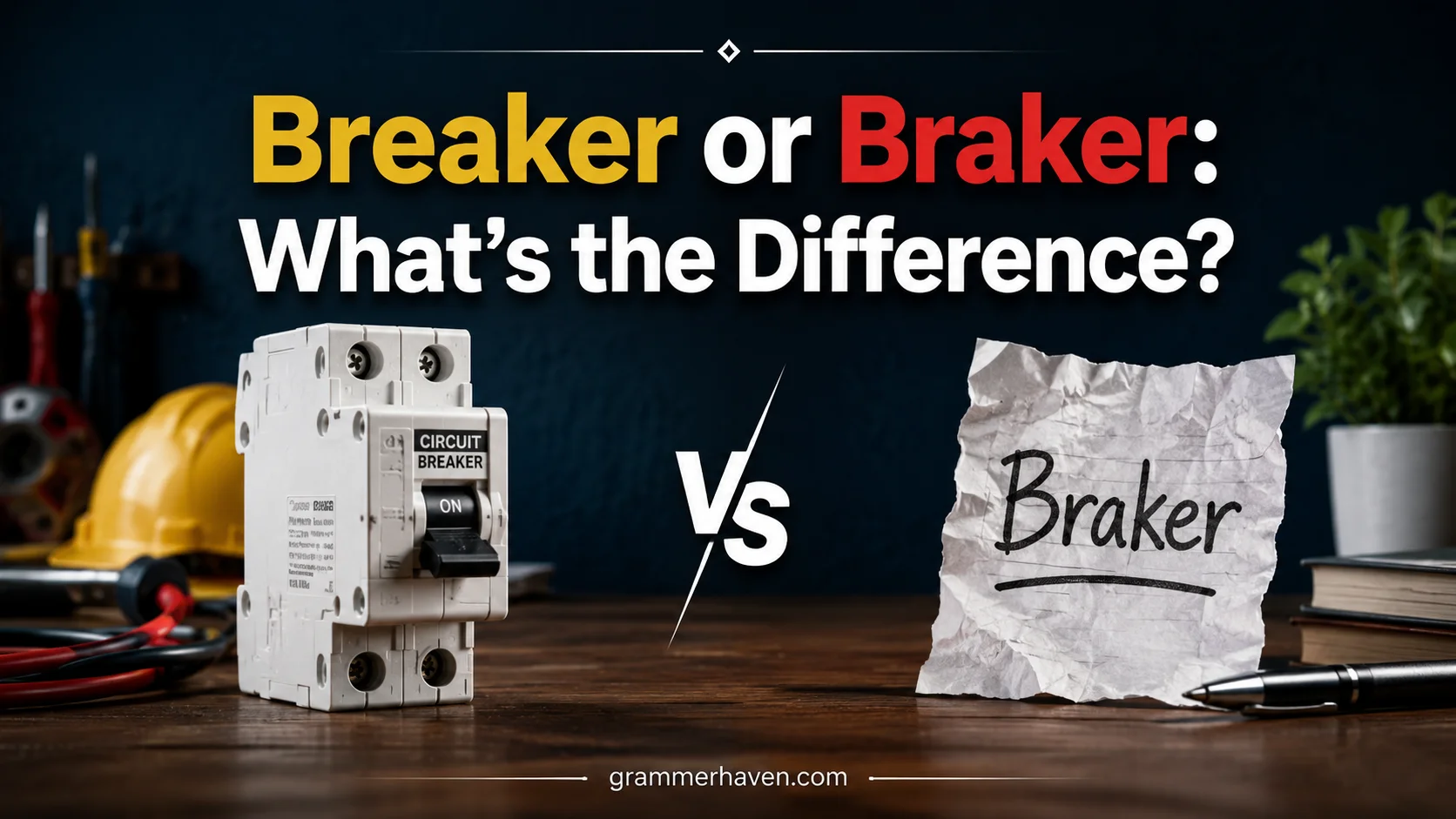
Breaker or Braker: What’s the Difference? explains why these similar words cause confusion and how to choose the correct spelling with confidence. When you see breaker and braker, the difference may seem minor because these two words have a similar sound, especially during fast speech. That can cause confusion, making people assume they are alternate spellings of the same word. However, their meanings differ. Breaker is the common, standard English word you’ll usually encounter in daily life and everyday writing, while braker does exist as a rare, specialty term that isn’t used equally in ordinary language. Understanding this distinction can prevent common mistakes and help you make the right spelling choice.
The best way to understand these words is to examine their use in real situations. A breaker can describe a device or something that breaks, while a braker can describe someone or something that applies brakes. You may see these terms in technical topics, cars, electricity, and sports, where the exact meaning matters. British English and American English both recognize breaker as a normal English word, while braker remains uncommon and specialized. If you’re a writer, a spellcheck tool can flag unusual terms, but understanding the terminology gives you a clear answer instead of making you depend entirely on software.
When you face this problem, work through it step by step. Check the context, identify the intended meaning, and choose the right word. In common usage, breaker is usually the safer spelling. The letter difference looks small, but it can affect your writing and create a mix-up for readers. Looking at real examples from cars or electricity can strengthen your confidence and understanding. This article helps explain why these terms shouldn’t be treated as two interchangeable words that can be swapped freely.
Breaker vs Braker: Quick Difference
The easiest way to understand breaker vs braker is to look at what each word comes from.
| Word | Comes From | Meaning | Common Examples |
| Breaker | Break | Something or someone that breaks, interrupts, or separates | Circuit breaker, wave breaker, icebreaker |
| Braker | Brake | Someone or something that applies brakes | Railroad braker, specialized machinery |
In everyday English, breaker is the word you will use almost all the time.
If you’re talking about your home’s electrical panel, a storm wave, a sports competition, or a machine that breaks material apart, the correct spelling is breaker.
What Does Breaker Mean?
The word breaker is a noun formed from the verb break. It describes a person, object, or system that breaks something or causes something to stop, split, or change.
The term appears in many industries, from electrical engineering to sports.
A breaker does not always mean something that destroys. In many cases, it describes a tool or system designed to safely interrupt, separate, or control something.
For example:
- A circuit breaker interrupts electrical flow to prevent damage.
- A wave breaker describes a wave that collapses or breaks.
- A rock breaker crushes large stones into smaller pieces.
- An icebreaker opens paths through frozen water.
The common idea is interruption or separation.
What Is a Circuit Breaker?
One of the most common uses of the word breaker is in electrical systems.
A circuit breaker is a safety device that automatically stops electricity flowing through a circuit when it detects a problem.
Problems that can trigger a circuit breaker include:
- Electrical overloads
- Short circuits
- Excessive current
- Fault conditions
Without circuit breakers, electrical wiring could overheat and potentially create fire hazards.
How a Circuit Breaker Works
A simple explanation:
- Electricity flows normally through the circuit.
- The breaker monitors the electrical current.
- If the current becomes unsafe, the breaker switches off.
- The circuit stops receiving power.
- After fixing the issue, the breaker can often be reset.
Think of it like a security guard standing at a doorway. When everything looks normal, people pass through. If there’s danger, the guard blocks entry.
Breaker Panel vs Braker Panel
A very common spelling mistake involves home electrical systems.
The correct term is:
✅ Breaker panel
❌ Braker panel
A breaker panel contains multiple circuit breakers that control different parts of a building’s electrical system.
For example:
| Area of Home | Possible Circuit |
| Kitchen outlets | Kitchen breaker |
| Air conditioner | HVAC breaker |
| Lights | Lighting breaker |
| Washing machine | Laundry breaker |
If someone writes “braker panel,” they are almost always making a spelling error.
What Are Wave Breakers?
The word breaker also appears in ocean and coastal terminology.
A wave breaker refers to a wave that breaks when it reaches shallow water. As waves move toward the shore, the bottom of the wave slows down while the top continues forward. Eventually, the wave becomes unstable and collapses.
Surfers often talk about:
- Beach breakers
- Reef breakers
- Point breakers
The word describes the wave’s action.
For example:
“The beach has powerful breakers during winter storms.”
Here, breakers means waves that are breaking.
What Is an Icebreaker?
Another familiar use of breaker appears in the word icebreaker.
An icebreaker has two common meanings.
1. Icebreaking Ships
An icebreaker ship is a vessel designed to travel through frozen waters by breaking thick ice.
These ships use:
- Reinforced hulls
- Powerful engines
- Specially shaped bows
They help ships travel through polar regions where ordinary vessels cannot move.
2. Conversation Icebreakers
An icebreaker can also mean an activity or question that helps people feel comfortable.
Examples:
- “What’s your favorite travel destination?”
- “What hobby could you talk about for hours?”
The idea is that the activity “breaks” social tension.
What Does Braker Mean?
The word braker is real, but it is uncommon.
It comes from the word brake, meaning to slow or stop movement.
A braker is someone or something that applies brakes.
However, modern English usually uses more specific terms instead.
Instead of saying:
“The person who operates the brakes is a braker.”
People usually say:
“The operator controls the braking system.”
Railroad Braker: A Historical Meaning
One of the most recognized uses of braker appeared in railroad history.
Before modern automatic braking systems, trains relied heavily on railroad workers who manually controlled braking equipment.
A railroad braker helped:
- Apply train brakes
- Connect and disconnect rail cars
- Control train movements
- Assist with switching operations
This job became much less common after improvements in railroad technology.
Modern trains use advanced braking systems, so the occupation largely disappeared.
Braker vs Brake Operator
Although braker is understandable, many industries prefer clearer terms.
Common alternatives include:
- Brake operator
- Braking technician
- Brake system engineer
- Equipment operator
The word “braker” sounds natural because English often creates nouns by adding -er.
Examples:
- Teach → teacher
- Drive → driver
- Build → builder
So people naturally assume:
- Brake → braker
The pattern makes sense, but everyday usage never became widespread.
Breaker vs Braker: Detailed Comparison Table
| Category | Breaker | Braker |
| Root word | Break | Brake |
| Main idea | Breaking, interrupting, separating | Stopping movement |
| Frequency | Very common | Rare |
| Used in homes | Yes | Almost never |
| Used in engineering | Frequently | Occasionally |
| Used in transportation | Sometimes | Historically |
| Common mistake | Correct spelling mistaken as wrong | Often a typo |
Why Do People Confuse Breaker and Braker?
The confusion happens because English contains many words that sound alike but have different meanings.
These are called homophones or near-homophones.
Examples:
- Break / brake
- Their / there / they’re
- To / too / two
- Right / write
With breaker vs braker, the pronunciation creates the problem.
Both are pronounced:
BRAY-ker
The difference appears only in writing.
Break vs Brake: Understanding the Root Words
To master breaker vs braker, you need to understand the original words.
Break Meaning
The verb break means to separate, damage, interrupt, or stop something.
Examples:
- “I broke the glass.”
- “The machine broke down.”
- “The company broke the agreement.”
- “The breaker stopped the electrical current.”
Common words from break include:
- Breaker
- Breakdown
- Breakthrough
- Breakaway
- Breakup
Brake Meaning
The verb brake means to slow down or stop movement.
Examples:
- “The driver pressed the brake pedal.”
- “The train braked before the station.”
- “The bike needs new brakes.”
Words from brake include:
- Braking
- Brake system
- Brake pad
However, braker never became a common everyday word.
Easy Memory Trick: Breaker vs Braker
Use this simple trick:
Breaker has an “e” because it breaks things.
Think:
Break = change, split, interrupt
Examples:
- Circuit breaker
- Icebreaker
- Wave breaker
Braker has an “a” because it comes from brake.
Think:
Brake = slow down
Examples:
- Car brake
- Train brake
A quick mental picture helps:
- A hammer breaking a wall → breaker
- A car stopping at a red light → brake/braker
Common Breaker vs Braker Mistakes
Many spelling errors happen because people write words based on sound rather than meaning.
Here are common mistakes.
Mistake 1: Writing “Braker Box”
Incorrect:
“The electrician checked the braker box.”
Correct:
“The electrician checked the breaker box.”
A breaker box contains electrical circuit breakers.
Mistake 2: Writing “Power Braker”
Incorrect:
“The power braker shut off.”
Correct:
“The power breaker shut off.”
Electrical systems use breakers because they interrupt current.
Mistake 3: Using Braker for Vehicles
Incorrect:
“The car needs a new braker.”
Correct:
“The car needs new brakes.”
A vehicle has brakes, not brakers.
When Should You Use Breaker?
Use breaker when referring to something that breaks, interrupts, or separates.
Common examples include:
Electrical
- Circuit breaker
- Breaker panel
- Breaker switch
Construction
- Concrete breaker
- Rock breaker
- Hydraulic breaker
Sports
- Tiebreaker
- Record breaker
Social Situations
- Icebreaker
Nature
- Wave breaker
When Should You Use Braker?
Use braker only when the context specifically refers to something or someone that applies brakes.
Examples:
- Historical railroad references
- Specialized technical writing
- Certain machinery descriptions
Even then, check whether a more common term works better.
For most readers, “braker” will look unusual.
Real-World Examples: Breaker vs Braker
Example Sentences With Breaker
✅ “The circuit breaker tripped during the storm.”
Meaning: The electrical safety device interrupted power.
✅ “The surfer waited for the perfect breaker.”
Meaning: A wave that was breaking.
✅ “The company developed a stronger concrete breaker.”
Meaning: A machine used to break concrete.
Example Sentences With Braker
✅ “The railroad braker manually controlled the train cars.”
Meaning: A historical worker who managed braking.
✅ “The machine operator acted as a braker for the equipment.”
Meaning: Someone responsible for applying brakes.
Breaker vs Braker in Search and Writing
When people search online, breaker appear far more frequently.
Most searches involving “braker” are usually:
- Spelling checks
- Questions about the difference
- Mistakes involving electrical terms
If you are writing for a general audience, choosing breaker is almost always the correct option.
Read also: Smoky or Smokey: Which Spelling Is Correct?
FAQs:
1. Is “breaker” the correct spelling?
Yes. Breaker is a common and standard English word. It can describe something that breaks, a device that interrupts an electrical circuit, or something that breaks waves.
2. Is “braker” a real word?
Yes, braker exists, but it’s rare and specialized. It generally refers to a person or thing that applies or operates brakes.
3. Are breaker and braker interchangeable?
No. Although they have a similar sound, their meanings and uses differ. You should choose the word that matches the context.
4. Why do people confuse breaker and braker?
The confusion usually comes from their similar pronunciation. Fast speech, spelling habits, and the connection between braker and brakes can make the two words easy to mix up.
5. Should I use “breaker” in everyday writing?
In most cases, yes. Breaker is the standard choice in everyday writing and common English. Use braker only when the specific context calls for that rare term.
Conclusion:
Breaker and braker may look and sound similar, but they aren’t interchangeable. Breaker is the standard word you’ll use in most situations, while braker has a much narrower and less common use. When you’re unsure, check the meaning and context before making your spelling choice.