What Does Yea or Nay Mean? Definition, Examples, and Usage explains how yea means yes and nay means no in English, speech, and writing today. Yea and nay signal agreement or disagreement. Speakers and writers have useful options for signaling a clear decision. In spoken English, yea can sound formal or traditional and can mean I agree. Nay can mean of course not or I disagree. Their uses depend on the situation and context, while their basic meanings remain easy to understand.
The correct spelling helps separate yea from the different word yay and from yeah. Yea expresses agreement, yay expresses excitement, and yeah has similar meanings to yea as an informal expression. Dictionaries treat these terms as distinct. Collins English Dictionary lists yay as an alternative spelling of yea. Yeah is derived from yea. These alternative words may confuse learners because English is a versatile language with a wealth of words that have similar sounds and different meanings.
Nay and neigh are homophones, but they aren’t interchangeable. Nay means no. Neigh is an onomatopoeia for the sound a horse makes. Listeners rely on context to intuit an intended meaning in speech. Written English makes spelling a key part of learning these differences. Mixing up confusing words can cause spelling errors. ProWritingAid is a free editing tool that supports homophone usage through its Homonyms Report.
What Does Yea or Nay Mean?
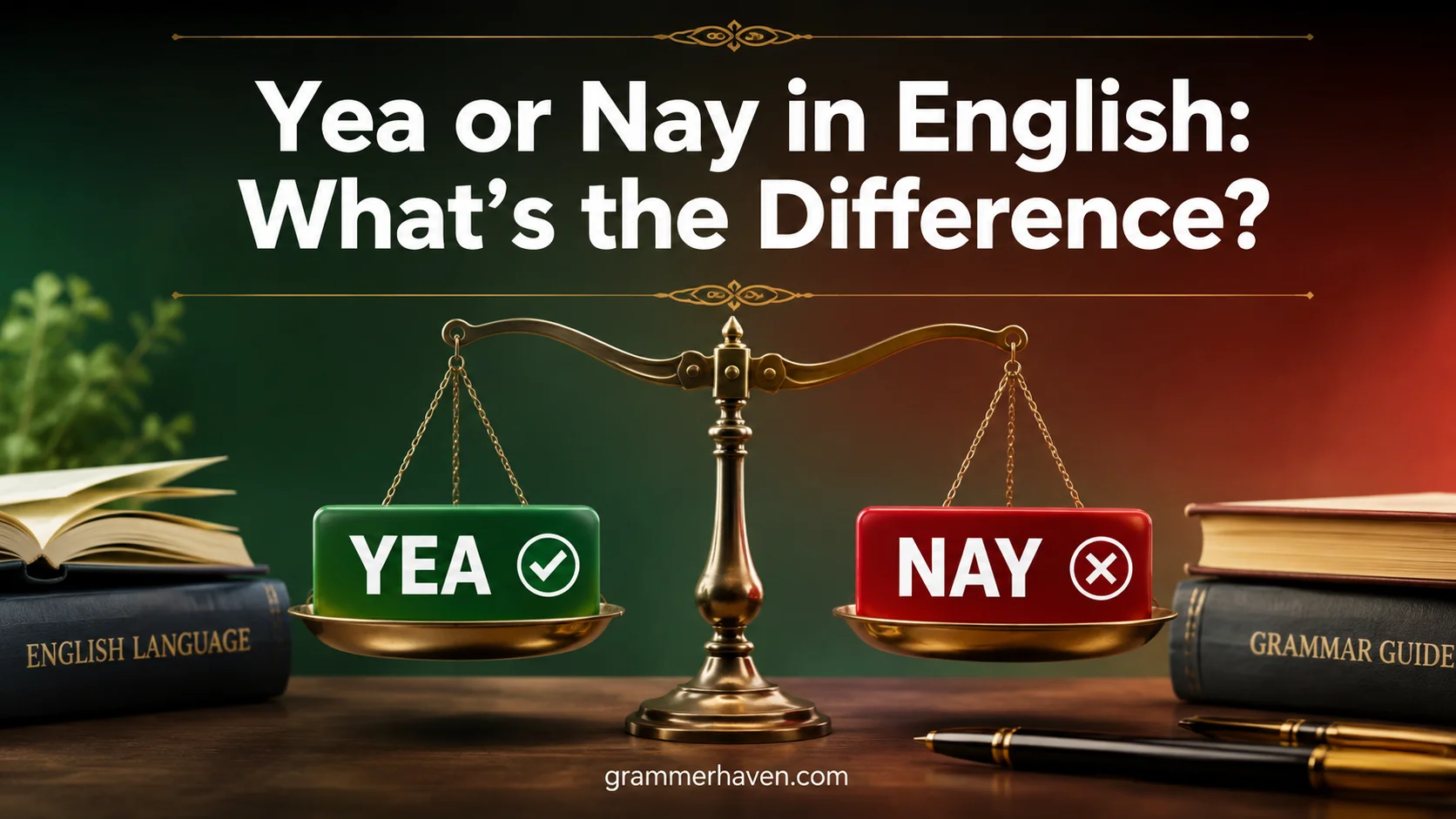
The phrase “yea or nay” means “yes or no.” It asks someone to choose between approval and rejection.
The phrase usually appears when someone needs a definite decision.
| Word | Meaning | Purpose |
| Yea | Yes, approve, agree | Shows support or acceptance |
| Nay | No, reject, disagree | Shows opposition or refusal |
| Yea or nay | Yes or no decision | Requests a clear choice |
Think of it like a traffic light:
- Yea is the green light. It means “go ahead.”
- Nay is the red light. It means “stop.”
The phrase removes uncertainty. Instead of asking someone to explain their thoughts, it asks them to choose a side.
Examples:
- “Should we launch the new product? Yea or nay?”
- “The board members must give a yea or nay vote.”
- “Is this idea worth pursuing? Give me a yea or nay.”
What Does Yea Mean?
Yea means yes, approval, agreement, or support.
Today, you will mostly see “yea” in formal situations, especially voting. When a person votes “yea,” they support the proposal being discussed.
Examples:
- “The senator voted yea on the bill.”
- “Five members voted yea, while two voted nay.”
- “The proposal received enough yea votes to pass.”
Although “yea” means yes, it does not always sound natural in everyday conversation.
You probably would not say:
“Yea, I would like a coffee.”
Most people would simply say:
“Yes, I’d like a coffee.”
The word “yea” carries a formal or old-fashioned tone.
What Does Nay Mean?
Nay means no, rejection, disagreement, or refusal.
Like “yea,” it appears most often in official votes and formal discussions.
Examples:
- “The proposal failed after receiving more nay votes.”
- “The committee members were asked to vote yea or nay.”
- “Three representatives voted nay against the amendment.”
In normal conversation, “nay” can sound dramatic or humorous.
For example:
“Should we order another pizza?”
Someone might jokingly answer:
“Nay! We have eaten enough.”
The person means “no,” but the word creates a playful, old-fashioned effect.
Yea or Nay Meaning in Simple Terms
The easiest way to understand yea or nay is:
Yea or nay = Yes or no = Approve or reject
Here is a quick comparison:
| Phrase | Simple Meaning | Example |
| Yea | Yes | “I support this idea.” |
| Nay | No | “I disagree with this idea.” |
| Yea or nay | Choose one | “Do you approve or reject it?” |
The phrase works best when a decision needs a direct answer.
For example, a manager might ask:
“Should we hire another employee? I need a yea or nay.”
The manager is not asking for a long debate. They want a decision.
Where Did “Yea or Nay” Come From?
The history of yea or nay goes back hundreds of years.
The words yea and nay developed from Old English. They became common ways to express agreement and disagreement before modern words like “yes” and “no” became dominant.
During earlier periods of English, people used different words depending on the question being asked.
For example:
- Yea often confirmed a positive statement.
- Nay often rejected or contradicted something.
Over time, these words became strongly connected with voting systems.
Yea and Nay in Government Voting
One of the biggest reasons the phrase survived is its connection to government and official decisions.
Many legislative bodies still use “yea” and “nay” when recording votes.
A typical voting process looks like this:
Proposal Introduced
↓
Discussion and Debate
↓
Members Cast Votes
↓
Yea = Support
Nay = Opposition
↓
Votes Are Counted
↓
Decision Announced
For example:
A committee considers a new policy.
- 8 members vote yea.
- 3 members vote nay.
The policy passes because more members supported it.
The words create a clear public record. Anyone reviewing the vote can immediately understand who supported or opposed the decision.
Yea vs Yes: What Is the Difference?
Many people assume yea and yes are interchangeable. While they share a similar meaning, they have different uses.
Yea
- Formal.
- Often used in voting.
- Sounds traditional.
- Appears in official records.
Example:
“The motion passed with 20 yea votes.”
Yes
- Common everyday word.
- Works in almost every situation.
- Sounds natural in casual conversations.
Example:
“Yes, I can help you.”
Here is the difference:
| Situation | Better Choice |
| Ordering food | Yes |
| Answering a friend | Yes |
| Voting on a proposal | Yea |
| Official meeting record | Yea |
A simple way to remember:
Yes is conversational. Yea is ceremonial.
Nay vs No: What Is the Difference?
The difference between nay and no works the same way.
Nay
Used mainly for:
- Voting.
- Formal disagreements.
- Historical writing.
- Dramatic expression.
Example:
“The motion received ten nays.”
No
Used everywhere.
Examples:
- “No, I’m busy.”
- “No, that’s not correct.”
- “No, thank you.”
The word “no” feels natural because modern English has moved away from many older terms.
How to Use Yea or Nay in a Sentence
The phrase can appear in different situations.
Formal Examples
“The board must decide yea or nay before approving the merger.”
“Members were called upon to cast their yea or nay votes.”
“The committee requested a yea or nay response from each participant.”
Workplace Examples
In professional settings, the phrase can make a decision sound structured and clear.
Examples:
“Please send your yea or nay by Friday afternoon.”
“We need a final yea or nay before investing additional resources.”
“The leadership team gave the proposal a unanimous yea.”
Casual Examples
Although formal, people sometimes use the phrase for humor.
Examples:
“New restaurant downtown? Yea or nay?”
“Movie night with this film? Give me your yea or nay.”
“Is this outfit a yea or nay?”
In casual use, the phrase often adds personality.
Is Yea or Nay Still Used Today?
Yes. Although it sounds old-fashioned, people still use yea or nay in many areas.
Common Modern Uses
Government
Officials use yea and nay votes to record decisions.
Business
Companies use the phrase when asking for approval.
Legal Settings
Lawyers and judges may use similar formal language.
Online Discussions
People use “yea or nay” in polls and social media conversations.
Example:
“New logo design: yea or nay?”
The phrase remains popular because it is short, clear, and memorable.
Why Does “Yea or Nay” Remain Popular?
Several reasons explain why this phrase continues to survive.
It Creates a Clear Choice
People often avoid making decisions. “Yea or nay” encourages a direct answer.
It Sounds Authoritative
The phrase carries a sense of seriousness.
Compare:
- “What do you think?”
- “Yea or nay?”
The second question feels more decisive.
It Adds Personality
In casual settings, the phrase can make a simple question more interesting.
Instead of:
“Do you like this?”
Someone might say:
“Yea or nay?”
It feels more playful.
Common Mistakes When Using Yea or Nay
Many people misuse these words because several similar-sounding terms exist.
Mistake: Confusing Yea With Yeah
These words sound similar but have different meanings.
Yea
Means:
- Yes.
- Approval.
- Agreement.
Example:
“The vote was yea.”
Yeah
Means:
- A casual form of yes.
Example:
“Yeah, I’ll join you.”
Remember:
Yea belongs in voting. Yeah belongs in conversation.
Mistake: Confusing Yea With Yay
This is one of the most common errors.
Yea
Means approval.
Example:
“The members voted yea.”
Yay
Shows excitement or happiness.
Example:
“Yay! We won the game.”
A simple trick:
- Yea = yes
- Yay = excitement
Mistake: Using Nay Too Often
Using “nay” in everyday conversation can sound unusual.
For example:
Normal:
“No, I don’t want dessert.”
Dramatic:
“Nay, I shall refuse the dessert.”
The second sentence sounds like something from a historical play.
That does not mean it is wrong. It simply changes the tone.
Yea or Nay vs Yay or Nay
Many people write “yay or nay” when they mean “yea or nay.”
Here is the difference:
| Phrase | Meaning | Example |
| Yea or nay | Yes or no decision | “Vote yea or nay.” |
| Yay or nay | Informal opinion | “Is this outfit yay or nay?” |
Technically, yea or nay is the traditional phrase.
However, yay or nay has become common online because people use “yay” to mean something they like.
Is Yea or Nay Formal or Informal?
The phrase can work in both settings.
Formal Settings
Use it for:
- Voting.
- Business approvals.
- Government decisions.
- Official discussions.
Example:
“The committee will announce the yea or nay decision tomorrow.”
Informal Settings
Use it when you want a playful tone.
Example:
“Chocolate cake recipe: yea or nay?”
The context determines whether it sounds professional or humorous.
Real-Life Examples of Yea or Nay
Business Example
A company considers opening a new office.
The CEO asks:
“Should we expand into another city? I need a yea or nay from the leadership team.”
The phrase works because the company needs a final decision.
Group Decision Example
Friends plan a weekend trip.
Someone asks:
“Beach vacation this summer? Yea or nay?”
Nobody needs a formal vote. The phrase simply makes the decision fun.
Government Example
A law proposal reaches a vote.
Members respond:
- “Yea” to support it.
- “Nay” to oppose it.
The final count determines whether the proposal passes.
See also: Happy New Year or Happy New Years: Which Is Correct?
FAQs:
1. What does “yea or nay” mean?
“Yea or nay” means yes or no. Yea shows agreement, approval, or acceptance, while nay shows disagreement, rejection, or refusal.
2. Is “yea” the same as “yay”?
No. Yea means yes or agreement, while yay expresses excitement or happiness. They may sound similar, but they have different meanings and uses.
3. Is “yea” the same as “yeah”?
Not exactly. Yeah is an informal way to say yes, while yea is more formal, traditional, or associated with voting and official decisions.
4. What does “nay” mean?
Nay means no or disagreement. You may see it in formal voting, traditional expressions, or writing that uses an older style of English.
5. What is the difference between “nay” and “neigh”?
Nay means no, while neigh refers to the sound a horse makes. They are homophones, which means they sound alike but have different meanings and spellings.
6. Is “yea or nay” grammatically correct?
Yes. Yea or nay is a correct expression when asking someone to choose between approval and rejection. For example, “Give me your yea or nay on the proposal.”
7. When should you use “yea” and “nay”?
Use yea and nay when you want to express agreement or disagreement, especially in formal, traditional, or voting-related situations.
8. Why do people confuse “yea,” “yay,” and “yeah”?
People often confuse these words because they have similar sounds. Their meanings are different, though. Yea means yes, yay expresses excitement, and yeah is an informal form of yes.
9. Are “yea” and “nay” still used today?
Yes. Although they aren’t as common in everyday spoken English, you can still encounter yea and nay in voting, formal writing, historical contexts, and expressions such as “yea or nay.”
10. How can I remember the difference between “yea,” “yay,” and “nay”?
A simple way to remember them is: yea = yes, nay = no, and yay = excitement. Keeping these basic meanings separate can prevent common spelling and usage mistakes.
Conclusion:
Yea or nay is a straightforward expression meaning yes or no. Yea indicates agreement or approval, while nay indicates disagreement or rejection. Although these words may seem old-fashioned in everyday English, they remain useful in formal decisions, voting, and traditional expressions.
Remember that yea, yay, yeah, and nay aren’t interchangeable. Yea means yes, yay expresses excitement, yeah is an informal yes, and nay means no. Understanding these differences makes your spelling, word choice, and overall English usage clearer.