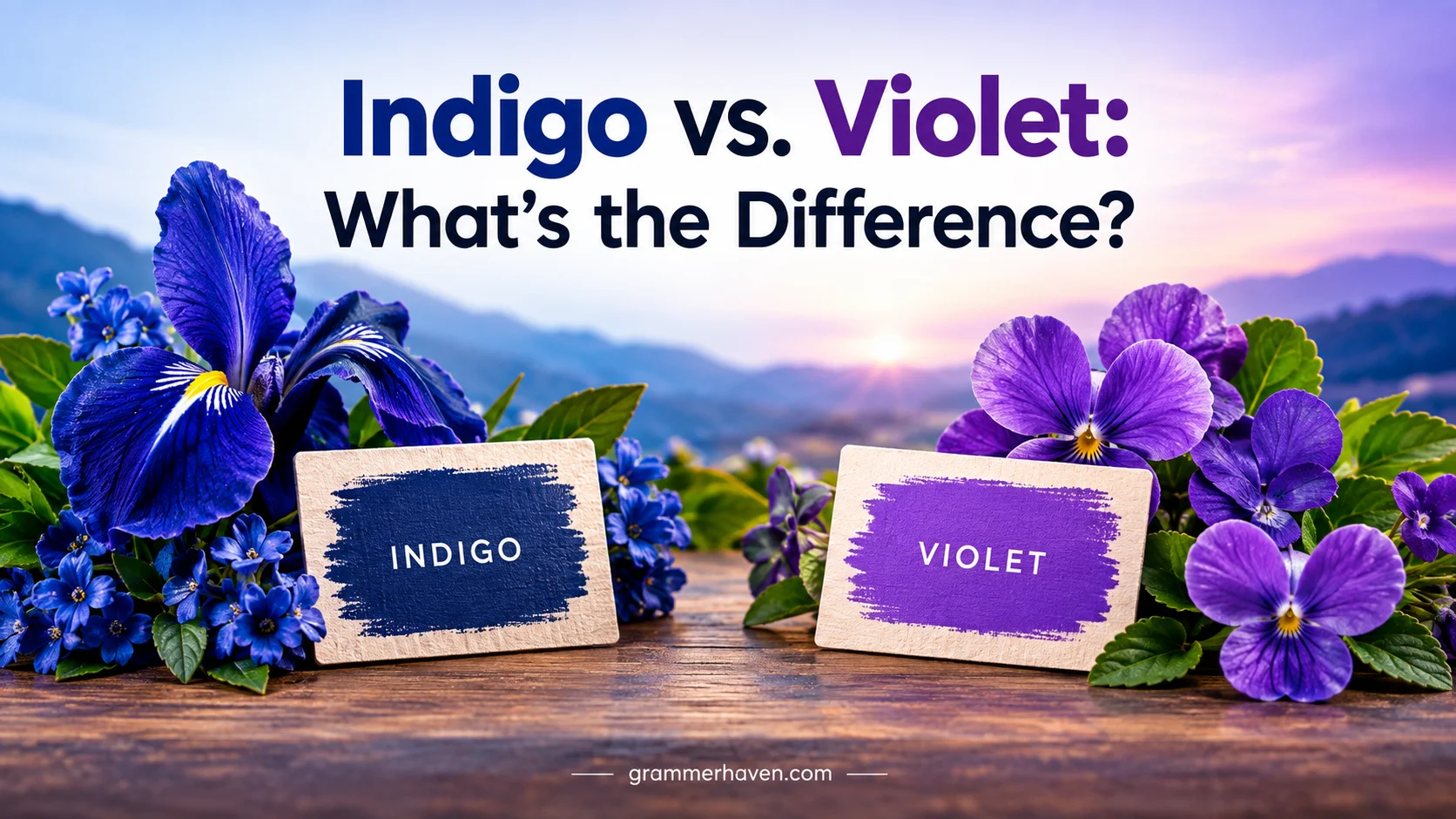
Indigo vs. Violet: What’s the Difference? compares two nearby colors that can look alike, while their scientific meanings and light positions differ. Indigo is commonly seen as a deep blue-violet shade positioned between blue and violet. Violet belongs to the shorter-wavelength side of visible light. Lighting can make both colors appear nearly identical, which creates confusion in everyday descriptions.
The terms purple, blue-violet, indigo, and violet can overlap in ordinary speech, art, and design. Scientific terminology uses more specific ideas based on wavelength and visible radiation. The International Commission on Illumination (CIE) does not define one exact lower or upper boundary for visible radiation. Perception varies with the observer and the amount of radiation reaching the retina. A color wheel gives a useful visual guide, but it does not capture every scientific distinction between these shades.
Indigo vs. Violet: Quick Answer
Indigo is generally a deep blue-violet color that sits between blue and violet in the traditional visible-spectrum sequence. Violet is the color at the short-wavelength end of visible light.
In a traditional rainbow, the order is:
Red → Orange → Yellow → Green → Blue → Indigo → Violet
Violet has a shorter wavelength and higher frequency than the longer-wavelength colors toward the red end. Light’s wavelength and frequency move in opposite directions. As wavelength decreases, frequency increases.
| Feature | Indigo | Violet |
| General appearance | Deep blue-violet | Violet or blue-purple |
| Traditional spectrum position | Between blue and violet | At the violet end |
| Wavelength | Commonly placed around the low-400-nm region | Commonly placed around the high-300s to low-400s nm |
| Relation to blue | Usually appears more blue | Usually appears less blue |
| Relation to purple | Can resemble blue-purple | Often resembles purple, but isn’t identical to purple |
| Traditional rainbow | Included in ROYGBIV | Included in ROYGBIV |
| Scientific boundary | Not universally fixed | Not universally fixed |
The important point is that color names are categories, while visible light exists as a continuous range of wavelengths. There isn’t a physical wall where blue suddenly ends and indigo begins.
What Is Indigo?
Indigo Definition
Indigo is a deep blue-violet color traditionally placed between blue and violet. It is especially familiar from the traditional seven-color description of the rainbow.
The word also has a strong connection to indigo dye, which has been used for centuries to color textiles. That connection makes indigo somewhat unusual because the word can describe both a color and a historically important dye.
When people picture indigo, they often imagine a shade deeper than ordinary blue but not as distinctly violet as many violet shades.
Think of the progression as a gradual slide:
Blue → blue-violet → indigo → violet
That isn’t a strict scientific scale. It simply helps explain why the colors can be difficult to separate visually.
What Does Indigo Look Like?
Indigo usually appears dark, rich, and blue-heavy compared with violet.
However, the exact appearance depends on the color system, material, lighting, and surrounding colors. A fabric called indigo might look strongly blue in daylight and noticeably more purple under another light source.
This happens because perceived color depends on more than one factor. The CIE explains that perceived color can depend on the light stimulus, the size and surroundings of the colored area, the observer’s visual adaptation, and previous visual experience.
So when someone says, “That looks blue, not indigo,” they aren’t necessarily contradicting a scientific definition. They may simply be responding to the particular shade and viewing conditions.
Indigo as a Dye
Indigo dye is a material colorant traditionally associated with deep blue textiles. Denim is one of the most familiar modern examples of indigo-colored fabric.
This distinction is important because an indigo-colored object doesn’t need to produce one single wavelength of light. When you look at a colored surface, the light reaching your eyes depends on the illumination and which parts of that light the material absorbs or reflects.
That is very different from looking directly at a source of nearly monochromatic light.
What Is Violet?
Violet Definition
Violet is the short-wavelength color traditionally located at the end of the visible spectrum next to ultraviolet radiation.
It has a shorter wavelength than blue and therefore a higher frequency. The visible spectrum extends toward ultraviolet beyond violet and toward infrared beyond red.
A commonly used simplified description puts violet roughly around 380–450 nanometers, although the exact range varies by source and by how the spectrum is divided.
The CIE gives an important scientific qualification: visible radiation doesn’t have one exact boundary. Its lower limit is generally taken somewhere between about 360 and 400 nm, while the upper limit is commonly placed between about 760 and 830 nm, depending on conditions and the observer.
So it would be misleading to claim that violet begins at one universally agreed wavelength.
What Does Violet Look Like?
Violet generally looks more violet and less blue than indigo.
A bright violet can appear distinctly purple to the eye. A darker violet may look closer to blue-violet. Once again, brightness and surrounding colors can change what you perceive.
There’s another important distinction here: spectral violet isn’t exactly the same thing as purple.
That difference often gets lost in everyday language.
Indigo vs. Violet on the Visible Spectrum
Where Does Indigo Appear?
In the traditional ROYGBIV sequence, indigo comes after blue and before violet.
Many educational diagrams place indigo in a region somewhere around the 420–450 nm area. Other references use narrower or different boundaries.
That variation isn’t necessarily an error. The visible spectrum is continuous, so dividing it into named sections requires human classification.
The Physics Classroom, for example, presents the visible spectrum as a sequence of colors associated with wavelength and shows violet toward approximately the 400-nm region.
The practical takeaway is more useful than memorizing one exact cutoff:
Indigo occupies the blue-violet transition region, while violet sits farther toward the short-wavelength end.
Where Does Violet Appear?
Violet occupies the shorter-wavelength side of the visible spectrum.
As you travel from red toward violet, wavelength decreases. Frequency increases. Energy also increases because photon energy is related to frequency.
The relationship can be summarized as:
Longer wavelength → lower frequency → lower photon energy
Shorter wavelength → higher frequency → higher photon energy
That makes violet more energetic than red light within the visible spectrum.
Why Are the Wavelength Ranges Different?
This is one of the most important details in the entire indigo vs. violet discussion.
You may encounter different wavelength ranges in different books, websites, and diagrams. That’s because color categories don’t have perfectly sharp physical borders.
The CIE’s definition of visible radiation makes this especially clear. It doesn’t assign one universal pair of boundaries to human-visible light because the visual response depends on conditions and the observer.
The same principle applies when people divide the visible spectrum into named colors.
The spectrum is continuous. The labels are human categories.
Indigo vs. Violet: Color and Appearance
Which Color Is More Blue?
Indigo is generally more blue than violet.
That’s the easiest practical distinction to remember.
If two shades are close together and one has a stronger blue character while the other looks more distinctly violet, the bluer one will usually be described as indigo.
For example:
- A deep denim-like blue may be called indigo.
- A bright blue-violet flower may be called violet.
- A shade between the two might reasonably receive either label depending on the context.
Which Color Is More Purple?
Violet generally looks more purple or violet than indigo.
However, saying that violet is simply “purple” creates another problem. Purple and violet have different scientific meanings.
Violet can correspond to a region of the visible spectrum. Purple, by contrast, isn’t represented by a single spectral wavelength. The CIE specifically describes purple as a hue that isn’t represented among the hues of the spectrum.
That distinction is easy to miss because everyday language often treats the words as interchangeable.
Is Indigo Darker Than Violet?
Indigo often appears darker than violet in common color palettes. However, darkness isn’t an inherent rule that applies to every possible indigo and violet sample.
A color’s appearance involves attributes such as hue, brightness or lightness, and colorfulness. The CIE notes that perceived color depends on several visual conditions rather than hue alone.
So this statement is safer:
Indigo is often represented as darker and bluer than violet, but neither color has one mandatory brightness level.
Indigo vs. Violet vs. Purple
This three-way comparison clears up much of the confusion.
Is Purple the Same as Violet?
No. Purple and violet are related, but they aren’t technically identical.
Spectral violet can be produced by light from a particular region of the visible spectrum. Purple isn’t represented by one single wavelength in the same way.
The CIE defines a purple stimulus in relation to the region between the two ends of the spectrum on a chromaticity diagram.
In everyday language, however, people use “purple” broadly for many reddish-blue, blue-purple, and violet-looking shades.
That’s why a color that one person calls violet might be called purple by another.
Indigo vs. Violet vs. Purple Comparison
| Characteristic | Indigo | Violet | Purple |
| Basic appearance | Deep blue-violet | Violet-blue | Red-blue or violet-like |
| Single spectral wavelength? | Used as a spectrum label | Yes, spectral violet exists | No |
| Traditional spectrum | Yes | Yes | No |
| Main visual association | Blue-violet | Violet | Red-blue |
| Common confusion | Blue or purple | Purple or indigo | Violet or magenta |
| Common use | Dye, textiles, color descriptions | Spectrum, flowers, art | Art, fashion, design |
The biggest scientific distinction is simple:
Violet can refer to spectral light. Purple describes a nonspectral color family.
Indigo vs. Violet in the Rainbow
Is Indigo Really a Rainbow Color?
In the traditional ROYGBIV model, yes.
The sequence divides the rainbow into seven named colors:
Red → Orange → Yellow → Green → Blue → Indigo → Violet
Educational materials commonly use this seven-color sequence to describe the visible spectrum.
But a rainbow doesn’t actually contain seven isolated strips separated by invisible borders.
A rainbow displays a continuous spread of wavelengths. Human beings then attach names to portions of that continuum.
Why Does the Rainbow Have Seven Colors?
The seven-color tradition is historically associated with Isaac Newton’s description of the spectrum.
The number seven is therefore partly a classification choice rather than evidence that visible light naturally breaks into exactly seven independent bands.
This explains why modern diagrams sometimes make indigo prominent while other representations barely distinguish it from blue or violet.
The physics hasn’t changed. The labeling system has.
Why Some Rainbows Seem to Have No Indigo
Look at a real rainbow and you may notice a strong blue region followed by violet. The indigo band can be difficult to identify.
That’s perfectly understandable.
The wavelengths blend continuously. There isn’t a narrow black line saying, “Indigo starts here.”
The distinction also depends on visual conditions. Perceived color depends partly on the surrounding stimulus, the observer’s visual adaptation, and other factors.
Indigo vs. Violet in Light and Pigments
Indigo as Light vs. Indigo as a Dye
This distinction is crucial.
A spectral color refers to light associated with a particular wavelength region. A pigment or dye color results from how a material interacts with incoming light.
When white light reaches a colored object, the material absorbs some wavelengths and reflects others toward your eyes. The reflected light then contributes to the color you perceive.
That means an indigo fabric isn’t simply “emitting indigo wavelength.”
It is interacting with illumination in a more complicated way.
Violet Light vs. Violet Pigment
The same principle applies to violet.
A source emitting violet light can produce a spectrum concentrated in the violet region. A violet-painted surface, however, gets its appearance from reflected light.
This is why light colors and pigment colors shouldn’t be treated as identical systems.
A screen, a painted wall, a dyed shirt, and a rainbow can all appear violet-like while producing very different physical light distributions.
Indigo vs. Violet in Different Color Systems
Indigo and Violet on Digital Screens
Digital displays use combinations of red, green, and blue light to create a huge range of perceived colors.
A screen’s “indigo” isn’t necessarily a single wavelength of indigo light. Instead, the display produces a particular mixture of red, green, and blue intensities that your visual system interprets as a particular color.
The human visual system uses three broad classes of cone photoreceptors with different wavelength sensitivities. Signals from these receptors contribute to the brain’s perception of color.
So a digital indigo swatch and a spectral indigo-looking light don’t have to contain identical physical wavelengths.
Indigo and Violet in Traditional Art
Artists often use color-wheel relationships rather than wavelength measurements.
Paint mixing also behaves differently from mixing light. Combining pigments removes portions of the incident light through absorption. Combining light sources adds their emitted light.
That’s why the statement “mix blue and red and you get exactly spectral violet” is too simplistic.
The result depends on the specific pigments, their spectral properties, proportions, illumination, and the viewing environment.
Why Hex Codes Don’t Settle the Debate
A hex color code identifies a digital RGB color.
It doesn’t establish a universal scientific definition of “indigo.”
For example, two websites can use different RGB values for indigo while both labels remain understandable to their audiences.
That’s because named colors are not always standardized with one universal digital value.
How Human Eyes Perceive Indigo and Violet
Why Indigo Can Be Hard to Distinguish
Indigo sits in a visually challenging neighborhood.
Blue transitions toward violet gradually. There isn’t a sudden jump between them. As a result, a shade near the boundary can look blue to one observer and violet to another.
The CIE describes perceived color as dependent on the spectral distribution of the stimulus as well as factors such as the surrounding area and the observer’s visual adaptation.
This is why online color comparisons can sometimes create more confusion than clarity.
Why Surrounding Colors Change What You See
Place a blue-violet color next to a strong blue background and it may look more violet.
Place the same shade next to purple and it may suddenly appear more blue.
This is a classic example of color contrast.
Your visual system doesn’t judge every color in isolation. It interprets visual information in context.
Simple Example
Imagine two identical indigo squares.
- Put one against a bright blue background.
- Put the other against a deep purple background.
- The squares are physically identical.
- Yet they may appear noticeably different.
The surrounding colors influence perception even though the central color hasn’t changed.
Indigo vs. Violet in Real Life
Indigo dye is closely associated with deep blue fabrics, especially denim. When someone describes jeans as indigo, they generally mean a rich, dark blue shade rather than a bright violet.
Fabric also introduces another variable: texture.
A smooth surface reflects light differently from a rough or woven surface. Fading, washing, artificial lighting, and nearby colors can all alter the way indigo appears.
Violet in Nature
Violet appears frequently in descriptions of flowers and other natural objects.
The word can describe a visible appearance without implying that the object reflects one pure wavelength.
For example, a flower described as violet doesn’t need to reflect only spectral violet. Its color can result from a complex mixture of wavelengths reaching the eye.
That’s an important distinction between color naming and spectral analysis.
Indigo and Violet in Art and Design
Designers use indigo and violet to create different visual impressions.
Indigo often occupies a space between strong blue and purple. Violet can push farther toward the purple end.
Neither choice is automatically “better.” The right shade depends on the surrounding palette, lighting, contrast, and purpose.
For a clean comparison, consider:
| Design goal | Often suitable |
| Deep blue appearance | Indigo |
| Blue-violet transition | Indigo |
| Strong violet appearance | Violet |
| Purple-focused palette | Violet or purple |
| Denim-inspired palette | Indigo |
| Rainbow/spectrum discussion | Violet and indigo |
Common Misconceptions About Indigo and Violet
“Indigo Is Just Dark Purple”
Not quite.
Indigo is traditionally positioned closer to blue, although it can contain a noticeable violet character.
Calling every dark purple shade “indigo” removes the distinction that makes the term useful.
“Violet and Purple Are Exactly the Same”
They aren’t.
In ordinary speech, people often use the terms interchangeably. Scientifically, however, spectral violet and nonspectral purple have different meanings. The CIE explicitly treats purple as a hue outside the spectral hues.
“Indigo Has One Exact Wavelength”
This is another oversimplification.
Color boundaries depend on the classification system. Visible radiation itself doesn’t have perfectly fixed limits, according to the CIE.
So a single number shouldn’t be presented as the unquestionable beginning or end of indigo.
“Everyone Sees Indigo the Same Way”
Human color perception isn’t that simple.
Lighting, surroundings, visual adaptation, display settings, and individual differences can affect how a color appears.
“ROYGBIV Proves Indigo Is a Separate Physical Band”
ROYGBIV is a useful educational model. It doesn’t mean that nature divides the visible spectrum into seven hard-edged sections.
The spectrum remains continuous.
The names are convenient labels placed over that continuum.
Indigo vs. Violet: Which One Should You Use?
Use “Indigo” When…
Use indigo when you’re describing a deep blue-violet shade, especially one with a strong blue character.
Examples include:
- Indigo jeans
- Indigo dye
- An indigo-blue fabric
- The indigo region in a traditional rainbow diagram
- A deep blue-violet paint color
Example
The designer chose an indigo background instead of a bright violet one.
Here, indigo suggests a deeper and bluer shade.
Use “Violet” When…
Use violet when you’re referring to the short-wavelength end of the visible spectrum or a color that clearly appears violet.
Examples include:
- Violet light
- The violet end of the visible spectrum
- Violet flowers
- A violet-colored design
- Violet radiation near the visible/ultraviolet boundary
Example
Violet has a shorter wavelength than the longer-wavelength colors toward the red end of the visible spectrum.
Use “Purple” When…
Use purple when you’re talking about the broader red-blue color family rather than a specific spectral color.
This is particularly useful in everyday descriptions where scientific wavelength distinctions aren’t important.
Indigo vs. Violet Examples
Example Sentences With Indigo
- The artist used indigo to create a deep blue-violet background.
- Her jacket had an indigo shade that looked almost purple under warm lighting.
- Indigo dye has a long history in textile coloring.
- The traditional rainbow sequence places indigo between blue and violet.
Example Sentences With Violet
- The lamp produced a strong violet light.
- The flower has delicate violet petals.
- Violet lies at the short-wavelength end of the visible spectrum.
- The painting uses several shades of violet and blue.
Indigo vs. Violet in a Sentence
Compare these:
The wall is indigo.
This suggests a deep blue-violet shade.
The wall is violet.
This suggests a more distinctly violet appearance.
The wall is purple.
This gives a broader description without making the same spectral distinction.
Indigo vs. Violet: Key Facts
Here are the most useful facts to remember:
- Indigo is traditionally positioned between blue and violet.
- Violet occupies the short-wavelength end of visible light.
- Violet has a shorter wavelength than indigo in the traditional spectrum model.
- Shorter wavelength means higher frequency.
- Purple isn’t a single spectral wavelength.
- The visible spectrum is continuous rather than divided into seven hard boundaries.
- ROYGBIV is a traditional way of labeling visible-spectrum colors.
- Indigo is strongly associated with indigo dye and textiles.
- Color perception depends on lighting, surroundings, the stimulus, and the observer.
- There is no universally fixed wavelength boundary for every named color category.
See also: Too or To: What’s the Difference and How to Use Them Correctly?
FAQs:
Is indigo darker than violet?
Indigo is often represented as darker than violet, but darkness isn’t a defining scientific property of indigo. A color’s perceived brightness depends on the actual color, lighting, display, and surroundings.
Is indigo closer to blue or purple?
Indigo is generally closer to blue. It is commonly described as a deep blue-violet shade.
Is violet a shade of purple?
In everyday language, people often describe violet as a type of purple. Scientifically, however, spectral violet and purple aren’t identical concepts. Purple isn’t represented by a single wavelength in the visible spectrum.
Is indigo a real color in the rainbow?
Yes. Indigo is part of the traditional ROYGBIV description of the rainbow. However, the rainbow itself is a continuous spectrum rather than seven sharply separated bands.
Which has a shorter wavelength, indigo or violet?
Violet has the shorter wavelength in the traditional spectrum classification.
Shorter wavelengths also correspond to higher frequencies.
Are indigo and violet the same color?
No. They are neighboring color categories. Indigo generally appears more blue, while violet generally appears more distinctly violet.
Why do indigo and violet look similar?
They sit close together in the visible spectrum. Their hues therefore transition gradually rather than changing abruptly.
Lighting and surrounding colors can make the difference even harder to see.
What is the difference between violet and purple?
Violet can refer to a spectral color, while purple is a nonspectral color family. The CIE specifically identifies purple as a hue that isn’t represented among the spectral hues.
Does indigo have an exact wavelength?
Not one universally accepted wavelength boundary.
Different references divide the visible spectrum differently. The underlying spectrum remains continuous.
Which color comes first, indigo or violet?
In the traditional rainbow sequence, indigo comes before violet:
Blue → Indigo → Violet
Conclusion:
The difference between indigo vs. violet comes down to their position, appearance, and relationship to visible light. Indigo is traditionally described as a deep blue-violet color between blue and violet, while violet sits at the shorter-wavelength end of the visible spectrum.
Although the two colors can look very similar, indigo generally appears bluer and deeper, while violet usually looks more distinctly violet. Their boundaries aren’t perfectly fixed because the visible spectrum forms a continuous range rather than separate blocks of color.
It’s also important not to confuse violet with purple. Violet can refer to a spectral color, whereas purple describes a broader nonspectral color family. In everyday use, however, these terms often overlap.