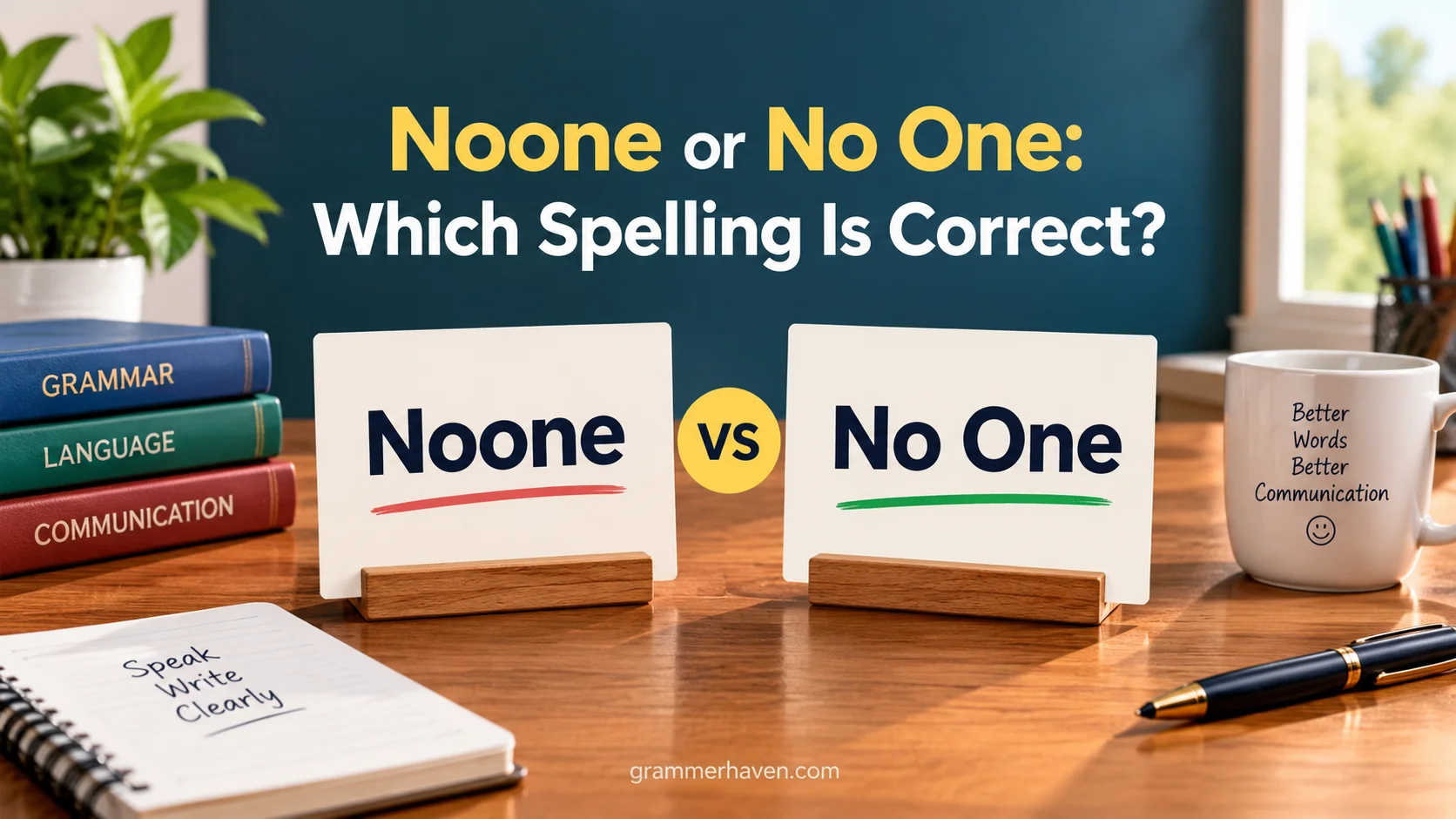
Noone or No One raises a spelling, usage, and context issue in English: No One is the correct spelling in standard US English for no person or not any person, while Noone is nonstandard.
No One works as an indefinite pronoun, matching the pattern of someone, anyone, and everyone, but standard English grammar keeps it as two words. Cambridge Dictionary lists no one as the standard dictionary form, with the definition referring to no person. No-one is a hyphenated version found in British English, while US English generally uses no one as the clearest choice. Noone should be avoided in formal writing, academic writing, professional writing, and edited writing.
Personally, I see No One as the practical choice because readers recognize the established written English form. Logical reasoning, linguistic perspective, argument, counterargument, preference, opinions, other people’s opinions, and attempts to change my mind or change others’ minds don’t alter the standard rule. Umlauts, noöne, accent, accentuating, word, meaning, different meaning, not one, posting, hear, people, topic, issue, terminology, correct, incorrect, alternative, feel, and encounter don’t change the accepted form.
Noone or No One: Quick Answer
No one is the correct standard spelling in US English.
| Spelling | Standard US English? | Meaning | Recommendation |
| no one | ✅ Yes | No person | Use it |
| noone | ❌ No | Intended to mean “no person” | Avoid it |
| no-one | ⚠️ Regional/variant | No person | Use no one in US English |
So, if you’re writing a sentence such as:
No one knows the answer.
you should keep no and one separate.
Not:
❌ Noone knows the answer.
And generally not:
❌ No-one knows the answer.
The standard form is no one. Cambridge’s grammar guidance specifically states that the phrase is written as “no one” or, in some usage, “no-one,” but not “noone.”
What Does “No One” Mean?

No one means “no person,” “not any person,” or “nobody.”
It refers exclusively to people.
For example:
- No one called me yesterday.
- No one knows what happened.
- There was no one in the office.
- No one wanted to leave early.
- No one answered the door.
In each sentence, no one identifies an absence of people.
Consider this sentence:
No one came to the meeting.
The sentence doesn’t mean that a particular person stayed away. It means not a single person came.
Cambridge classifies no one as an indefinite pronoun, along with words such as nobody, nothing, and nowhere.
Why “No One” Refers to People
English uses different indefinite pronouns depending on what you’re talking about.
| Pronoun | Refers to | Example |
| someone | An unspecified person | Someone called. |
| anyone | Any person | Did anyone call? |
| everyone | All people | Everyone arrived. |
| no one | No person | No one arrived. |
| something | An unspecified thing | Something happened. |
| anything | Any thing | Did anything happen? |
| nothing | No thing | Nothing happened. |
| everything | All things | Everything changed. |
This pattern makes noone look reasonable. Yet spelling patterns don’t always work like mathematical equations.
English is full of exceptions.
Why Is “No One” Written as Two Words?
The short answer is simple: standard English spelling treats “no one” as two words.
That may feel inconsistent because several similar indefinite pronouns appear as single words:
- someone
- somebody
- anyone
- anybody
- everyone
- everybody
- nobody
So why not noone?
Because English doesn’t require every related expression to share the same spelling structure. No one developed and remains standardized as a separate two-word expression.
The difference becomes especially noticeable when you compare these pairs:
| One word | Two words |
| someone | no one |
| somebody | no one |
| anyone | no one |
| everyone | no one |
| nobody | no one |
There’s no reliable rule saying that no + noun or pronoun must become one word.
For example, English writes:
- no one
- no problem
- no reason
- no idea
- no matter
The fact that someone is one word doesn’t automatically make noone acceptable.
Why “Noone” Looks So Natural
There’s a perfectly understandable reason people make this mistake.
When you learn:
someone → anyone → everyone
your brain naturally expects:
noone
The spelling even looks visually symmetrical.
However, familiarity isn’t the same as correctness. Noone appears in informal writing, online posts, messages, and other places where spelling often receives little editing. Its appearance in real-world text doesn’t make it the standard form.
Scribbr likewise identifies noone as an incorrect spelling that should be avoided.
Is “Noone” a Word?
Noone is not the standard spelling of the pronoun meaning “no person.”
You may still encounter it. People sometimes type noone because they assume it follows the same pattern as someone or anyone.
That doesn’t change the standard spelling.
For careful writing, choose no one.
This matters especially in:
- School assignments
- College papers
- Professional emails
- Business documents
- Resumes
- Articles
- Websites
- Academic writing
- Formal correspondence
A spelling mistake this small can be easy to overlook during casual writing. In polished content, though, it can make the writer appear less careful than intended.
Noone vs. No One Examples
Compare these sentences:
| Incorrect | Correct |
| ❌ Noone called me. | ✅ No one called me. |
| ❌ Noone was there. | ✅ No one was there. |
| ❌ Noone knows the answer. | ✅ No one knows the answer. |
| ❌ Noone understood the question. | ✅ No one understood the question. |
| ❌ Noone wanted to leave. | ✅ No one wanted to leave. |
The correction is remarkably simple.
Separate the words: no one.
Is “No-One” Correct?
This question requires a little more nuance.
No-one is a recognized hyphenated variant, especially in British English. Cambridge’s grammar reference lists both no one and no-one, while explicitly rejecting noone.
Other dictionaries also recognize the hyphenated form. Dictionary.com, for example, lists no-one as a variant and identifies no one as an American form.
For US English, however, the practical choice is straightforward:
Use “no one.”
That form is familiar, standard, and widely accepted.
So the distinction looks like this:
- No one → standard US English
- No-one → accepted variant, especially in British English
- Noone → nonstandard spelling
If your goal is consistent American English, there’s little reason to complicate things. Stick with no one.
How to Use “No One” in a Sentence
Once the spelling is clear, the grammar becomes fairly straightforward.
No one can function as the subject or object of a sentence.
No One as the Subject
When no one performs the action, it acts as the subject.
Examples:
No one knows the answer.
No one called after the meeting.
Here, no one tells you who performs the action: nobody.
No One as the Object
You can also use no one as the object of a verb.
Examples:
She told no one about the surprise.
He trusted no one with the information.
The witness recognized no one in the photograph.
In these sentences, another person performs the action, while no one receives it.
“No One Else” Is Correct
The expression no one else is also common.
It means no other person.
Examples:
- No one else knew about the plan.
- I wanted no one else to see the document.
- No one else could solve the problem.
- She said no one else had contacted her.
Cambridge specifically gives no one else as a normal construction meaning “no other person.”
Does “No One” Take a Singular Verb?

Yes.
This is one of the most important grammar rules to remember.
No one takes a singular verb.
For example:
✅ No one knows the answer.
Not:
❌ No one know the answer.
More examples:
| Incorrect | Correct |
| ❌ No one know what happened. | ✅ No one knows what happened. |
| ❌ No one are ready. | ✅ No one is ready. |
| ❌ No one have called. | ✅ No one has called. |
| ❌ No one were there. | ✅ No one was there. |
Why does this happen?
Although no one can describe zero people collectively, the pronoun itself is grammatically singular. Cambridge notes that no one, nobody, nothing, and nowhere take singular verbs.
Think of it this way:
No one = not a single person
That singular idea helps explain the verb agreement.
A Simple Test
Replace no one with nobody.
No one knows.
becomes:
Nobody knows.
You wouldn’t normally write:
Nobody know.
The same rule applies to no one.
Can You Use “They” After “No One”?
Yes.
Modern English commonly uses singular they when the gender of an individual isn’t known or isn’t relevant.
For example:
No one remembered where they had parked.
Here, they refers back to an unspecified person.
Another example:
No one should share their password with strangers.
The grammatical pattern can look strange at first because no one takes a singular verb while they is plural in form. English nevertheless uses singular they naturally for an unknown or unspecified individual.
Cambridge and the British Council both document this pattern with indefinite pronouns.
No One vs. Nobody: What’s the Difference?
In most situations, no one and nobody mean the same thing.
Both mean:
No person.
Compare:
No one answered the phone.
Nobody answered the phone.
The basic meaning doesn’t change.
The difference is mainly one of style and tone. Cambridge notes that nobody is somewhat less formal than no one and that no one is used more often in writing.
| Expression | Meaning | General feel |
| no one | No person | Neutral, often preferred in writing |
| nobody | No person | Slightly more conversational |
Neither form is inherently wrong.
For example:
Nobody was home.
sounds perfectly natural.
So does:
No one was home.
Choose the version that fits your tone.
No One vs. None: They Aren’t the Same
No one and none can look interchangeable because both express absence. They don’t work in exactly the same grammatical situations.
Use no one when you mean no person:
No one answered the question.
Use none when you mean not one or not any within an understood group or category:
None of the students answered the question.
Notice the difference.
The first sentence says not a single person answered.
The second identifies a particular group: the students.
Cambridge specifically warns against using none when the intended meaning is no one or nobody.
No One vs. None Examples
| Use | Example |
| No one for people generally | No one came to the party. |
| None of for a defined group | None of the guests came. |
| None for things | I had several options, but none worked. |
A useful rule is:
No one = no person.
None = not one or not any of a particular group or set.
No One vs. Anyone vs. Someone vs. Everyone

These words form a useful family of indefinite pronouns.
| Word | Meaning | Example |
| someone | An unspecified person | Someone called. |
| anyone | Any person | Did anyone call? |
| everyone | All people | Everyone called. |
| no one | No person | No one called. |
The distinction becomes easier when you imagine a room.
- Someone is in the room.
- Anyone could enter the room.
- Everyone is in the room.
- No one is in the room.
The meanings move in different directions even though the words look closely related.
The British Council includes someone, anyone, no one, and everyone among English indefinite pronouns.
No One and Double Negatives
Because no one already expresses a negative meaning, you need to be careful when combining it with another negative word.
For example:
❌ No one didn’t call.
This construction creates a confusing negative combination.
In standard English, the clearer sentence is:
✅ No one called.
Or:
✅ No one called me.
Another option is:
✅ I didn’t hear from anyone.
The British Council specifically advises against adding another negative with nobody, no one, or similar negative indefinite pronouns.
Compare These Sentences
No one came.
Meaning: Not a single person came.
I didn’t see anyone.
Meaning: I saw zero people.
Both are grammatically sound.
The problem arises when you unnecessarily combine negative elements:
❌ I didn’t see no one.
In standard US English, that construction is generally considered a double negative.
Common Mistakes With “No One”
The spelling itself causes the biggest problem, but several grammar mistakes appear alongside it.
Mistake: Writing “Noone”
❌ Noone helped me.
✅ No one helped me.
This is the central spelling issue.
Mistake: Using a Plural Verb
❌ No one know the answer.
✅ No one knows the answer.
Remember that no one takes a singular verb.
Mistake: Adding an Unnecessary Negative
❌ No one didn’t answer.
✅ No one answered.
✅ No one answered anything.
Negative indefinite pronouns already carry negative meaning.
Mistake: Confusing “No One” With “None”
❌ None was injured.
✅ No one was injured.
When you mean no person, no one is the better choice.
If you’re referring to a defined group, use none of:
None of the players were injured.
The exact verb choice with none can depend on what it refers to and the style of writing.
Why English Has “Someone” but Not “Noone”
This is probably the most frustrating part of the spelling.
English seems to offer a neat pattern:
some + one = someone
any + one = anyone
every + one = everyone
no + one = noone?
The pattern feels logical.
Unfortunately, English spelling isn’t a perfectly engineered system. Related expressions can develop different forms and conventions over time.
Consider these examples:
- someone
- somebody
- anyone
- anybody
- everyone
- everybody
- no one
- nobody
Notice that nobody exists as one word while no one remains two words.
That’s simply part of the structure of modern English.
A useful lesson emerges here: word formation and spelling don’t always follow perfect symmetry.
Easy Ways to Remember “No One”
If noone keeps sneaking into your writing, use one of these tricks.
Remember the Two-Word Rule
The simplest method wins:
No one = two words.
When you mean “no person,” separate no from one.
Use the “No Person” Test
Replace no one with no person.
No one answered.
becomes:
No person answered.
The meaning remains understandable.
That tells you you’re dealing with the two-word pronoun no one.
Don’t Let “Someone” Trick You
The fact that someone is one word doesn’t mean no one should be.
Memorize the pair:
someone → one word
no one → two words
That tiny distinction saves a surprising number of spelling errors.
“No One” in Everyday Writing
The phrase appears naturally in almost every type of English writing.
Casual Conversation
“No one told me we were leaving early.”
Text Messages
“No one is answering 😭”
Professional Writing
“No one from the department responded to the request.”
Academic Writing
“No one in the sample reported experiencing the same effect.”
Narrative Writing
“No one spoke for several minutes.”
The phrase itself isn’t overly formal or overly casual. Context determines the tone.
Noone or No One: Real-World Correction Examples
Here are several common sentences that need only one small correction.
| Common mistake | Correct version |
| Noone knows where she went. | No one knows where she went. |
| Noone was available. | No one was available. |
| Noone answered the question. | No one answered the question. |
| Noone wanted to volunteer. | No one wanted to volunteer. |
| Noone remembered his name. | No one remembered his name. |
| Noone else knew about it. | No one else knew about it. |
| Noone has contacted us. | No one has contacted us. |
| Noone could explain the problem. | No one could explain the problem. |
The pattern never changes.
No one remains two words.
A Practical Case Study: Editing a Professional Sentence
Imagine a workplace email contains this sentence:
“Noone from the finance team has responded.”
At first glance, the sentence seems fine. The meaning is obvious. Yet the spelling is nonstandard.
The corrected version is:
“No one from the finance team has responded.”
Notice that only one space changed.
That’s a useful reminder that grammar editing doesn’t always require rewriting an entire sentence. Sometimes the smallest correction produces the biggest improvement.
Now compare a second issue:
❌ No one from the finance team have responded.
The spelling is correct, but the verb isn’t.
The improved version is:
✅ No one from the finance team has responded.
This time, two separate rules matter:
- No one must be written as two words.
- No one takes a singular verb.
Small details. Big difference in polished writing.
See also: Indigo vs. Violet: What’s the Difference?
Quick Grammar Guide to “No One”
| Question | Answer |
| Is no one correct? | Yes |
| Is noone correct? | No in standard US English |
| Is no one one word? | No, it’s two words |
| What does no one mean? | No person |
| Is no one an indefinite pronoun? | Yes |
| Does it take a singular verb? | Yes |
| Can it mean nobody? | Yes |
| Can it refer to objects? | No; use a suitable form such as none |
| Can you say no one else? | Yes |
| Is no-one used anywhere? | Yes, especially as a British variant |
| What should US English writers use? | No one |
FAQs:
Is “noone” a correct spelling?
No. Noone is a nonstandard spelling when you mean “no person.” Use no one instead.
Is “no one” one word or two?
No one is two words. It functions as an indefinite pronoun meaning “no person” or “nobody.”
Is “no-one” correct?
No-one is an accepted variant in some English usage, particularly British English. For standard US English, no one is the preferred form.
Why isn’t “noone” spelled like “someone”?
English doesn’t require related indefinite pronouns to follow identical spelling patterns. Someone is one word, while no one is conventionally written as two.
Is “no one” an indefinite pronoun?
Yes. No one is an indefinite pronoun that refers to no person. Cambridge and the British Council both classify it this way.
Does “no one” take a singular verb?
Yes.
No one knows the answer.
Not:
❌ No one know the answer.
Is “no one” the same as “nobody”?
Yes. Both generally mean “no person.” Nobody can sound slightly more conversational, while no one is often preferred in writing.
What’s the difference between “no one” and “none”?
No one refers to people generally and means “no person.” None generally means “not one” or “not any” and can refer to things or a defined group.
Can “they” refer back to “no one”?
Yes. Singular they can refer to an unspecified person’s gender.
No one remembered where they had parked.
This usage appears in established English grammar guidance.
Can you say “no one else”?
Absolutely.
No one else knew the answer.
Here, else means “other,” so the phrase means no other person.
How can you remember the correct spelling?
Use the simplest rule:
No one = two words.
If you mean no person, separate no and one.
Conclusion:
No One is the standard and correct spelling in US English when you mean no person or not any person. Although Noone may look logical because of words such as someone, anyone, and everyone, standard English grammar uses two words. No-one is also found in British English, but No One is the clearest choice for US written English.