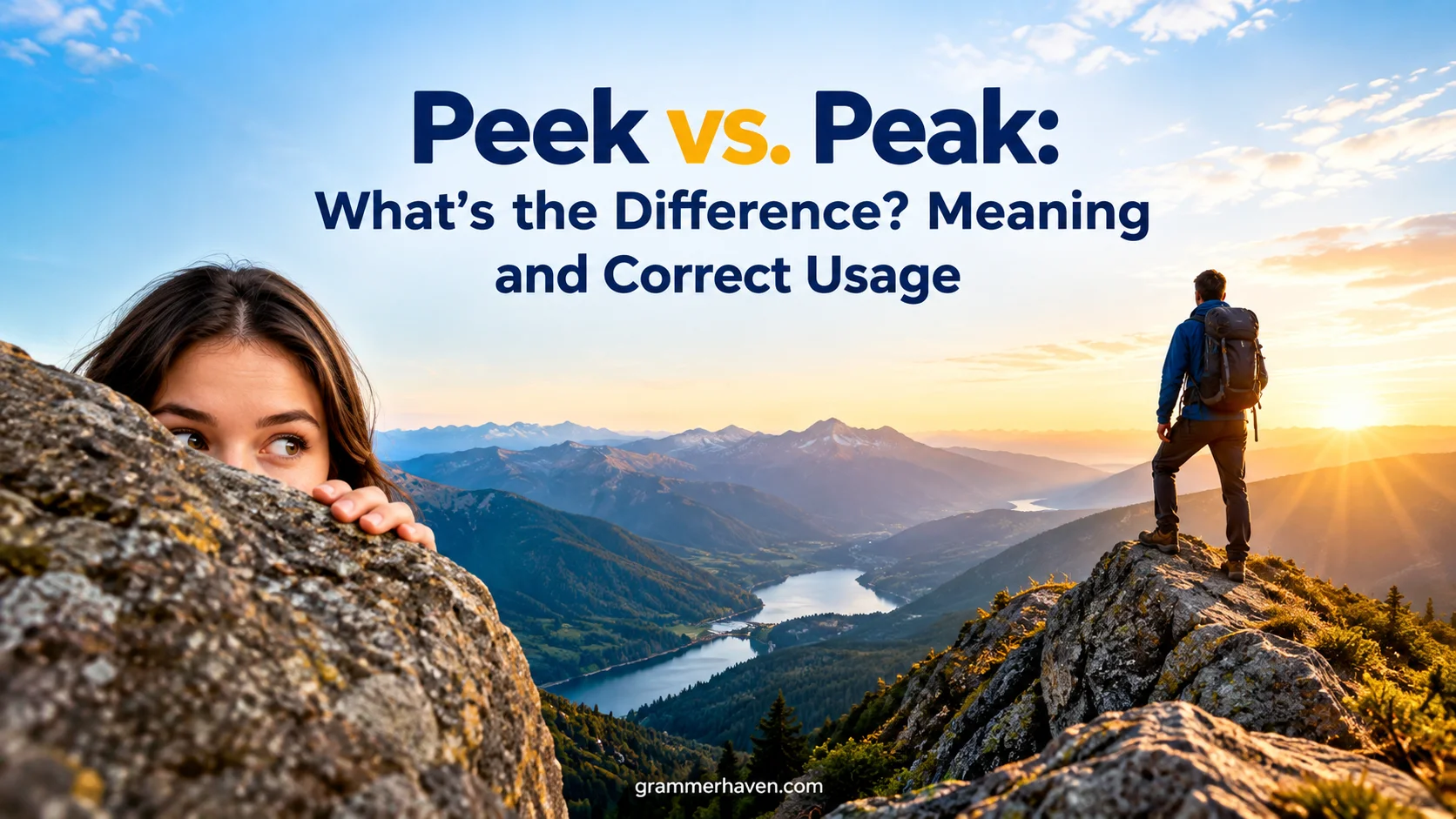
Peek vs. Peak uses words that sound the same but have different meanings, making their spelling tricky when you’re learning English.
Peek and Peak are a homophone because they are identical when pronounced, but their meanings are completely different. Peak means the highest point, level, value, or degree and can work as a noun, verb, or adjective. These words describe two ideas that are entirely different, even though they sound the same. In standard American English and American English, knowing the difference helps you use the correct word, spelling, and meaning.
You can connect peek with looking and peak with the highest part of something. Peek can be a verb for looking quickly or a noun for a quick look. Peak can be a noun, verb, or adjective in different contexts. These tips make it easy to remember which word fits your sentence, helps you describe the right idea, and lets you carry accurate usage into your writing.
Quick Answer: Peek vs. Peak
Peek means to look quickly, briefly, or secretly at something. It can also mean a quick or furtive look.
- Correct: Take a peek inside the box.
- Correct: She peeked through the curtains.
- Correct: I took a quick peek at the document.
Peak means the highest point, level, amount, or degree of something. It can refer to a mountain, performance, popularity, demand, prices, or many other things.
- Correct: We finally reached the mountain peak.
- Correct: Her career reached its peak.
- Correct: Sales peaked in December.
A simple rule makes the distinction easy:
If you’re looking, peek. If you’re talking about the top or highest point, peak.
| Word | Meaning | Example |
| Peek | A quick or secret look | I took a peek inside. |
| Peak | The highest point or level | Sales reached their peak. |
So, neither word is “more correct.” The meaning determines the spelling.
What Does Peek Mean?
Peek means to look at something briefly, often secretly, cautiously, or through a small opening. It can describe an ordinary quick glance as well as a more deliberate attempt to look without being noticed.
For example:
She peeked through the doorway to see who had arrived.
The person isn’t staring for several minutes. She simply takes a quick look.
That short duration is an important part of the word’s meaning. Cambridge defines peek as looking, especially for a short time or while trying to avoid being seen.
Peek as a Verb
When peek acts as a verb, it describes the action of looking.
Consider these examples:
- Don’t peek at your birthday present.
- He peeked through the window.
- She peeked around the corner.
- The child peeked into the bag.
- I peeked ahead to see what happened next.
The word often appears with prepositions such as at, into, through, in, and out.
For instance:
- peek at something
- peek into something
- peek through something
- peek in somewhere
- peek out from somewhere
Each construction keeps the central idea of taking a brief look.
Peek as a Noun
Peek can also function as a noun. In that form, it means a quick look or glance.
Common examples include:
- Take a peek.
- Have a peek inside.
- I took a peek at the results.
- She gave me a quick peek at the design.
The expression “take a peek” is especially common in everyday American English.
What Does Peek Suggest?
Although peek doesn’t always imply secrecy, it often carries a sense of quickness or limited visibility.
Compare these sentences:
- “I looked through the window.”
- “I peeked through the window.”
The first sentence simply says that you looked. The second suggests a brief, cautious, or discreet glance.
That’s why peek works naturally in situations involving surprises, hiding, curiosity, and restricted views.
What Does Peak Mean?
Peak refers to the highest point, strongest level, greatest amount, or best stage of something. It can describe physical objects as well as abstract ideas.
A mountain has a physical peak. A person’s career can have a figurative peak. A company’s sales can reach a peak. Traffic can reach peak levels during rush hour.
The underlying idea remains the same: something reaches its highest point or level.
Peak as a Noun
As a noun, peak can describe the highest part of a mountain or the highest level of an activity, condition, or measurement.
For example:
- We could see the mountain’s peak from miles away.
- She reached the peak of her career.
- The athlete was performing at her peak.
- Prices reached a peak in August.
- Traffic reaches its peak during the evening commute.
Cambridge specifically defines the noun peak as the highest, strongest, or best point, value, or level of skill.
Peak as a Verb
Here’s where things get particularly useful.
Peak can also function as a verb meaning to reach the highest point or level.
For example:
- Sales peaked in December.
- Temperatures peaked at 102°F.
- The athlete peaked at the right time.
- Demand peaked during the holiday season.
- Unemployment peaked in November.
Notice the difference:
Sales reached their peak in December.
and
Sales peaked in December.
The first uses peak as a noun. The second uses peak as a verb.
Both sentences express essentially the same underlying idea.
Peak as an Adjective
Peak can also modify another noun.
You’ll see this use frequently in everyday, business, travel, transportation, and economic contexts.
Common expressions include:
- peak season
- peak hours
- peak time
- peak demand
- peak performance
- peak efficiency
- peak traffic
- peak levels
- peak viewing time
For example:
Hotels often charge more during peak season.
Here, peak doesn’t mean a mountain. It describes the busiest or most active period.
Cambridge notes that peak times are periods when the greatest number of people are using or doing something. It also uses peak for the highest levels, rates, and values.
Peek vs. Peak: The Main Difference
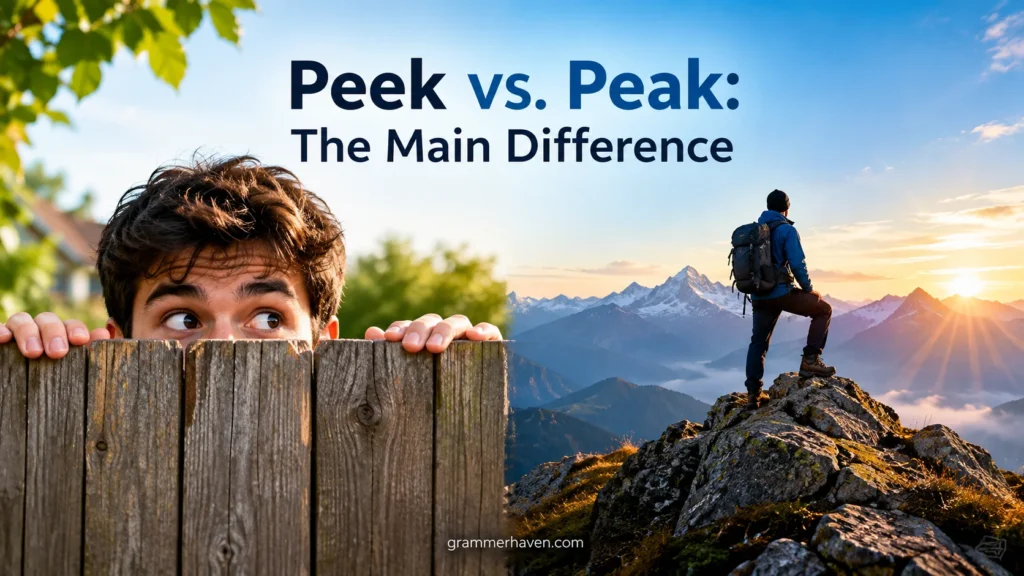
The fastest way to understand the distinction is to focus on the action or idea behind the word.
Peek involves your eyes. Peak involves the top.
| Feature | Peek | Peak |
| Pronunciation | /piːk/ | /piːk/ |
| Main idea | Looking | Highest point |
| Noun | Yes | Yes |
| Verb | Yes | Yes |
| Adjective | No | Yes |
| Physical meaning | A brief look | Top of a mountain |
| Figurative meaning | A glimpse | Highest level |
| Common phrase | Take a peek | Reach a peak |
| Example | Peek inside | Peak performance |
The pronunciation won’t help you choose the spelling because both words sound alike.
Meaning is your guide.
Why Are Peek and Peak Confused?
The confusion comes from pronunciation.
Peek and peak are homophones. Homophones are words that sound the same but have different meanings and spellings.
For example:
- peek / peak
- right / write
- sea / see
- flower / flour
- break / brake
When someone says, “Take a peek,” you hear the sound /piːk/. You don’t hear the spelling.
That creates no problem in conversation. Writing is different.
Once the word reaches the page, you need to know which meaning the sentence requires.
How to Use Peek Correctly
The easiest way to master peek is to associate it with looking.
Use Peek When Someone Looks Quickly
I peeked inside the package.
The person looked inside briefly.
Use Peek When Someone Looks Secretly
Don’t peek before the surprise.
The person is supposed to avoid looking.
Use Peek When Someone Looks Through an Opening
She peeked through the curtains.
The curtains partially conceal her view.
Use Peek for a Quick Glimpse
Can I take a peek at your notes?
The speaker wants a brief look, not an extended examination.
Common Expressions With Peek
| Expression | Meaning | Example |
| take a peek | Take a quick look | Take a peek at this. |
| have a peek | Look briefly | Have a peek inside. |
| peek at | Look briefly at something | Don’t peek at the answers. |
| peek into | Look inside | She peeked into the room. |
| peek through | Look through an opening | He peeked through the blinds. |
| peek out | Become partly visible | The puppy peeked out from under the table. |
These patterns make peek easy to recognize in real sentences.
How to Use Peak Correctly
When the sentence concerns a maximum, top, summit, or highest level, choose peak.
Physical Highest Point
We finally reached the peak of the mountain.
Here, peak refers to the highest part of the mountain.
Highest Point of Success
She was at the peak of her career.
Her career had reached its strongest or most successful stage.
Highest Level of Activity
Traffic reaches its peak around 5 p.m.
The amount of traffic is highest around that time.
Maximum Value
The stock price reached a peak before falling.
The price reached its highest point during that period.
Highest Point as a Verb
Demand peaked during the holidays.
Here, peaked means demand reached its maximum level.
Peek vs. Peak in Real-Life Examples

Context often makes the distinction obvious.
Example 1: A Birthday Present
“Don’t peek at your present!”
You’re talking about looking. Therefore, peek is correct.
Example 2: A Mountain
“The mountain’s peak was covered in snow.”
You’re talking about the highest part of a mountain. Therefore, peak is correct.
Example 3: Career Success
“She reached the peak of her career at age 35.”
You’re describing the highest stage of her career.
Example 4: A Secret
“He tried to peek through the door.”
Again, you’re describing looking.
Example 5: Business Sales
“The company’s sales peaked during December.”
The verb describes sales reaching their highest level.
Example 6: A Quick Look
“Can I take a peek at your new phone?”
The person wants a quick look.
Common Mistakes With Peek and Peak
These mistakes are common because the words sound identical. However, the incorrect spelling changes the meaning.
“Take a Peak” vs. “Take a Peek”
❌ Take a peak at this.
✅ Take a peek at this.
If you’re asking someone to look at something briefly, peek is the correct word.
Take a peek at this photograph.
You’re not asking someone to find the highest point of the photograph. You’re asking them to look at it.
“Peek of My Career” vs. “Peak of My Career”
❌ She was at the peek of her career.
✅ She was at the peak of her career.
A career can reach a peak, meaning its highest or most successful stage.
“Mountain Peek” vs. “Mountain Peak”
❌ We climbed to the mountain’s peek.
✅ We climbed to the mountain’s peak.
The summit is a peak.
“Sales Peeked” vs. “Sales Peaked”
❌ Sales peeked in December.
✅ Sales peaked in December.
Sales don’t secretly look at something. They reach a maximum. Therefore, peaked is correct.
Peek vs. Peak vs. Pique
There’s a third word that makes this trio even more confusing: pique.
All three words are pronounced the same, but their meanings differ sharply.
| Word | Meaning | Example |
| Peek | To look briefly | I took a peek inside. |
| Peak | Highest point or level | Sales reached a peak. |
| Pique | To arouse interest or curiosity | The mystery piqued my curiosity. |
What Does Pique Mean?
As a verb, pique commonly means to arouse interest, curiosity, or excitement.
For example:
The strange headline piqued my curiosity.
That doesn’t mean the headline looked at something. It doesn’t mean the headline reached its highest point.
It aroused curiosity.
Cambridge defines the American English verb pique as meaning to excite or cause interest.
Pique can also refer to anger, annoyance, or wounded pride in certain contexts.
He left the meeting in a fit of pique.
That meaning is less common in everyday American conversation than the familiar expression “pique someone’s interest.”
A Simple Memory Trick for Peek vs. Peak

Here’s a practical way to remember the difference.
Remember “Peek” With Eyes
Think:
PEEK → SEE
When you peek, you use your eyes.
You might:
- peek through a window
- peek inside a box
- peek around a corner
- peek at an answer
All of these involve looking.
Remember “Peak” With a Mountain
Think of a mountain.
The peak sits at the top.
That gives you this connection:
PEAK → TOP
So:
Peek with your eyes. Peak at the top.
There’s another useful memory trick. The A in peak can remind you of apex, which means the highest point.
Peek vs. Peak Grammar: Noun, Verb, and Adjective
Knowing the definitions isn’t enough if you want to use these words confidently. You also need to understand how they function grammatically.
| Word | Noun | Verb | Adjective |
| Peek | ✓ | ✓ | — |
| Peak | ✓ | ✓ | ✓ |
Peek as a Noun
I took a peek at the schedule.
Here, peek names the action of taking a quick look.
Peek as a Verb
She peeked through the window.
Here, peeked describes the action.
Peak as a Noun
The athlete reached her peak.
Here, peak names the highest point.
Peak as a Verb
The athlete peaked during the final season.
Here, peaked describes reaching the highest level.
Peak as an Adjective
We traveled during peak season.
Here, peak modifies season.
This grammatical flexibility explains why peak appears in so many different kinds of writing.
Peek and Peak in Formal and Informal Writing
Peek works naturally in casual conversation, personal writing, marketing copy, entertainment writing, and ordinary descriptions.
For example:
Here’s a quick peek at what’s coming next.
That’s friendly and conversational.
Peak, meanwhile, appears across almost every register of English. You can encounter it in business reports, sports writing, scientific discussions, economics, transportation, travel, and everyday conversation.
Consider:
Energy demand peaked during the afternoon.
That sentence sounds perfectly natural in a technical report.
Meanwhile:
We hit peak traffic on the way home.
That works just as well in casual conversation.
A Practical Case Study: Choosing the Right Word

Imagine you’re writing about a company’s holiday shopping season.
You might write:
Customers began arriving early, hoping to get a peek at the new products. As the holiday approached, customer traffic reached its peak. Sales eventually peaked during the final week of December.
Notice how both words can appear naturally in the same paragraph.
- peek = a quick look at products
- peak = highest level of customer traffic
- peaked = reached the maximum sales level
This example shows why the words can’t simply be treated as spelling variations.
They describe different ideas.
How to Choose Between Peek and Peak in Seconds
When you’re unsure, don’t focus on how the word sounds. Ask what the sentence means.
Step One: Is Someone Looking?
If yes, use peek.
I want to peek inside.
Step Two: Is Something Reaching Its Highest Point?
If yes, use peak.
Demand will peak tomorrow.
Step Three: Is Something Stimulating Interest?
If yes, consider pique.
The mystery piqued my interest.
This three-question test handles most everyday situations.
Peek vs. Peak Practice Quiz
Choose peek, peak, or the appropriate form of either word.
- Can I take a ___ at your new design?
- The mountain’s ___ was hidden by clouds.
- Don’t ___ at the answers.
- Temperatures ___ at 101°F yesterday.
- She reached the ___ of her career.
- He ___ through the doorway.
- The company experienced ___ demand during December.
- I took a quick ___ inside the room.
- Sales ___ during the holiday season.
- The unusual story ___ her curiosity.
Answers
- peek
- peak
- peek
- peaked
- peak
- peeked
- peak
- peek
- peaked
- piqued
The pattern becomes clear once you focus on meaning rather than sound.
See also: Noone or No One: Which Spelling Is Correct?
FAQs:
Is it “take a peek” or “take a peak”?
The correct phrase is “take a peek” when you mean “take a quick look.”
Take a peek at this.
Peak refers to a highest point or level.
Are peek and peak pronounced the same?
Yes. Peek and peak are homophones. Standard dictionaries give both words the pronunciation /piːk/.
What does peek mean?
Peek means to look briefly, quickly, secretly, or through a small opening. It can function as both a noun and a verb.
What does peak mean?
Peak means the highest point, level, amount, degree, or stage of something. It can function as a noun, verb, and adjective.
Is it “peak of my career” or “peek of my career”?
The correct expression is “peak of my career.”
She was at the peak of her career.
A career can reach its highest stage, or peak.
Is “peek” a noun or a verb?
It’s both.
As a verb:
I peeked inside.
As a noun:
I took a peek inside.
Is “peak” a noun or a verb?
It’s both, and it can also function as an adjective.
- Noun: the peak of the mountain
- Verb: sales peaked
- Adjective: peak season
What is the difference between peek, peak, and pique?
Peek means to look briefly. Peak means the highest point or level. Pique means to arouse interest or curiosity.
What is an easy way to remember peek and peak?
Remember:
Peek = look. Peak = top.
You peek with your eyes, while a mountain has a peak at the top.
Is “peeked” the past tense of peek?
Yes.
- Present: peek
- Past: peeked
- Present participle: peeking
For example:
She peeked through the window.
Merriam-Webster lists peeked, peeking, and peeks as forms of the verb.
Conclusion:
Understanding Peek vs. Peak becomes easier when you connect each word with its meaning. Peek means a quick look, while peak means the highest point, level, value, or degree. Remembering this simple difference can help you choose the right spelling and use each word correctly in English.