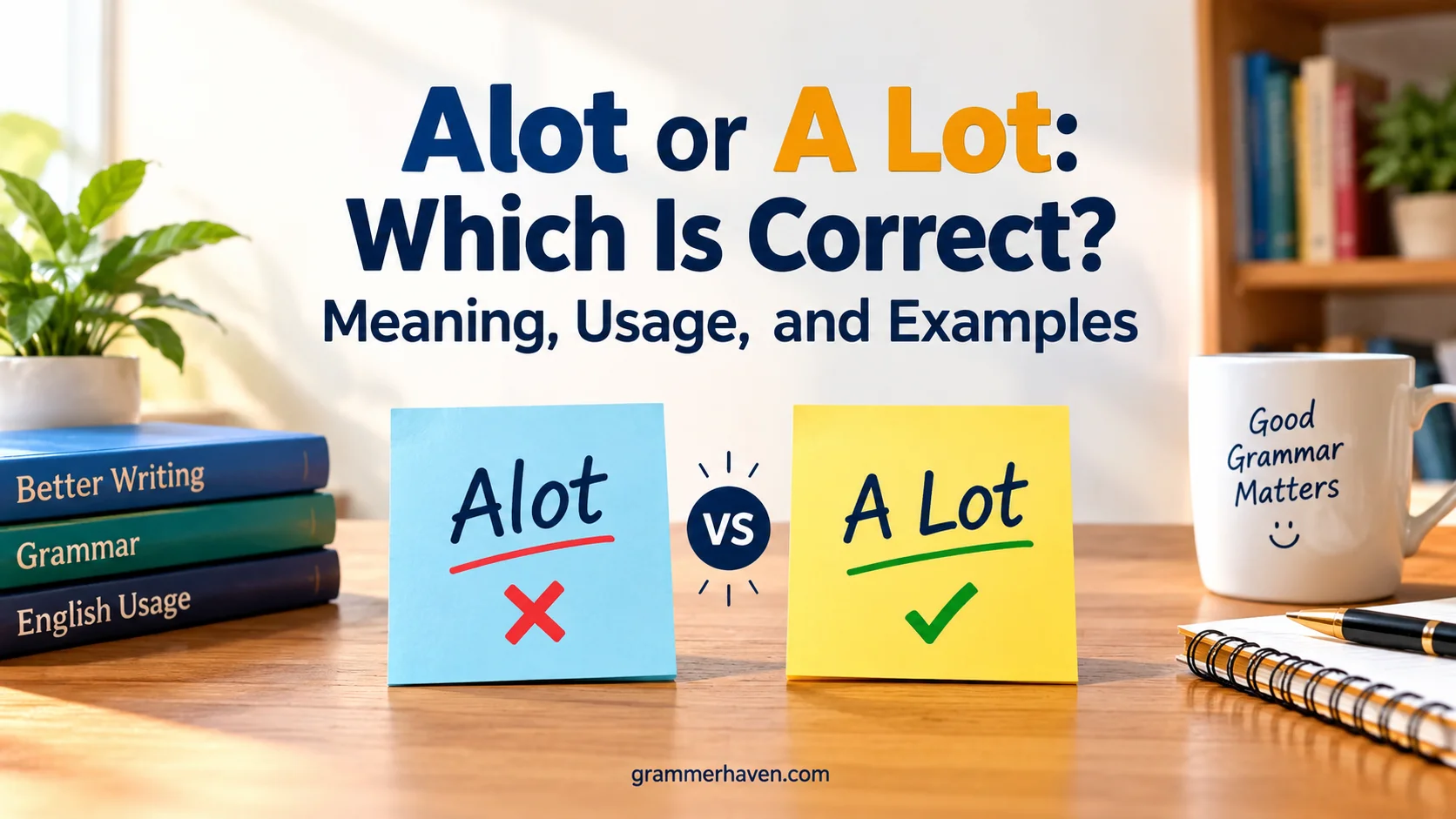
Alot or A Lot causes confusion because the words look almost identical, yet a lot is the correct form in standard English.
A lot is a commonly used phrase written as two words. Its meaning can express very much, a large amount, a large number, or frequently, depending on the context. For clarity, remember the small space between a and lot rather than mentally inserting or removing it after you type. Alot is a misspelling and an incorrect single word, while A Lot keeps its separate words, clear form, and accepted spelling. These distinctions help you avoid treating different spellings as interchangeable when they have separate meanings.
Allot is a legitimate word with a different meaning: to assign, distribute, or set aside a share of something. The sentence structure, expression, and surrounding context help show the intended meaning. Several examples can reinforce the pattern: use a lot for an amount, number, or something done frequently, and use allot for an assignment or distribution of resources.
Alot or A Lot: Quick Answer
A lot is correct when you mean a large amount, a large number, very much, or frequently.
Alot is not the standard spelling of this expression. Although people commonly type it as one word, major dictionaries and usage guides recognize a lot as the standard form.
Allot is a different word. It’s a verb that means to assign or distribute something for a particular purpose.
| Form | Correct? | Meaning | Example |
| a lot | Yes | A large amount, number, degree, or frequency | “She reads a lot.” |
| alot | No, in standard usage | Usually a misspelling of “a lot” | “She reads alot.” ❌ |
| allot | Yes | To assign or distribute | “We will allot each speaker ten minutes.” |
The simplest rule
If you mean “very much” or “a large amount,” use “a lot.” If you mean “assign” or “distribute,” use “allot.”
That one rule will eliminate most mistakes.
What Does “A Lot” Mean?
The phrase a lot has several closely related uses. Its exact meaning depends on where it appears in the sentence.
Cambridge Dictionary defines a lot as a large amount or number and also uses it to mean very much or very often.
“A Lot” Means a Large Amount or Number
When a lot of comes before a noun, it usually indicates a large quantity or number.
For example:
- A lot of people attended the concert.
- She has a lot of books.
- We spent a lot of money.
- There was a lot of traffic this morning.
- He needs a lot of patience to do that job.
One useful feature makes a lot of especially flexible: you can use it with both countable and uncountable nouns.
Countable nouns
Countable nouns refer to things you can count individually.
- a lot of students
- a lot of cars
- a lot of questions
- a lot of houses
- a lot of mistakes
Example:
There are a lot of students in this class.
Uncountable nouns
Uncountable nouns refer to things that aren’t normally counted as individual units.
- a lot of water
- a lot of information
- a lot of time
- a lot of money
- a lot of work
Example:
We don’t have a lot of time.
Notice the difference between the noun types. The phrase a lot of works with both.
How “A Lot” Works Without a Noun
You don’t always need to put a noun after a lot.
When the meaning is already clear, a lot can stand on its own.
Consider these examples:
- I travel a lot.
- She talks a lot.
- They argue a lot.
- We laughed a lot.
- He exercises a lot.
Here, a lot functions adverbially. It tells you about the degree or frequency of the action. Merriam-Webster lists uses of a lot meaning “to a considerable degree or extent” and “often” or “frequently.”
Compare:
I have a lot of books.
Here, a lot of describes the quantity of books.
Now compare:
I read a lot.
Here, a lot describes how frequently or extensively you read.
The words look identical, but their grammatical jobs differ.
Why Is “Alot” Incorrect?
The main problem with alot is simple: standard English writes this expression as two words.
The phrase consists of the indefinite article followed by the noun lot. Merriam-Webster specifically explains that a lot is formed from the article a and the noun lot.
Think about similar structures:
- a little
- a few
- a number
- a great deal
- a lot
You wouldn’t normally combine a little into a little. You wouldn’t write a few when you mean “a few.”
The same principle applies to a lot.
Incorrect and Correct Examples
| Incorrect | Correct |
| I have alot of work. | I have a lot of work. |
| She travels alot. | She travels a lot. |
| We made alot of progress. | We made a lot of progress. |
| He talks alot. | He talks a lot. |
The error often happens because pronunciation doesn’t clearly reveal the word boundary. In normal conversation, a lot sounds like a compact phrase. When you’re writing quickly, your fingers may simply follow that sound.
Still, standard spelling keeps the space.
Why Do People Write “Alot”?
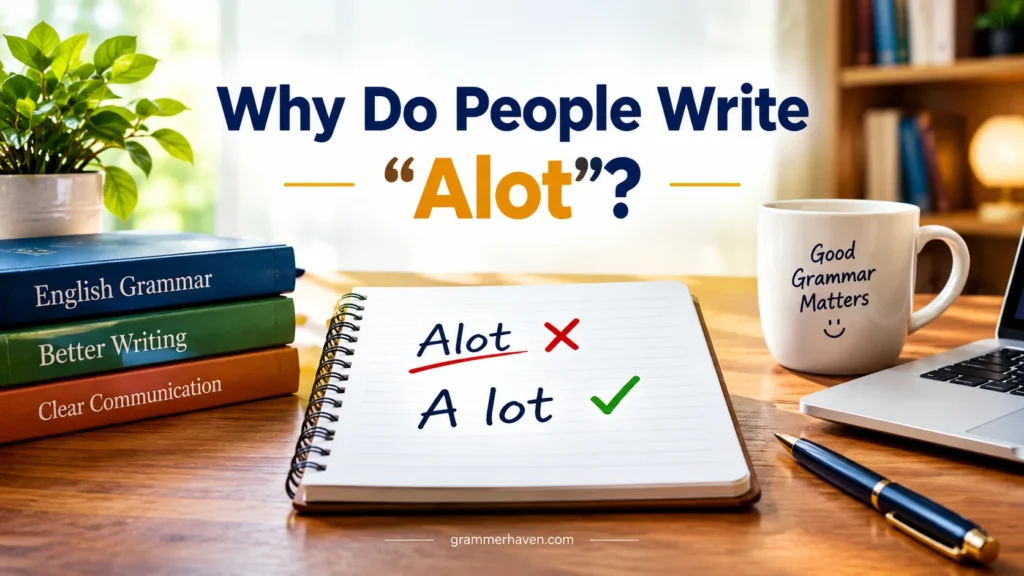
The spelling alot is common enough that many learners wonder whether it might be an accepted alternative.
It isn’t the standard form for this meaning. Major language references identify alot as a common mistake rather than the standard spelling.
Several factors probably contribute to the confusion:
- Speech blends the two words together.
- A lot appears extremely frequently in everyday English.
- English contains many legitimate compound words.
- People often type quickly in informal digital communication.
- The expression can feel like a single unit of meaning.
There’s also a visual trap. Because a lot appears so often, writers may begin to perceive it as one familiar chunk.
That doesn’t change the spelling rule.
What Does “Allot” Mean?
Now comes the word that causes the most interesting confusion: allot.
Unlike alot, allot is absolutely a real English word.
It functions as a verb and means to give, assign, or distribute a share of something for a particular purpose. Cambridge Dictionary gives examples involving desks, budgets, time, and space.
For example:
- The manager allotted each employee two hours.
- The committee will allot funds to the project.
- We should allot enough time for questions.
- Each student was allotted ten minutes.
- The organization allots money for training.
Here’s a useful test:
If you can replace the word with assign, allocate, or distribute, you probably need allot.
Example
The teacher will allot five minutes to each student.
You could rewrite that as:
The teacher will assign five minutes to each student.
The meaning works.
Now try the same substitution with:
I exercise a lot.
“I exercise assign” obviously makes no sense.
That’s your clue.
A Lot vs. Allot: The Difference
The easiest way to understand the distinction is to focus on their grammatical roles.
| Feature | A lot | Allot |
| Word type | Phrase | Verb |
| Main meaning | Large amount, number, degree, or frequency | Assign or distribute |
| Common pattern | a lot of + noun | allot + object |
| Example | “We have a lot of work.” | “We allotted two hours.” |
| Related words | much, many, lots | assign, allocate, distribute |
Compare these sentences
We have a lot of money.
This tells you about quantity.
We will allot the money to three departments.
This tells you what you’re doing with that money.
The first describes how much. The second describes how something is distributed.
That’s the heart of the difference.
A Lot vs. Alot vs. Allot Examples
Seeing the three forms together makes the distinction much clearer.
Example 1: Quantity
She has a lot of experience.
Correct. The phrase describes a large amount of experience.
Example 2: Frequency
She travels a lot.
Correct. Here, a lot means frequently.
Example 3: Assignment
The company will allot more money to research.
Correct. The company will assign or allocate money for a specific purpose.
Example 4: The common mistake
She travels alot.
Incorrect in standard English.
The correct version is:
She travels a lot.
How to Use “A Lot” Correctly in a Sentence
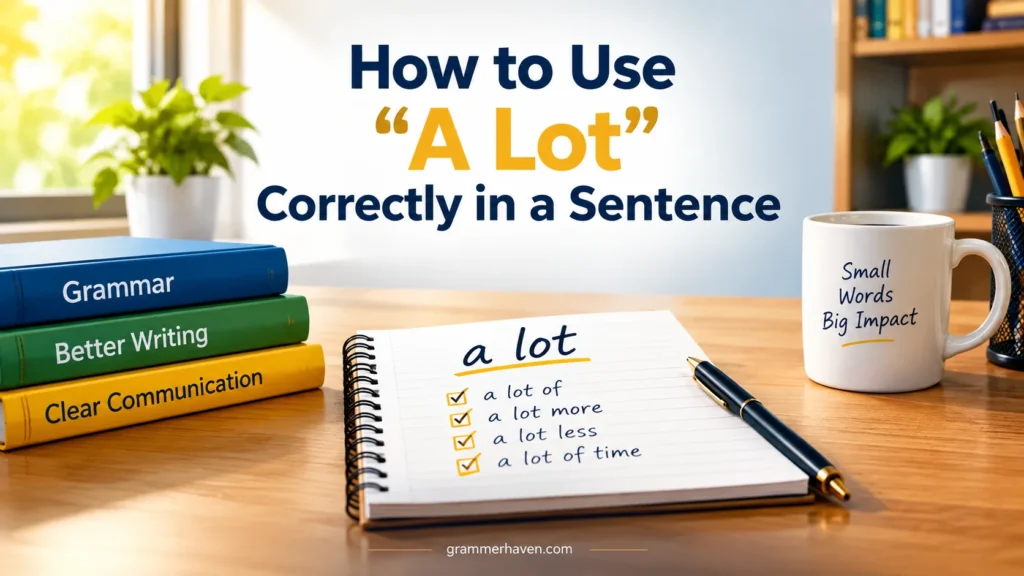
Using a lot correctly becomes straightforward once you recognize its common patterns.
A Lot of + Noun
Use a lot of before a noun when you mean a large quantity or number.
Examples:
- We have a lot of options.
- She drinks a lot of water.
- They received a lot of support.
- There are a lot of reasons to stay.
- He has a lot of experience.
Don’t drop of when a noun directly follows.
Incorrect:
I have a lot books.
Correct:
I have a lot of books.
Cambridge specifically identifies the need for of before the noun in this construction.
A Lot After a Verb
When the noun isn’t present, use a lot by itself.
- I work a lot.
- She studies a lot.
- They travel a lot.
- We talked a lot.
Here, adding of would create a different structure.
I work a lot. ✓
You wouldn’t say:
I work a lot of. ✗
Unless a noun or another appropriate complement follows.
“A Lot” With Comparative Adjectives
Another useful pattern is a lot + comparative adjective.
Examples include:
- a lot better
- a lot easier
- a lot bigger
- a lot smaller
- a lot faster
- a lot more expensive
- a lot less complicated
For example:
This version is a lot easier to understand.
Here, a lot strengthens the comparison. It means the difference is substantial.
Compare:
This version is better.
with:
This version is a lot better.
The second sentence emphasizes a much larger difference.
A Lot vs. Lots of
Lots of is also standard English. It means essentially the same thing as a lot of, although it tends to sound more informal. Cambridge notes that lots is more informal than a lot.
Compare:
We have a lot of work.
We have lots of work.
Both are grammatical.
The difference is mainly tone. Lots of can sound more relaxed and conversational.
However, neither form becomes alot.
Quick comparison
| Expression | Meaning | Tone |
| a lot of | Large amount or number | Neutral/informal |
| lots of | Large amount or number | More informal |
| alot | Nonstandard spelling | Avoid |
| allot | Assign or distribute | Standard verb |
A Lot vs. Many vs. Much
English gives you several ways to talk about large quantities, but they don’t all behave the same way.
A Lot Of
Works with both countable and uncountable nouns:
- a lot of books
- a lot of water
Many
Generally works with plural countable nouns:
- many books
- many students
- many questions
Much
Generally works with uncountable nouns:
- much water
- much time
- much money
In everyday positive statements, a lot of often sounds more natural than much or many. Cambridge notes this difference in its guidance on quantities.
For example:
I have a lot of work.
sounds more natural in ordinary conversation than:
I have much work.
The second isn’t necessarily impossible in every context, but it doesn’t sound natural in most everyday positive statements.
A Lot vs. Allot vs. Allocate
The words allot and allocate overlap in meaning, which makes them useful memory partners.
Allot means to assign or distribute a share. Allocate also means to distribute resources or assign them to a particular purpose. Merriam-Webster lists allocate, assign, and distribute among synonyms for allot.
Consider:
The director allotted 30 minutes for the presentation.
You could also say:
The director allocated 30 minutes for the presentation.
But you can’t replace a lot with either word.
We have a lot of work. ✓
We have allot of work. ✗
The meanings simply don’t match.
Common “Alot” Mistakes and Their Corrections
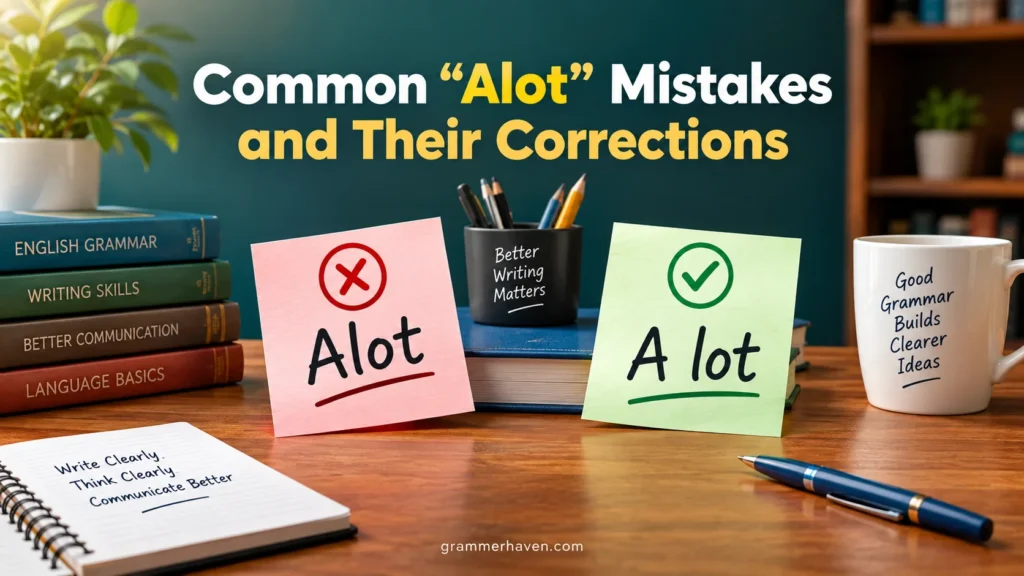
These mistakes appear frequently because the incorrect form looks plausible.
| Mistake | Correct Form | Explanation |
| I have alot of work. | I have a lot of work. | Use two words for the quantity expression. |
| She studies alot. | She studies a lot. | Here, “a lot” means frequently or extensively. |
| There are alot of choices. | There are a lot of choices. | Use “a lot of” before the noun. |
| We need to alot more time. | We need to allot more time. | “Allot” means assign or set aside. |
| He has alot of experience. | He has a lot of experience. | “A lot of” describes quantity. |
One particularly sneaky error is confusing alot with allot.
For example:
We need to alot more money.
This sentence doesn’t need a lot. It needs allot because the intended meaning is “assign more money.”
That distinction depends on meaning, not pronunciation.
Is “A Lot” Formal or Informal?
A lot is common and natural in everyday English. It’s not a spelling mistake or grammatical error simply because it sounds conversational.
However, in highly formal or academic writing, you may sometimes choose a more precise expression.
For example:
The study collected a lot of data.
could become:
The study collected a substantial amount of data.
Or:
The organization received a lot of applications.
could become:
The organization received a large number of applications.
The choice depends on context.
You shouldn’t replace every a lot simply to sound sophisticated. Precision matters more than fancy vocabulary.
A Lot With Countable and Uncountable Nouns
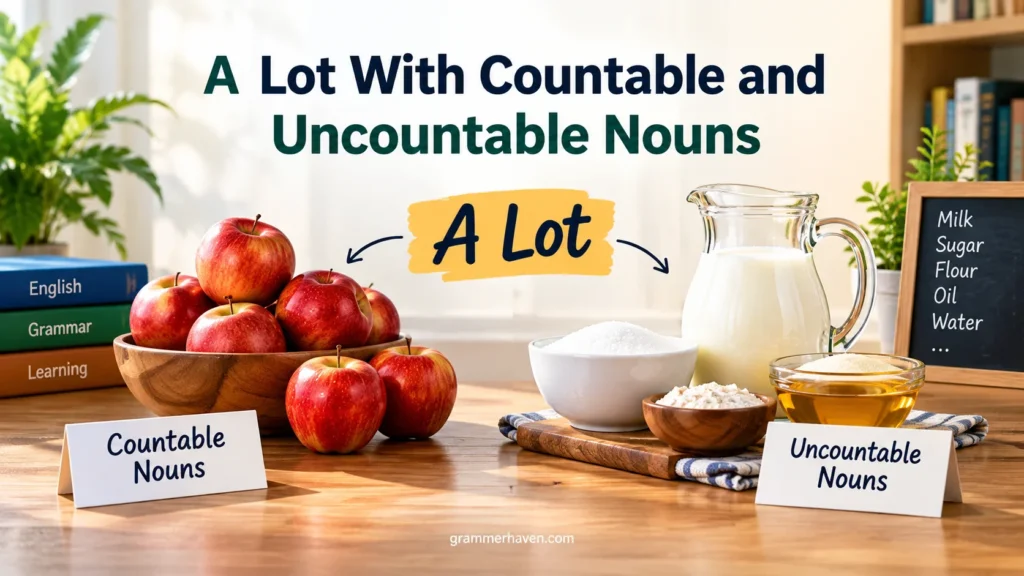
This is one of the most useful grammar points to remember.
Countable
A lot of students attended.
Students can be counted:
1 student, 2 students, 3 students.
Uncountable
A lot of information was provided.
Information isn’t normally counted as one information, two informations in standard English.
Both structures work because a lot of can modify either type.
More examples
Countable:
- a lot of questions
- a lot of people
- a lot of problems
- a lot of opportunities
Uncountable:
- a lot of information
- a lot of money
- a lot of advice
- a lot of knowledge
This flexibility makes a lot of one of the most useful quantity expressions in everyday English.
Common Expressions With “A Lot”
You’ll encounter a lot in several established expressions.
Thanks a Lot
Thanks a lot for helping me.
Depending on context and tone, this can express genuine gratitude or sarcasm.
A Whole Lot
That made a whole lot of difference.
A whole lot intensifies the idea of a large amount or degree.
A Lot More
This method is a lot more efficient.
A Lot Less
The new process takes a lot less time.
These expressions show that a lot isn’t limited to quantity nouns. It can also modify degree and comparison.
A Lot in Real-World Writing
Consider three situations.
Workplace Example
We have a lot of tasks to finish before Friday.
The phrase communicates quantity.
Now:
The manager will allot two hours to the final review.
That sentence describes assigning time.
School Example
Students often have a lot of homework during exam season.
But:
The teacher will allot 20 minutes for the final section.
Again, quantity and allocation are different ideas.
Everyday Conversation
I listen to podcasts a lot.
Here, a lot describes frequency rather than quantity.
These examples show why simply memorizing spelling isn’t enough. Understanding the meaning makes the spelling much easier.
A Simple Memory Trick for “A Lot”
If alot keeps sneaking into your writing, use this trick:
Remember “A Little”
You already know:
a little
Not:
alittle
The same pattern applies:
a lot
Not:
alot
Another useful trick is to connect allot with allocate.
Both relate to assigning resources.
- allot → assign
- allocate → assign
- a lot → a large amount
That gives you three separate mental boxes.
Quick Test: Alot, A Lot, or Allot?
Choose the correct form in each sentence.
- I have ___ of things to finish today.
- The supervisor will ___ ten minutes to each speaker.
- She exercises ___.
- We received ___ of applications.
- The committee decided to ___ additional funds to the project.
- He talks ___ when he’s excited.
- There isn’t ___ of evidence to support that claim.
- The school will ___ more classroom space to the program.
Answers
- a lot
- allot
- a lot
- a lot
- allot
- a lot
- a lot
- allot
The fastest way to solve these is to ask what the sentence means.
If it describes quantity, degree, or frequency, choose a lot.
If it describes assigning or distributing something, choose allot.
See also: Peek vs. Peak: What’s the Difference? Meaning and Correct Usage
FAQs:
Is “alot” a word?
Alot isn’t the standard spelling of the phrase meaning “a large amount” or “very much.” Use a lot instead.
Is “a lot” one word or two?
A lot is written as two words when it means a large amount, number, degree, or frequency.
What does “a lot” mean?
It can mean a large amount, a large number, very much, or frequently, depending on context.
What does “allot” mean?
Allot means to assign, distribute, or give someone a particular share of something.
Is “a lot of” grammatically correct?
Yes. A lot of can modify both plural countable nouns and singular uncountable nouns.
Can you say “a lot” without “of”?
Yes. When no noun follows, a lot can function as an adverbial expression.
I travel a lot.
Is “lots of” correct?
Yes. Lots of is a standard informal expression meaning a large amount or number. It’s generally more informal than a lot of.
What’s the difference between “a lot” and “allot”?
A lot refers to a large amount, number, degree, or frequency. Allot means to assign or distribute something.
Why do people write “alot”?
The pronunciation of a lot can make the phrase sound like one word. Frequent informal typing also helps explain why the misspelling appears so often.
How can you remember the correct spelling?
Think of a little. Since you write a little as two words, write a lot as two words as well.
Conclusion:
When it comes to Alot or A Lot, always use A Lot as two separate words in standard English. Alot is an incorrect spelling, while allot has a different meaning related to assigning or distributing something. Remembering the space between a and lot will help you avoid this common writing mistake.