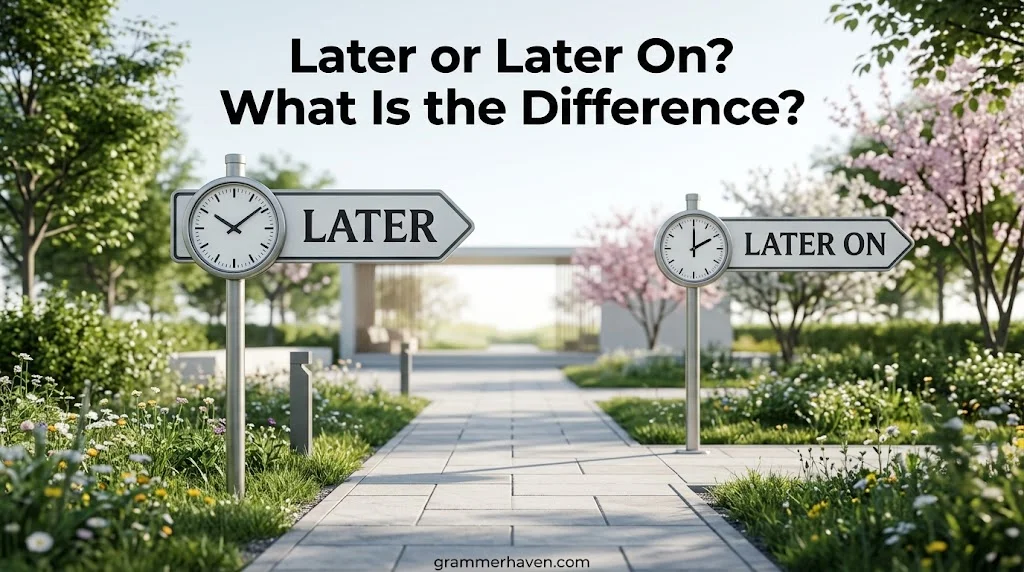
The phrase Later or Later On? What Is the Difference? helps learners understand small language choices and improve clear communication skills. When exploring English language words and phrases, many people feel confused because later and later on share a close meaning. This difference creates confusion among native speakers and learners, but noticing small nuances can make your communication skills stronger. These tiny tweaks can dramatically shift the perceived distinction between expressions and help you elevate your understanding of this seemingly simple conundrum.
The context of time and the future makes the usage clearer. Later often points to an open time, while later on usually connects with another event or a series of events that will happen afterward. For example, saying you will make a call later leaves the exact point less specific, but using later on can imply that something comes first. A daily walk through real conversations, a text, sentence, or story can show how a small phrase changes the way people understand messages and avoid misunderstanding.
Learning these expressions takes practice, especially when you juggle words like balls in the air and try to make them sound right, natural, and professional. A useful guide is to pause and ask yourself how you have used similar phrases before. The practical tips from everyday writing and speaking help you notice that phrases similar can still create different effects. These challenges are not trivial at a glance because they add rich texture to your language texture, reveal the layers behind language choices, and prevent a wrong step through the minefield of communication.
Later vs. Later On: The Short Answer
In most situations, later and later on both mean at a future time.
Consider these examples:
- I’ll call you later.
- I’ll call you later on.
Both sentences are grammatically correct. Both communicate the same basic idea.
The difference lies in style rather than meaning.
Later is usually shorter, simpler, and more common.
Later on often adds a slight sense of time passing before something happens.
Quick Comparison
| Feature | Later | Later On |
| Meaning | At a future time | At a future time |
| Common in conversation | Yes | Yes |
| Common in writing | Yes | Yes |
| Sounds concise | Yes | No |
| Emphasizes passage of time | Sometimes | More often |
| Frequently used in storytelling | Less | More |
Simple Rule
If you’re unsure which one to choose, use later.
It works in almost every situation.
What Does “Later” Mean?
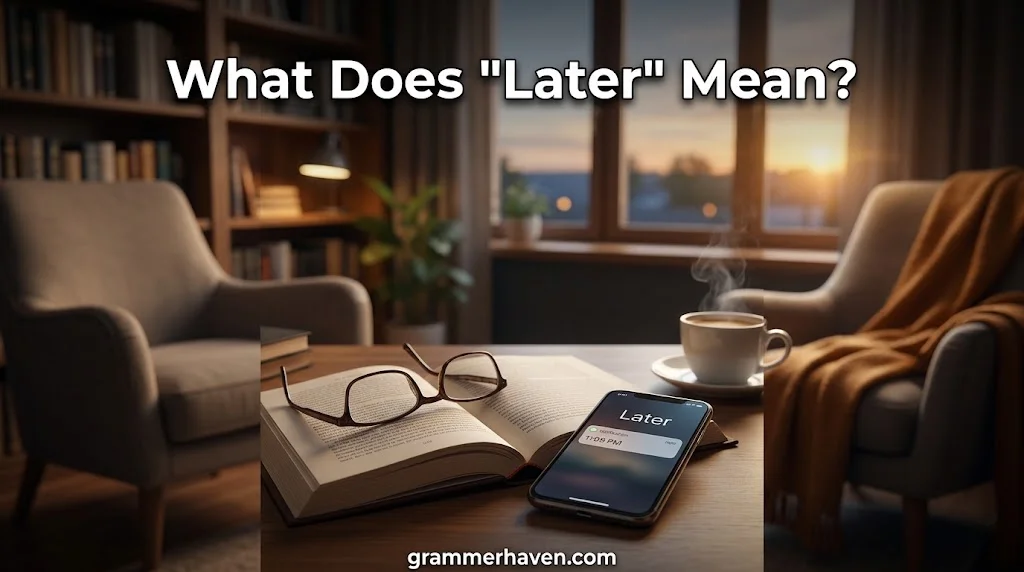
The word later refers to a time that comes after the present moment or after another event.
It is one of the most commonly used time expressions in English.
Basic Definition
Later means:
At some point after now or after a previously mentioned time.
Examples:
- I’ll finish the report later.
- We can discuss that later.
- She arrived later than expected.
- The truth became clear later.
In each example, the action happens after another point in time.
Why Native Speakers Prefer “Later”
People often choose later because it is brief and efficient.
English naturally favors shorter expressions in everyday conversation.
Compare:
- Talk to you later.
- Talk to you later on.
Both work.
The first sounds more natural in many situations because it is shorter.
Common Uses of “Later”
Referring to the Near Future
This is the most common use.
Examples:
- I’ll see you later.
- Let’s eat later.
- We can decide later.
- Call me later tonight.
The exact time is not specified. It simply happens after now.
Referring to a Time After Another Event
Sometimes later refers to something that occurs after a previous action.
Examples:
- He apologized later.
- We learned the details later.
- The company released an update later.
The focus is on sequence.
Describing Future Versions
Later can also function as an adjective.
Examples:
- A later edition corrected the errors.
- Later generations viewed the issue differently.
- The later chapters become more complex.
In these examples, later describes a noun rather than a future time.
What Does “Later On” Mean?
Later on has almost the same meaning as later.
However, speakers often use it when they want to highlight that some time passes before an event occurs.
Definition of “Later On”
Later on means:
At a future time, often after some period has passed.
Examples:
- We’ll discuss the budget later on.
- Later on, she changed her mind.
- Problems appeared later on.
The phrase subtly draws attention to the progression of time.
Why Native Speakers Use “Later On”

Native speakers often choose later on when telling stories.
The phrase creates movement in a narrative.
For example:
- We started the project in January.
- Later on, we expanded into three new markets.
The second sentence sounds like a new stage in the story.
That is why you’ll hear later on frequently in conversations about personal experiences, business growth, historical events, and life changes.
Are Later and Later On Interchangeable?
Most of the time, yes.
You can swap one for the other without changing the overall meaning.
Examples
| Later | Later On |
| I’ll explain later. | I’ll explain later on. |
| We can talk later. | We can talk later on. |
| I’ll decide later. | I’ll decide later on. |
| We learned the answer later. | We learned the answer later on. |
In all these cases, both options sound natural.
The difference is stylistic rather than grammatical.
When “Later On” Sounds More Natural
Although both expressions often work, certain situations favor later on.
During Storytelling
Storytelling frequently involves movement through time.
Examples:
- Later on, we discovered the real cause.
- Later on, the business doubled in size.
- Later on, researchers found new evidence.
The phrase acts almost like a signpost that guides listeners through a timeline.
When Discussing Future Developments
Sometimes events unfold gradually.
Examples:
- Side effects appeared later on.
- Issues emerged later on in the process.
- Additional costs became apparent later on.
Here, later on emphasizes delayed development.
When Describing Life Changes
Examples:
- Later on, she became a lawyer.
- Later on, they moved abroad.
- Later on, he started his own company.
The phrase creates a sense of progression.
When “Later” Sounds Better
Certain situations strongly favor later.
Everyday Conversations
Short responses almost always use later.
Examples:
- See you later.
- Talk later.
- Maybe later.
- I’ll text you later.
Adding “on” can sound unnecessary.
Quick Informal Replies
Imagine a conversation:
Person A: Can we discuss this now?
Person B: Later.
This sounds natural.
Replying with:
Person B: Later on.
is possible but less common.
Brief Instructions
Examples:
- Save it for later.
- We’ll handle that later.
- Check back later.
The shorter form feels cleaner and more direct.
Fixed Expressions That Use “Later”
English contains several phrases where later is the standard choice.
See You Later
This is one of the most common farewells in English.
Examples:
- See you later.
- Okay, see you later.
While “see you later on” is grammatically possible, native speakers rarely use it.
Sooner or Later
This expression means something will eventually happen.
Examples:
- Sooner or later, everyone learns this lesson.
- Sooner or later, the truth comes out.
The phrase is fixed.
Changing it to “sooner or later on” would be incorrect.
Until Later
Examples:
- Goodbye for now.
- Until later.
Again, later is the accepted form.
Later vs. Later On in Spoken English
Real-world speech often reveals patterns that grammar books miss.
Everyday Conversation
Native speakers overwhelmingly favor later in casual exchanges.
Examples:
- Call me later.
- Text me later.
- Let’s meet later.
The shorter option feels faster and more natural.
Narratives and Stories
When people tell stories, usage shifts.
Examples:
- Later on, we found out what happened.
- Later on, the weather changed.
- Later on, everyone laughed about it.
Storytelling often benefits from the extra rhythm that later on provides.
Why “Later On” Feels More Descriptive
Think of these sentences:
- We discovered the problem later.
- We discovered the problem later on.
The second sentence subtly suggests that some time passed before the discovery occurred.
The difference is small.
Yet native speakers often feel it instinctively.
It’s similar to the difference between:
- Then.
- Then afterward.
Both indicate sequence.
One simply provides more emphasis.
Regional Differences in Usage
Both American and British English use later and later on.
However, neither variety treats one as more correct.
The choice usually depends on:
- Personal speaking style
- Context
- Rhythm of the sentence
- Desired emphasis
As a result, you will encounter both expressions in books, movies, news articles, and everyday conversations.
Common Mistakes With Later and Later On
Although the expressions are simple, learners frequently make mistakes.
Assuming One Is Grammatically Superior
Many people believe later on is more correct.
It isn’t.
Both forms are standard English.
Using “Later On” Everywhere
Overusing later on can make writing feel repetitive.
Example:
- I’ll call you later on.
- We can meet later on.
- I’ll explain later on.
- I’ll finish later on.
The repetition becomes noticeable.
Mixing both expressions creates more natural writing.
Changing Fixed Expressions
Incorrect:
- Sooner or later on
- See you later on every time
- Until later on
Correct:
- Sooner or later
- See you later
- Until later
Learning fixed expressions helps you sound more fluent.
Later, Later On, Afterwards, and Subsequently
English offers several ways to talk about future or subsequent events.
Understanding the differences can improve your word choice.
Comparison Table
| Expression | Tone | Typical Use |
| Later | Neutral | Everyday speech |
| Later On | Conversational | Storytelling and future developments |
| Afterwards | Slightly formal | Events occurring after another action |
| Subsequently | Formal | Academic and professional writing |
Using “Afterwards”
Examples:
- We had dinner. Afterwards, we watched a movie.
- The meeting ended. Afterwards, everyone went home.
Afterwards typically follows a completed action.
Using “Subsequently”
Examples:
- The policy changed. Subsequently, profits increased.
- The company expanded internationally. Subsequently, revenue grew.
Subsequently sounds formal and appears often in business and academic writing.
Choosing the Right Option
Use:
- Later for everyday communication.
- Later on for emphasis and storytelling.
- Afterwards when discussing what happened next.
- Subsequently in formal contexts.
Real-Life Examples of Later and Later On

Workplace Examples
Later:
- I’ll review the proposal later.
- Let’s discuss the budget later.
Later On:
- Later on, management approved the expansion.
- Later on, new regulations affected the project.
Academic Examples
Later:
- We’ll study that topic later.
- Researchers examined the issue later.
Later On:
- Later on, additional studies confirmed the findings.
- Later on, scientists developed improved models.
Family Conversations
Later:
- We’ll go shopping later.
- Clean your room later.
Later On:
- Later on, we’ll visit Grandma.
- Later on, we’ll talk about vacation plans.
Case Study: Which Sounds More Natural?
Consider this short story.
Version One
We launched the product in March. Later, we expanded into Canada. Later, we entered Europe. Later, we introduced new features.
Version Two
We launched the product in March. Later on, we expanded into Canada. Later on, we entered Europe. Later on, we introduced new features.
Both versions work.
However, the second version creates a stronger sense of progression through time.
That is why storytellers often favor later on.
Quick Memory Trick
If you’re struggling to choose between the two expressions, remember this simple guideline:
Use “later” for conversation. Use “later on” for progression.
This rule won’t apply in every situation.
Still, it works surprisingly well most of the time.
Easy Cheat Sheet
| Situation | Best Choice |
| Text messages | Later |
| Casual conversation | Later |
| Quick responses | Later |
| Storytelling | Later On |
| Long-term developments | Later On |
| Narrative writing | Later On |
| Fixed expressions | Later |
See also: Berth vs Birth: Meaning, Definition & Differences Is Expaland
FAQs:
1. What is the main difference between later and later on?
Later refers to a time after now without giving much detail, while later on often suggests something will happen after another action, event, or point in a sequence.
2. Can later and later on be used interchangeably?
Sometimes they can be used in similar situations, but they do not always create the same feeling. Later on often adds the idea of progression or something happening afterward.
3. Is “later on” more formal than “later”?
No, both phrases are natural in everyday English. The choice depends more on the context and the meaning you want to express rather than formality.
4. Which phrase should I use in a conversation?
Use later when you simply mean “at a future time.” Use later on when you want to show that something will happen after another activity or event.
5. Why do learners confuse later and later on?
Learners often confuse them because both phrases refer to future time and have similar meanings. The difference becomes clearer when you focus on the situation, sequence of events, and intended message.
Conclusion:
Understanding Later or Later On? What Is the Difference? helps you make better choices in everyday English communication. Although both phrases talk about another point in time or the future, their context creates a small but important distinction. Later keeps the timing open, while later on often connects with a planned sequence or another event. By noticing these small nuances, you can improve your writing, speaking, and overall language confidence.
Latest Post:
- Result In or Result To: Which Is Correct? (With Examples)
- A Dime a Dozen: Meaning, Definition, Origin and Real-Life Usage
- Hooplehead Definition, Meaning, Usage and Examples
- Whole vs Hole: What’s the Difference?
- Acumen vs Acuity vs Acuteness: What’s the Difference?