Has or Have is a common grammar question for writers, students, professionals, and native speakers who want the right word in a sentence. Has and Have are English verbs whose form can change depending on the subject, context, and usage.
This basic distinction reduces confusion and helps learners avoid trying to memorize unrelated rules. The main trouble appears in long sentences, plural-sounding subjects, questions, negative sentences, compound subjects, indefinite pronouns, and sentences with helping verbs.
A practical guide covering common mistakes, British usage, American usage, English history, and language trends can clarify has vs. have. Clear examples, comparison tables, practical shortcuts, and exercises can strengthen your use of each form.
Quick Answer: Has or Have?
The simplest rule is this:
Use has with he, she, it, and singular third-person nouns. Use have with I, you, we, they, and plural nouns.
| Subject | Correct Form | Example |
| I | have | I have a question. |
| You | have | You have enough time. |
| He | has | He has a new car. |
| She | has | She has a meeting. |
| It | has | It has a problem. |
| We | have | We have a plan. |
| They | have | They have two children. |
| Singular noun | has | The student has a book. |
| Plural noun | have | The students have books. |
There’s one detail worth remembering: I is singular, but it takes have, not has. Likewise, you takes have whether you’re talking to one person or several people.
So:
- I have a car.
- You have a car.
- He has a car.
- She has a car.
- We have a car.
- They have a car.
That’s the backbone of the entire rule.
What Do “Has” and “Have” Mean?
Has and have are two present-tense forms of the verb to have. The verb can express possession, relationships, characteristics, experiences, conditions, events, and several other ideas.
For example:
- I have a new phone.
- She has two brothers.
- They have enough food.
- The house has three bedrooms.
- We have a meeting tomorrow.
The form changes according to the subject.
English grammar calls this subject-verb agreement. In other words, the verb needs to match the grammatical person and number of its subject. The British Council explains the broader principle as making sure the subject and verb agree in person and number.
Think of the subject and verb as two pieces of a puzzle. If the subject changes, the verb form may need to change with it.
“Has” Is the Third-Person Singular Form
Use has with:
- he
- she
- it
- singular names
- singular nouns
Examples:
- He has a new job.
- She has a beautiful voice.
- It has four wheels.
- Maria has a question.
- The dog has a long tail.
- The company has several offices.
“Have” Works With the Other Main Subjects
Use have with:
- I
- you
- we
- they
- plural nouns
Examples:
- I have an appointment.
- You have several options.
- We have enough time.
- They have two dogs.
- The students have their books.
When to Use “Has”
The easiest way to remember has is to connect it with third-person singular subjects.
He + Has
Use has when he is the subject.
- He has a new computer.
- He has three sisters.
- He has a lot of experience.
- He has finished the assignment.
She + Has
The same rule applies to her.
- She has a new apartment.
- She has an important meeting.
- She has two children.
- She has already left.
It + Has
Use has with it.
- It has a broken screen.
- It has four doors.
- It has become expensive.
- It has stopped working.
Singular Nouns + Has
You also use has with a singular noun.
- The teacher has a question.
- The restaurant has outdoor seating.
- My brother has a new job.
- The computer has a large screen.
A useful test is to replace the noun with he, she, or it. If that replacement works, has will usually be the correct form.
The laptop has a touchscreen.
→ It has a touchscreen.
That makes the choice easy.
When to Use “Have”
Use have with I, you, we, and they, plus plural nouns.
I + Have
Although I refer to one person, standard English uses have.
- I have a question.
- I have enough money.
- I have two brothers.
- I have finished my work.
Never write:
- ❌ I has a question.
- ✅ I have a question.
This is one of those rules you simply need to internalize.
You + Have
You always takes have in the present tense.
- You have a choice.
- You have enough time.
- You have a great opportunity.
This remains true whether you refer to one person or multiple people.
- You have a nice house.
- You have several nice houses.
We + Have
Use have with we.
- We have a meeting.
- We have enough food.
- We have completed the project.
They + Have
Use have with they.
- They have two cars.
- They have several questions.
- They have already arrived.
Has or Have With Singular and Plural Nouns
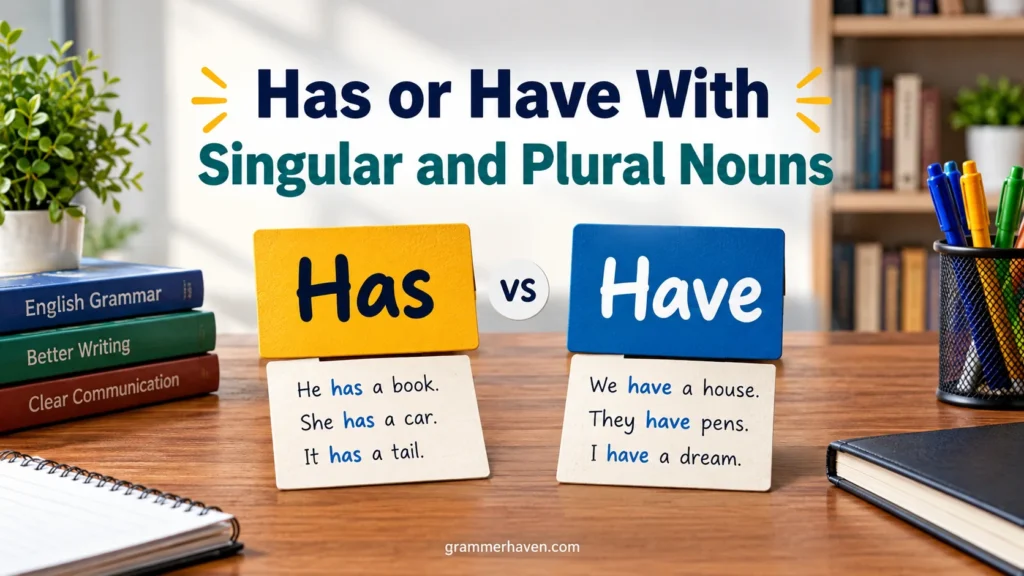
Nouns make the rule particularly clear.
A singular noun normally takes has:
- The student has a book.
- The child has a toy.
- The company has a new policy.
- The car has four doors.
A plural noun takes have:
- The students have books.
- The children have toys.
- The companies have new policies.
- The cars have four doors.
| Singular | Plural |
| The student has a book. | The students have books. |
| The child has a toy. | The children have toys. |
| The company has a policy. | The companies have policies. |
| The car has four doors. | The cars have four doors. |
The important point is that the verb agrees with the subject, not with another noun that happens to appear nearby.
Consider this sentence:
The box of old photographs has been moved.
The word photographs is plural, but it isn’t the subject. Box is the subject, and box is singular.
Therefore:
The box has been moved.
Not:
The box have been moved.
Has or Have in Questions
Questions cause a surprising number of mistakes because English often uses do or does to form questions.
With do, use have:
- Do I have enough time?
- Do you have a pen?
- Do we have a meeting?
- Do they have tickets?
With does, you still use have:
- Does he have a car?
- Does she have enough money?
- Does the machine have a warranty?
Why Is It “Does She Have,” Not “Does She Has”?
This is a crucial rule.
When does carries the third-person singular marking, the main verb returns to its base form.
So:
- ❌ Does she has a car?
- ✅ Does she have a car?
And:
- ❌ Does he has enough time?
- ✅ Does he have enough time?
The same principle applies to other verbs:
- Does she work here?
- Does he know the answer?
- Does it look broken?
You wouldn’t say “Does she works here?” The same logic explains why “Does she have” is correct.
Has or Have in Negative Sentences
Negative sentences follow a similar pattern.
Use don’t have with:
- I
- you
- we
- they
Examples:
- I don’t have enough money.
- You don’t have to worry.
- We don’t have enough chairs.
- They don’t have any tickets.
Use doesn’t have with:
- he
- she
- it
- singular nouns
Examples:
- He doesn’t have a car.
- She doesn’t have enough time.
- It doesn’t have a battery.
- The machine doesn’t have a manual.
Don’t Make This Common Mistake
- ❌ She doesn’t has a car.
- ✅ She doesn’t have a car.
- ❌ He doesn’t has enough time.
- ✅ He doesn’t have enough time.
Why? Because doesn’t already carries the third-person singular form. The following verb stays in its base form: have.
Has or Have in the Present Perfect Tense
Has and have don’t only express possession. They also work as auxiliary verbs in the present perfect tense.
The basic structure is:
has/have + past participle
For example:
- She has finished her work.
- He has arrived.
- They have finished their work.
- We have arrived.
The British Council describes the present perfect as have or has + past participle, connecting a past action or state with the present.
| Subject | Correct Form | Example |
| I | have | I have finished. |
| You | have | You have finished. |
| He | has | He has finished. |
| She | has | She has finished. |
| It | has | It has finished. |
| We | have | We have finished. |
| They | have | They have finished. |
Notice something important: the past participle doesn’t change.
- She has finished.
- They have finished.
The form of have changes. The participle remains the same.
Has or Have as a Main Verb vs. Helping Verb
Compare these two sentences:
She has a car.
Here, has is the main verb. It expresses possession.
She has bought a car.
Here, has is an auxiliary verb. Bought carries the main meaning.
That distinction matters because you’ll encounter has and have in many different grammatical structures.
Has or Have After Modal Verbs
Here’s another rule that catches people off guard:
After a modal verb, use the base form have.
Common modal verbs include:
- can
- could
- may
- might
- must
- should
- will
- would
Examples:
- She can have another chance.
- He might have forgotten.
- They could have arrived earlier.
- You should have called.
- We must have missed the announcement.
Avoid these forms:
- ❌ She can has it.
- ❌ He might has forgotten.
- ❌ They should has known.
The correct form is always:
- can have
- might have
- could have
- should have
- must have
Modal verbs take the base form of the following verb. That’s why have remains unchanged.
Has or Have With Indefinite Pronouns
Some words look plural in meaning but behave as singular subjects.
Words such as everyone, everybody, someone, somebody, anyone, anybody, nobody, no one, each, either, and neither normally take has in standard English.
Examples:
- Everyone has a chance.
- Everybody has an opinion.
- Someone has left a message.
- Nobody has the answer.
- Each student has a locker.
- Neither option has enough support.
Other indefinite pronouns are plural and take have:
- Both have advantages.
- Many have tried.
- Several have responded.
- Few have succeeded.
The trick is simple: don’t decide based only on what the word seems to mean. Learn how the pronoun behaves grammatically.
Has or Have With Collective Nouns
Collective nouns refer to groups:
- team
- family
- company
- committee
- class
- government
- audience
In standard American English, these nouns are generally treated as singular when the group acts as a single unit.
So you would write:
- The team has a new coach.
- The company has a new policy.
- The family has a large house.
- The committee has reached a decision.
The word team refers to several people, but grammatically it functions as a singular noun in these sentences.
This distinction becomes more important when writing professionally. Agreement errors can make otherwise polished writing look careless.
Has or Have With Compound Subjects
When two subjects join with and, the combination is usually plural.
Therefore, use have:
- John and Maria have a house.
- The teacher and student have agreed.
- My brother and sister have arrived.
- The manager and employees have discussed the issue.
However, subjects connected with or or nor can require closer attention.
Compare:
- Either the manager or the employees have the keys.
- Either the employees or the manager has the keys.
The verb often agrees with the subject closest to it. When a sentence sounds awkward, rewriting it can make the agreement much clearer.
Has or Have With Relative Clauses
Words such as who, which, and that can make subject-verb agreement harder to spot.
Look at this example:
The woman who has the red bag is my sister.
The relative pronoun who refers to woman. Since woman is singular, use has.
Now compare:
The women who have the red bags are my sisters.
Here, who refers to women. The antecedent is plural, so use have.
Another Pair
- The car that has the broken window is mine.
- The cars that have broken windows need repairs.
A useful strategy is to identify the noun that the relative pronoun represents. Once you find that noun, the correct form usually falls into place.
Watch Out for Distracting Words
One of the most common subject-verb agreement problems occurs when another noun sits between the subject and the verb.
Consider:
The list of names has been updated.
Some writers see names and instinctively choose have. That’s a trap.
The subject is list.
- List = singular
- Therefore = has
Another example:
The students in the classroom have finished.
Here, the subject is students.
The phrase in the classroom merely gives additional information. It doesn’t control the verb.
A Simple Three-Step Method
When you’re unsure whether to use has or have, follow this process:
- Find the subject.
- Ignore extra phrases temporarily.
- Choose has or have according to the subject.
For example:
The collection of rare books ___ a high value.
Subject: collection
Collection is singular.
Therefore:
The collection of rare books has a high value.
That little mental pause can prevent a surprising number of mistakes.
Has vs. Have in Everyday English
These forms appear constantly in ordinary conversation and writing.
At Work
- She has a meeting at 10.
- We have a deadline tomorrow.
- The company has several offices.
- They have an important presentation.
At School
- He has an exam today.
- I have a question.
- The students have three assignments.
- The teacher has a new lesson plan.
At Home
- My sister has two children.
- We have a large family.
- They have a new house.
- The kitchen has two windows.
With Technology
- This phone has a better camera.
- These phones have larger batteries.
- Does this laptop have a touchscreen?
- The device doesn’t have enough storage.
These examples show why the rule matters. Has and have aren’t rare grammar-book forms. They’re everyday verbs you use constantly.
Has vs. Have: A Complete Comparison
| Situation | Use | Example |
| I | have | I have a plan. |
| You | have | You have a choice. |
| He | has | He has a car. |
| She | has | She has a job. |
| It | has | It has a problem. |
| We | have | We have time. |
| They | have | They have tickets. |
| Singular noun | has | The dog has food. |
| Plural noun | have | The dogs have food. |
| Do + subject | have | Do they have time? |
| Does + subject | have | Does she have time? |
| Don’t + subject | have | They don’t have time. |
| Doesn’t + subject | have | He doesn’t have time. |
| Modal + verb | have | She might have time. |
| Third-person singular present perfect | has | She has finished. |
| Other present perfect subjects | have | They have finished. |
Common Has vs. Have Mistakes
The following errors appear often because writers focus on the nearest word instead of the actual subject.
| Incorrect | Correct | Reason |
| She have a car. | She has a car. | She is third-person singular. |
| They has a problem. | They have a problem. | They takes have. |
| I has a question. | I have a question. | I takes have. |
| Does he has time? | Does he have time? | Does requires the base form. |
| She doesn’t has it. | She doesn’t have it. | Doesn’t already carries the agreement. |
| The students has books. | The students have books. | Students is plural. |
| Everyone have a choice. | Everyone has a choice. | Everyone is grammatically singular. |
| The box of books have arrived. | The box of books has arrived. | Box is the subject. |
Has or Have: A Simple Trick That Works
When you’re stuck, ask one question:
Who or what has or have something?
For example:
The dog ___ four legs.
Who has four legs?
The dog.
Dog is singular, so:
The dog has four legs.
Now change it:
The dogs ___ four legs.
Who have four legs?
The dogs.
Dogs is plural, so:
The dogs have four legs.
This method works especially well when a sentence contains several nouns.
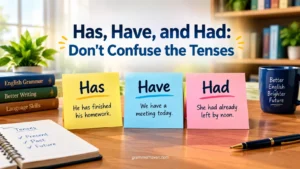
Has, Have, and Had: Don’t Confuse the Tenses
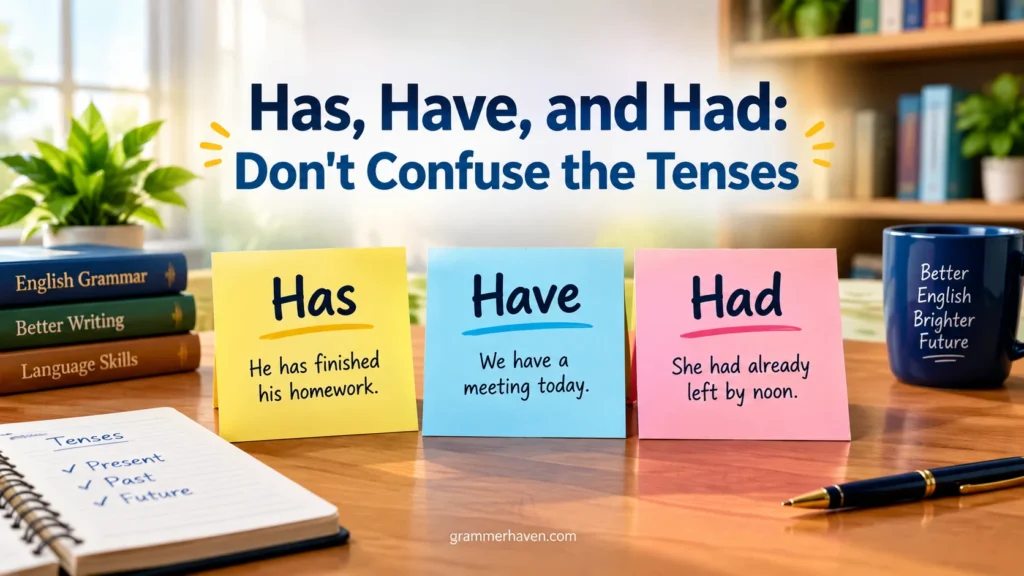
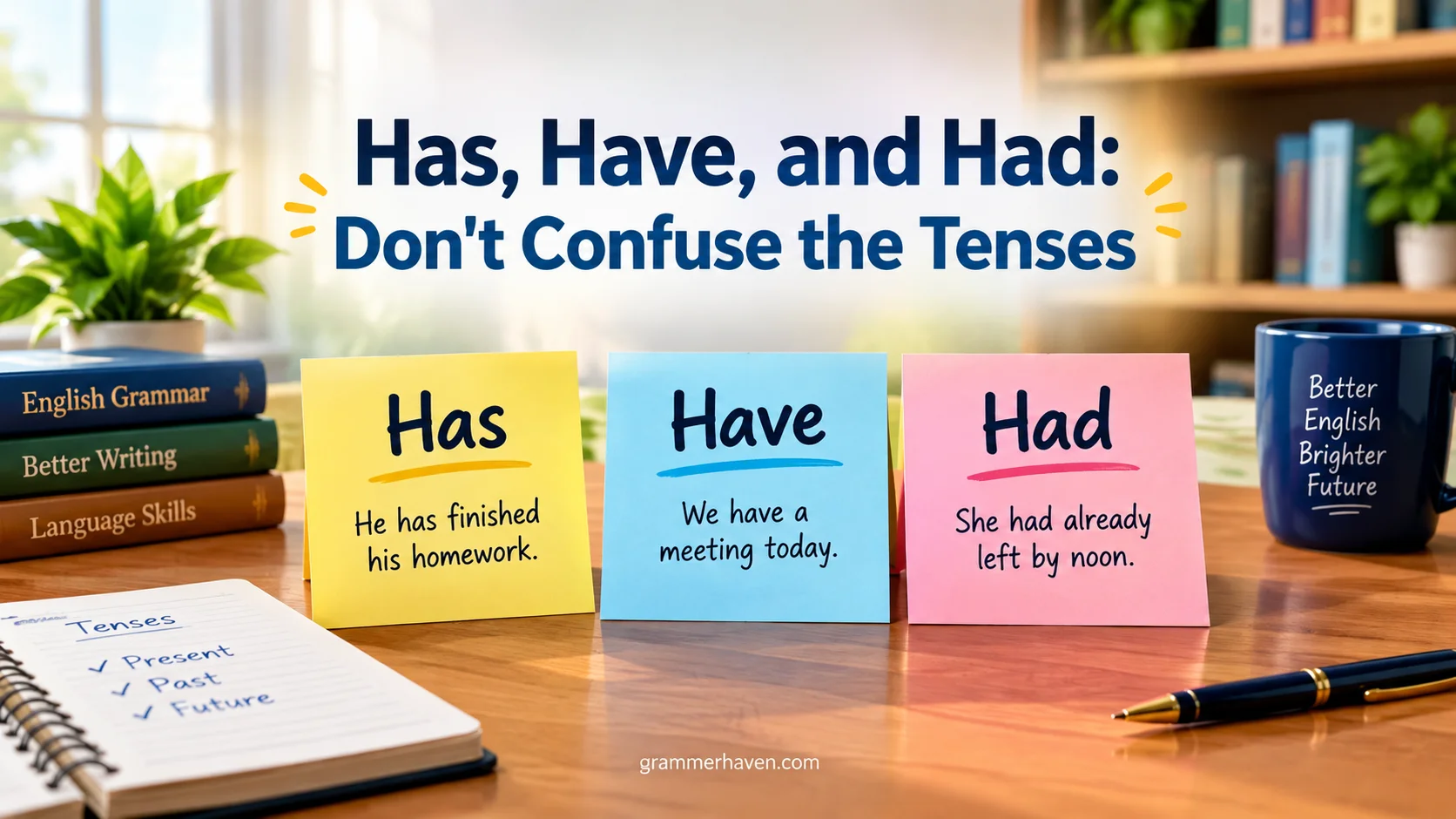
Has and have are present-tense forms. Had is the past-tense form and works with every subject.
| Subject | Present | Past |
| I | I have | I had |
| You | You have | You had |
| He | He has | He had |
| She | She has | She had |
| We | We have | We had |
| They | They have | They had |
For example:
- She has a car now.
- She had a car last year.
- They have enough money now.
- They had enough money before.
Unlike has and have, had doesn’t change based on the subject.
Has or Have With “Have Got”
You’ll also encounter has got and have got, especially when talking about possession or characteristics.
Examples include:
- I have got a new phone.
- She has got a new job.
- They have got two children.
- He has got blue eyes.
The British Council notes that have got commonly expresses possession, family relationships, appearance, illnesses, scheduled events, and abstract things. It also explains that have got and have can often carry the same meaning.
In everyday American English, you’ll often hear:
- I have a new phone.
- Do you have a car?
- She doesn’t have enough time.
The have got construction remains perfectly familiar in English, particularly in British usage.
Practice: Choose Has or Have
Test yourself before checking the answers.
- She ___ a new laptop.
- They ___ three children.
- I ___ a question.
- The dog ___ a long tail.
- We ___ enough food.
- Does he ___ a ticket?
- Everyone ___ a responsibility.
- The students ___ their books.
- He doesn’t ___ enough time.
- You ___ several options.
- The company ___ three offices.
- My parents ___ a new car.
- The list of names ___ been updated.
- Both ___ valid points.
- Each student ___ a locker.
Answer Key
| # | Answer | Complete Sentence |
| 1 | has | She has a new laptop. |
| 2 | have | They have three children. |
| 3 | have | I have a question. |
| 4 | has | The dog has a long tail. |
| 5 | have | We have enough food. |
| 6 | have | Does he have a ticket? |
| 7 | has | Everyone has a responsibility. |
| 8 | have | The students have their books. |
| 9 | have | He doesn’t have enough time. |
| 10 | have | You have several options. |
| 11 | has | The company has three offices. |
| 12 | have | My parents have a new car. |
| 13 | has | The list of names has been updated. |
| 14 | have | Both have valid points. |
| 15 | has | Each student has a locker. |
Final Has vs. Have Cheat Sheet
If you only remember one section, make it this one.
Use HAS with:
- He
- She
- It
- Singular nouns
- Singular names
- Everyone
- Everybody
- Someone
- Somebody
- Anyone
- Anybody
- Nobody
- No one
- Each
- Either
- Neither
Use HAVE with:
- I
- You
- We
- They
- Plural nouns
- Both
- Many
- Several
- Few
- After do
- After does
- After don’t
- After doesn’t
- After modal verbs such as can, could, might, and should
The four rules worth memorizing
He, she, it → has
I, you, we, they → have
Does + subject → have
Modal verb + subject → have
Once those patterns become automatic, most has or have questions become remarkably easy.
See also: Has Been or Have Been: Which Is Correct?
FAQs:
Is it “he has” or “he have”?
He has is correct.
He has a new job.
“He” is a third-person singular subject.
Is it “she has” or “she have”?
She has is correct.
She has two sisters.
Is it “I has” or “I have”?
I have is correct.
I have a question.
Although I is singular, English uses have with it.
Is it “you has” or “you have”?
You have is correct.
You have enough time.
This applies whether you refers to one person or several people.
Is it “they has” or “they have”?
They have is correct.
They have three children.
Is it “does he have” or “does he has”?
Does he have is correct.
Does he have a passport?
After does, use the base form have.
Is it “does she have” or “does she has”?
Does she have is correct.
Does she have enough money?
Again, does carries the third-person singular marking.
Is it “everyone has” or “everyone have”?
Everyone has is standard.
Everyone has a responsibility.
Everyone is grammatically singular.
Is “has” past tense?
No. Has is a present-tense form of have.
The past-tense form is had.
Is “have” always plural?
No. That’s an oversimplification.
Have works with plural subjects, but it also appears with I and you.
So:
- I have
- You have
- We have
- They have
That’s why memorizing “has = singular, have = plural” alone can lead you into trouble.
Conclusion:
Understanding Has or Have becomes easier when you focus on the subject of the sentence. Use has with singular third-person subjects such as he, she, and it, and use have with I, you, we, they, and plural subjects. This simple rule also helps you handle questions, negative sentences, and the present perfect tense with greater confidence.
Pay attention to the subject rather than the words around it. With regular practice and clear examples, you can avoid common mistakes and choose the correct form naturally in both everyday and formal English.