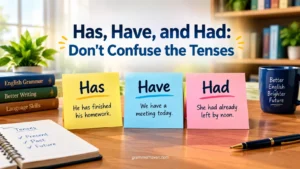
Has Been or Have Been can seem similar, but the subject decides the correct choice, so learners should check who or what performs the action before choosing a form. Use has been with he, she, it, or a singular noun; have been works with I, you, we, they, or a plural noun. The forms cannot be used interchangeably.
This simple-looking rule often leaves English learners and professionals confused when choosing the right form. To understand the difference, consider this example: She has been working all day, while I have been working all day. The distinction also appears with a student and students: The student has been studying, while The students have been studying.
Quick Answer: Has Been or Have Been?
“Has been” is correct with third-person singular subjects such as he, she, it, and singular nouns. “Have been” is correct with I, you, we, they, and plural nouns.
| Subject | Correct Form | Example |
| I | have been | I have been busy. |
| You | have been | You have been helpful. |
| He | has been | He has been working. |
| She | has been | She has been studying. |
| It | has been | It has been difficult. |
| We | have been | We have been waiting. |
| They | have been | They have been traveling. |
| Singular noun | has been | The dog has been sleeping. |
| Plural noun | have been | The dogs have been sleeping. |
A simple shortcut works in most cases:
He, she, it → has been
I, you, we, they → have been
That small rule solves a surprisingly large number of grammar questions.
What Does “Has Been” Mean?
Has been combines has, the third-person singular form of have, with been, the past participle of be. Oxford Learner’s Dictionaries identifies been as the past participle of be and go.
You commonly see has been in present perfect sentences.
For example:
- She has been sick.
- He has been busy.
- The weather has been beautiful.
- The company has been successful.
The phrase can describe a state that began in the past and still matters now. The present perfect commonly connects a past situation with the present.
Consider this example:
Maria has been sick for three days.
The illness started in the past, but the sentence suggests that it remains relevant now.
When Should You Use “Has Been”?
Use has been with:
- He
- She
- It
- A singular person’s name
- A singular noun
- A singular organization, object, place, or concept
Examples:
- James has been absent today.
- The car has been unreliable lately.
- The company has been growing quickly.
- My sister has been busy this week.
- The weather has been unusually warm.
The key isn’t the length of the subject. It is its grammatical number.
For instance:
The group of students has been waiting.
Although students is plural, the subject is group, which is singular in this construction. Therefore, has been is correct.
What Does “Have Been” Mean?
Have been uses the present form have with subjects such as I, you, we, they, and plural nouns.
Examples include:
- I have been busy.
- You have been patient.
- We have been friends for years.
- They have been working all morning.
- The students have been studying.
The underlying grammar is the same as with has been. Only the subject changes.
Compare these sentences:
She has been waiting for an hour.
They have been waiting for an hour.
The activity and time period are identical. The subject determines whether you use has or have.
Has Been vs. Have Been: The Basic Grammar Rule
The easiest way to understand the difference is to focus on subject-verb agreement.
English changes the form of have according to the subject in the present perfect.
| Subject Type | Use |
| First-person singular: I | have been |
| Second-person singular: you | have been |
| Third-person singular: he/she/it | has been |
| First-person plural: we | have been |
| Third-person plural: they | have been |
| Singular noun | has been |
| Plural noun | have been |
So these are correct:
- I have been learning English.
- She has been learning English.
- We have been learning English.
- They have been learning English.
The verb phrase changes because the subject changes.
Why “Has Been” and “Have Been” Are Present Perfect Forms
The present perfect follows this basic structure:
Subject + has/have + past participle
Because been is the past participle of be, we get:
- She has been
- He has been
- I have been
- They have been
The present perfect commonly describes past actions, experiences, or states that connect to the present. It can also describe something that started in the past and continues now.
For example:
She has been a teacher for ten years.
The sentence doesn’t merely tell you about a finished period in the past. It suggests that she became a teacher ten years ago and remains a teacher now.
Likewise:
They have been friends since childhood.
Their friendship began in the past and continues into the present.
Has Been in Different Sentence Patterns
Has been can do more than describe someone’s condition. It appears in several useful constructions.
Has Been + Adjective
Use this pattern to describe a condition or state.
- The movie has been excellent.
- She has been tired lately.
- The weather has been terrible.
- He has been very helpful.
Here, been links the subject to an adjective.
Has Been + Noun
You can also use has been before a noun or noun phrase.
- She has been a doctor for fifteen years.
- He has been the team captain since January.
- The building has been a museum for decades.
The construction describes an identity, role, or classification that connects the past with the present.
Has Been + Prepositional Phrase
This pattern describes location or circumstances.
- She has been at home all day.
- He has been in London since Monday.
- The package has been on the desk for hours.
Has Been + Verb-ing
This creates the present perfect continuous.
- She has been studying all morning.
- He has been working since 8 a.m.
- The company has been expanding rapidly.
The present perfect continuous uses has/have + been + -ing and often emphasizes an activity that continues into the present or has recently stopped.
Have Been in Different Sentence Patterns

The same sentence patterns work with have been, but the subject must fit.
Have Been + Adjective
- We have been busy.
- They have been helpful.
- You have been patient.
Have Been + Noun
- We have been friends for years.
- They have been teachers since 2015.
- I have been a member since June.
Have Been + Prepositional Phrase
- We have been at home all evening.
- They have been in the office since morning.
- I have been at this company for five years.
Have Been + Verb-ing
- I have been studying.
- We have been waiting.
- They have been working.
Oxford’s grammar guidance gives the same core structure: subject + have + been + -ing form, with has replacing have for he, she, and it.
Has Been vs. Have Been in the Present Perfect Continuous
This is where the distinction becomes especially visible.
The formula is:
Subject + has/have + been + verb-ing
Examples:
- She has been reading.
- He has been sleeping.
- I have been reading.
- They have been sleeping.
The present perfect continuous often emphasizes duration, ongoing activity, or a recent activity with a present result.
Consider:
He has been running, so he’s tired.
The running happened recently and explains his current condition.
Now compare:
They have been working for six hours.
The sentence focuses on the duration of the activity.
Has Been vs. Have Been With “For”
Use for when you give a length of time.
- She has been working for three hours.
- They have been waiting for twenty minutes.
- I have been studying for two years.
Has Been vs. Have Been With “Since”
Use since when you identify the starting point.
- She has been working since 9 a.m.
- They have been waiting since noon.
- I have been studying English since 2022.
A useful memory trick is:
For = how long
Since = when it started
Both forms commonly appear with present perfect constructions describing continuing situations.
Has Been or Have Been With Singular and Plural Nouns
Nouns can make the choice slightly trickier because sentences sometimes contain several nouns.
Singular Noun → Has Been
- The student has been absent.
- My brother has been working.
- The computer has been running all night.
- The restaurant has been busy.
Plural Noun → Have Been
- The students have been absent.
- My brothers have been working.
- The computers have been running all night.
- The restaurants have been busy.
Here’s the trap:
The box of books has been moved.
Not:
The box of books have been moved.
The word books is plural, but it isn’t the main subject. Box is the subject.
Think of the sentence as having a grammatical spotlight. The spotlight falls on box, not books.
Tricky Cases With Has Been and Have Been
Some sentence structures can fool even experienced writers.
Each and Every
Each and every normally take singular agreement.
- Each student has been given a book.
- Every employee has been trained.
Even though these sentences refer to multiple people collectively, the grammatical subject remains singular.
One of the…
The same principle applies to one of the.
- One of the students has been absent.
- One of the cars has been damaged.
Don’t let the plural noun immediately after one of trick you.
The subject is one.
Collective Nouns
In standard American English, collective nouns such as team, committee, family, and company commonly take singular verbs when the group acts as one unit.
- The team has been practicing.
- The committee has been meeting weekly.
- The company has been expanding.
The exact treatment of collective nouns can vary across English varieties and depending on whether the writer emphasizes the group as a unit or its individual members. For general American English writing, singular agreement is usually the safest choice when the group acts collectively.
Compound Subjects With “And”
When two subjects join with and, use have been in ordinary cases.
- John and Maria have been friends for years.
- The teacher and students have been working together.
- The manager and assistant have been discussing the issue.
Why? The compound subject represents more than one person or thing.
“There Has Been” vs. “There Have Been”
This pair causes plenty of confusion.
Use there has been with a singular noun or an uncountable noun:
- There has been a problem.
- There has been an accident.
- There has been some confusion.
Use there have been with a plural noun:
- There have been several problems.
- There have been three accidents.
- There have been many changes.
Compare them:
| Sentence | Correct? | Reason |
| There has been a problem. | Yes | Problem is singular. |
| There have been problems. | Yes | Problems is plural. |
| There has been several problems. | No | Problems is plural. |
| There have been several problems. | Yes | Problems is plural. |
The noun that follows there has/have been determines the form in these constructions.
Has Been or Have Been in Questions
Questions simply move has or have before the subject.
Questions With Has Been
- Has she been working?
- Has he been sleeping?
- Has the project been completed?
- Has your brother been there before?
Questions With Have Been
- Have you been working?
- Have they been waiting long?
- Have we been here before?
- Have the students been studying?
For present perfect questions, have or has comes before the subject. Oxford’s grammar guidance follows this pattern for both yes/no and wh-questions.
You can also ask about experience:
Have you ever been to New York?
Has she ever been to Canada?
The present perfect commonly describes experiences up to the present.
Hasn’t Been vs. Haven’t Been
The negative forms follow exactly the same subject-agreement rule.
Use “Hasn’t Been”
- He hasn’t been feeling well.
- She hasn’t been home today.
- The store hasn’t been open.
Use “Haven’t Been”
- I haven’t been feeling well.
- We haven’t been there before.
- They haven’t been informed.
- The employees haven’t been paid.
| Full Form | Contraction |
| has not been | hasn’t been |
| have not been | haven’t been |
Contractions such as I’ve, he’s, she’s, haven’t, and hasn’t are common in conversational English and informal writing.
Has Been vs. Had Been
Don’t confuse has been and have been with had been.
| Form | General Tense | Example |
| has been | Present perfect | She has been busy. |
| have been | Present perfect | They have been busy. |
| had been | Past perfect | They had been busy before the meeting. |
The important difference is the time relationship.
Has been and have been connect a past situation to the present.
She has been sick for three days.
Had been places one past situation before another past event.
She had been sick before the trip began.
Notice another useful feature: had been doesn’t change according to the subject.
- I had been
- He had been
- She had been
- We had been
- They had been
That makes had been easier to form but different in meaning.
Has Been vs. Was
Another common mistake involves has been and was.
Compare:
She has been sick for three days.
She was sick last Monday.
The first sentence presents the situation as connected to the present. The second describes a completed past situation.
Present perfect generally doesn’t combine with finished-time expressions such as yesterday, last week, last year, or in 2017. The British Council specifically warns against using present perfect with finished past-time references.
So:
- She was sick yesterday. ✅
- She has been sick since yesterday. ✅
- She has been sick yesterday. ❌
The difference is subtle but important.
Has Been vs. Have Been vs. Been
Remember that been by itself doesn’t tell you whether the sentence is grammatically complete.
For example:
She has been happy.
They have been happy.
The word been remains unchanged. The auxiliary verb changes.
This is why the real choice isn’t technically between two forms of been. The choice is between has and have before been.
Has Been vs. Have Been: Common Mistakes
Here are some of the errors worth catching immediately.
| Incorrect | Correct | Explanation |
| He have been working. | He has been working. | He takes has. |
| They has been waiting. | They have been waiting. | They takes have. |
| I has been there. | I have been there. | I takes have. |
| The students has been studying. | The students have been studying. | Students is plural. |
| One of the students have been absent. | One of the students has been absent. | The subject is one. |
| There has been several problems. | There have been several problems. | Problems is plural. |
| She have been sick. | She has been sick. | She takes has. |
These aren’t differences in style. They’re differences in grammatical agreement.
A Simple Way to Choose the Correct Form
When you’re unsure whether to write has been or have been, don’t stare at the entire sentence. Break it down.
Find the Subject
Ask:
Who or what are you talking about?
For example:
The group of employees ___ working late.
The subject is group, not employees.
Replace the Subject With a Pronoun
Ask which pronoun fits.
- Group → it
- Employees → they
Because the grammatical subject is group, use has:
The group of employees has been working late.
Check the Verb
Use:
- has been → he, she, it, singular nouns
- have been → I, you, we, they, plural nouns
Check the Time Meaning
If you’re using the present perfect, make sure the sentence connects the past with the present. If you mention a finished past time, the simple past may be more appropriate.
Real-World Examples of Has Been and Have Been

Grammar becomes easier when you see how these phrases work in ordinary situations.
At Work
The manager has been in meetings all morning.
The employees have been working on the project.
The first sentence has a singular subject. The second has a plural subject.
At School
The student has been absent this week.
The students have been preparing for their exams.
Again, the subject determines the auxiliary verb.
In Conversation
Where have you been?
Has Sarah been here today?
We have been waiting for you.
These forms appear constantly in everyday speech.
When Talking About Experience
I have been to Chicago twice.
She has been to Chicago twice.
The meaning stays essentially the same. The subject changes, so have changes to has.
The British Council notes that have/has been can describe a visit where someone went somewhere and returned. By contrast, have/has gone generally indicates that the person has not returned.
Has Been vs. Have Been: A Useful Comparison
| Feature | Has Been | Have Been |
| He | ✅ | ❌ |
| She | ✅ | ❌ |
| It | ✅ | ❌ |
| I | ❌ | ✅ |
| You | ❌ | ✅ |
| We | ❌ | ✅ |
| They | ❌ | ✅ |
| Singular noun | ✅ | ❌ |
| Plural noun | ❌ | ✅ |
| Present perfect | ✅ | ✅ |
| Present perfect continuous | ✅ | ✅ |
The meaning isn’t inherently different because of has versus have. The subject determines which form belongs in the sentence.
Has Been or Have Been: Quick Practice
Test yourself with these sentences.
- She ___ been working all day.
- They ___ been waiting outside.
- I ___ been there before.
- The dog ___ been sleeping.
- The dogs ___ been sleeping.
- One of the employees ___ been promoted.
- There ___ been several changes.
- There ___ been a major change.
Answers
- has
- have
- have
- has
- have
- has
- have
- has
The pattern becomes almost automatic once you identify the subject.
Has Been or Have Been: Final Rule
The distinction is straightforward once you strip away the extra words.
Use “has been” with he, she, it, and singular nouns.
- He has been busy.
- She has been studying.
- The company has been growing.
Use “have been” with I, you, we, they, and plural nouns.
- I have been busy.
- You have been studying.
- We have been working.
- They have been growing.
The biggest trap comes from sentences with extra nouns.
The box of old photographs has been damaged.
Not have been, because box is the subject.
Once you learn to find the subject first, the choice between has been and have been becomes much less mysterious. Think of it as a grammatical traffic signal: he, she, it, and singular nouns take “has,” while I, you, we, they, and plural nouns take “have.”
See also: Colon vs. Semicolon: How to Use Them Correctly?
FAQs:
Is “has been” singular or plural?
Has been normally goes with a third-person singular subject, such as he, she, it, or a singular noun.
Is “have been” singular or plural?
Have been goes with I, you, we, they, and plural nouns.
Is “I has been” correct?
No. The standard form is I have been.
Is “he have been” correct?
No. Use he has been.
Is “they has been” correct?
No. Use they have been.
Which is correct: “there has been” or “there have been”?
Both can be correct. Use there has been with a singular or uncountable noun and there have been with a plural noun.
- There has been a mistake.
- There have been several mistakes.
What is the difference between “has been” and “have been”?
The main difference is subject agreement. Both can form present perfect constructions, but has pairs with third-person singular subjects while have pairs with I, you, we, they, and plural subjects.
What is the difference between “has been” and “had been”?
Has been generally forms part of the present perfect and connects a past situation to the present. Had been forms part of the past perfect and places one past situation before another past event.
Can “has been” and “have been” be used with -ing verbs?
Yes. They form the present perfect continuous:
- She has been working.
- They have been working.
This construction commonly emphasizes an activity that has continued over time or has recently stopped.
Conclusion:
Choosing between has been and have been becomes easier when you check the subject first. Use has been with singular subjects such as he, she, and it, while have been goes with I, you, we, they, and plural subjects. With regular practice, this simple rule can help you use both forms correctly and write clearer English.