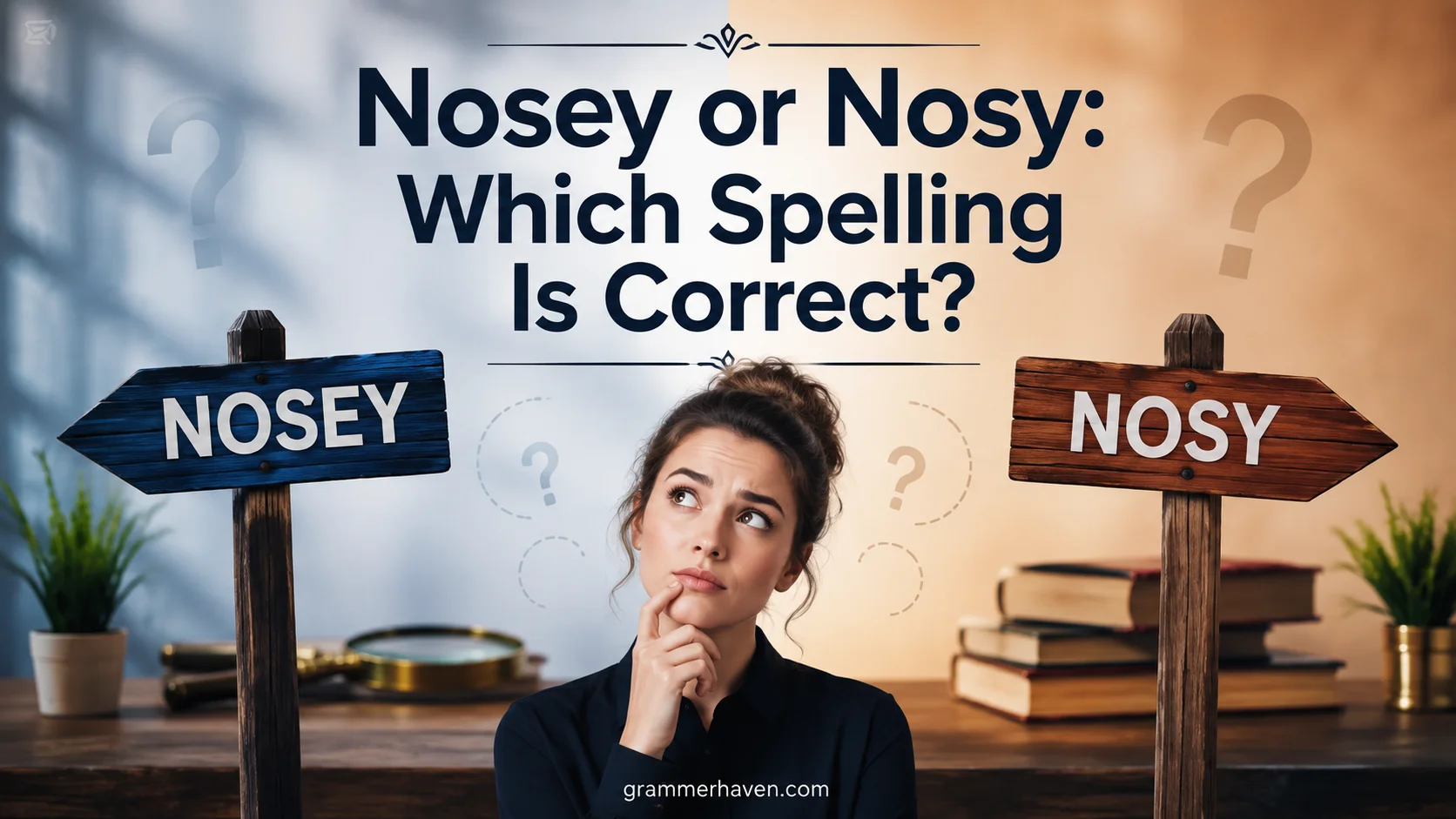
Nosey or Nosy: Which Spelling Is Correct? Many people have typed this question, searched for an answer, and wondered which spelling is correct because both versions exist, share the same meaning, pronunciation, and sound, yet only Nosy is the preferred written English form today. Every month, thousands of people, including English learners and native speakers, face the same confusion. The small difference between the two words may seem minor, but choosing the right form with confidence improves your writing, conversation, and overall communication. The origin of the word, interest in other people’s business, geography, style, and audience all influenced its development. When you compare British English and American English, you’ll see they are closely related, although usage and spelling rules can differ. Building a better understanding of this distinction helps students, writers, and professionals avoid spelling mistakes in every email, blog, article, and social media post.
Nosy or Nosey: The Short Answer
If you’re looking for the quick answer, here it is.
Nosy is the preferred spelling in modern American English.
Nosey is an accepted alternative spelling, but it’s less common and appears far less frequently in edited writing.
Both spellings have the same meaning, pronunciation, and grammatical function. The difference lies mainly in usage and preference rather than correctness.
| Spelling | Correct? | Preferred in US English | Recommended for Formal Writing |
| Nosy | ✔ Yes | ✔ Yes | ✔ Yes |
| Nosey | ✔ Yes | Less common | Usually not |
The safest choice
If you’re unsure which spelling to use, choose nosy.
You’ll see it more often in:
- Newspapers
- Books
- Academic writing
- Business communication
- Professional websites
- Modern publications
While nosey isn’t wrong, many editors automatically replace it with nosy for consistency.
What Does “Nosy” Mean?
The adjective nosy describes someone who takes too much interest in other people’s private lives or personal matters.
A nosy person often asks questions that aren’t their business, listens to private conversations, or tries to discover information that doesn’t concern them.
Simple definition
Nosy: excessively curious about other people’s affairs.
The word almost always carries a negative meaning.
For example:
- My neighbor is so nosy that she notices every visitor.
- Stop asking nosy questions.
- He looked through my desk, which felt incredibly nosy.
Being curious isn’t necessarily bad. Being nosy usually means crossing personal boundaries.
Everyday Situations Where “Nosy” Applies
You probably encounter nosy behavior more often than you realize.
Examples include:
- Asking someone how much money they earn.
- Reading another person’s text messages.
- Listening to private conversations.
- Looking through someone else’s belongings.
- Demanding details about someone’s relationship.
- Constantly checking what neighbors are doing.
Notice the pattern?
The issue isn’t curiosity itself.
It’s unwanted curiosity.
Synonyms of Nosy
Different situations call for different words.
| Word | Meaning Difference |
| Curious | Wants to learn; usually neutral |
| Inquisitive | Naturally interested; often positive |
| Meddlesome | Interferes with others |
| Intrusive | Invades personal space |
| Snoopy | Informal way to describe nosy behavior |
| Prying | Trying to discover secrets |
| Interfering | Gets involved unnecessarily |
Opposites of Nosy
Some useful antonyms include:
- Respectful
- Discreet
- Reserved
- Private
- Unobtrusive
- Considerate
- Mindful
These words describe people who respect boundaries instead of crossing them.
Why Are There Two Spellings: Nosey and Nosy?
This is where things become interesting.
English spelling doesn’t always follow simple rules. Many words have developed multiple accepted spellings over centuries of use.
The word nosy comes from the noun nose.
Historically, English speakers imagined that someone who constantly “sticks their nose” into other people’s business deserved a special adjective.
Eventually, that adjective became nosy.
However, because the word clearly comes from nose, many writers naturally began spelling it nosey.
Both spellings spread.
Over time, publishers, dictionaries, and style guides gradually favored nosy, making it today’s standard spelling.
How Language Evolves
English changes continuously.
Consider these examples:
| Older or Alternative Form | Preferred Modern Form |
| Judgement | Judgment (US) |
| Grey | Gray (US preference) |
| Catalogue | Catalog (US preference) |
| Axe | Ax (common US preference) |
| Nosey | Nosy (preferred) |
Language evolves because people naturally simplify spelling over time.
Why “Nosy” Won
Several reasons explain why nosy became dominant.
Simpler spelling
People generally prefer shorter spellings.
Removing unnecessary letters makes words easier to read and write.
Publishing standards
Major publishers gradually standardized nosy.
When newspapers, magazines, and books repeatedly use one spelling, readers become accustomed to it.
Dictionary recommendations
Modern dictionaries usually list nosy first while identifying nosey as a variant spelling.
That ordering influences schools, editors, and style guides.
Which Dictionaries Accept Nosy and Nosey?
Nearly every major English dictionary recognizes both spellings.
However, they don’t always give them equal weight.
| Dictionary | Nosy | Nosey | Notes |
| Merriam-Webster | ✔ | ✔ | Nosey listed as a variant |
| American Heritage | ✔ | ✔ | Nosy preferred |
| Collins | ✔ | ✔ | Both accepted |
| Oxford | ✔ | ✔ | Variant spelling acknowledged |
| Cambridge | ✔ | Limited | Focuses primarily on nosy |
The important takeaway isn’t whether nosey appears.
It’s how it appears.
Most dictionaries list nosy as the main entry.
That signals which spelling modern writers should generally choose.
What Does “Variant Spelling” Mean?
People sometimes misunderstand dictionary entries.
If a dictionary labels nosey as a variant spelling, it doesn’t mean the word is incorrect.
Instead, it means:
- The spelling exists.
- Native speakers use it.
- Readers recognize it.
- Another spelling is generally preferred.
Think of it as choosing between two roads that reach the same destination.
One road simply gets much more traffic.
Is “Nosey” Wrong?
No.
This point deserves emphasis because it’s one of the biggest misconceptions surrounding the word.
Nosey is not wrong.
It isn’t a grammar mistake.
It isn’t an invented word.
However, because nosy appears much more frequently in professional writing, many readers assume nosey is incorrect.
That’s understandable.
Most people rarely encounter the variant spelling.
Why Editors Usually Change “Nosey”
Professional editing focuses heavily on consistency.
Editors often replace nosey with nosy because:
- It matches common style guides.
- Readers expect it.
- It looks more familiar.
- It reduces distractions.
- It creates consistency across publications.
This doesn’t mean nosey lacks legitimacy.
It simply reflects modern editorial preference.
When Is It Fine to Use “Nosey”?
You might intentionally use nosey in situations like:
- Writing dialogue for a character.
- Quoting historical documents.
- Preserving regional spelling.
- Matching a publication’s house style.
- Reproducing original texts.
Creative writing sometimes values authenticity over strict standardization.
Nosy vs. Nosey: Side-by-Side Comparison
The easiest way to understand the difference is to compare them directly.
| Feature | Nosy | Nosey |
| Meaning | Same | Same |
| Pronunciation | Same | Same |
| Dictionary accepted | ✔ | ✔ |
| Preferred American spelling | ✔ | |
| Common in professional writing | ✔ | Less common |
| Suitable for academic work | ✔ | Usually avoided |
| Seen in creative writing | ✔ | Sometimes |
| Modern recommendation | ✔ | Acceptable variant |
Quick Comparison at a Glance
NOSY
│
Preferred modern spelling
│
Newspapers • Schools • Books
│
Business • Academic Writing
│
Best everyday choice
NOSEY
│
Accepted alternative spelling
│
Less common in edited publications
│
Often appears in regional or informal writing
Real-World Examples
Consider these sentences.
✔ The nosy neighbor watched everyone who walked down the street.
✔ My aunt isn’t trying to be rude. She’s just a little nosy.
✔ The reporter asked several nosy questions.
Now compare them with the alternative spelling.
✔ The nosey neighbor watched everyone who walked down the street.
✔ She’s a nosey child who wants to know everything.
Both versions communicate the exact same meaning.
The first simply aligns with modern writing conventions more closely.
Case Study: Why One Letter Can Affect Reader Perception
Imagine two companies publishing customer newsletters.
Company A
“Our nosey employees love learning about customer needs.”
Company B
“Our nosy employees love learning about customer needs.”
Neither sentence is ideal because nosy has a negative meaning. However, most readers will immediately recognize the second spelling as standard. The first may cause some to pause and wonder whether it’s a typo.
This illustrates an important principle of professional writing: choosing the most familiar accepted spelling helps readers focus on your message instead of your word choice.
“Good writing removes distractions. The best spelling is often the one readers notice the least.”
See also: Bougie or Boujee: Which Spelling Is Correct?
FAQs:
1. Is Nosy or Nosey the correct spelling?
Nosy is the preferred spelling in modern English, especially in dictionaries and style guides. Nosey is an accepted variant but is much less common.
2. Do Nosy and Nosey have different meanings?
No. Both words have the same meaning. They describe someone who is too interested in other people’s private matters.
3. Is Nosey wrong?
Not exactly. Nosey isn’t incorrect, but it appears less often than Nosy in modern writing. If you’re unsure, Nosy is the safer choice.
4. Does British English use Nosey instead of Nosy?
Both spellings can be found in British English, although Nosy is still widely used. Your choice should match the style guide or audience you’re writing for.
5. Which spelling should I use in school, work, or professional writing?
Use Nosy. It is the standard spelling in most dictionaries and is the best option for academic, business, and professional writing.
Conclusion:
Choosing between Nosey and Nosy is easier once you know the difference. While both spellings share the same meaning and pronunciation, Nosy is the standard and more widely accepted form in modern English. Using the preferred spelling keeps your writing clear, consistent, and professional, whether you’re writing an email, a blog post, or a social media update.