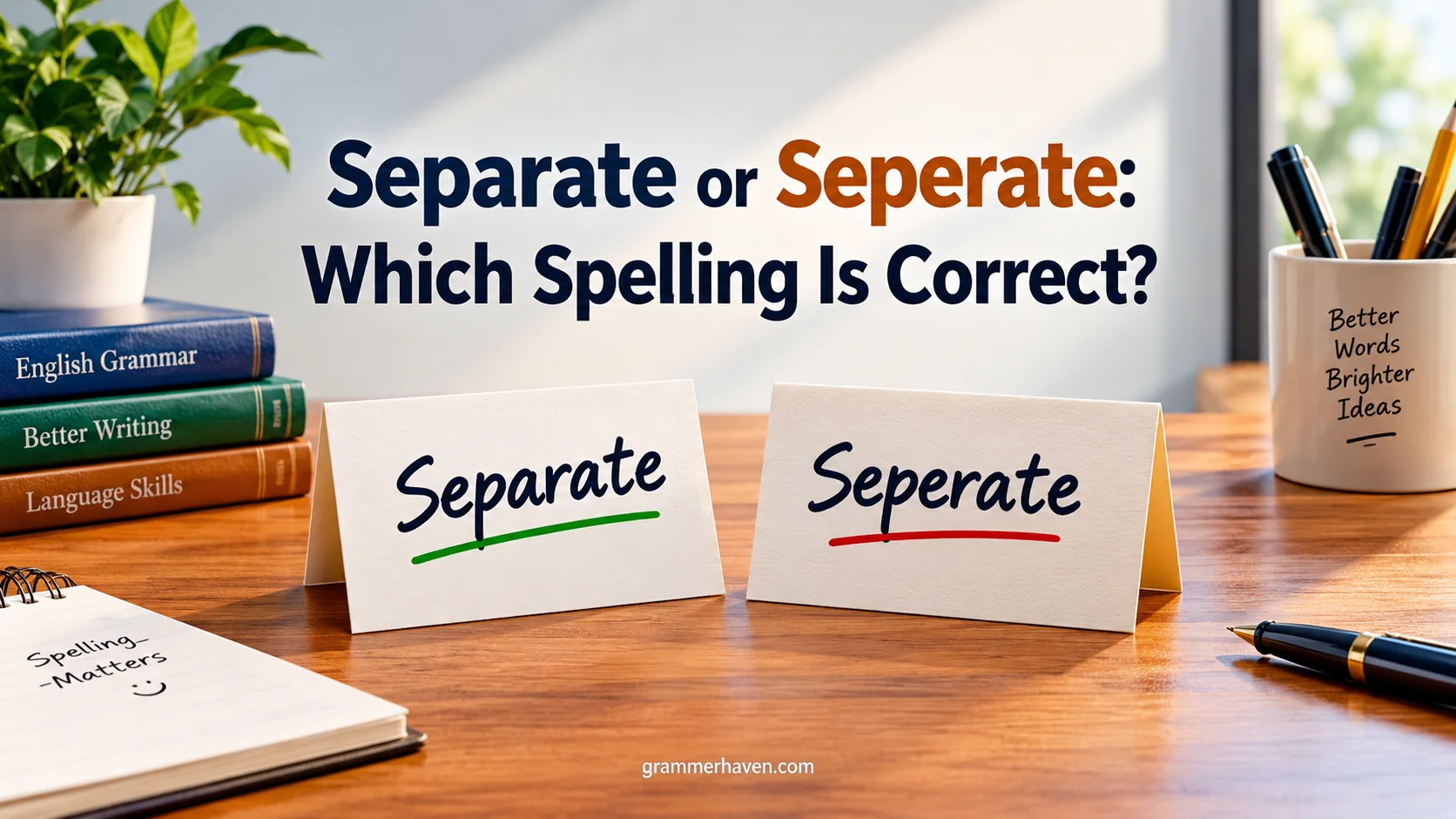
Separate or Seperate: separate is the correct spelling, while seperate is an incorrect spelling and a common spelling mistake in the English language. The standard English word separate can mean keeping things apart, distinct, or divided, depending on the context. Its pronunciation may cause confusion because the middle vowel has a weak, unclear sound, which can make the spelling difficult to remember.
A useful memory trick is to remember the a in separate and its spelling pattern. This helps students, professionals, and native speakers avoid the mistake when typing or writing emails, worksheets, and social posts. The word may look simple at first glance, but the small vowel difference makes seperate seem reasonable to some people.
The good news is that the standard spelling becomes easier to understand with practice. When people search for this keyword, they often want a quick answer, clear rules, word history, and real examples showing why the two forms are not the same. Separate is the English word to use, while seperate is a wrong form caused by a typing error or spelling confusion. This guide can help you feel confident about the correct form and recognize this surprisingly common error quickly.
Quick Answer: Separate or Seperate?
Separate is the correct spelling. Seperate is a misspelling.
| Word | Correct? | Meaning |
| Separate | ✅ Yes | Apart, distinct, divided, or kept apart |
| Seperate | ❌ No | Common misspelling of separate |
The correct spelling is:
S-E-P-A-R-A-T-E
A useful way to see the spelling is:
SEP-A-RATE
The incorrect form replaces the middle A with an E:
SEP-E-RATE ❌
If you’re writing an email, essay, report, resume, school assignment, or professional document, use separate.
Cambridge Dictionary lists separate as both an adjective and a verb. As an adjective, it describes things that exist independently or in different spaces. As a verb, it can mean to divide things or make people or things move apart.
Separate vs. Seperate: What’s the Difference?
The difference is straightforward: one spelling is correct and the other isn’t.
Separate Is the Correct Spelling
Separate is the standard English spelling.
You can use it as an adjective:
- We have separate bedrooms.
- The company operates from two separate buildings.
- Keep the clean clothes in a separate drawer.
You can also use it as a verb:
- Please separate the documents by category.
- Separate the white clothes from the dark ones.
- The wall separates the two properties.
The word can describe physical distance, conceptual differences, divisions, or independent things. That range makes it useful in everyday conversation as well as formal writing.
Seperate Is a Misspelling
Seperate isn’t the correct spelling of this word.
For example:
❌ Please keep the two accounts seperate.
The corrected version is:
✅ Please keep the two accounts separate.
The error usually doesn’t change the meaning of the sentence. It simply creates a spelling mistake that can stand out in polished writing.
Think of the middle vowel as the gatekeeper:
separ + a + te = separate ✅
Not:
separ + e + te = seperate ❌
What Does Separate Mean?
The meaning of separate depends on how you use it in a sentence. At its core, however, the word carries the idea of being apart, distinct, or divided.
Cambridge defines the adjective separate as describing something that exists independently or in a different physical space.
Separate as an Adjective
As an adjective, separate describes something that isn’t joined, shared, or combined with something else.
For example:
- We booked separate rooms.
- The school has separate buildings for different departments.
- She keeps her work and personal files separate.
- The two incidents happened on separate occasions.
- Each student received a separate worksheet.
Here, separate doesn’t necessarily mean extremely far apart. Two things can sit next to each other and still be separate.
Imagine two notebooks lying on the same desk. They’re physically close, but they’re still separate notebooks.
That’s an important distinction.
Separate as a Verb
As a verb, separate means to divide, disconnect, distinguish, or move things apart.
For example:
- Separate the eggs carefully.
- The fence separates the two gardens.
- Please separate the recyclable materials.
- The teacher separated the students into groups.
- Nothing could separate the two friends.
Merriam-Webster includes several related meanings, including setting things apart, sorting them, distinguishing between them, and dividing something into parts.
Separate in Relationships
Separate can also describe a relationship in which two married people stop living together.
For example:
The couple decided to separate after years of disagreements.
This doesn’t automatically mean the couple has divorced. Separation and divorce aren’t identical terms. Separation generally describes living apart or ending the marital relationship without necessarily completing a legal divorce.
Cambridge specifically recognizes this relationship-related use of separate.
Why Is “Separate” So Often Misspelled as “Seperate”?
Here’s where the mystery gets interesting.
The incorrect spelling seperate feels natural to many writers because English pronunciation doesn’t always reveal every letter clearly.
Pronunciation Creates the Confusion
The adjective separate is pronounced differently from the verb.
Cambridge gives the US pronunciation of the adjective as approximately:
/ˈsep.ɚ.ət/
The verb is pronounced approximately:
/ˈsep.ə.reɪt/
The middle sound in the adjective is relatively weak, which can make the spelling harder to hear.
That creates a classic English spelling problem: you hear one thing while the written form contains another pattern.
It’s similar to trying to identify every ingredient in a soup just by tasting it. Some ingredients are obvious. Others blend into the background.
The Middle “A” Is Easy to Forget
Look closely:
separate
The tricky part is the A after SEP.
Many people unconsciously turn it into an E:
seperate
That produces a spelling that looks plausible because English contains countless words with similar-looking vowel patterns.
Unfortunately, plausible isn’t the same as correct.
English Spelling Doesn’t Always Follow Pronunciation
English spelling has accumulated influences from several languages and historical periods. As a result, pronunciation alone isn’t always a reliable spelling guide.
That’s why memorizing the written form of difficult words can be more effective than trying to spell them entirely by sound.
Separate is one of those words worth memorizing visually.
How to Remember the Spelling of Separate
A good memory trick should make the correct spelling easier to recall, not add another complicated rule to remember.
Remember “SEP-A-RATE”
Break the word into three visual parts:
SEP + A + RATE
That gives you:
SEP-A-RATE
The key is the middle A.
Whenever you hesitate between separate and seperate, pause for a second and picture:
SEP-A-RATE
That tiny mental reset can save you from the most common spelling error.
Think “A” for “Apart”
Here’s another useful association:
Separate → A → Apart
The word describes things that are apart, so the A in the middle can serve as a reminder.
This isn’t the word’s etymological explanation. It’s simply a memory device.
A mnemonic doesn’t need to explain history. It only needs to help you remember the right letters.
Don’t Memorize “Seperate”
This sounds obvious, but it matters.
If you repeatedly write seperate while trying to remember what not to write, your brain can reinforce the wrong visual pattern.
Instead, practice the correct form:
- separate
- separate
- separate
The correct spelling should become the familiar one.
How to Pronounce Separate
Pronunciation adds another layer to this spelling question because separate changes in pronunciation depending on whether you’re using it as an adjective or a verb.
Separate as an Adjective
In US English, the adjective is pronounced approximately:
SEP-uh-rut
The final part doesn’t sound like the verb’s -rate ending.
For example:
They live in separate houses.
Separate as a Verb
As a verb, the pronunciation changes:
SEP-uh-rate
For example:
Please separate the papers.
Cambridge distinguishes these two pronunciations in its pronunciation guide.
This difference is useful because it explains why simply sounding out the word may not always lead you to its spelling.
Separate in Different Parts of Speech
One reason separate appears so often in English is that it can function in several grammatical roles.
| Form | Part of Speech | Basic Meaning | Example |
| separate | Adjective | Apart or distinct | We have separate offices. |
| separate | Verb | Divide or move apart | Separate the files. |
| separated | Verb/adjective | Divided or apart | The two groups were separated. |
| separating | Verb | Dividing or moving apart | The wall is separating the spaces. |
| separately | Adverb | Not together | We discussed the issues separately. |
| separation | Noun | The act or state of separating | The separation took several months. |
Understanding this word family helps you avoid repeating the same spelling mistake in different forms.
Is “Separately” Spelled With an A or E?
This is another common trap.
The correct spelling is:
separately ✅
The incorrect spelling is:
seperately ❌
Cambridge defines separately as meaning “not together” and gives the US pronunciation as /ˈsep.ɚ.ət.li/.
For example:
- The students worked separately.
- The two products are sold separately.
- We considered each proposal separately.
- The ingredients should be stored separately.
Merriam-Webster also defines separately as “in a separate manner or by separate means” and lists examples involving products, people, and tasks.
The same spelling principle remains:
separately
Not:
seperately
Common Words Related to Separate
Learning the entire word family gives you a stronger grasp of the spelling.
Separated
Separated is the past tense and past participle of separate.
Examples:
- The children were separated into two groups.
- The documents were separated by date.
- The couple has been separated for several months.
Separating
Separating describes an action that is happening.
Examples:
- A wall is separating the two rooms.
- The machine is separating the materials.
- The river is separating the two regions.
Separately
Separately means not together or independently.
Examples:
- We interviewed the candidates separately.
- The items are available separately.
- Deal with each problem separately.
Separation
Separation is the noun form.
Examples:
- The separation of the two substances was difficult.
- The couple announced their separation.
- The separation between the two sections is clearly marked.
The spelling stays connected to the same root. Once separate is firmly in your memory, these related forms become easier to recognize.
Common Spelling Mistakes With Separate
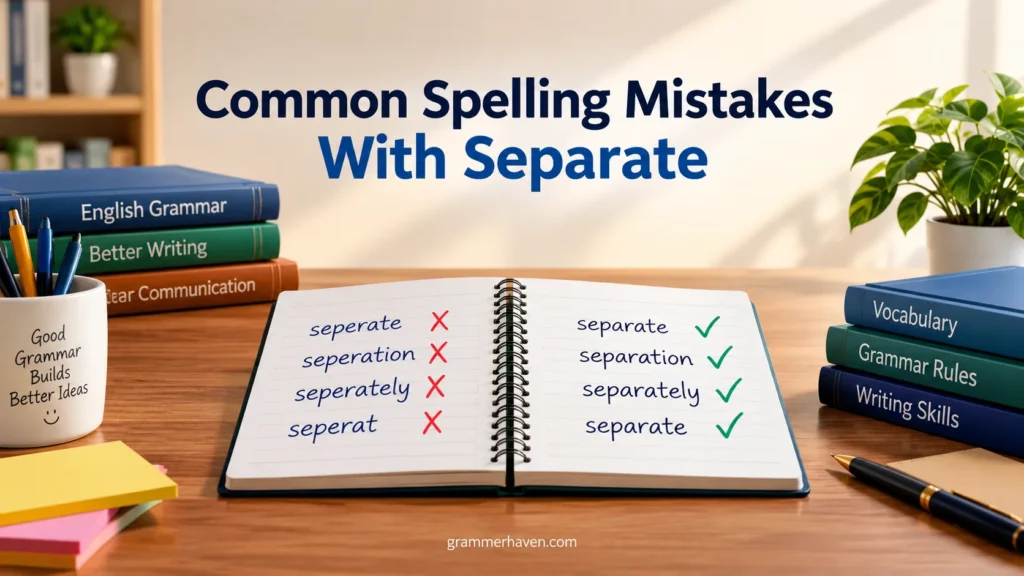
The main mistake is seperate, but the problem doesn’t stop there.
| Incorrect | Correct |
| ❌ seperate | ✅ separate |
| ❌ seperately | ✅ separately |
| ❌ seperated | ✅ separated |
| ❌ seperation | ✅ separation |
| ❌ seperating | ✅ separating |
Notice the recurring problem.
The A keeps disappearing.
That makes the best strategy surprisingly simple: learn the root spelling first.
A Useful Root Pattern
Start with:
SEPARATE
Then build from it:
SEPARATED
SEPARATING
SEPARATELY
SEPARATION
Not every form looks identical because English spelling sometimes changes when suffixes are added. However, the important separ- pattern remains visible.
Separate vs. Divide vs. Split
These words overlap, but they aren’t perfect substitutes.
Separate
Separate focuses on putting things apart or keeping them apart.
Please separate the blue files from the red files.
Divide
Divide often emphasizes breaking something into sections, portions, or groups.
Divide the class into four teams.
Split
Split commonly suggests breaking or dividing something into parts. In many contexts, it sounds more informal than divide.
Let’s split the bill.
The distinction becomes clearer in this comparison:
| Word | Main Idea | Example |
| Separate | Put or keep apart | Separate the documents. |
| Divide | Break into sections or groups | Divide the class into teams. |
| Split | Break or share into parts | Split the money equally. |
Choosing the right word depends on what you want to emphasize.
Separate vs. Apart: Are They the Same?
Separate and apart often describe similar ideas, but they don’t always work in the same grammatical position.
Compare:
The houses are separate.
with:
The houses are far apart.
In the first sentence, separate emphasizes their distinct status. In the second, a part emphasizes the distance between them.
You can also use separate as a verb:
Please separate the two documents.
You can’t simply replace it with apart:
❌ Please apart the two documents.
So, although the concepts overlap, the words don’t always behave the same way grammatically.
Separate in Everyday Writing
You encounter separate in more places than you might realize.
In School
- Write your answers on separate sheets.
- The teacher created separate groups.
- Each student received a separate assignment.
At Work
- Keep personal and business expenses separate.
- The company has separate departments.
- Submit the documents as separate files.
In Technology
- Create a separate user account.
- Save the backups in a separate folder.
- Store sensitive files separately.
At Home
- Keep raw meat separate from other food.
- Wash dark and light clothes separately.
- Put the ingredients into separate containers.
In Formal Writing
- The researchers analyzed the groups separately.
- The two issues require separate consideration.
- The report examines three separate factors.
This broad usage explains why mastering the spelling matters. Separate isn’t an obscure vocabulary word. It’s an everyday word that appears across personal, academic, technical, and professional writing.
A Practical Case Study: Spotting the Mistake
Consider this sentence:
The company maintains seperate accounts for each department.
At first glance, the sentence looks perfectly normal. The meaning is clear. Yet the spelling creates a problem.
Change it to:
The company maintains separate accounts for each department.
Now the sentence uses the standard spelling.
The lesson is simple: clear meaning doesn’t make an incorrect spelling correct.
A reader might understand seperate immediately, but polished writing requires the conventional spelling.
Is “Seperate” Ever Correct?
For standard English, seperate isn’t the correct spelling when you mean separate.
If you encounter seperate online, it may simply be a typo.
That doesn’t mean the writer doesn’t understand the word. Spelling errors happen for many reasons, including:
- Fast typing
- Autocorrect failures
- Weak visual familiarity with the word
- Pronunciation-based spelling
- Careless proofreading
- Confusion about the middle vowel
Still, when accuracy matters, use separate.
Quick Test: Can You Spot the Correct Spelling?
Choose the correct option in each sentence.
- Please keep the files separate / seperate.
- The teacher asked us to separate / seperate into groups.
- They booked separate / seperate rooms.
- The candidates were interviewed separately / seperately.
- The two substances must remain separate / seperate.
- The couple decided to separate / seperate.
- The documents were separated / seperated by category.
Answers
- Separate
- Separate
- Separate
- Separately
- Separate
- Separate
- Separated
The pattern is consistent. Whenever you’re tempted to write seperate, stop and look for the A.
Separate or Seperate: The Easy Rule
Here’s the rule worth remembering:
If you mean “apart” or “divided,” spell it SEPARATE.
Remember the visual pattern:
SEP-A-RATE
That middle A is the letter that commonly gets lost.
A second memory aid is even simpler:
Separate → A → Apart
You don’t need a complicated spelling formula. You just need a reliable visual cue.
Quick Reference
| Question | Answer |
| Correct spelling | Separate |
| Incorrect spelling | Seperate |
| Main meaning | Apart, distinct, or divided |
| Verb meaning | To divide or move apart |
| Adverb | Separately |
| Past tense | Separated |
| Noun | Separation |
| Memory trick | SEP-A-RATE |
| Common error | Replacing the middle A with E |
The simplest rule is the one worth keeping: separate has an A in the middle. When you remember that, seperate has nowhere to hide.
See also: Crow vs Raven: What’s the Difference?
FAQs:
Is “seperate” a correct spelling?
No. Separate is the correct spelling. Seperate is a common misspelling.
How do you spell separate?
The correct spelling is:
S-E-P-A-R-A-T-E
A useful breakdown is SEP-A-RATE.
Why do people spell separate incorrectly?
The main reason is pronunciation. The middle vowel can sound weak, especially in the adjective, so writers may substitute E for A.
What does separate mean?
As an adjective, separate means existing independently, being distinct, or being apart. As a verb, it can mean dividing or moving people or things apart.
Is separately spelled with an A?
Yes. The correct spelling is separately.
Seperately is incorrect.
What is the past tense of separate?
The past tense is separated.
They separated the materials into different containers.
What is the noun form of separate?
The common noun form is separation.
The separation of the two groups occurred gradually.
How can you remember the spelling of separate?
Use SEP-A-RATE.
You can also associate the A with apart:
Separate → A → Apart
Is separate an adjective or a verb?
It can be both.
As an adjective:
They live in separate houses.
As a verb:
Separate the documents.
Is separate pronounced the same as a verb and adjective?
No. The pronunciation changes depending on its grammatical role. Cambridge gives the adjective approximately as /ˈsep.ɚ.ət/ and the verb approximately as /ˈsep.ə.reɪt/ in US English.
Conclusion:
Separate is the correct spelling, while seperate is an incorrect spelling and a common spelling mistake. The confusion often comes from pronunciation and the weak middle vowel sound, which can make the wrong form seem reasonable. Remember the a in separate, and you’ll have a simple memory trick to avoid this error. Using the standard spelling in your writing, emails, worksheets, and social posts will help you feel more confident with the English language.