Into or Onto can confuse English learners because these prepositions describe movement, direction, and location but express different relationships between objects and destinations.
English has many small words with important meanings. Prepositions such as “into” and “onto” help explain movement and position. Into describes entering the inside of a place or changing into a new state. For example, “She walked into the room” describes entering a physical space. The phrase “He got into trouble” expresses a change in circumstances through a figurative expression. Onto describes movement toward the top of a surface. In “He climbed onto the roof,” the action shows movement to a higher position. Similarly, “The cat jumped onto the table” describes movement that results in surface contact. Remembering these examples makes choosing the correct preposition easier.
These prepositions also appear in everyday conversations and professional writing. Walking into a building means entering its interior. Climbing onto a platform means reaching its surface. Their contextual meaning depends on the destination and the action. Understanding spatial relationships, direction, and position improves sentence clarity and helps you avoid common grammar mistakes. Careful word choice strengthens sentence construction and supports correct usage in everyday language and professional communication. Learning these language patterns helps you explain your thoughts accurately and distinguish movement inside a space from movement onto a surface.
Quick Answer: Into vs. Onto
Into usually describes movement from outside to inside a place or thing. Onto usually describes movement toward and onto a surface.
Compare these examples:
- She walked into the classroom. — She entered the room.
- She climbed onto the desk. — She moved to the desk’s surface.
- He poured water into the bottle. — The water entered the bottle.
- The cat jumped onto the sofa. — The cat landed on the sofa.
The easiest way to remember the difference is to ask yourself one question: Does the action involve entering something or reaching a surface?
| Word | Main meaning | Example |
| Into | Movement to the inside | He ran into the house. |
| Onto | Movement to a surface | He jumped onto the roof. |
This distinction also applies to many figurative expressions. For example, someone can get into trouble or catch onto a clever trick. The correct preposition depends on the meaning and structure of the sentence.
What Does Into Mean?
Into is a preposition that commonly describes movement from the outside to the inside of a place, container, or defined space. It connects an action with a destination and shows where something or someone ends up.
Consider the sentence, “The girl walked into the library.” The word into tells you that she entered the library rather than simply walking in its direction. This small word adds important information about the action.
However, into doesn’t always describe physical movement. It can also express a change in condition, involvement in an activity, or contact with something.
For example:
- The ice melted into water.
- He got into an argument with his neighbor.
- She ran into an old friend at the store.
- The company invested into a new market.
The last example is less natural in many contexts than “invested in a new market.” The best preposition depends on the verb and the intended meaning.
Common Uses of Into
The word into has several important uses in English. Recognizing these patterns helps you understand its meaning beyond simple movement.
Movement from outside to inside
Use into when someone or something enters a place or container.
- The puppy ran into the kitchen.
- She put her phone into her bag.
- The workers carried the boxes into the warehouse.
Change or transformation
Use into when something changes from one form, state, or condition to another.
- The witch turned the prince into a frog.
- The small business grew into a successful company.
- The conversation developed into a heated debate.
Involvement or participation
Use into in expressions that describe becoming involved in a situation or activity.
- He got into trouble for arriving late.
- She went into business with her cousin.
- They entered into an agreement with the supplier.
Collision or unexpected encounters
Use into in expressions involving physical contact or an unplanned meeting.
- The cyclist crashed into a parked car.
- I bumped into my former teacher downtown.
- The truck ran into a barrier.
Interests and preferences
In informal English, into can describe something a person enjoys or finds interesting.
- She’s into photography.
- My brother is really into science fiction.
- Are you into hiking?
These examples show why you shouldn’t define into only as movement toward the inside. Its meaning changes with the context.
Example Sentences With Into
Here are additional examples showing how into works in different situations.
| Sentence | Meaning of Into |
| Pour the coffee into the mug. | The coffee enters a container. |
| The child ran into the bedroom. | The child entered a room. |
| Water froze into ice. | Water changed its physical state. |
| She got into debt. | She entered an undesirable financial situation. |
| He looked into the complaint. | He investigated the matter. |
| The car crashed into a fence. | The car struck the fence. |
Notice that looked into doesn’t involve entering a physical space. It means investigating something. Learning common expressions alongside literal meanings will help you use the preposition naturally.
What Does Onto Mean?
Onto is a preposition that generally describes movement to a surface or position on something. It often shows that a person or object moves from one place and ends up on another object.
For example, in the sentence “The cat jumped onto the counter,” the cat moves to the counter’s surface. The word onto highlights the destination and the result of the movement.
Unlike into, which often involves an interior space, onto typically focuses on a surface, platform, or position. It can also describe moving information or objects to a different platform.
Examples include:
- The child climbed onto the chair.
- She placed the documents onto the table.
- The technician uploaded the files onto the server.
- The detective was onto the suspect’s scheme.
The last sentence uses onto figuratively. It suggests that the detective has discovered or begun to understand what the suspect is doing.
Common Uses of Onto
Movement to a surface
Use onto when someone or something moves to the top or surface of an object.
- The cat jumped onto the bed.
- He stepped onto the stage.
- The ball rolled onto the sidewalk.
Climbing or jumping
Use onto when an action places someone or something on a surface.
- The hikers climbed onto the rocks.
- She jumped onto the moving platform.
- The child scrambled onto his father’s lap.
Transfer to a platform or destination
In modern English, onto can describe transferring data or other material to a platform or system.
- The team uploaded the video onto the website.
- She transferred the photographs onto her laptop.
- The company moved its records onto a digital system.
In many digital contexts, to or on may also sound more natural. For instance, “uploaded the video to the website” is widely used and concise.
Discovery or awareness
Some informal expressions use onto to indicate that someone has discovered a secret, understood a trick, or recognized a hidden plan.
- The teacher was onto his excuse.
- I think we’re onto something useful.
- She caught onto the practical joke.
In these examples, onto doesn’t refer to a physical surface. Instead, it communicates awareness or understanding.
Example Sentences With Onto
The following table highlights the different ways onto appears in everyday English.
| Sentence | Meaning of Onto |
| The boy climbed onto the roof. | He moved to the roof’s surface. |
| She put the plate onto the counter. | She placed it on a surface. |
| The ball bounced onto the grass. | The ball moved to the grass. |
| He uploaded the file onto the platform. | He transferred a file to a digital destination. |
| The detective was onto the thief. | The detective suspected or understood the thief’s plan. |
| The students moved onto the next activity. | They proceeded to another stage or task. |
The final example illustrates an important distinction: onto can express movement between stages or activities, but the phrase on to may be more appropriate when on belongs to the preceding verb or expression.
Into vs. Onto: Key Differences
The main difference between into vs. onto lies in the relationship between the action and its destination. Into typically describes movement toward an interior, while onto describes movement to a surface or position on something.
According to Purdue University’s guide to prepositions of direction, into relates to movement toward an interior and onto relates to movement toward a surface. Both words can express completed movement rather than merely pointing toward a destination.
| Feature | Into | Onto |
| Basic meaning | Movement to the inside | Movement to a surface |
| Typical destination | Room, container, enclosed area | Table, roof, platform |
| Common verbs | Enter, pour, run, dive | Climb, step, jump, place |
| Figurative meaning | Change, involvement, investigation | Awareness, discovery, progression |
| Example | She walked into the shop. | She walked onto the stage. |
Consider these examples:
- The puppy jumped into the basket.
- The puppy jumped onto the basket.
The first sentence describes the puppy entering the basket. The second describes the puppy landing on its surface. The words change the reader’s understanding of where the puppy ends up.
Into vs. Onto: Movement and Position
Another useful distinction involves movement versus position. Although into and onto usually describe direction, in and on generally describe a location or state.
Compare the following sentences:
- The keys are in the drawer.
- She put the keys into the drawer.
- The book is on the desk.
- He placed the book onto the desk.
The first and third sentences describe where something is. The other two emphasize movement to a destination. In some sentences, in and on can also describe movement, so the distinction isn’t absolute.
Into vs. Onto: How to Use Each Word Correctly
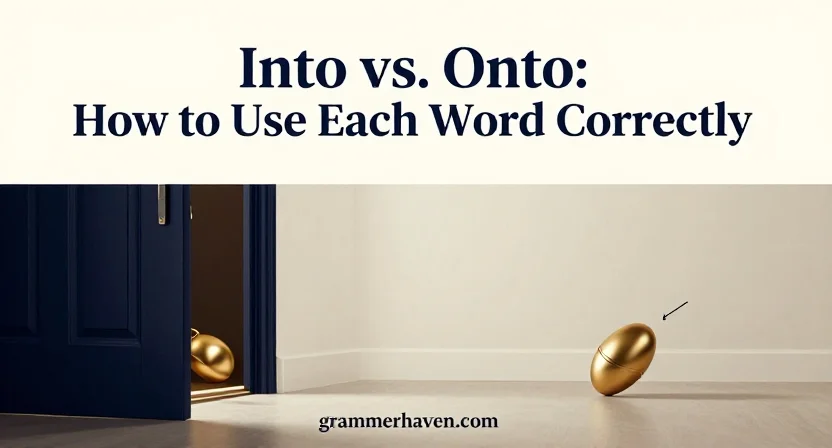
Choosing the right preposition becomes easier when you picture the action. Instead of memorizing long grammar rules, focus on the destination and what happens when the action ends.
Ask yourself these questions:
- Does the person or object enter a space?
- Does the person or object reach a surface?
- Does the sentence describe a change, an interest, or a figurative expression?
- Does the verb require a particular preposition?
Your answers will usually reveal which word fits best.
When to Use Into
Use into when a person or object moves from outside to inside a place or container.
Examples:
- The students walked into the auditorium.
- She slipped the letter into an envelope.
- The rabbit disappeared into its burrow.
You should also use into to describe transformations or changes in form.
- The artist turned the sketch into a painting.
- The caterpillar changed into a butterfly.
- The team transformed an empty room into a modern office.
Additionally, into appears in many established expressions. For example, look into means investigate, get into can mean become involved, and run into can mean encounter someone unexpectedly.
- The manager will look into the complaint.
- He got into a disagreement with his colleague.
- I ran into my neighbor at the supermarket.
When to Use Onto
Use onto when someone or something moves to a surface or position on another object.
Examples:
- The gymnast jumped onto the mat.
- The child climbed onto the playground equipment.
- The mechanic lifted the tire onto the workbench.
The word also appears in expressions involving awareness or discovery.
- The detective was onto the suspect’s plan.
- She caught onto the salesman’s dishonest tactics.
- We might be onto a better solution.
In these figurative examples, onto means that someone has recognized something or discovered a useful idea. The expression doesn’t involve physical movement.
One final point matters: not every verb that describes placing something on a surface requires onto. English speakers commonly say, “She placed the book on the table” and “The plane landed on the runway.” Both are natural constructions.
Into vs. In To: What’s the Difference?
The difference between into and in to is more than a matter of spacing. Into is a single preposition, while in to contains two separate words that perform different grammatical jobs.
Use into when you mean entry, transformation, collision, or interest.
- She walked into the kitchen.
- The chef turned the ingredients into a delicious meal.
- He is really into jazz music.
Use in to when in belongs to a verb or expression and to serves a separate purpose.
- She came in to ask a question.
- Please hand the completed form in to your supervisor.
- He logged in to check his account.
In the first example, came in describes entering, while to ask explains the purpose. In the second, hand in means submit, and to your supervisor identifies the recipient.
How to Tell Into and In To Apart
Try examining the sentence’s meaning and verb structure.
| Example | Correct form | Why |
| She walked ___ the office. | into | She entered the office. |
| He came ___ speak with us. | in to | Came in is followed by a purpose. |
| She turned the idea ___ a business. | into | The idea became something new. |
| Please turn your assignment ___ the teacher. | in to | Turn in means submit. |
A useful tip is to identify whether in belongs to a phrasal verb, such as turn in, hand in, or log in. If it does, the following to may need to remain separate. However, some constructions, such as log into an account, also appear in standard usage when the intended meaning supports that reading.
Onto vs. On To: What’s the Difference?
The words onto and on to create a similar challenge. Use onto when it expresses movement to a surface or position. Use on to when on belongs to a verb or expression and to introduces the next part of the sentence.
Compare these examples:
- The cat jumped onto the windowsill.
- Let’s move on to the next lesson.
- She climbed onto the platform.
- He held on to the railing.
In the first and third sentences, onto identifies a destination. In the second, move on means continue to another subject.
A Simple Test for Onto vs. On To
Try replacing onto with on or upon. If the sentence keeps its intended meaning, onto may be appropriate.
For example:
- She placed the package onto the shelf.
- She placed the package on the shelf.
Both sentences work naturally.
Now consider this example:
– Let’s move on to the next chapter.
Replacing on to with upon would change the construction and sound unnatural. Here, the two-word form is the better choice.
Remember that some verbs allow more than one construction. For instance, both “log onto your account” and “log on to your account” are common. The surrounding words determine whether the single-word preposition or the two-word sequence best expresses the intended meaning.
Can Into and Onto Be Used Interchangeably?

No, into and onto generally aren’t interchangeable when they describe movement. Replacing one with the other often changes the destination or meaning of a sentence.
Consider these examples:
- The boy jumped into the pool.
- The boy jumped onto the diving board.
In the first sentence, the boy enters the water. In the second, he lands on the board’s surface. Both sentences describe jumping, but the destination changes the meaning.
Here are more examples that demonstrate the distinction:
| Using Into | Using Onto |
| The cat climbed into the box. | The cat climbed onto the box. |
| She stepped into the bathtub. | She stepped onto the bathtub’s edge. |
| The ball rolled into the garage. | The ball rolled onto the driveway. |
| He threw the clothes into the basket. | He threw the clothes onto the bed. |
The correct choice depends on the destination, not simply the verb. For instance, jump can work with both words because someone can jump into a pool or onto a platform.
Grammar tip: If both options seem possible, describe the final position in your mind. If the object ends up inside something, into may fit. If it ends up on a surface, onto may fit.
Common Mistakes to Avoid When Using Into or Onto
Even experienced writers sometimes confuse these prepositions. Most mistakes happen when writers focus on the action without considering the destination or grammatical structure.
Using Onto When You Mean Inside
Incorrect: The child climbed onto the car and sat inside it.
Better: The child climbed into the car and sat inside it.
The corrected sentence makes the destination clear. Use onto if the child climbs onto the car’s roof instead.
Using Into When You Mean a Surface
Incorrect: The cat jumped into the sofa and settled on top.
Better: The cat jumped onto the sofa and settled on top.
The first sentence suggests that the cat entered the sofa itself. The second describes the intended action.
Confusing Into With In To
Incorrect: She came into help with dinner.
Better: She came in to help with dinner.
The second version shows that she came in for a purpose. Here, to help is an infinitive phrase rather than part of the preposition into.
Confusing Onto With On To
Incorrect: Let’s move onto the next topic.
Better: Let’s move on to the next topic.
The two-word form works because move on means proceed or continue. However, “The speaker stepped onto the stage” correctly uses the single-word form.
Assuming Every Surface Requires Onto
Incorrect: The plane landed onto the runway.
More natural: The plane landed on the runway.
Although onto often indicates movement toward a surface, many verbs naturally take on. English usage depends on common verb patterns as well as meaning.
Into vs. Onto in Everyday Situations
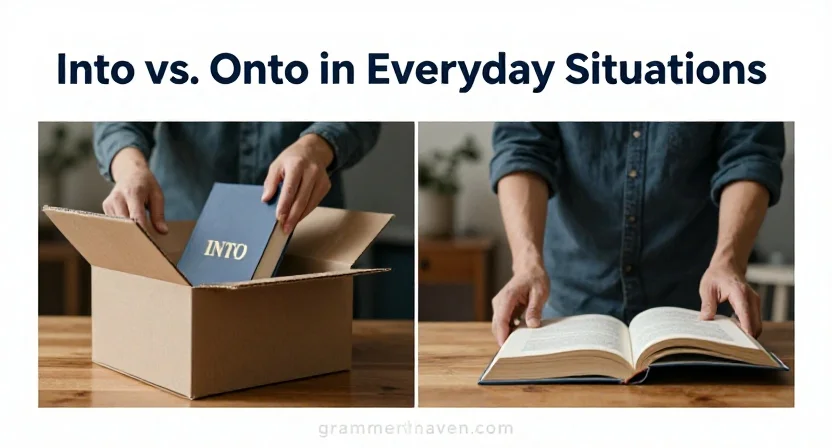
Understanding into vs. onto becomes easier when you apply the distinction to familiar situations. These examples show how the prepositions work in homes, schools, workplaces, and digital environments.
Rooms, Buildings, and Containers
Use into when someone or something enters an enclosed space.
- She walked into the classroom.
- The dog ran into the garage.
- He dropped the coins into a jar.
Use onto when someone or something moves to a surface.
- She climbed onto the classroom stage.
- The dog jumped onto the garage roof.
- He placed the coins onto the counter.
Furniture and Other Surfaces
Furniture provides some of the clearest examples of the difference.
- The toddler climbed onto the couch.
- She put her phone onto the desk.
- The cat crawled into the cardboard box.
- He tossed his jacket onto the chair.
Notice that the same object can take different prepositions depending on the action. A cat can climb onto a box or crawl into it.
Vehicles and Transportation
Use into when someone enters a vehicle or enclosed compartment.
- She got into the car.
- The passengers climbed into the lifeboat.
- The driver backed into the garage.
Use onto when someone moves to a vehicle’s surface or platform.
- The workers climbed onto the truck.
- The mechanic stepped onto the bus’s roof.
- The passenger jumped onto the loading platform.
However, some transportation expressions use other prepositions. English speakers usually say “get on the bus” and “get on the train,” so don’t apply the rule mechanically.
Computers and Digital Platforms
In digital writing, onto can describe transferring files or information to a platform. However, to and on are often more natural depending on the verb.
- She uploaded the photos to the website.
- He saved the backup onto an external drive.
- The team transferred its records to a new database.
- She logged in to her account.
For professional writing, choose the preposition that fits the specific verb. For example, “upload the file to the website” is a clear and widely used construction.
Figurative Expressions
Both prepositions appear in expressions that don’t describe physical movement.
- He got into trouble at work.
- She’s into classical music.
- The detective was onto the suspect’s plan.
- We may be onto something important.
These expressions are best learned as complete phrases. Memorizing common combinations helps you avoid choosing a preposition based only on its literal meaning.
Into vs. Onto: Practice Quiz
Test your understanding with the following sentences. Choose into, onto, in to, or on to for each blank.
- The puppy ran ___ the kitchen.
- She climbed ___ the roof to retrieve her hat.
- He poured the juice ___ a glass.
- Let’s move ___ the next question.
- The child jumped ___ the bed.
- She came ___ speak with the manager.
- The detective was ___ the suspect’s plan.
- The mechanic lifted the tire ___ the workbench.
- Please turn your assignment ___ the instructor.
- The hikers walked ___ the cave.
Answers and Explanations
| No. | Answer | Explanation |
| 1 | into | The puppy entered the kitchen. |
| 2 | onto | The person moved to the roof’s surface. |
| 3 | into | The juice entered the glass. |
| 4 | on to | Move on means proceed to another question. |
| 5 | onto | The child landed on the bed. |
| 6 | in to | Came in describes entering, while to speak gives the purpose. |
| 7 | onto | The detective recognized or suspected the plan. |
| 8 | onto | The tire moved to the workbench’s surface. |
| 9 | in to | Turn in means submit. |
| 10 | into | The hikers entered the cave. |
If you missed a few answers, focus on the destination and the role each word plays. Those two clues will help you make the right choice in most sentences.
Into vs. Onto at a Glance
| Expression | Correct usage | Example |
| Into | Entry or movement inside | She walked into the room. |
| Onto | Movement to a surface | She climbed onto the roof. |
| In to | Separate grammatical functions | He came in to help. |
| On to | Continuing or proceeding | Let’s move on to the next task. |
| In | Position inside | The keys are in the drawer. |
| On | Position on a surface | The book is on the desk. |
For a final check, remember this simple rule: into means inside, while onto means onto a surface. Then consider the full sentence to make sure the preposition fits the verb and intended meaning.
See also: Minoot vs. Minute: Which Spelling Is Correct?
FAQs:
Is It Into or Onto?
Use into when describing movement to the inside of a place or thing. Use onto when describing movement to a surface or position on something.
For example, “She walked into the office” means she entered the office. “She stepped onto the platform” means she moved onto its surface.
What Is the Main Difference Between Into and Onto?
The main difference is the destination. Into usually indicates entry, while onto usually indicates movement to a surface.
You can remember the distinction by picturing a box. When you put something inside the box, you put it into the box. When you place something on top, you place it onto the box.
Is Onto Always One Word?
No. Onto is one word when it functions as a preposition expressing movement to a surface or a figurative meaning such as awareness. However, on to remains two words when on belongs to a verb or expression and to has a separate grammatical role.
For example, “She climbed onto the roof” uses one word. “Let’s move on to the next chapter” uses two.
What Is the Difference Between Into and In To?
Into is a single preposition that expresses entry, transformation, collision, or interest. In to consists of two separate words that serve different grammatical functions.
For example, “He walked into the room” describes entry. “He came in to ask a question” describes entering for a particular purpose.
Can I Say “Jumped Into the Table” or “Jumped Onto the Table”?
Usually, jumped onto the table is the natural choice when someone lands on its surface. For example, “The cat jumped onto the table.”
“Jumped into the table” would suggest a collision with the table or another unusual context. If you mean that someone hit the table while jumping, a clearer sentence would be “He jumped and crashed into the table.”
Conclusion:
Understanding the difference between into and onto helps you write clearer sentences and avoid common preposition mistakes. Use into when someone or something enters a space, changes form, or becomes involved in a situation. Choose onto when someone or something moves to a surface or when an expression describes awareness or discovery.
For example, you walk into a room but climb onto a table. Remember that context matters because the same verb can take different prepositions depending on the destination. Once you recognize whether an action involves entering something or moving to a surface, choosing between into or onto becomes much easier.