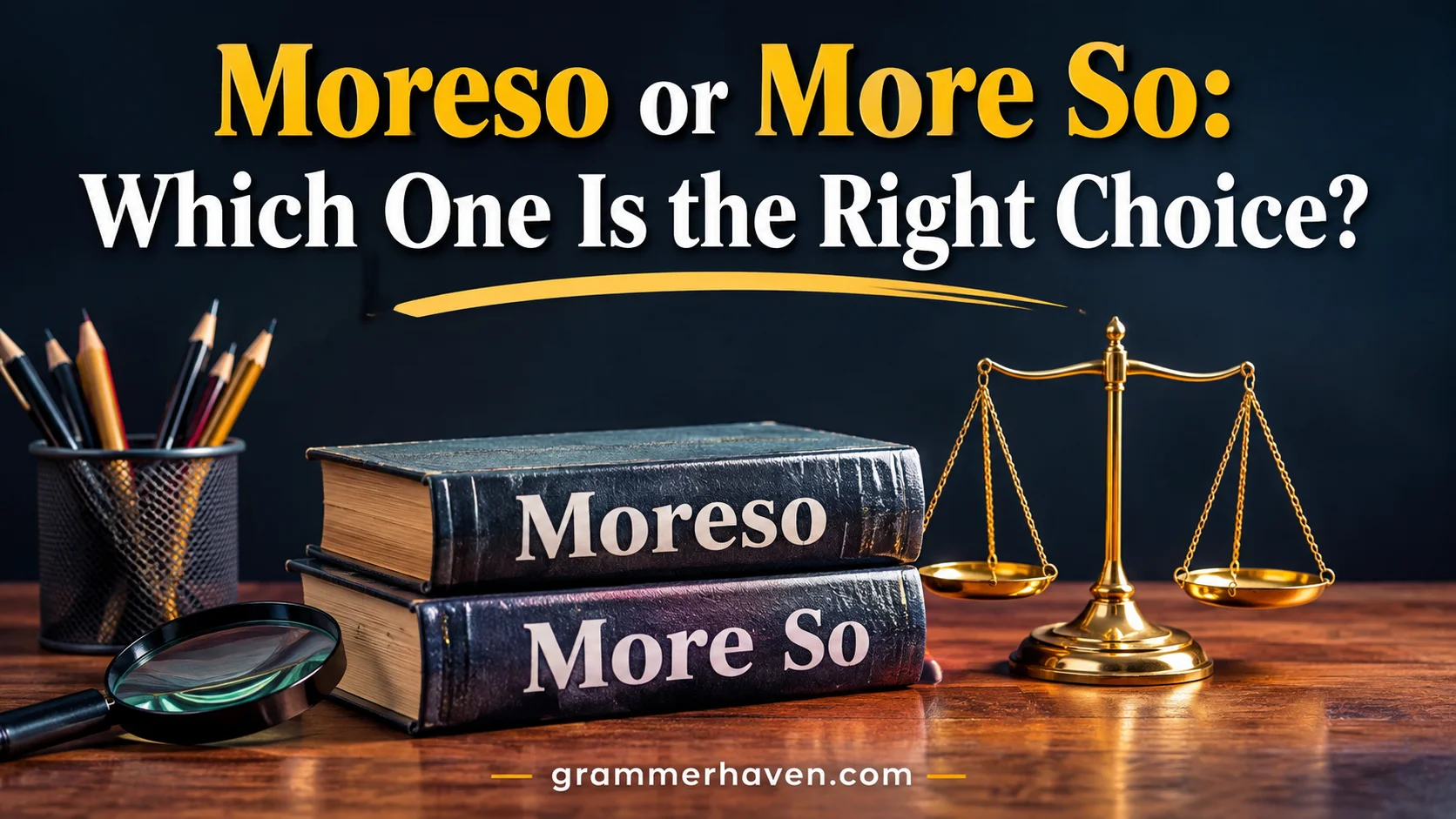
Moreso or More So: Which One Is Write Choice? is a common spelling question because moreso appears increasingly and more and more frequently in written English. Although both can have the same meaning and mean the same thing, they aren’t equally acceptable. Standard dictionaries and editors generally treat more so as the proper two-word phrase, while moreso remains an alternative spelling that some readers and writers find reluctantly acceptable. If you must decide which word to use, choose more so.
The spelling preference becomes easier to understand when you look at English compound words and their different varieties. For example, moreover is a widely accepted compound that has existed for centuries, which may make moreso seem logical. However, more so functions as an adverbial phrase and can emphasize a point. You might say, “They love to travel, more so now than ever.” It can also have a conjunction-like role to connect ideas, as in, “The restaurant was great; more so, it was affordable.” This distinction matters in documents, academic writing, and professional work involving readers, writers, and editors. The safest usage is to split it into two words, not write it as one word.
English also contains tricky pairs such as anymore and any more. In U.S. English, anymore is an adverb meaning any longer or nowadays, while any more combines an adjective and noun to mean additional quantity. Learning to determine whether an expression should appear as one word, two words, a two-word form, or a compound can prevent similar mistakes. The same issue appears with nevermind and never mind; the standard form is never mind when you indicate that something you said should be ignored. These examples show why moreso may look natural, but the standard phrase remains more so. In a formal situation, polished grammar and the correct spelling make more so the better alternative.
Moreso or More So: Which Spelling Is Correct?
The short answer:
✅ More so is the standard and recommended spelling.
⚠️ Moreso is sometimes used informally but is generally considered nonstandard.
The phrase more so consists of two separate words:
- More = to a greater amount or degree
- So = referring back to something already mentioned
Together, more so means:
- To a greater extent
- Even more
- More strongly
- To a higher degree than something else
Example:
“I enjoyed the second book more so than the first one.”
This means:
“I enjoyed the second book more than the first one.”
The phrase compares two levels of preference.
Quick Comparison: Moreso vs More So
| Form | Status | Recommended Use | Example |
| More so | Standard English form | Formal and informal writing | “The second option works better, more so for beginners.” |
| Moreso | Informal or disputed variant | Avoid in professional writing | “The second option works moreso for beginners.” |
When you are unsure, choose more so. It matches modern grammar expectations and avoids distracting readers.
What Does More So Mean?
The phrase more so shows that something applies to a greater degree than something else.
Think of it as a volume control.
Imagine someone says:
“This song is relaxing.”
Then you compare another song:
“The second song is more so.”
You are saying the second song is even more relaxing.
The phrase does not introduce a completely new idea. Instead, it strengthens or increases an idea that already exists.
Basic Meaning of More So
More so = even more + the same quality or action
Examples:
- “The new design is attractive, more so than the previous version.”
- “The problem affects everyone, more so younger workers.”
- “Exercise becomes important as you age, more so after 50.”
In each example, more so points toward a stronger degree.
Why Do People Write Moreso as One Word?
The confusion happens because English constantly changes.
Many words that started as separate phrases eventually became single words.
Examples:
| Original Phrase | Modern Form |
| Every day | Everyday |
| Some time | Sometime |
| Any way | Anyway |
| To night | Tonight |
| Mean while | Meanwhile |
Because of this pattern, people naturally assume:
More + so = Moreso
The problem is that not every word combination follows this path.
Some phrases remain separate because they still function as individual words.
For example:
- More important
- More likely
- More useful
- More so
We do not combine these into:
- Moreimportant ❌
- Morelikely ❌
- Moreuseful ❌
The same logic applies to more so.
How to Use More So Correctly in a Sentence
Understanding where more so fits in a sentence makes it much easier to use.
The phrase usually appears when you want to compare, emphasize, or strengthen an idea.
Using More So for Comparisons
One of the most common uses of more so involves comparing two things.
Structure:
Statement + more so + comparison
Examples:
“The second movie was enjoyable, more so than the first.”
Meaning:
The second movie was more enjoyable compared with the first.
Another example:
“The updated software is faster, more so on newer computers.”
The sentence suggests that the speed improvement is especially noticeable on newer computers.
Using More So for Emphasis
Sometimes more so does not directly compare two objects. Instead, it highlights a stronger situation.
Examples:
“Good communication matters in every workplace, more so during difficult projects.”
The meaning:
Communication matters everywhere, but it matters even more during difficult projects.
Another example:
“Planning becomes important before major decisions, more so when money is involved.”
The phrase increases the importance of planning.
More So vs More: Understanding the Difference
Although they look similar, more and more so serve different purposes.
| Word | Function | Example |
| More | Shows an increased amount or degree | “I need more time.” |
| More so | Shows a stronger degree compared with something else | “I agree with this idea more so than the previous one.” |
Consider these examples:
Using “more”
“She wants more information.”
This means she wants additional information.
Using “more so”
“She prefers the second explanation more so than the first.”
This compares two explanations.
The key difference:
More So vs Even More: Are They the Same?
People often wonder whether more so and even more mean the same thing.
They overlap, but they are not identical.
More So
Usually refers back to something already mentioned.
Example:
“The second strategy is effective, more so for small businesses.”
Meaning:
The strategy is effective, especially or to a greater extent for small businesses.
Even More
Simply increases intensity.
Example:
“The second strategy is even more effective.”
Meaning:
The effectiveness has increased.
Comparison Table
| Phrase | Main Purpose | Example |
| More so | Comparison or stronger degree | “The rule applies more so to beginners.” |
| Even more | Greater intensity | “The rule is even more important today.” |
Is Moreso a Real Word?
This question has a complicated answer.
The word “moreso” appears in some writing, especially online. Some dictionaries and language databases record it as an informal variant.
However, many professional writers, editors, and grammar experts still prefer “more so.”
The reason is simple:
Standard English recognizes “more so” as the established form.
Using “moreso” may not stop readers from understanding you, but it can make your writing look less polished.
Where You Might See “Moreso”
You may encounter it in:
- Social media posts
- Text messages
- Online comments
- Informal blogs
- Casual conversations
Where You Should Avoid “Moreso”
Avoid it in:
- Academic writing
- Business reports
- Professional emails
- Job applications
- Published articles
A small spelling choice can affect how readers judge the quality of your writing.
Why More So Remains Two Words
The grammar behind more so explains why the phrase stays separated.
The word more acts as an adverb. It modifies the degree of something.
The word so refers to a previous quality, action, or situation.
Example:
“The second solution is useful, more so than the first.”
Breaking it down:
- Useful = the quality being discussed
- More = increases the degree
- So = refers back to “useful”
The phrase works like a shortcut.
Instead of writing:
“The second solution is more useful than the first solution is useful.”
You can simply write:
“The second solution is more useful, more so than the first.”
English often creates shorter expressions by allowing words to refer back to earlier ideas.
Common Mistakes When Using More So
Even people who spell the phrase correctly sometimes misuse it.
Here are the most common problems.
Mistake 1: Writing Moreso in Formal Writing
Incorrect:
“This method is moreso effective for beginners.”
Correct:
“This method is more effective for beginners.”
Or:
“This method is more so effective for beginners.”
In many cases, more effective sounds more natural than more so effective.
Mistake 2: Using More So Without Context
The phrase needs something to connect with.
Unclear:
“This product is more so.”
The reader immediately asks:
More so than what?
Better:
“This product is useful, more so for experienced users.”
Now the comparison has context.
Mistake 3: Using More So When Especially Works Better
Sometimes writers use more so when they actually mean especially.
Example:
Awkward:
“I enjoy outdoor activities more so during summer.”
Better:
“I enjoy outdoor activities especially during summer.”
The difference:
- More so compares degrees.
- Especially highlights a specific situation.
More So Sentence Examples
Seeing real examples makes the phrase easier to understand.
Everyday Examples
- “I like the second restaurant more so because of the atmosphere.”
- “She became more confident, more so after practicing regularly.”
- “I enjoy traveling, more so when I can explore new cultures.”
Workplace Examples
- “Clear communication matters in every team, more so during remote work.”
- “Customer service has become important, more so in competitive industries.”
- “Security measures matter more so as companies collect more data.”
Academic Examples
- “The theory applies broadly, more so in developing countries.”
- “This research method works well, more so when studying large groups.”
- “The issue deserves attention, more so because it affects younger generations.”
More So vs Similar Expressions
Several phrases can replace more so, depending on your meaning.
| Expression | Meaning | Example |
| More so | To a greater degree | “The second option works more so for experts.” |
| Especially | Particularly | “This matters especially for beginners.” |
| Even more | Increased intensity | “The results became even more impressive.” |
| To a greater extent | More formally | “The policy affects workers to a greater extent.” |
| Particularly | Specifically | “The rule applies particularly to new users.” |
Choosing the right phrase improves clarity.
Sometimes more so is correct but not the best option.
Case Study: How a Small Spacing Error Changes Professional Writing
Imagine two versions of a business report.
Version One:
“Customer expectations have changed moreso because of digital technology.”
Version Two:
“Customer expectations have changed more so because of digital technology.”
The second version looks more familiar and professional.
However, an even clearer version would be:
“Customer expectations have changed significantly because of digital technology.”
The lesson:
Correct spelling matters, but clear writing matters even more.
How to Remember More So vs Moreso
Use this simple memory trick:
Think of “more so” as “more of that.”
Example:
“The second product is better, more so than the first.”
You are saying:
“The second product has more of that quality.”
Another trick:
If you can replace the phrase with “even more”, you usually need two words.
Example:
“The second option is more so useful.”
Replace:
“The second option is even more useful.”
This shows that the phrase should remain separate.
Read also: Make Due or Make Do: Which One Is Correct?
FAQs:
1. Is “moreso” a correct spelling?
No. More so is the standard and preferred spelling. Moreso is increasingly seen in informal writing, but it isn’t generally accepted as the standard form.
2. Should “more so” be written as one word?
No. Write more so as two words when you mean “to a greater degree” or want to emphasize something.
3. Do “moreso” and “more so” have the same meaning?
They are generally intended to have the same meaning, but more so is the accepted spelling in standard English.
4. Can I use “moreso” in formal writing?
It’s best to avoid moreso in formal writing. Use more so in academic, professional, and carefully edited content.
5. What is the easiest way to remember “more so”?
Remember that more so functions as a phrase, so keep the two words separate. For example: “I enjoy reading, more so than watching television.”
Conclusion:
More so is the correct choice in standard English. Although moreso appears frequently, especially in informal writing, it isn’t the preferred standard spelling. When you want your writing to be clear, polished, and grammatically correct, always write more so as two words.