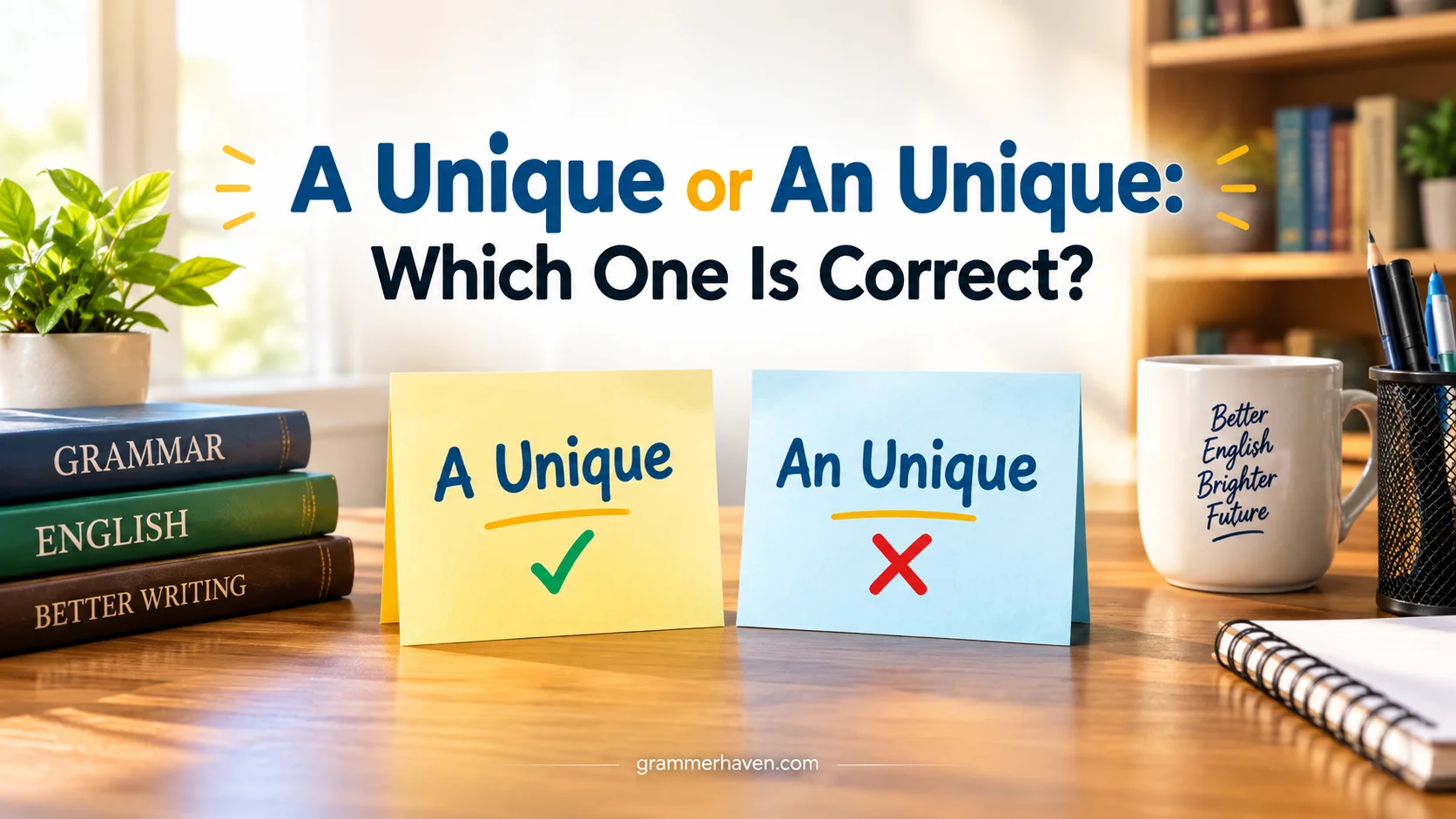
A Unique or An Unique is a common grammar question; the correct form is a unique because unique starts with the consonant sound /yoo/ in English. The choice between a and an depends on pronunciation, not simply on the first letter. Although unique starts with the vowel letter U, its opening sound is /yoo/. Standard English therefore uses a unique, not an unique. The same pronunciation rule applies to other words that begin with a vowel letter but produce a consonant sound.
The grammar rule is straightforward: use a before a consonant sound and an before a vowel sound. Words such as unique, university, and uniform begin with the letter U but start with the /yoo/ sound. Correct examples include a unique idea, a university, and a uniform. Use an with words that begin with a genuine vowel sound, such as an unusual idea or an umbrella. This distinction matters in professional emails, academic writing, business communication, reports, announcements, and everyday speech. Correct article usage makes your English sound natural and precise.
The form an unique is incorrect in standard English because the opening sound of unique is consonantal. The spelling can make the choice confusing because U is a vowel letter, but pronunciation determines the article. Correct expressions include a unique opportunity, a unique solution, and a unique experience. The rule remains the same in American English and British English. You can avoid the mistake by saying the phrase aloud and listening to the first sound after the article. If the word begins with /yoo/, choose a. This pronunciation rule gives you a reliable way to choose the correct indefinite article.
A Unique or An Unique: Quick Answer
“A unique” is correct in standard US English. “An unique” is not the standard form.
The reason comes down to pronunciation. Merriam-Webster gives unique the pronunciation /yu̇-ˈnēk/, which starts with a sound like “you.”
That initial /j/ sound is a consonant sound. Therefore, a is the appropriate indefinite article.
| Phrase | Correct? | Why? |
| a unique idea | ✅ Yes | unique begins with a consonant /j/ sound |
| an unique idea | ❌ No | unique doesn’t begin with a vowel sound |
| a university | ✅ Yes | university begins with /juː/ |
| an umbrella | ✅ Yes | umbrella begins with a vowel sound |
| an unusual event | ✅ Yes | unusual begins with a vowel sound |
Cambridge Dictionary explains the same sound-based principle: a comes before consonant sounds, while an comes before vowel sounds. It specifically lists a university as an example of a word that begins with a vowel letter but a consonant sound.
Why Is It “A Unique” Instead of “An Unique”?
The confusion disappears once you separate letters from sounds.
English spelling and pronunciation don’t always line up neatly. A word can start with a vowel letter while producing a consonant sound. The reverse can also happen: a word can start with a consonant letter but produce a vowel sound.
That’s exactly what happens with unique.
The pronunciation of “unique”
The word unique is pronounced approximately:
/juːˈniːk/
The beginning sounds like “you.”
Think about saying these words aloud:
- you
- unique
- university
- user
- useful
They all have that initial “yoo” sound in common.
Because that sound functions as a consonant sound at the beginning of the word, English uses a:
a unique solution
Not:
an unique solution
Cambridge’s grammar guidance makes this distinction explicit: words that begin with a vowel letter can still take a when their pronunciation begins with a consonant sound.
A useful way to remember it
Don’t think:
U = vowel = an
Instead, think:
Listen to the first sound.
If unique sounds like “yoo-neek,” the choice becomes obvious:
a + unique → a unique
What Does “Unique” Mean?
Before looking at more grammar examples, it’s useful to understand what unique actually means.
Unique is an adjective. Its traditional sense means being the only one of its kind or having no equal. In modern usage, it can also describe something unusually distinctive or notably different. Merriam-Webster lists meanings including “being the only one,” “without a like or equal,” and “distinctively characteristic.”
For example:
- She has a unique perspective.
- The building has a unique design.
- We found a unique solution.
- He developed a unique approach to the problem.
The word can describe almost anything that stands apart from comparable things.
“Unique” doesn’t mean merely “good”
There’s an important difference between unique and words such as excellent, good, or high-quality.
If something is unique, the point is that it has characteristics that distinguish it from others.
For example:
The company developed a unique payment system.
This doesn’t necessarily mean the system is the best payment system. It means its characteristics differ from those of comparable systems.
That distinction matters when you use unique in professional, academic, or technical writing.
A vs. An: The Real Grammar Rule
The easiest way to understand a unique or an unique is to learn the actual rule instead of relying on a shortcut.
Use “A” Before a Consonant Sound
Use a when the following word begins with a consonant sound.
Examples include:
- a book
- a car
- a house
- a teacher
- a university
- a useful tool
- a unique opportunity
Notice something interesting about the last three examples.
Each word begins with a vowel letter:
- university
- useful
- unique
Yet each takes a because each begins with the “yoo” sound.
Use “An” Before a Vowel Sound
Use an when the following word begins with a vowel sound.
Examples include:
- an apple
- an elephant
- an idea
- an umbrella
- an unusual situation
This is why an umbrella is correct even though umbrella also begins with U.
The two words simply start with different sounds:
- unique → “yoo” → a
- umbrella → “uhm” → an
The rule in one table
| Article | Sound that follows | Example |
| a | Consonant sound | a unique idea |
| a | Consonant sound | a university |
| a | Consonant sound | a useful tool |
| an | Vowel sound | an umbrella |
| an | Vowel sound | an unusual event |
| an | Vowel sound | an opportunity |
The distinction is based on pronunciation, not alphabetic appearance.
A Unique or An Unique: Side-by-Side Comparison
Here’s the difference at a glance.
| Feature | A Unique | An Unique |
| Standard US English | ✅ Correct | ❌ Not standard |
| First written letter | U | U |
| First sound | /j/ | /j/ |
| Initial sound type | Consonant | Consonant |
| Correct article | a | — |
| Example | a unique idea | an unique idea |
The interesting part is that both versions begin with the same word. The difference comes entirely from the article.
Since unique starts with the consonant /j/ sound, a unique follows the standard article rule.
Examples of “A Unique” in Sentences
Knowing the rule is useful. Seeing it in real sentences makes it easier to apply naturally.
Everyday Examples
She has a unique sense of style.
We found a unique way to solve the problem.
That restaurant offers a unique dining experience.
He has a unique talent for explaining difficult ideas.
The house has a unique shape that makes it easy to recognize.
In each sentence, a modifies the singular countable noun that follows unique.
Academic Writing
The phrase also works naturally in formal writing:
The researchers proposed a unique explanation for the observed results.
The study provides a unique perspective on language development.
The model offers a unique approach to analyzing the data.
Here, unique describes the noun, while a introduces one non-specific example.
Business and Professional Writing
You might see the construction in business contexts as well:
The company created a unique customer experience.
The platform offers a unique solution for small businesses.
The team identified a unique opportunity in the market.
The grammar doesn’t change simply because the context becomes more formal.
Words That Follow the Same “Yoo” Sound Pattern
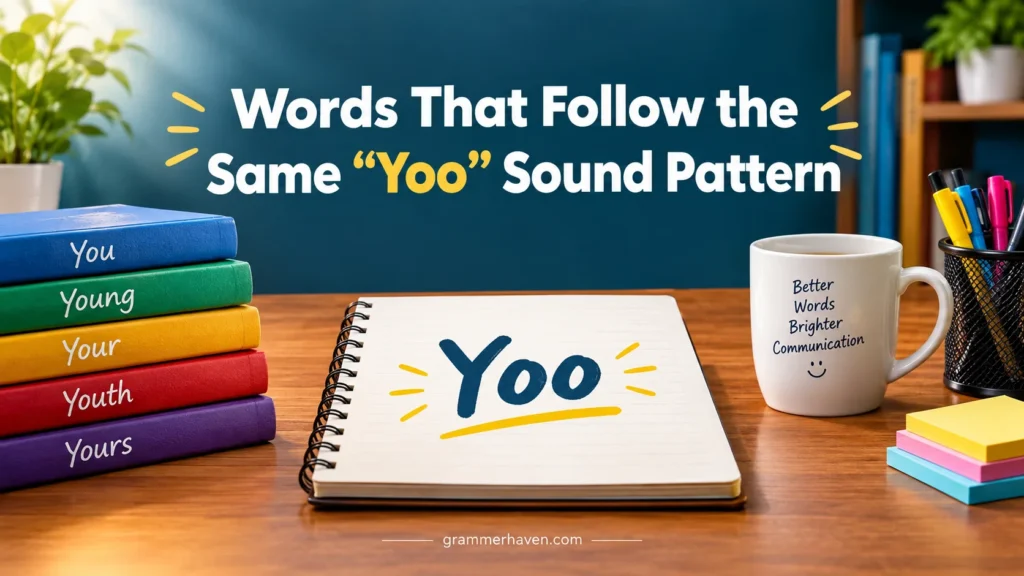
Once you understand unique, you’ll notice the same pattern in many other English words.
A University
Although university starts with U, its pronunciation begins with /juː/.
Correct:
a university
Incorrect:
an university
Cambridge specifically gives a university as an example of this sound-based rule.
A User
The word user also begins with the “yoo” sound.
a user account
Not:
an user account
A Useful Tool
The same principle applies to useful.
a useful tool
The opening sound resembles “yoo,” so a fits naturally.
A European Country
This pattern isn’t limited to words beginning with U.
European begins with a consonant-like /j/ sound in standard pronunciation.
Therefore:
a European country
The spelling starts with E, but the sound determines the article. Cambridge also uses European to illustrate this distinction.
Quick comparison
| Word | Beginning sound | Correct phrase |
| unique | /j/ + vowel sound | a unique idea |
| university | /j/ + vowel sound | a university |
| user | /j/ + vowel sound | a user |
| useful | /j/ + vowel sound | a useful tool |
| European | /j/ + vowel sound | a European country |
The shared feature isn’t the spelling. It’s the opening sound.
Words Beginning With “U” That Take “An”
This is where the rule becomes especially useful.
Not every U-word takes a.
Consider these examples:
- an umbrella
- an uncle
- an unusual event
- an unfair decision
- an urgent request
Why?
Because these words begin with vowel sounds rather than the consonant-like /j/ sound found in unique.
A Unique vs. An Unusual
These two phrases make an excellent comparison:
a unique idea
an unusual idea
At first glance, the words look similar. Both begin with un-. Yet their opening sounds differ.
Unique begins with “yoo.”
Unusual begins with a vowel sound.
Therefore:
- a unique idea ✅
- an unusual idea ✅
This is one of the best examples to remember because it demonstrates why spelling alone can’t determine the article.
Common Mistakes With “A Unique” and “An Unique”
Several mistakes repeatedly appear when people choose between these articles.
Mistake 1: Looking Only at the First Letter
The most common mistake goes like this:
“Unique starts with U. U is a vowel. Therefore, it must be an unique.”
The first two statements are true. The conclusion isn’t.
The article doesn’t depend simply on whether the first letter is a vowel. It depends on whether the first sound is a vowel sound.
Mistake 2: Memorizing “An Before Vowels”
This classroom shortcut can cause trouble.
A better version is:
Use “a” before consonant sounds and “an” before vowel sounds.
That small change makes the rule much more accurate.
Mistake 3: Confusing “Unique” With “Unusual”
It’s easy to assume that because both words begin with un-, they should take the same article.
They don’t.
| Word | Correct article | Example |
| unique | a | a unique solution |
| unusual | an | an unusual solution |
| university | a | a university |
| umbrella | an | an umbrella |
| useful | a | a useful resource |
| urgent | an | an urgent request |
Mistake 4: Trusting Something You See Online
Seeing “an unique” on a website doesn’t make it standard US English.
Online writing contains typos, regional usage, editing errors, and nonstandard constructions. For grammar questions, pronunciation and established reference sources provide stronger evidence.
A Unique or An Unique in Formal Writing
If you’re writing an essay, article, report, business document, or academic paper, use a unique.
For example:
The researchers developed a unique method for measuring the results.
The organization has a unique relationship with local communities.
The proposal presents a unique opportunity for growth.
Using an unique can distract readers because the construction conflicts with standard pronunciation-based article usage.
In polished writing, small grammatical choices matter. A sentence doesn’t need to be complicated to sound professional. Often, correctness comes down to details this small.
Does “An Unique” Ever Make Sense?
In standard modern US English, “an unique” isn’t the form to use.
You may occasionally encounter it in older material, nonstandard writing, or contexts influenced by spelling rather than pronunciation. That doesn’t make it the preferred grammatical form for contemporary American writing.
The standard construction is:
a unique
This isn’t an arbitrary exception. It’s a direct result of the sound at the beginning of unique.
Cambridge’s guidance explicitly explains that a precedes consonant sounds even when the spelling begins with a vowel letter.
“A Unique” vs. “Unique” Without an Article
There’s another useful distinction that often gets overlooked.
You don’t always need a simply because you use the word unique. The article depends on the noun and sentence structure.
“A Unique Idea”
Because idea is a singular countable noun, it can take a:
She proposed a unique idea.
You’re referring to one idea without identifying it as a particular known idea.
“Unique Ideas”
With a plural noun, you don’t use a or an:
The students proposed unique ideas.
You wouldn’t write:
The students proposed a unique ideas. ❌
The plural noun already changes the grammatical structure.
“Unique Information”
Some nouns are uncountable in ordinary English.
For example:
The report contains unique information.
Not:
The report contains a unique information. ❌
You could instead say:
The report contains a unique piece of information.
That version uses a because piece is a singular countable noun.
A Unique vs. The Unique
Sometimes the real question isn’t a or an. It may be a or the.
Use “A Unique” to Introduce One Example
She designed a unique product.
This introduces one product without assuming that the reader already knows which product you mean.
Use “The Unique” for a Specific Referent
She designed the unique product discussed in the report.
Now the phrase refers to a particular product identified by the surrounding context.
Cambridge explains that a/an generally introduces something not already identified, while the makes the noun specific.
So the articles aren’t interchangeable:
- a unique product = one product of this type
- the unique product = a particular product already identified or made specific by context
A Quick Test: Can You Choose the Correct Article?
Try these sentences before checking the answers.
Practice
- She created ___ unique design.
- He had ___ unusual experience.
- She attended ___ university.
- They bought ___ umbrella.
- We found ___ unique solution.
- The manager sent ___ urgent email.
- He developed ___ useful tool.
- They visited ___ European countries.
Answer Key
| Sentence | Correct answer | Reason |
| She created ___ unique design. | a | “unique” begins with /j/ |
| He had ___ unusual experience. | an | “unusual” begins with a vowel sound |
| She attended ___ university. | a | “university” begins with /j/ |
| They bought ___ umbrella. | an | “umbrella” begins with a vowel sound |
| We found ___ unique solution. | a | “unique” begins with /j/ |
| The manager sent ___ urgent email. | an | “urgent” begins with a vowel sound |
| He developed ___ useful tool. | a | “useful” begins with /j/ |
| They visited ___ European countries. | a | “European” begins with /j/ |
If you got all eight right, you’ve mastered the central rule.
A Simple Trick to Remember “A Unique”
Here’s the easiest mental shortcut:
Don’t look at the letter. Listen to the sound.
Say unique slowly:
yoo-neek
Now put the article in front:
a yoo-neek idea
That sounds natural because a ends with a vowel sound while unique begins with the consonant /j/ sound.
Now try:
an yoo-neek idea
The transition sounds unnatural because an normally connects to the following vowel sound.
This sound-based approach works far beyond unique.
Why Pronunciation Matters More Than Spelling
English spelling can be a bit of a trickster.
Consider these examples:
Vowel Letter, Consonant Sound
- a university
- a unique idea
- a European country
- a useful tool
Each begins with a vowel letter but a consonant sound.
Consonant Letter, Vowel Sound
Now look at:
- an hour
- an honest person
- an heir
- an MBA
The written first letter doesn’t determine the article because the pronunciation begins with a vowel sound. Cambridge gives an hour and an MP3 player as examples of this pattern.
That’s why the more accurate rule is:
Sound first. Spelling second.
A Note About the Meaning and Use of “Unique”
There is another subtle point worth knowing. Traditionally, unique can mean literally one of a kind. However, modern English also commonly uses it to mean unusual, distinctive, or notably different. Merriam-Webster records both the “only one” sense and broader senses such as “distinctively characteristic” and “very special or notable.”
For example:
Every fingerprint is unique.
Here, unique has a literal sense of being distinguishable from others.
Compare that with:
The restaurant has a unique atmosphere.
Here, the word can mean that the atmosphere is distinctive or unusual.
This distinction matters because you may encounter debates about whether something can be “very unique” or “more unique.” Modern usage does allow unique to carry broader meanings than simply “one and only,” although careful writers may choose distinctive, unusual, or exceptional when they want to avoid that debate.
Real-World Usage: A Mini Case Study
Imagine a company launches a new product.
A writer wants to describe it:
“The company developed an unique product.”
The writer probably chose an because they saw the first letter U and remembered the simplified rule “an before vowels.”
Now change the sentence:
“The company developed a unique product.”
The correction becomes clear once you say it aloud:
a unique
a yoo-neek
The article follows the sound.
This tiny change illustrates a larger principle in English grammar: written letters and spoken sounds don’t always behave the same way.
Once you understand that principle, you’ll make fewer mistakes with words such as university, European, hour, and honest as well.
See also: Whoever or Whomever? How to Choose the Correct Word?
FAQs:
Is “a unique” grammatically correct?
Yes. “A unique” is the standard form in US English. The word unique begins with the consonant /j/ sound, similar to the beginning of you.
Is “an unique” correct?
No, not in standard US English. The standard construction is a unique because unique begins with a consonant sound.
Why do we say “a unique” when unique starts with U?
Because articles depend on sounds rather than simply written letters. Unique starts with the “yoo” sound, represented in pronunciation as /juː/.
Is “a unique idea” correct?
Yes.
She proposed a unique idea.
This is the standard construction.
Why is it “a university” but “an umbrella”?
University begins with a /juː/ sound, so it takes a.
Umbrella begins with a vowel sound, so it takes an.
Therefore:
- a university ✅
- an umbrella ✅
Why is “a unique opportunity” correct?
Because unique begins with the consonant /j/ sound.
a unique opportunity
The article agrees with the sound at the beginning of unique, not the U on the page.
Is “an unusual” correct?
Yes.
an unusual situation
Unusual begins with a vowel sound, unlike unique. That’s why these two phrases use different articles:
- a unique situation
- an unusual situation
What’s the easiest way to remember “a unique or an unique”?
Remember this phrase:
“Unique” starts with “you,” so use “a.”
you → unique → a unique
Does the same rule apply to “useful”?
Yes.
a useful tool
Useful begins with the same general “yoo” sound pattern, so a is correct.
What about “European”?
Use:
a European country
The opening sound begins with a consonant-like /j/ sound in standard pronunciation, so a is appropriate.
What about “an hour”?
Use:
an hour
Although hour begins with the consonant letter H, the H isn’t pronounced. The word begins with a vowel sound, so an is correct.
Conclusion:
The correct expression is a unique, not an unique. The choice depends on pronunciation rather than spelling. Since unique begins with the consonant sound /yoo/, it takes a. Once you focus on the sound that follows the article, this rule becomes simple and easy to apply. Use a unique idea, a unique opportunity, or a unique experience in both formal and everyday English. Remember the key rule: a comes before a consonant sound, while an comes before a vowel sound.