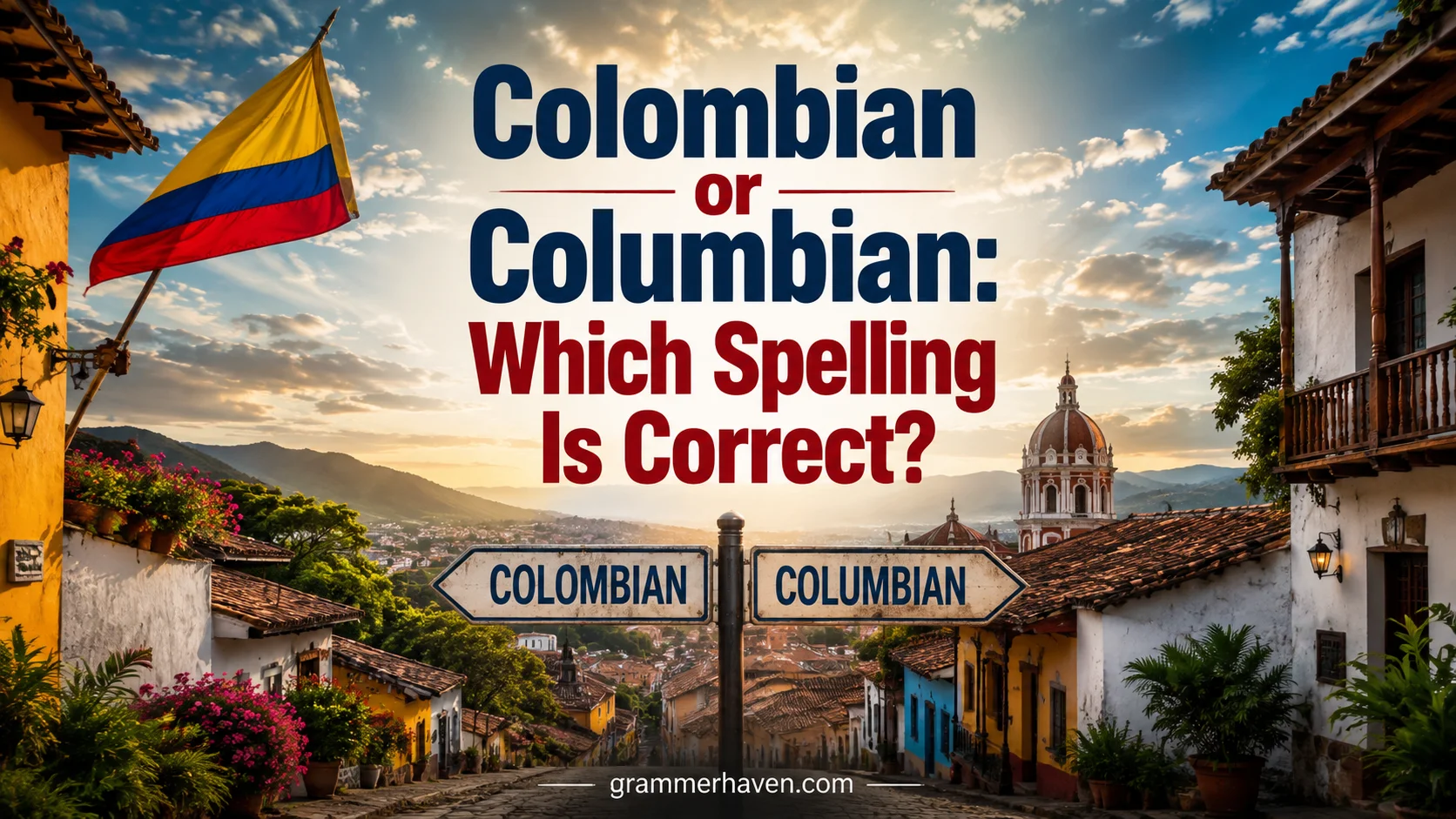
Colombian or Columbian: Which Spelling Is Correct? explains why these words look alike but have a different meaning in English. Colombian is the correct word for Colombia, its people, culture, language, food, coffee, and sports. The South American nation has its own related terms, and this small spelling difference can change the meaning of a sentence. When you’re referring to the country, Colombian is the word to use.
Columbian has a historical connection to Christopher Columbus and Columbus. It can refer to places, institutions, and institutions named after him. Columbia is also a poetic name that was historically used to represent the United States. The meanings are completely different, even though the words look almost identical. You may see them in social media, posts, articles, and formal writing, but you shouldn’t use them interchangeably. A clear way to understand the connection is to break down what each word refers to.
This simple guide helps you avoid a common writing mistake and spelling mix-ups. Colombian is the correct choice for things, people, and places related to Colombia. Columbian connects with Columbus, Christopher Columbus, or poetic Columbia. It’s important to understand each word and use it properly. If you mix them up, the intended meaning can become less clear. The way you choose the word should match the historical or modern reference.
Colombian vs. Columbian at a Glance
Here’s the quickest way to separate the two:
| Word | Correct Context | Meaning | Example |
| Colombian | Colombia | From, belonging to, or related to Colombia | She is Colombian. |
| Columbian | Columbia or Columbus-related contexts | Related to Columbia or Christopher Columbus | The Columbian Exchange changed global history. |
| Colombia | Country | A country in northwestern South America | Colombia is famous for its coffee. |
| Columbia | Various proper names and historical uses | A name used for places, institutions, and other concepts | Columbia University is in New York City. |
The simplest rule is this:
Colombia → Colombian
If you’re talking about the South American country, its people, or anything associated with it, Colombian is the word you want.
On the other hand, Columbian belongs to a different family of terms. Its meaning depends on the context.
What Does Colombian Mean?
Colombian is the standard adjective and noun associated with Colombia, the South American country.
As an adjective, it describes something that comes from Colombia or relates to the country. As a noun, it refers to a person from Colombia.
The country itself is officially called the Republic of Colombia. It sits in northwestern South America and has coastlines on both the Caribbean Sea and Pacific Ocean.
Colombian as an Adjective
When you describe something connected to Colombia, use Colombian.
For example:
- Colombian coffee
- Colombian food
- Colombian music
- Colombian history
- Colombian culture
- Colombian literature
- Colombian politics
- Colombian art
- Colombian athletes
- Colombian cities
Notice the pattern. The spelling always follows Colombia, not Columbia.
Consider these sentences:
Colombia has a diverse culinary tradition.
Colombian cuisine reflects influences from Indigenous, African, European, and regional traditions.
Both sentences use the country’s name correctly.
Colombian as a Noun
Colombian can also refer to a person from Colombia.
For example:
- She is Colombian.
- He is a Colombian.
- Several Colombians attended the event.
- The Colombian won the cycling competition.
The plural is straightforward:
Colombian → Colombians
You don’t change the spelling to Columbian when referring to a person.
Colombian Can Describe Much More Than Nationality
It’s also worth remembering that Colombian isn’t limited to nationality.
You can use it to describe things associated with Colombia’s geography, history, society, and cultural traditions.
For example:
- Colombian architecture
- Colombian wildlife
- Colombian exports
- Colombian universities
- Colombian festivals
- Colombian filmmakers
- Colombian musicians
- Colombian literature
- Colombian agriculture
So if the underlying idea is “related to Colombia,” your spelling should almost always be Colombian.
What Does Columbian Mean?
Here’s where the confusion gets interesting.
Columbian is a real word. It isn’t automatically a spelling mistake. However, it doesn’t normally mean “from Colombia.”
Instead, Columbian can refer to Columbia or to Christopher Columbus, depending on the context.
That’s why correcting every instance of Columbian to Colombian can create a new error.
Columbian and Columbia
Columbia appears in numerous proper names and historical references.
For example, Columbia University uses the spelling Columbia, not Colombia. Therefore, an adjective derived from that proper name may use Columbian.
The same basic distinction appears with organizations, publications, places, and other names.
When a word comes from a proper name, you shouldn’t casually “correct” its spelling just because another similar word is more familiar.
Columbian and Christopher Columbus
Columbian also appears in historical terminology connected with Christopher Columbus.
The best-known example is the Columbian Exchange.
The term describes the widespread transfer of plants, animals, foods, diseases, people, and other biological and cultural elements between the Americas and Afro-Eurasia following European contact.
For example, foods such as:
- Potatoes
- Tomatoes
- Maize
- Cacao
- Peppers
originated in the Americas and eventually spread to other parts of the world.
Meanwhile, Europeans brought crops and animals such as:
- Wheat
- Sugarcane
- Horses
- Cattle
- Pigs
to the Americas.
So in Columbian Exchange, the spelling Columbian has nothing to do with the modern country of Colombia.
That’s an important distinction.
Colombian vs. Columbian: What’s the Difference?
The difference becomes much easier when you connect each word to its source.
Colombian = Colombia
Use Colombian when you’re talking about the country Colombia.
Think:
Colombia → Colombian
Examples:
- Colombian citizen
- Colombian restaurant
- Colombian coffee
- Colombian history
- Colombian soccer player
- Colombian city
- Colombian culture
Columbian = Columbia or Columbus-Related Contexts
Use Columbian when the context specifically calls for that spelling.
Think:
Columbia → Columbian
or, in historical terminology:
Columbus → Columbian
Examples include:
- Columbian Exchange
- established names containing “Columbian”
- terms derived from Columbia
- historical references associated with Columbus
This gives you a reliable mental shortcut.
If you mean Colombia, use Colombian.
Is “Columbian” a Misspelling of “Colombian”?
Sometimes, but not always.
If someone writes:
She is Columbian.
and they mean that she’s from Colombia, the spelling is incorrect.
The correct sentence is:
She is Colombian.
Likewise, you should write:
They sell Colombian coffee.
not:
They sell Columbian coffee.
However, imagine someone writes:
The Columbian Exchange transformed agriculture around the world.
That sentence isn’t using Columbian as a misspelling of Colombian. The historical term is Columbian Exchange.
This is why context matters.
Compare These Examples
| Incorrect or Correct? | Sentence | Explanation |
| ❌ Incorrect | She is Columbian. | If she is from Colombia, use Colombian. |
| ✅ Correct | She is Colombian. | Correct demonym for Colombia. |
| ❌ Incorrect | We bought Columbian coffee from Colombia. | Use Colombian for coffee from Colombia. |
| ✅ Correct | We bought Colombian coffee. | Correct adjective. |
| ✅ Correct | The Columbian Exchange changed global agriculture. | Historical term associated with Columbus. |
| ✅ Correct | Columbia University has a long history. | Columbia is part of the institution’s proper name. |
The mistake happens when people treat Columbian and Colombian as interchangeable. They aren’t.
Why Do People Confuse Colombian and Columbian?
The confusion makes perfect sense once you look at the words side by side.
Colombia
Columbia
Only one vowel changes. Yet the meanings can point in completely different directions.
Colombia and Columbia Look Almost Identical
The visual similarity is the biggest reason people mix them up.
Compare:
- Colombia
- Columbia
Now compare the adjectives:
- Colombian
- Columbian
The difference is easy to miss when you’re reading quickly.
English also contains many words that use Columbia in names and historical references. That familiarity can influence spelling choices.
Columbia Is a Familiar English Name
Columbia has a long history in English-language usage.
It has been used in names for places, institutions, ships, publications, businesses, and other entities. It also appears as a historical poetic name associated with the United States.
As a result, English speakers frequently encounter Columbia.
Colombia, meanwhile, refers specifically to the South American nation.
That creates a trap: someone remembers the familiar Columbia and unconsciously turns Colombian into Columbian.
Historical References Add Another Layer
The word Columbian also appears in historical discussions about Columbus.
That means readers may encounter both words in completely legitimate writing:
Colombian culture
and:
the Columbian Exchange
They look similar enough to cause confusion, but their origins differ.
Pronunciation Doesn’t Always Help
When you hear Colombian and Columbian, the distinction can become less obvious.
The written difference is clearer than the spoken one for many people. That’s especially true when someone says the word quickly.
When spelling the term, therefore, it’s useful to connect it with the underlying proper noun.
Colombia → Colombian
That’s the safest memory rule.
Examples of Colombian in a Sentence
The best way to understand a spelling distinction is to see it working naturally.
Colombian Culture
Colombian culture reflects Indigenous, African, European, and regional influences.
Here, Colombian describes culture associated with Colombia.
Colombian Coffee
She bought Colombian coffee because she enjoys its distinctive flavor.
The coffee comes from Colombia, so Colombian is correct.
Colombian History
The students studied Colombian history before visiting Bogotá.
The adjective describes the history of Colombia.
Colombian Food
The restaurant serves several traditional Colombian dishes.
Again, the food is associated with Colombia.
Colombian People
Many Colombians have made important contributions to literature, music, science, sports, and the arts.
The noun Colombians refers to people from Colombia.
Colombian Geography
Colombian geography ranges from Caribbean coastlines to high Andean regions and Amazonian landscapes.
The adjective works because the subject relates to Colombia.
Colombian Music
Colombian music includes a wide range of regional styles and traditions.
The word describes music associated with Colombia.
Colombian Products
The company imports Colombian cacao for its chocolate products.
The cacao comes from Colombia, making Colombian the correct adjective.
Examples of Columbian in a Sentence
Now compare those examples with legitimate uses of Columbian.
The Columbian Exchange
The Columbian Exchange dramatically changed diets on both sides of the Atlantic.
This is one of the most familiar historical uses of Columbian.
A Proper Name
The organization’s official name includes the word Columbian.
If Columbian appears as part of an established name, its spelling should remain unchanged.
Historical Writing
The historian examined Columbian-era developments in the context of European exploration.
The precise meaning depends on the author’s historical context. It shouldn’t automatically be interpreted as “Colombian.”
A Columbia-Related Name
The institution’s Columbian traditions are reflected in its historical records.
Here, Columbian derives from the proper name Columbia rather than the country Colombia.
The lesson is simple: don’t judge the spelling without looking at what the word refers to.
Colombian vs. Columbian in American English
In US English, Colombian is the standard word for anything or anyone associated with Colombia.
If you’re writing about the country’s people, products, history, geography, or culture, choose Colombian.
For example:
- Colombian citizens
- Colombian businesses
- Colombian food
- Colombian artists
- Colombian literature
- Colombian exports
- Colombian cities
There’s no reason to use Columbian as an alternative spelling.
However, American English also uses Columbia in many proper names. That’s where Columbian can legitimately appear.
The distinction isn’t about British versus American spelling. It’s about meaning and word origin.
In other words, this isn’t a case like color vs. colour, where two regional spelling conventions exist.
Colombian and Columbian aren’t US and UK variants of the same word.
They serve different purposes.
Colombian vs. Columbian vs. Columbia vs. Colombia
Four related-looking terms cause much of the confusion.
Here’s a useful reference table:
| Term | Meaning | Example |
| Colombia | A country in South America | Colombia borders both the Caribbean Sea and Pacific Ocean. |
| Colombian | Something or someone from Colombia | Colombian coffee is exported worldwide. |
| Columbia | A name used for certain places, institutions, and historical concepts | Columbia University is located in New York City. |
| Columbian | Related to Columbia or, in historical contexts, Columbus | The Columbian Exchange had global consequences. |
The most important connection is:
Colombia → Colombian
That’s the pair you need when discussing the South American country.
Meanwhile:
Columbia → Columbian
is useful when the underlying name is actually Columbia.
And some historical uses of Columbian connect to Columbus.
A Simple Way to Remember Colombian
Here’s an easy trick that works well:
Keep the “o” from Colombia.
Look at these two words:
Colombia → Colombian
The spelling stays visually connected.
Now look at:
Columbia → Columbian
The u carries through.
This gives you a quick memory system:
| If you mean… | Use… |
| The South American country | Colombia |
| A person from Colombia | Colombian |
| Something from Colombia | Colombian |
| Columbia as a proper name | Columbia |
| Something derived from Columbia | Columbian |
| Certain historical references to Columbus | Columbian |
Memory Shortcut
Think of Colombia and Colombian as a matched pair.
If the country has an o, the related adjective has an o too.
Colombia → Colombian
That one connection eliminates most spelling mistakes
Common Mistakes to Avoid
Mistake: “She Is Columbian”
If you mean she comes from Colombia, this is incorrect.
Correct:
She is Colombian.
The word describes her nationality.
Mistake: “Columbian Coffee”
When you’re talking about coffee produced in Colombia, use:
Colombian coffee
The same rule applies to other products:
- Colombian chocolate
- Colombian cacao
- Colombian fruit
- Colombian exports
- Colombian cuisine
Mistake: Treating “Columbian” as an Alternative Spelling
Columbian isn’t a second spelling of Colombian.
Changing o to u changes the word’s reference.
This is why the distinction matters in professional writing, academic work, journalism, travel content, and educational material.
Mistake: Correcting Every “Columbian” to “Colombian”
This mistake goes in the opposite direction.
If you see:
Columbian Exchange
don’t change it to Colombian Exchange.
The established historical term is Columbian Exchange.
Likewise, if Columbian appears within an official name, preserve the official spelling.
A Practical Editing Test
When proofreading, ask one question:
“What does this word refer to?”
If the answer is Colombia, write:
Colombian
If the answer is Columbia, the appropriate form may be:
Columbian
If the answer involves Christopher Columbus, Columbian may also be correct in established historical terminology.
This test works better than memorizing isolated spellings because it connects the spelling to the meaning.
Case Study: Colombian Coffee vs. the Columbian Exchange
Consider these two sentences:
Colombian coffee is popular around the world.
The Columbian Exchange changed global food systems.
At first glance, the words look almost interchangeable. They aren’t.
In the first sentence, Colombian describes coffee associated with Colombia.
In the second, Columbian appears in a historical term associated with Columbus and the post-1492 exchange of biological and cultural materials across the Atlantic.
The difference becomes obvious when you ask what each word modifies.
Coffee → Colombia → Colombian
Exchange → Columbus → Columbian
This is a useful example because it shows why spelling alone doesn’t tell the entire story. Meaning drives the spelling.
Why the Distinction Matters
At first, confusing one vowel might seem trivial. In practice, it can create an entirely different reference.
Imagine a travel article that says:
“The hotel serves authentic Columbian food.”
A reader could reasonably assume the writer means food from Colombia. The intended meaning becomes clear, but the spelling remains wrong.
Now imagine a history textbook that changes:
Columbian Exchange
to:
Colombian Exchange
That change would introduce a factual and terminological error.
Small spelling differences can carry substantial meaning.
That’s especially true with proper names, nationalities, historical terms, and geographic references.
Colombian or Columbian: Which One Should You Use?
Use Colombian when you’re referring to:
- A person from Colombia
- Something produced in Colombia
- Colombian culture
- Colombian history
- Colombian geography
- Colombian food
- Colombian coffee
- Colombian music
- Colombian literature
- Colombian businesses
- Colombian cities
- Colombian traditions
Use Columbian when you’re referring to:
- Columbia in an established context
- A proper name that contains Columbian
- Historical terminology associated with Christopher Columbus
- The Columbian Exchange
- Other established uses where Columbian has a specific meaning
The distinction can be summarized in one line:
Colombian describes Colombia. Columbian describes something else, depending on context.
See also: Where or Were: What’s the Difference?
FAQs:
Is Colombian or Columbian correct?
Both can be correct, but they don’t mean the same thing. Use Colombian for something or someone from Colombia. Use Columbian in contexts connected to Columbia, Columbus, or established names and historical terms.
Is it Colombian coffee or Columbian coffee?
The correct phrase is Colombian coffee when you’re referring to coffee from Colombia.
For example:
Colombian coffee is one of the country’s best-known exports.
Columbian coffee would incorrectly suggest that the coffee relates to Columbia rather than Colombia.
Is someone from Colombia Colombian or Columbian?
Someone from Colombia is Colombian.
For example:
My coworker is Colombian.
The plural form is Colombians:
The group included several Colombians.
Why do people spell Colombian as Columbian?
The confusion mainly comes from the visual similarity between Colombia and Columbia. English speakers also encounter Columbia frequently in proper names and historical contexts.
Because Columbian is itself a legitimate word, the incorrect spelling can look perfectly reasonable at first glance.
Is Columbian a real word?
Yes.
Columbian is a legitimate word in certain contexts. It can refer to something associated with Columbia or appear in historical terminology connected with Christopher Columbus.
It isn’t, however, the standard adjective for Colombia.
Conclusion:
Choosing between Colombian and Columbian depends on what you mean. Use Colombian for Colombia, its people, culture, language, and other things connected to the country. Use Columbian for Christopher Columbus, Columbus, Columbia, or related historical references. Remembering this small spelling difference will help you avoid a common mistake and use each word properly.