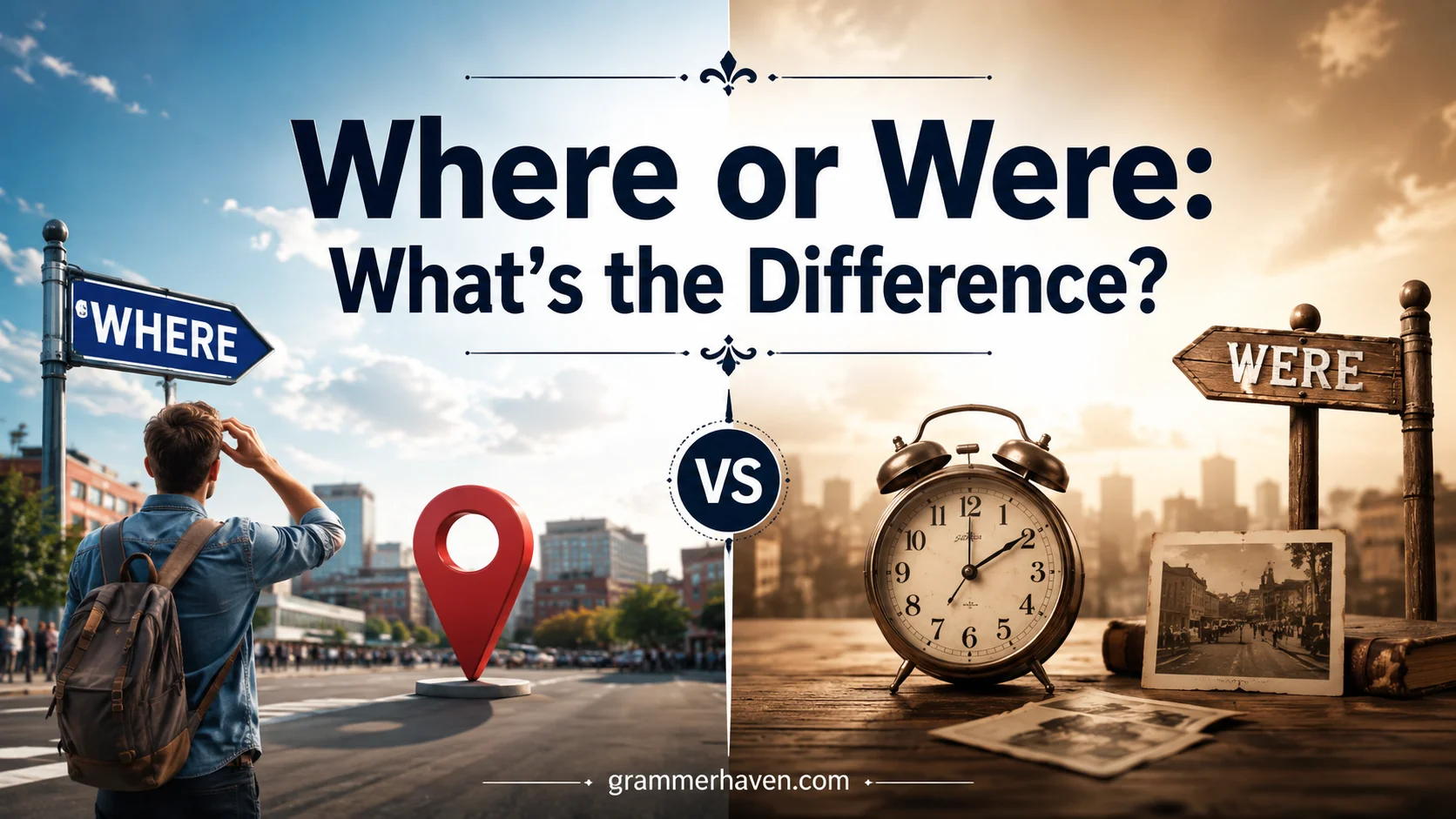
Where or Were: What’s the Difference? explains why where and were cause confusion through sound, meaning and spelling.
Where and were have similar sound, but their meanings, spellings, and roles differ. Were is a past tense form of the verb be, while where identifies a specific place or location. In English writing, students often make mistakes because they’re confused by these two words. You can remember where by connecting its h with home, a place. Where can function as an adverb, pronoun, or conjunction.
Were occurs in several past tense forms, including indicative past tenses and the past subjunctive mood. Where appears in a question when you ask about an unknown place or location. For example, “the pen is where you left it” uses where to identify a place at a particular time. These terms appear frequently in the English language, so knowing their correct use helps you select the right answers in an article or exercise. The following points show the key distinction: were describes the past, while where identifies a place.
Pronunciation can also help. Where rhymes with there, while were rhymes with fur. Read each sentence out loud and listen to the word that fits its meaning. Were connects to be in the past, while where identifies a place. Were appears three times more frequently than where, making it more common. Knowing this reason can prevent recurring mistakes, helping you stay cautious and use the words differently in each response.
Where or Were: Quick Difference Between the Two Words
Before exploring the details, look at this quick comparison:
| Word | Meaning | Grammar Function | Example |
| Where | Refers to a place or location | Adverb, pronoun, or conjunction | Where is the library? |
| Were | Past form of “are” | Verb | They were happy yesterday. |
| We’re | Short form of “we are” | Contraction | We’re going home. |
The biggest difference comes down to the question each word answers.
Ask yourself:
- Is the sentence talking about a place? Use where.
- Is the sentence talking about something that happened in the past? Use were.
- Can you replace the word with we are? Use we’re.
For example:
- Where is my jacket?
→ You are asking about a location. - They were tired after work.
→ You are describing a past condition. - We’re meeting tomorrow.
→ You mean “we are meeting tomorrow.”
What Does Where Mean?
The word where relates to location. It tells you the place where something happens, exists, or occurs.
It answers questions like:
- At what place?
- In what location?
- To what place?
Examples:
- Where do you live?
- Where is the nearest hospital?
- Do you know where she went?
- This is the restaurant where we celebrated.
In each example, “where” connects to a place.
A useful way to recognize where is to replace it with phrases like:
- “what place”
- “which location”
- “at what point”
If the sentence still makes sense, where is likely the correct choice.
Example:
Where did you park the car?
Replace “where”:
At what place did you park the car?
The meaning stays clear, so “where” works.
Where as a Question Word
The most common use of where is asking about a location.
People use it every day in conversations:
- Where are you?
- Where are my keys?
- Where should we meet?
- Where did you learn that?
These questions usually require an answer involving a place.
Examples:
Question: Where is Sarah?
Answer: Sarah is at the office.
Question: Where did you travel last summer?
Answer: I traveled to Italy.
Notice how every answer gives a location.
Where as a Relative Word in Sentences
Besides asking questions, where can connect two parts of a sentence.
This use often appears in longer sentences.
Examples:
- This is the house where I grew up.
- I remember the park where we played as children.
- The city where she works has beautiful architecture.
Here, “where” does not ask a question. Instead, it introduces information about a specific place.
You can often replace it with phrases like:
- in which
- at which
- from which
Example:
This is the building where he works.
Also means:
This is the building in which he works.
Common Expressions That Use Where
Many everyday English expressions include “where.”
| Expression | Meaning | Example |
| Somewhere | An unknown place | My phone is somewhere in the house. |
| Anywhere | Any possible place | You can sit anywhere. |
| Everywhere | All places | I looked everywhere for my wallet. |
| Nowhere | No place | There was nowhere to park. |
| Where else | Another possible place | Where else could we go? |
These words all connect to the idea of location.
What Does Were Mean?
The word were is a verb. It is the past tense form of are.
You use were when talking about something that happened before now.
Examples:
- They were late yesterday.
- We were excited about the trip.
- You were right.
- The students were prepared.
Think of it as moving from the present into the past:
| Present | Past |
| They are happy. | They were happy. |
| We are busy. | We were busy. |
| You are correct. | You were correct. |
The situation existed before, but it may not be true anymore.
Were With Different Subjects
English verbs change depending on the subject. Here is where “were” fits:
| Subject | Correct Form |
| I | was |
| He | was |
| She | was |
| It | was |
| You | were |
| We | were |
| They | were |
Examples:
Correct:
- I was tired.
- She was nervous.
- They were excited.
- You were helpful.
A common mistake happens when people use “where” instead of “were” because they sound similar.
Incorrect:
They where happy yesterday.
Correct:
They were happy yesterday.
The sentence talks about their past emotion, not a location.
Were in Hypothetical Situations
One of the most interesting uses of were appears in imaginary situations.
English uses were in statements about things that are not real, unlikely, or only being imagined.
Examples:
- If I were rich, I would travel the world.
- If she were here, she could help us.
- I wish it were easier.
This grammar pattern is called the subjunctive mood.
The famous phrase:
“If I were you…”
is an example.
People use it when giving advice because they are imagining being another person.
Example:
If I were you, I would save more money.
The speaker is not actually the other person. They are imagining that situation.
Where or Were: Examples Side by Side
Seeing the difference in real sentences makes the rule easier to remember.
| Incorrect Sentence | Correct Sentence | Explanation |
| Were is the bathroom? | Where is the bathroom? | Asking about a place |
| I don’t know were he lives. | I don’t know where he lives. | Referring to location |
| They where tired after work. | They were tired after work. | Talking about the past |
| Where you at the meeting? | Were you at the meeting? | Asking about a past event |
How to Remember the Difference Between Where and Were
Grammar rules become easier when you connect them to simple memory tricks.
Remember Where With “Here”
The word where contains the same “-here” sound connection as “here.”
Think:
- Here = this place.
- Where = what place?
Examples:
- I am here.
- Where are you?
Both words deal with location.
Remember Were as the Past Form of Are
A simple trick:
Are today → Were yesterday
Examples:
Today:
They are busy.
Yesterday:
They were busy.
Today:
We are friends.
Past:
We were friends.
Replace the Word Test
When you are unsure, replace the word.
Test for Where
Replace it with:
What place?
Example:
Where did you buy that shirt?
Replacement:
What place did you buy that shirt?
The meaning works.
Test for Were
Replace it with:
Was or are (depending on the sentence)
Example:
They were excited.
Replacement:
They are excited.
The sentence changes from past to present, but the verb relationship is clear.
Common Mistakes With Where and Were
Using Were When Asking About a Place
Wrong:
Were is the nearest coffee shop?
Correct:
Where is the nearest coffee shop?
Why?
Because the question asks for a location.
Using Where Instead of Were in Past Sentences
Wrong:
We where watching a movie.
Correct:
We were watching a movie.
Why?
The sentence describes a past activity.
Confusing Where, Were, and We’re
Many writers struggle with all three words.
Here is the difference:
| Word | Meaning | Example |
| Where | Location | Where are my shoes? |
| Were | Past form of are | We were home yesterday. |
| We’re | We are | We’re leaving now. |
A helpful test:
- Replace we’re with “we are.”
- Replace where with “what place.”
- Replace were with a past version of “are.”
Where vs. Were vs. We’re: Real-Life Examples
These three words can appear in the same conversation.
Example:
Where were you yesterday?
Meaning:
At what place were you yesterday?
Answer:
We were at the park.
Another example:
Where are we going?
Answer:
We’re going to the mall.
Notice how all three words can appear naturally but each has a different purpose.
Practice: Choose Where or Were
Test your understanding.
Fill in the blanks:
- ______ did you put my notebook?
- They ______ playing football yesterday.
- I wonder ______ she bought that dress.
- If I ______ taller, I would join the team.
- ______ are you traveling next year?
Answers:
- Where did you put my notebook?
- Asking about location.
- They were playing football yesterday.
- Describing a past action.
- I wonder where she bought that dress.
- Referring to a place.
- If I were taller, I would join the team.
- Imaginary situation.
- Where are you traveling next year?
- Asking about destination.
See also: Capital or Capitol: What’s the Difference?
FAQs:
1. What is the difference between where and were?
Where refers to a place or location, while were is a past tense form of the verb be.
2. When should you use where?
Use where when you’re talking about a place, asking about a location, or connecting information related to a place.
3. When should you use were?
Use were when describing something in the past with the verb be, such as “They were happy.”
4. Are where and were pronounced the same?
No. In standard pronunciation, where rhymes with there, while were rhymes with fur.
5. Why do people confuse where and were?
People often confuse them because the words look similar and can sound similar in some accents. Their meanings and grammatical roles are different.
6. Is where a verb?
No. Where can function as an adverb, pronoun, or conjunction, depending on how you use it.
7. Is were always a past-tense word?
Were is commonly used as a past-tense form of be. It can also appear in the past subjunctive mood, as in “If I were you.”
8. What is an easy way to remember where?
Think of the h in where as standing for home. A home is a place, which can remind you that where relates to location.
9. Which is correct: “Where you were” or “Were you where”?
Both can be correct, but they serve different purposes. “Where you were” asks or describes a location, while “Were you where…” needs additional context to form a complete idea.
10. How can I avoid mistakes with where and were?
Check the meaning of the sentence. If you’re talking about a place, use where. If you’re using a past form of be, use were.
Conclusion:
Where and were may look and sound similar, but they have different jobs in English. Where points to a place or location, while were functions as a past tense form of be. Remembering this basic distinction, along with the pronunciation trick, can help you choose the correct word with confidence.