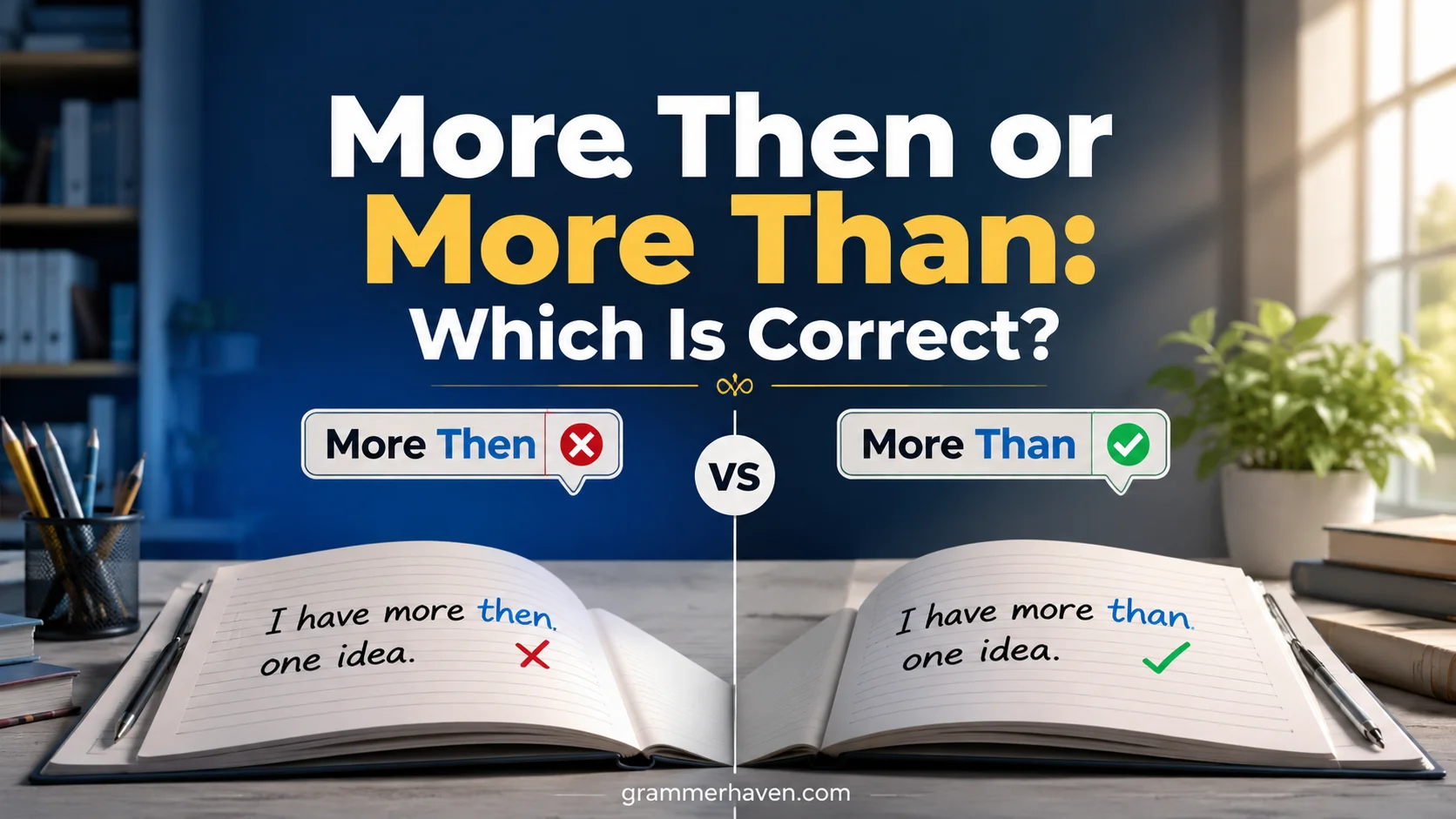
More Then or More Than creates confusion in English writing and reading because more than and more then look similar.
The correct phrase is more than when you indicate a greater quantity, extent, or comparison. For instance, “I have more than five apples in my basket” uses than for comparison. The wrong form, more then, uses then, which relates to time or order. A simple rule helps learners, students, writers, and ESL learners remember the correct form. Careful practice, review, and attention can improve your understanding and confidence.
Then and than have distinct meanings and uses. Then can mean at that time or show sequence, while than shows comparison. If you’re unsure, try substituting “at that time” for then and see whether the sentence makes sense. People, native speakers, and learners may mix them up in spoken English and everyday discussion. Easy rules, examples, and explanations make the difference clear. The mistake is common, but you can learn the correct phrase and use it every time.
Quick Answer: More Then or More Than?
The correct phrase is “more than” when you’re making a comparison or talking about a quantity, amount, or degree.
“More then” is usually incorrect because then doesn’t serve the comparative function required in these sentences.
| Phrase | Correct? | Main use | Example |
| More than | ✅ Yes | Comparison, amount, quantity, or degree | The book has more than 300 pages. |
| More then | ❌ Usually incorrect | Incorrect substitution of then for than | The book has more then 300 pages. |
A simple rule can save you a lot of editing:
Than compares. Then shows time, sequence, or result.
For example:
- ✅ Maria has more than five years of experience.
- ❌ Maria has more then five years of experience.
- ✅ Finish the report, then send it.
- ❌ Finish the report, than send it.
The distinction isn’t about American versus British English. Both varieties use than for comparisons and then for time or sequence.
What Does “More Than” Mean?
More than generally means that something exceeds a particular amount, number, level, or comparison point. The word more indicates a greater amount or degree, while than introduces the comparison.
Cambridge Dictionary gives examples such as “more than I intended” and “more than 20 books,” showing how than connects the greater amount with its comparison point.
More Than for Comparing Two Things
The most familiar use of more than involves a direct comparison.
Consider these examples:
- This car is more expensive than my old one.
- James reads more books than his brother.
- I enjoy walking more than driving.
- The second proposal sounds more practical than the first.
In each sentence, than introduces the other side of the comparison.
You can think of it as a bridge:
Thing with the greater amount → more → than → thing being compared
For instance:
This laptop costs more than that laptop.
The sentence doesn’t merely say that the laptop costs a lot. It says that its cost is greater in comparison with another laptop.
More Than for Numbers and Quantities
More than also works with specific numbers, measurements, and amounts.
Examples include:
- More than 100 people attended the event.
- The journey took more than six hours.
- She has more than $500 in her account.
- The building is more than 50 years old.
- The article received more than 10,000 views.
This use is especially common in reports, news writing, business communication, and everyday conversation.
If a sentence means “greater than this amount,” than is normally the correct word.
More Than for Degree or Emphasis
There’s another useful meaning that often gets overlooked. More than can emphasize an adjective or expression.
For example:
- I’m more than happy to help.
- She is more than capable of doing the job.
- The explanation was more than sufficient.
- The experience was more than worth the effort.
Here, more than doesn’t necessarily compare two measurable quantities. Instead, it can mean something like very, extremely, or to a great degree. Merriam-Webster lists this emphatic meaning of more than, giving examples such as “more than happy” and “more than welcome.”
That makes more than a flexible phrase. It can handle straightforward comparisons and more expressive statements.
Why Is “More Then” Usually Incorrect?
The problem comes from confusing two words that look remarkably similar.
Than is a comparison word.
Then is generally a time or sequence word.
Their spelling differs by only one letter, and their pronunciation can sound similar in quick speech. That’s enough to trip up even careful writers.
Look at this example:
- ❌ I have more then ten dollars.
- ✅ I have more than ten dollars.
The writer is comparing the amount of money with the number ten. Therefore, than is required.
Now compare it with:
- I finished my work, then I went home.
Here, no comparison exists. The sentence describes what happened next. That’s why then works.
Why Writers Mix Up Than and Then
Several factors make this mistake common:
- The words look almost identical.
- Their sounds can be difficult to distinguish in casual speech.
- Both appear frequently in everyday English.
- Fast typing can cause accidental substitutions.
- Writers sometimes rely on sound instead of grammatical meaning.
The best solution isn’t to memorize hundreds of rules. Instead, ask what the sentence is doing.
Is it comparing something? Use “than.”
Is it showing what happened next or when something happened? Use “then.”
What Does “Then” Mean?
Unlike than, then has nothing to do with making a normal comparison. Cambridge Dictionary identifies several major uses of then, including referring to a particular time, describing what happens next, and indicating a result or consequence.
Then for Sequence
Use then when one event follows another.
Examples:
- First, wash the vegetables. Then chop them.
- We ate dinner and then watched a movie.
- Finish your homework, then play your game.
- She opened the door and then walked inside.
Here, then has a meaning close to “next” or “after that.”
A useful test is to replace then with after that.
We finished dinner, after that we went home.
The meaning remains clear. That’s a strong sign that then is appropriate.
Then for Time
Then can also refer to a particular point in time.
Examples:
- I lived in New York back then.
- She was only sixteen then.
- Things were very different then.
- I’ll call you tomorrow. I’ll have more information by then.
In these examples, then points to a time rather than making a comparison.
Then for a Result or Consequence
Then can also introduce a result, especially in conditional sentences.
Examples:
- If you study consistently, then you’ll improve.
- If the weather gets worse, then we’ll cancel the trip.
- If that’s true, then we need to reconsider the plan.
Cambridge describes this use of then as indicating a result or “in that case.”
More Than vs. More Then: Side-by-Side Examples
Seeing the words in context makes the difference much clearer.
| Incorrect | Correct | Reason |
| I have more then ten dollars. | I have more than ten dollars. | Than introduces a quantity comparison. |
| She is more then capable. | She is more than capable. | Than completes the expression. |
| He earns more then his brother. | He earns more than his brother. | Two incomes are being compared. |
| There were more then 50 guests. | There were more than 50 guests. | The number exceeds 50. |
| This costs more then expected. | This costs more than expected. | The cost is compared with an expectation. |
| Finish the work than leave. | Finish the work, then leave. | Then means “after that.” |
| We ate and than went home. | We ate and then went home. | The sentence describes sequence. |
| Things were different back than. | Things were different back then. | Then refers to a past time. |
The key isn’t the word immediately before or after than. The key is the relationship between the ideas.
When Should You Use “More Than”?
Several sentence patterns appear again and again in everyday writing.
More Than + Number
Use more than when an amount exceeds a number.
- More than 20 students joined the class.
- The company has more than 1,000 employees.
- The package weighs more than five pounds.
More Than + Noun
The phrase can also express that something exceeds a particular thing or idea.
- She wants more than money.
- The job requires more than technical skills.
- Good writing requires more than correct spelling.
Verb + More Than
You can use more than when comparing actions or preferences.
- I value honesty more than popularity.
- She talks more than she listens.
- He works more than his colleagues.
The comparison doesn’t always need two nouns. It can compare activities, qualities, or degrees.
More Than + Adjective
This pattern often adds emphasis.
- He’s more than ready.
- We’re more than willing to help.
- The explanation was more than adequate.
- She’s more than capable of solving the problem.
Merriam-Webster recognizes more than as an idiomatic phrase meaning “to a great degree,” which explains why expressions such as more than happy sound natural in English.
Common Expressions With “More Than”
Some combinations are so common that you’ll encounter them constantly.
More Than Enough
This means that there is a greater amount than necessary.
We have more than enough food for everyone.
More Than Likely
This means something is highly likely.
She’s more than likely to arrive early.
More Than Happy
This emphasizes willingness or pleasure.
I’m more than happy to answer your questions.
More Than Once
This means something happened multiple times.
I’ve visited that museum more than once.
More Than Ever
This means to a greater extent than at any previous point.
People rely on digital communication more than ever.
More Than Just
This emphasizes that something has a greater role, meaning, or value than might initially appear.
The book is more than just a grammar guide.
These expressions demonstrate why more than deserves attention beyond the simple rule “use than for comparisons.”
More Than vs. Over: Are They the Same?
Another question often appears alongside more than: Can you say over 100 instead of more than 100?
In many contexts, yes.
For example:
- More than 500 people attended the concert.
- Over 500 people attended the concert.
Both sentences communicate that the number exceeded 500.
Merriam-Webster explicitly recognizes over as meaning “more than” when referring to quantities, including examples such as “cost over $5” and “waited over an hour.” It also notes that this usage has a long history in English.
So, if you’re writing in modern American English, over 500 isn’t automatically an error. However, more than remains an especially clear choice when you want to make the comparison explicit.
More Than vs. Then: The Easiest Memory Trick
Grammar rules become much easier when you attach them to a simple idea.
Remember: THAN = Comparison
Think of:
- more than
- less than
- greater than
- faster than
- taller than
- better than
Each expression compares something.
Remember: THEN = Time or Sequence
Think of:
- first → then
- now → then
- before → then
- do this → then do that
For example:
The blue car is faster than the red car.
Comparison.
We checked the car, then we started the engine.
Sequence.
A handy memory line is:
Than compares. Then continues.
It’s short enough to remember when you’re proofreading.
Common Mistakes With More Than
The more then or more than confusion often appears alongside other comparison errors.
Using Then After More
Incorrect:
The company has more then 500 workers.
Correct:
The company has more than 500 workers.
The sentence expresses a quantity greater than 500. Therefore, than is the natural choice.
Using Then in Other Comparisons
The problem doesn’t disappear when more disappears.
Incorrect:
This building is taller then that one.
Correct:
This building is taller than that one.
The same principle applies to taller than, faster than, better than, older than, and countless other comparative structures.
Using Than for Sequence
The reverse mistake happens too.
Incorrect:
First, finish the assignment than submit it.
Correct:
First, finish the assignment, then submit it.
The sentence describes two actions in order. Then means “after that.”
More Then or More Than in a Sentence: Examples
Here are practical examples covering the most common uses:
- The restaurant serves more than 100 customers each day.
- This phone costs more than my previous one.
- She has more than five years of experience.
- I like this design more than the original.
- The journey took more than eight hours.
- More than 200 students attended the event.
- He has more than enough time to finish.
- I’m more than happy to help.
- She’s more than capable of leading the team.
- The results were more than surprising.
- We waited more than an hour.
- The book contains more than 400 pages.
- He values experience more than formal qualifications.
- The solution requires more than money.
- I’ve read that article more than once.
- First, check the instructions, then begin.
- We had lunch, then went for a walk.
- Things looked different back then.
- If you agree, then we’ll proceed.
- Finish the report, then send it to the manager.
Notice how the meaning determines the spelling every time.
A Quick Proofreading Test for “Than” and “Then”
When you encounter more then in your writing, don’t automatically rely on how the sentence sounds. Run a quick meaning test.
The Comparison Test
Ask:
Am I comparing two things, amounts, degrees, or values?
If yes, use than.
- more than
- less than
- better than
- older than
The Sequence Test
Ask:
Could I replace the word with “after that” or “next”?
If yes, use then.
- We ate, then left.
- First read the instructions, then answer the questions.
The Time Test
Ask:
Does the word refer to a particular time?
If yes, then is likely correct.
- I lived there then.
- Back then, things were different.
This approach is more reliable than trying to remember how each word sounds.
A Simple Comparison: Than and Then
| Feature | Than | Then |
| Main function | Comparison | Time, sequence, or result |
| Common phrase | more than | then |
| Example | She is older than me. | She arrived, then left. |
| Used with numbers | Yes | No, when making a comparison |
| Used for sequence | No | Yes |
| Used for past/future time | No | Yes |
| Memory clue | Compare | Next/time |
More Than or More Then in American English
For US English, the answer is straightforward: more than is the standard form when expressing a comparison, quantity, or degree.
There isn’t a special American spelling in which more then becomes acceptable. The two words simply have different grammatical functions.
Cambridge’s American Dictionary entry confirms that than is used with more or less when comparing numbers or amounts.
So these are correct:
- more than 50 miles
- more than two hours
- more than enough
- more than expected
- more than I imagined
But these are not correct when then is being used as a substitute for than:
- ❌ more then 50 miles
- ❌ more then two hours
- ❌ more then enough
- ❌ more then expected
Quick Grammar Checklist
Before publishing or submitting your writing, remember these points:
- More than is correct for comparisons.
- More than works with quantities and numbers.
- More than can express degree or emphasis.
- Than follows comparative words such as more, less, better, and faster.
- Then commonly refers to time.
- Then can show what happens next.
- Then can introduce a result or consequence.
- More then is usually an incorrect substitution.
- Over can also mean “more than” when referring to quantities.
See also: In Regard or In Regards: Which Is Correct?
FAQs:
Is it “more then” or “more than”?
More than is correct when you mean a greater amount, number, degree, or comparison. More then is usually a spelling or usage mistake.
Is “more than” grammatically correct?
Yes. More than is a standard English phrase used for comparisons, quantities, and degrees. For example, “The box weighs more than 10 pounds.”
Why is “more then” incorrect?
Then doesn’t normally introduce a comparison. It usually indicates time, sequence, or a result. Than is the appropriate word after more when the sentence expresses a comparison.
What is the difference between “than” and “then”?
Than is used for comparisons, while then usually refers to time, sequence, or consequence.
Compare:
- This costs more than that.
- Finish this, then leave.
When should I use “more than”?
Use more than when something exceeds another amount, number, level, or comparison point. You can also use it in expressions such as more than enough and more than happy.
Can I use “then” after “more”?
Not when more introduces a comparison. For example, write “more than five people,” not “more then five people.”
Is “more than enough” correct?
Yes. More than enough means there is a greater amount than necessary.
We have more than enough food for the guests.
Is “more than happy” correct?
Yes. More than happy is a common expression that emphasizes willingness or pleasure. Merriam-Webster recognizes this emphatic use of more than.
Is “more than likely” correct?
Yes. More than likely is a standard expression meaning that something is highly likely.
He’ll more than likely arrive before noon.
How can I remember “than” vs. “then”?
Use this simple rule:
Than = comparison. Then = time or sequence.
If you’re comparing two things, choose than. If you’re describing what happens next or referring to a particular time, choose then.
Conclusion:
Choosing between more then and more than becomes simple once you understand what each word does. More than is the correct phrase when you compare amounts, numbers, people, things, or degrees. For example, “She has more than five years of experience” uses than because the sentence compares her experience with a specific amount.
Then, on the other hand, it usually relates to time, sequence, or a result. You might write, “We finished dinner, then we went home.” A quick way to remember the difference is: than compares, while then shows what comes next or refers to a time.