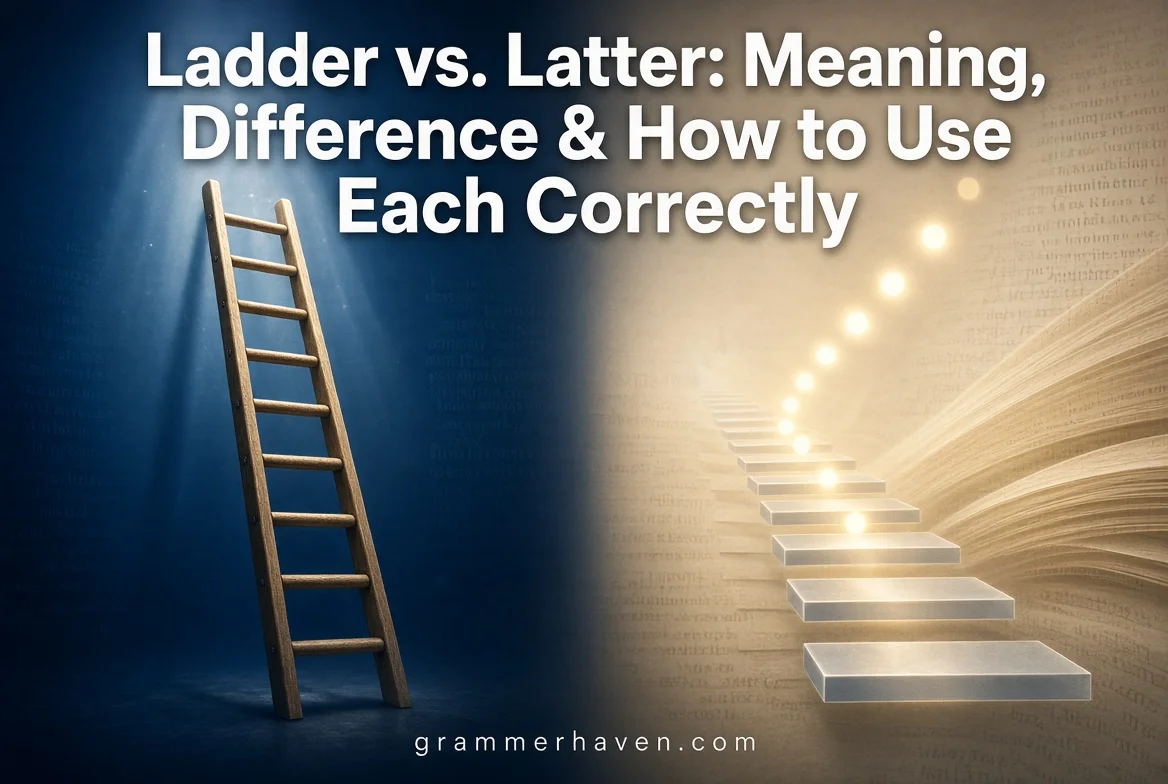
Ladder vs. Latter can confuse readers because the words have an important spelling difference but look almost identical on paper. They have completely different meanings: a ladder is a structure with rungs used to climb, while latter identifies the second of two people or the second of two things already mentioned. A staircase and a ladder make a useful comparison because you can identify the correct word from the context and meaning. The word later relates to time, adding another source of confusion when you’re choosing between two things. This mix-up can produce awkward sentences in writing, especially when you’re scratching your head over the correct spelling.
The easiest way to separate these words is to connect ladder with climb, latter with the second choice, and later with time. This distinction helps you avoid a common slip in written English and spoken English. Clear communication depends on precise usage, especially for readers and listeners. A careless spelling choice can change a sentence completely in an article or everyday speaking. The choices have to be already mentioned before latter can point to the second option. Ladder keeps its physical sense, and later stays connected with time.
This language ladder gives you a simple way to clear up linguistic confusion and strengthen your vocabulary. Collins Dictionary supports the same basic distinction between these terms and their meanings. Careful writing becomes easier when you recognize the correct word before forming a sentence. The same rule improves everyday communication and makes your language more precise.
Quick Answer: Ladder vs. Latter
Ladder is a structure used for climbing or a figurative series of levels or stages. Latter usually means the second of two people, things, or choices that have already been mentioned. It can also describe something near the end of a period or sequence.
| Word | Meaning | Example |
| Ladder | A structure used for climbing | She climbed the ladder to reach the roof. |
| Latter | The second of two things mentioned | I considered tea and coffee. I chose the latter. |
| Later | At a subsequent time | I’ll finish the task later. |
A simple memory trick works well:
You climb a ladder, choose the latter, and do it later.
That one sentence separates all three words.
What Does Ladder Mean?
A ladder is a structure designed to help someone move upward or downward. Traditional ladders have two side supports connected by horizontal rungs or steps. They can be made from materials such as wood, aluminum, fiberglass, or rope.
You might use a ladder to reach a roof, clean an upper window, retrieve something from a high shelf, or perform maintenance. The word therefore has a very concrete physical meaning.
For example:
- The painter climbed the ladder carefully.
- Please move the ladder away from the doorway.
- She used a step ladder to reach the cabinet.
- The firefighter extended the ladder toward the upper floor.
- He leaned the ladder against the wall.
Ladder as a Figurative Word
Ladder doesn’t always refer to something you physically climb. English also uses the word figuratively to describe a progression through levels, ranks, or stages.
Consider these expressions:
- career ladder
- corporate ladder
- social ladder
- ladder of success
- economic ladder
In these expressions, the idea of climbing remains. You move from one level to another just as someone climbs physical rungs.
For example:
She worked hard to climb the corporate ladder.
Nobody expects her to grab a metal ladder and start climbing it. The sentence uses ladder as a metaphor for advancing through professional ranks.
Collins also records this figurative meaning as a rising series of steps, stages, or levels.
Ladder as a Verb
Ladder can also function as a verb, although this use is far less common in everyday American English.
In British usage, particularly in connection with stockings, ladder can describe a run or tear forming in the material. Collins records this sense as well as the noun meaning.
For most everyday writing, however, you’ll encounter ladder primarily as a noun.
What Does Latter Mean?
Latter has nothing to do with a climbing device.
Its most familiar use is to identify the second of two people, things, or groups that have already been mentioned. Oxford defines the noun use as the second of two things or people mentioned.
Consider this sentence:
I can take the train or the bus. I prefer the latter.
Two choices appear:
- train
- bus
Because bus comes second, latter refers to bus.
The word points backward. You need to look at the earlier part of the sentence to understand what it means.
Examples of Latter in a Sentence
Here are several natural examples:
- I considered two apartments, but I preferred the latter.
- The company offered remote work or flexible hours. She chose the latter.
- Mark enjoys both history and chemistry, but he studies the latter more often.
- We could drive or take the train. The latter would be cheaper.
- The manager discussed quality and speed. The latter became the main concern.
In every example, latter refers to the second item.
Latter as an Adjective
Latter can also appear before a noun.
For example:
The latter option is more affordable.
Here, latter identifies the second option previously discussed.
You might also see:
- the latter point
- the latter argument
- the latter example
- the latter option
- the latter group
Oxford lists this use as referring to the second of two things or people mentioned.
Latter Can Also Mean “Near the End”
There’s an important meaning of latter that often gets overlooked.
The adjective latter can describe something that occurs nearer to the end of a period, event, or process.
For example:
- the latter half of the year
- the latter stages of the competition
- the latter part of the book
- the latter years of his career
- the latter stages of the project
Consider this sentence:
The latter half of the movie was much darker.
Here, latter doesn’t identify the second item in a pair. Instead, it means the part closer to the end.
This meaning explains why people sometimes associate latter with later. The words have related historical roots and overlapping ideas involving sequence and time. However, they don’t function the same way in modern sentences.
Ladder vs. Latter: Key Differences
The easiest way to understand ladder vs. latter is to focus on what each word does.
| Feature | Ladder | Latter |
| Main meaning | A structure used for climbing | The second of two things mentioned |
| Common grammatical role | Noun | Noun or adjective |
| Physical object | Yes | No |
| Can describe a choice? | No | Yes |
| Can describe a later part of a period? | No | Yes |
| Figurative use | Career or social advancement | Formal comparison and sequence |
| Typical phrase | Career ladder | The latter option |
The distinction becomes even clearer through examples.
He climbed the ladder.
Here, ladder names a physical object.
He considered a car and a motorcycle. He chose the latter.
Here, latter refers to the second choice: motorcycle.
The two words aren’t interchangeable. They simply happen to look and sound similar.
Ladder vs. Latter Examples
Correct Uses of Ladder
These examples all describe a physical or figurative ladder:
- The worker climbed the ladder to repair the roof.
- Keep the ladder on a stable surface.
- She grabbed a ladder from the garage.
- The children watched the firefighter raise the ladder.
- He hopes to climb the career ladder quickly.
- Education can help people move up the economic ladder.
The last two examples are figurative. They still use the basic idea of moving from one level to another.
Correct Uses of Latter
Now look at examples involving two previously mentioned items:
- I offered him tea or coffee. He chose the latter.
- The company discussed cost and quality. The latter mattered more.
- We could meet Monday or Tuesday. I prefer the latter.
- She considered teaching and writing. She eventually chose the latter.
- The report presented two explanations. The latter seemed more convincing.
Notice the pattern. Latter needs context.
If someone simply says, “I prefer the latter,” you may reasonably ask, “The latter of what?” The word gets its meaning from something mentioned earlier.
Former vs. Latter
If you want to master latter, learn former at the same time.
The pair works like this:
- Former = the first of two
- Latter = the second of two
For example:
The company offered two plans. The former was cheaper, while the latter included more features.
The first plan is the former.
The second plan is the latter.
This relationship makes the words easier to remember because they work as opposites in this specific context. Oxford and Cambridge both identify former as the contrasting term for this use of latter.
A Practical Case Study
Imagine that a restaurant offers two seating options:
The restaurant offers indoor seating and outdoor seating. The latter is especially popular in summer.
What does latter mean?
It means outdoor seating because that option appears second.
Now reverse the sentence:
The restaurant offers outdoor seating and indoor seating. The latter is quieter.
This time, latter means indoor seating.
That’s an important point: latter doesn’t permanently refer to a particular type of thing.
It always depends on order.
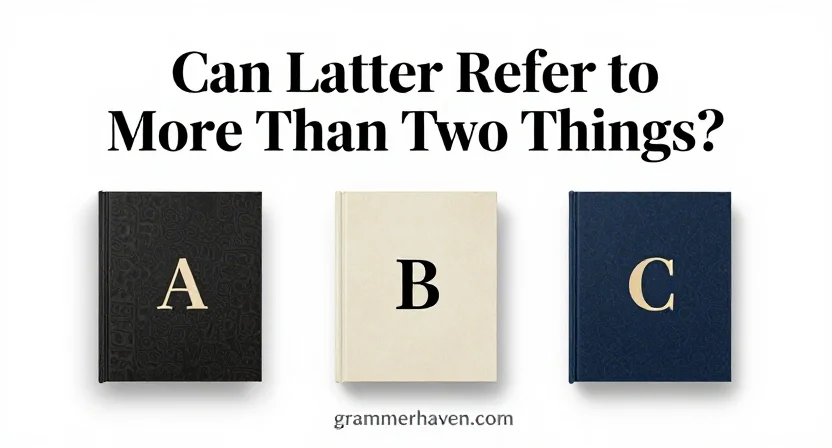
Can Latter Refer to More Than Two Things?
This question requires a little nuance.
Traditional usage advice generally recommends using latter for the second of two things. That’s still the clearest approach, especially in formal writing.
However, major dictionaries document broader usage. Cambridge notes that latter can refer to the last item in a larger group while also marking that use as nonstandard in its American English entry. Oxford likewise records a use involving the last item in a list.
For example:
The menu included soup, salad, pasta, and dessert. The latter was excellent.
Many readers will understand latter as referring to dessert. Yet the sentence isn’t as precise as it could be.
For maximum clarity, write:
The menu included soup, salad, pasta, and dessert. The last dish was excellent.
Or simply:
The dessert was excellent.
When three or more items appear, naming the specific item usually beats relying on latter.
The Best Practical Rule
Use former and latter when you’re clearly discussing two items.
If you’re discussing three or more items, repeat the noun when there is any chance of confusion.
Clear writing should remove guesswork.
Ladder vs. Latter vs. Later
Now add later to the comparison. This creates one of the most common spelling traps.
| Word | Meaning | Example |
| Ladder | A structure used for climbing | He climbed the ladder. |
| Latter | The second of two mentioned things | She chose the latter. |
| Later | At a subsequent time | I’ll call you later. |
Ladder: Think “Climb”
The painter needs a ladder.
You can picture the rungs immediately.
Latter: Think “Second”
I considered the red shirt and the blue shirt. I bought the latter.
The blue shirt came second.
Later: Think “Time”
I’ll finish the report later.
Nothing involves two choices. The sentence simply refers to a future or subsequent time.
A useful memory line is:
Ladder = climb. Latter = second. Later = time.
That three-word association can save you from many spelling mistakes.
Is Latter the Same as Later?
No.
Although latter and later are related historically, they have distinct modern uses.
Later normally refers to time or sequence:
- I’ll call you later.
- She arrived later than expected.
- We can discuss that later.
- He moved there three years later.
Latter, by contrast, commonly refers to the second of two things:
- I compared two plans and selected the latter.
- She offered tea and coffee. I chose the latter.
Latter can also mean nearer to the end of a period:
The latter part of the year was unusually busy.
Cambridge and Oxford both distinguish these meanings clearly.
Common Mistakes With Ladder and Latter
Using Latter When You Mean Ladder
Incorrect:
He climbed the latter to reach the roof.
Correct:
He climbed the ladder to reach the roof.
The person is climbing a physical object, so ladder is required.
Using Ladder When You Mean Latter
Incorrect:
I compared both plans and chose the ladder.
Correct:
I compared both plans and chose the latter.
The sentence refers to the second plan. Therefore, latter is the correct word.
Confusing Latter With Later
Incorrect:
I’ll call you latter.
Correct:
I’ll call you later.
Here, the meaning involves time rather than the second item in a pair.
Using Latter Without Clear Context
Consider:
I prefer the latter.
That sentence isn’t necessarily wrong. However, it requires previous context.
If the reader hasn’t seen two options, latter has nothing clear to point toward.
A stronger version would be:
We can meet Tuesday or Wednesday. I prefer the latter.
Now the reference is obvious.
How to Remember the Difference Between Ladder and Latter
Several memory tricks can make the distinction stick.
1. Ladder Has Double D
Think about the double d in ladder as sturdy supports holding a climbing structure together.
Ladder → climb.
2. Latter Has Double T
Think of latter as pointing to the second item in a pair.
Latter → second.
3. Connect Latter With Former
This is perhaps the strongest grammar-based memory trick:
Former = first
Latter = second
For example:
I considered tea and coffee. The former is lighter. The latter is stronger.
Tea comes first.
Coffee comes second.
4. Remember the Three-Way Sentence
You climb a ladder, choose the latter, and do it later.
It sounds almost like a tongue twister. That’s exactly why it’s memorable.
Latter in Formal and Academic Writing
Latter appears frequently in formal writing because it lets writers avoid repeating a noun.
For example:
The study compared online learning with classroom instruction. The latter produced stronger results among the participants.
Here, the latter refers to classroom instruction.
This construction can make prose more compact. However, clarity should come first.
If a paragraph contains several nouns or multiple comparisons, repeatedly using latter can force readers to retrace the sentence. In those situations, repeating the specific noun may actually produce better writing.
Compare:
The report examined cost, quality, and reliability. The latter was the primary concern.
The reader may wonder whether latter means reliability or whether the writer is stretching the traditional two-item use.
A clearer version is:
The report examined cost, quality, and reliability. Reliability was the primary concern.
The second sentence is slightly longer. It’s also unmistakable.
Ladder in Figurative Expressions
Ladder has a much wider figurative range than many learners realize.
Common expressions include:
Career Ladder
The career ladder describes professional advancement through increasingly senior positions.
She worked her way up the career ladder.
Corporate Ladder
The corporate ladder refers to progression through ranks within a company.
He spent fifteen years climbing the corporate ladder.
Social Ladder
The social ladder describes levels of social status or position.
The novel explores characters trying to move up the social ladder.
Ladder of Success
This phrase presents success as a series of progressive stages.
Education can become an important rung on the ladder of success.
These expressions all preserve the same underlying image: one level leads to another.
When Should You Use Ladder, Latter, or Later?
Use this quick decision process when you’re unsure.
Ask Yourself What You Mean
Are you talking about something you climb?
Use ladder.
He carried the ladder upstairs.
Are you referring to the second of two things already mentioned?
Use latter.
We discussed two plans. I chose the latter.
Are you talking about a subsequent time?
Use later.
I’ll deal with that later.
Are you describing something near the end of a period?
Use latter.
The latter half of the year was difficult.
This simple test usually settles the question within seconds.
Ladder vs. Latter: A Quick Comparison
| Situation | Correct Word | Example |
| Something you climb | Ladder | Put the ladder in the garage. |
| Career advancement | Ladder | She climbed the career ladder. |
| Second of two choices | Latter | I chose the latter. |
| Second item previously mentioned | Latter | The latter option costs less. |
| Near the end of a period | Latter | The latter half was difficult. |
| A future or subsequent time | Later | I’ll call you later. |
See also: Favourite or Favorite: Which Spelling Is Correct?
FAQs:
What Is the Difference Between Ladder and Latter?
Ladder is generally a physical structure used for climbing. Latter usually refers to the second of two people, things, or choices previously mentioned. Latter can also describe something near the end of a period.
What Does Latter Mean in a Sentence?
Latter usually identifies the second of two previously mentioned things.
I compared a laptop and a tablet. I chose the latter.
Here, latter means tablet because it was mentioned second.
Is It Ladder or Latter?
It depends on the meaning.
Use ladder for a climbing structure or a figurative series of levels. Use latter for the second of two mentioned things or for something near the end of a period.
What Is the Difference Between Latter and Later?
Latter commonly means the second of two things or something near the end of a period. Later refers to a subsequent time.
I chose the latter.
I’ll do it later.
The first sentence concerns position. The second concerns time.
What Is an Easy Way to Remember Ladder and Latter?
Remember this sentence:
You climb a ladder, choose the latter, and do it later.
Ladder means climbing. Latter means second. Later means subsequent time.
Can Latter Refer to Three or More Things?
Some dictionaries document broader usage in which latter can refer to the last item in a larger group. However, the clearest traditional use is for the second of two. When three or more items are involved, naming the specific item usually avoids ambiguity.
Conclusion:
The difference between ladder and latter comes down to meaning. A ladder is something you climb, while latter refers to the second of two things already mentioned. Meanwhile, later relates to time or something that happens afterward.
Remember the simple rule: you climb a ladder, choose the latter, and do it later. Once you connect each word with its meaning, choosing the correct spelling becomes much easier. Whether you’re writing an email, essay, report, or everyday message, this small distinction can keep your writing clear and precise.