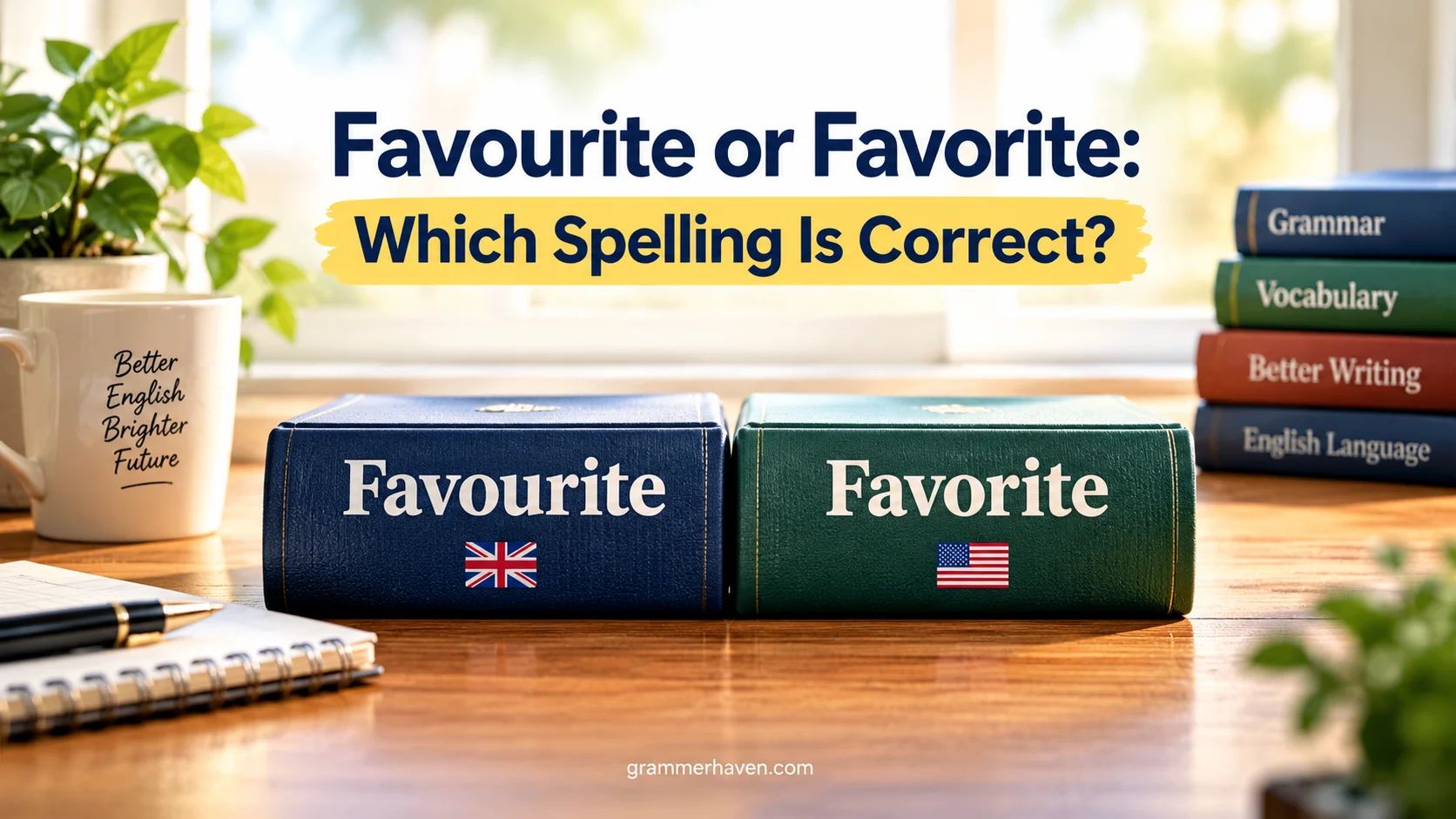
Favourite or Favorite have the same meaning, and their spelling shows regional usage in British English and American English. Both forms describe things you love, loved, or liked the most. The main difference is the spelling difference between these English varieties. Favourite appears in the UK and United Kingdom, while favorite follows common American English usage. These variations across the globe form part of the rich tapestry of the English language. A writer can choose either form based on the intended audience.
The two forms follow different spelling conventions but share the same grammatical functions and basic pronunciation. Their language variations reflect the history and quirks of English, producing regional differences and geographic variation without changing the meaning of the word. Colour and color show the same pattern in British English and American English. These examples reveal how spelling standards can differ among the major varieties of English. Favourite fits the British version of English, while favorite fits the American form.
Your specific audience can guide your spelling choice in writing. A school assignment, business document, website, or article should follow suitable English standards, spelling rules, and regional spelling. A British writer normally follows British English standards and uses favourite. An American writer normally uses favorite. Consistent British and American spellings support polished writing and prevent careless writing. Examples such as Sweet Treats or a Blue item can use either spelling according to the intended audience and English usage. The standard spelling depends on the chosen English variety.
Favourite or Favorite: Quick Answer
Favorite is correct in American English.
Favourite is correct in British English.
| Spelling | English variety | Example |
| favorite | American English | This is my favorite book. |
| favourite | British English | This is my favourite book. |
Both forms mean the person or thing you like best or prefer above others. Cambridge Dictionary lists favorite as the US spelling of favourite and lists both forms as nouns and adjectives.
So, if you’re writing for readers in the United States, choose favorite. If you’re following British English, choose favourite.
What Does Favourite Mean?
Favourite is the British English spelling of a word used to describe someone or something that you like more than others.
As an adjective, it describes a preferred person, object, activity, place, or idea.
For example:
- Chocolate is my favourite dessert.
- She is my favourite author.
- That was my favourite scene in the film.
- What is your favourite color?
- Football is his favourite sport.
As a noun, favourite refers to the person or thing that someone likes best. It can also describe a competitor who is expected to win a competition. Cambridge gives both meanings in its British English entry.
For example:
- This song is my favourite.
- She has always been the teacher’s favourite.
- The horse is the favourite to win the race.
The spelling doesn’t change the meaning. It simply follows British English conventions.
Favourite as an Adjective
When favourite works as an adjective, it usually comes before a noun.
Consider these examples:
- My favourite restaurant serves excellent pasta.
- That is her favourite movie.
- Sunday is my favourite day of the week.
- He wore his favourite jacket to the concert.
In each sentence, favourite tells you which person or thing the speaker prefers.
Notice that the word doesn’t mean merely “good” or “liked.” It identifies something that ranks especially high among the speaker’s choices.
Favourite as a Noun
Favourite can also stand alone as a noun.
For example:
- This is my favourite.
- She quickly became a class favourite.
- The blue dress remains a customer favourite.
- The team is the favourite to win.
The final example shows another useful meaning. In sports and competitions, the favourite can mean the participant considered most likely to win.
What Does Favorite Mean?
Favorite has exactly the same basic meaning as favourite. The difference is that favorite follows American English spelling.
Cambridge Dictionary defines favorite as something or someone that is best liked or most enjoyed. It also identifies the word as the US spelling of favourite.
You might see sentences such as:
- Pizza is my favorite food.
- She is my favorite singer.
- That is my favorite book.
- Blue has always been my favorite color.
- This restaurant is one of my favorites.
Favorite as an Adjective
As an adjective, favorite normally appears before a noun.
For example:
- What’s your favorite movie?
- This is my favorite restaurant.
- He wore his favorite shirt.
- History was her favorite subject.
- That became my favorite part of the trip.
The word works exactly like favourite in British English.
Favorite as a Noun
American English also uses favorite as a noun.
For example:
- That song is still my favorite.
- Chocolate chip cookies are my favorites.
- She became a fan favorite.
- The horse is the favorite to win.
Again, the spelling changes, but the underlying meaning doesn’t.
Favourite vs. Favorite at a Glance
The easiest way to understand the difference is to place the two forms side by side.
| Feature | Favourite | Favorite |
| Standard variety | British English | American English |
| Meaning | Something preferred above others | Something preferred above others |
| Part of speech | Noun and adjective | Noun and adjective |
| Extra letter | u | None |
| Pronunciation | Generally the same word | Generally the same word |
| Example | My favourite book | My favorite book |
| Related form | favour | favor |
The important point is that neither spelling has a different meaning. They are regional variants of the same word.
Why Does Favourite Have a “U”?
The extra u in favourite belongs to a wider British spelling pattern.
British English traditionally retains the -our spelling in several words. American English often uses -or instead.
Here are some familiar examples:
| British English | American English |
| favourite | favorite |
| favour | favor |
| colour | color |
| honour | honor |
| labour | labor |
| neighbour | neighbor |
| behaviour | behavior |
| flavour | flavor |
This pattern isn’t simply a modern preference for adding or removing a letter. English spelling developed over centuries through influences from other languages, regional usage, dictionaries, publishing practices, and spelling reforms.
The history is therefore more complicated than “Britain added a u and America removed it.”
Why Does American English Spell It Favorite?
American English developed its own spelling conventions over time. Noah Webster played an important role in popularizing several American spellings through his dictionaries and his broader interest in spelling reform.
His 1828 An American Dictionary of the English Language became an influential reference point for American English. However, it would be misleading to say that Webster personally invented every spelling now associated with American English. Many alternative forms already existed. Webster helped select and popularize particular forms based partly on simplicity, analogy, and etymology.
That history helps explain why American English eventually settled on forms such as:
- favorite instead of favourite
- color instead of colour
- honor instead of honour
- labor instead of labour
- neighbor instead of neighbour
The spelling difference between favorite and favourite therefore reflects a much broader divergence between American and British spelling traditions.
Favourite vs. Favorite in British and American English
The regional distinction becomes especially important in professional writing.
If you’re writing American English, favorite is the expected form:
What is your favorite book?
If you’re writing British English, favourite is the expected form:
What is your favourite book?
Neither sentence is grammatically superior. Each follows a different spelling system.
Favourite in British English
British English normally uses favourite.
You would therefore write:
- my favourite song
- your favourite restaurant
- her favourite author
- our favourite football team
- his favourite subject
British English also uses related forms such as favour, favourable, and favouritism.
Favorite in American English
American English normally uses favorite.
You would write:
- my favorite song
- your favorite restaurant
- her favorite author
- our favorite football team
- his favorite subject
Related American forms include favor, favorable, and favoritism.
This creates a useful pattern:
| British English | American English |
| favourite | favorite |
| favour | favor |
| favourable | favorable |
| favouritism | favoritism |
Is Favourite Correct in American English?
Favourite isn’t the standard spelling in American English.
An American reader will understand it without difficulty, but US English normally uses favorite. If you’re writing a paper, article, business document, or website specifically for an American audience, favorite is the better choice.
There are exceptions, of course.
You might deliberately preserve favourite when:
- Quoting a British speaker or source.
- Reproducing the official name of a British organization.
- Writing for a British audience.
- Discussing British spelling itself.
- Maintaining the original spelling of historical material.
So favourite isn’t an “incorrect” English word in the United States. It simply doesn’t match the normal American spelling standard.
Is Favorite Correct in British English?
Favorite is understandable in British English, but favourite is the standard British spelling.
If you’re writing for a UK audience, using favourite will normally fit the expected spelling convention better.
This distinction is similar to color and colour.
A British reader won’t struggle to understand color. However, British publications generally use colour.
The same principle applies to favorite and favourite.
Favourite or Favorite in Canada, Australia, and New Zealand
English spelling becomes more interesting outside the United States and United Kingdom.
Canadian, Australian, and New Zealand English generally retain many British-style spellings, including favourite. However, English usage in these countries isn’t simply identical to British English.
Canadian English, in particular, has been influenced by both British and American English. As a result, some spelling conventions can vary depending on the word, institution, publication, or style guide.
For practical writing, follow the style guide associated with your audience or organization.
A useful broad guide is:
| Audience | Common spelling |
| United States | favorite |
| United Kingdom | favourite |
| Australia | favourite |
| New Zealand | favourite |
| Canada | favourite is generally preferred |
The key word here is generally. National varieties of English contain plenty of exceptions and internal variation.
Favourite or Favorite in Formal Writing
Both spellings are appropriate in formal writing when they match the English variety you’re using.
The bigger issue is consistency.
Imagine an American report that says:
Our favorite color is blue. The team’s favourite player scored twice.
The reader can understand both sentences. Still, the spelling is inconsistent.
For American English, revise it to:
Our favorite color is blue. The team’s favorite player scored twice.
For British English, use:
Our favourite colour is blue. The team’s favourite player scored twice.
Consistency makes your writing look intentional rather than accidental.
A Practical Rule for Professional Writers
Before you start a major document, decide which English variety you’re using.
Then keep that choice throughout the document.
This matters particularly for:
- Business websites
- Academic papers
- Marketing campaigns
- News articles
- Product descriptions
- Technical documentation
- Resumes and cover letters
- School assignments
- Books and ebooks
A single regional spelling isn’t usually a problem. A document that constantly switches between regional conventions can be distracting.
Favourite or Favorite in Academic Writing
Academic writing should follow the spelling conventions required by your institution, publisher, instructor, or style guide.
If your assignment requires American English, use favorite.
If it requires British English, use favourite.
Don’t switch spelling simply because a source uses another variety. If you’re paraphrasing a source, adapt the spelling to your chosen style unless you need to preserve an exact quotation.
For example, an American academic paper might write:
The participants identified music as their favorite form of entertainment.
A British English paper might write:
The participants identified music as their favourite form of entertainment.
Both are structurally correct.
Common Words With Similar British and American Spelling Differences
The favourite/favorite distinction belongs to a larger group of British-American spelling differences.
| British English | American English |
| favourite | favorite |
| colour | color |
| flavour | flavor |
| honour | honor |
| labour | labor |
| neighbour | neighbor |
| behaviour | behavior |
| humour | humor |
| rumour | rumor |
These examples make the pattern easier to recognize.
However, don’t assume that American English removes every u from every British word. English spelling contains plenty of exceptions. The best approach is to learn common pairs rather than rely on a blanket rule.
Favourite vs. Favorite Examples in Sentences
Seeing both spellings in real sentences makes the distinction much easier to remember.
Examples With Favourite
Here are several natural British English examples:
- This is my favourite restaurant in London.
- What is your favourite book?
- She wore her favourite dress to the party.
- Football has always been his favourite sport.
- That song remains one of my favourites.
- Chocolate is her favourite dessert.
- The horse is the favourite to win the race.
Examples With Favorite
The same ideas appear in American English like this:
- This is my favorite restaurant in New York.
- What is your favorite book?
- She wore her favorite dress to the party.
- Football has always been his favorite sport.
- That song remains one of my favorites.
- Chocolate is her favorite dessert.
- The horse is the favorite to win the race.
Notice something important: the meaning hasn’t changed.
Only the regional spelling has changed.
Side-by-Side Examples
| American English | British English |
| My favorite color is green. | My favourite colour is green. |
| This is my favorite movie. | This is my favourite film. |
| She is my favorite author. | She is my favourite author. |
| What’s your favorite song? | What’s your favourite song? |
| He is the favorite to win. | He is the favourite to win. |
The first and second columns also demonstrate another point: regional spelling differences often appear in clusters. British English may use colour and film, while American English commonly uses color and movie.
Favourite vs. Favorite Pronunciation
Favourite and favorite generally represent the same word and have the same basic pronunciation.
The spelling difference doesn’t create a completely different spoken word. The extra u in favourite isn’t pronounced as a separate sound.
Cambridge gives closely related pronunciation entries for the two forms and identifies favorite as the US spelling of favourite.
There can still be natural accent differences between British and American speakers. Those differences come from pronunciation patterns in the accents themselves rather than from the spelling distinction.
In other words, don’t assume that the u makes favourite longer when spoken.
Related Forms of Favourite and Favorite

The spelling difference continues into several related words.
| British English | American English |
| favourite | favorite |
| favour | favor |
| favourable | favorable |
| favourably | favorably |
| favouritism | favoritism |
For example:
British English:
The judge gave the proposal a favourable review.
American English:
The judge gave the proposal a favorable review.
The same regional spelling principle applies.
This is useful when proofreading because correcting only favorite while leaving favourable or favouritism in another style can create inconsistency.
Common Mistakes to Avoid
Several mistakes appear repeatedly when writers encounter favourite or favorite.
1. Assuming One Form Is Always Wrong
Neither spelling is universally wrong.
Favorite is correct American English. Favourite is correct British English.
2. Mixing Regional Styles Without a Reason
A document can become inconsistent when it jumps between British and American spellings.
Choose one style and stick with it.
3. Thinking the Words Have Different Meanings
They don’t.
Both refer to someone or something preferred over others.
4. Treating the “U” as a Grammar Rule
The difference is about spelling conventions, not grammar.
The sentence structure doesn’t change simply because you add or remove the u.
5. Assuming British English Is More Correct
British and American English are both established varieties of English.
One isn’t inherently more correct than the other.
How to Remember the Difference
The simplest memory trick is:
Favorite = American English
Favourite = British English
If you already remember color versus colour, you can connect the pairs:
- favor → favorite
- favour → favourite
- color → colour
Think of the extra u as part of the broader British -our spelling pattern.
This won’t explain every spelling difference in English. It will, however, help you remember this particular one.
Which Spelling Should You Use?
The answer depends on your audience.
Use favorite when:
- You’re writing American English.
- Your target readers are primarily in the United States.
- Your publication follows US spelling.
- Your school or workplace requires American English.
- You’re following an American style guide.
Use favourite when:
- You’re writing British English.
- Your target readers are primarily in the United Kingdom.
- Your publication follows British spelling.
- Your institution requires British English.
- You’re deliberately maintaining British or Commonwealth spelling conventions.
If you’re unsure, look at the other spelling choices in your document. Do you already use color, honor, and behavior? If so, favorite will usually fit.
If you’ve used colour, honour, and behaviour, favourite will usually be the natural choice.
See also: Gaudy vs. Gawdy: Which Spelling Is Correct?
FAQs:
Is “favourite” British or American?
Favourite is the standard British English spelling. American English normally uses favorite. Cambridge Dictionary explicitly identifies favourite as the UK form and favorite as the US form.
Is “favorite” wrong in British English?
No. British readers understand favorite, but favourite is the standard British spelling. If you’re deliberately writing British English, favourite is the better choice.
Is “favourite” wrong in American English?
It’s not the standard American spelling. US English normally uses favorite. However, Americans may encounter favourite in British publications, quotations, names, or international content.
Do favourite and favorite mean the same thing?
Yes. Favourite and favorite have the same basic meaning. Both describe a person or thing that someone likes best or prefers above others.
Why does British English use “favourite”?
The spelling reflects a long history of English spelling conventions and the development of British and American standards. British English retained favourite, while American English standardized favorite. Noah Webster’s influential American dictionaries helped popularize several simplified American spellings.
Which spelling should I use in the US?
Use favorite.
For example:
This is my favorite restaurant.
If you’re writing for an American audience, that spelling will match standard US English.
Which spelling is more common worldwide?
There isn’t one universal spelling used across all English-speaking regions. Favorite dominates American English, while favourite is standard in British English and is also widely used in other English varieties influenced by British spelling.
Are favourite and favorite pronounced differently?
They generally have the same basic pronunciation. The spelling difference doesn’t create a different meaning or a separate word. Accent differences may affect how individual speakers pronounce the word.
Conclusion:
The choice between favourite or favorite depends on the type of English you’re using. Favorite is the standard spelling in American English, while favourite is preferred in British English and several other varieties. Both words have the same meaning, pronunciation, and grammatical function.
When writing, focus on your audience. Use favorite for US readers and favourite for UK readers. Most importantly, stay consistent throughout your article, essay, website, or professional document. Once you know this simple regional difference, choosing the correct spelling becomes easy.