English has plenty of phrases that sound perfectly clear when spoken but become surprisingly tricky when you write them down. “One in the same” is a classic example. It sounds close enough to the correct expression that many people use it without realizing there’s a problem.
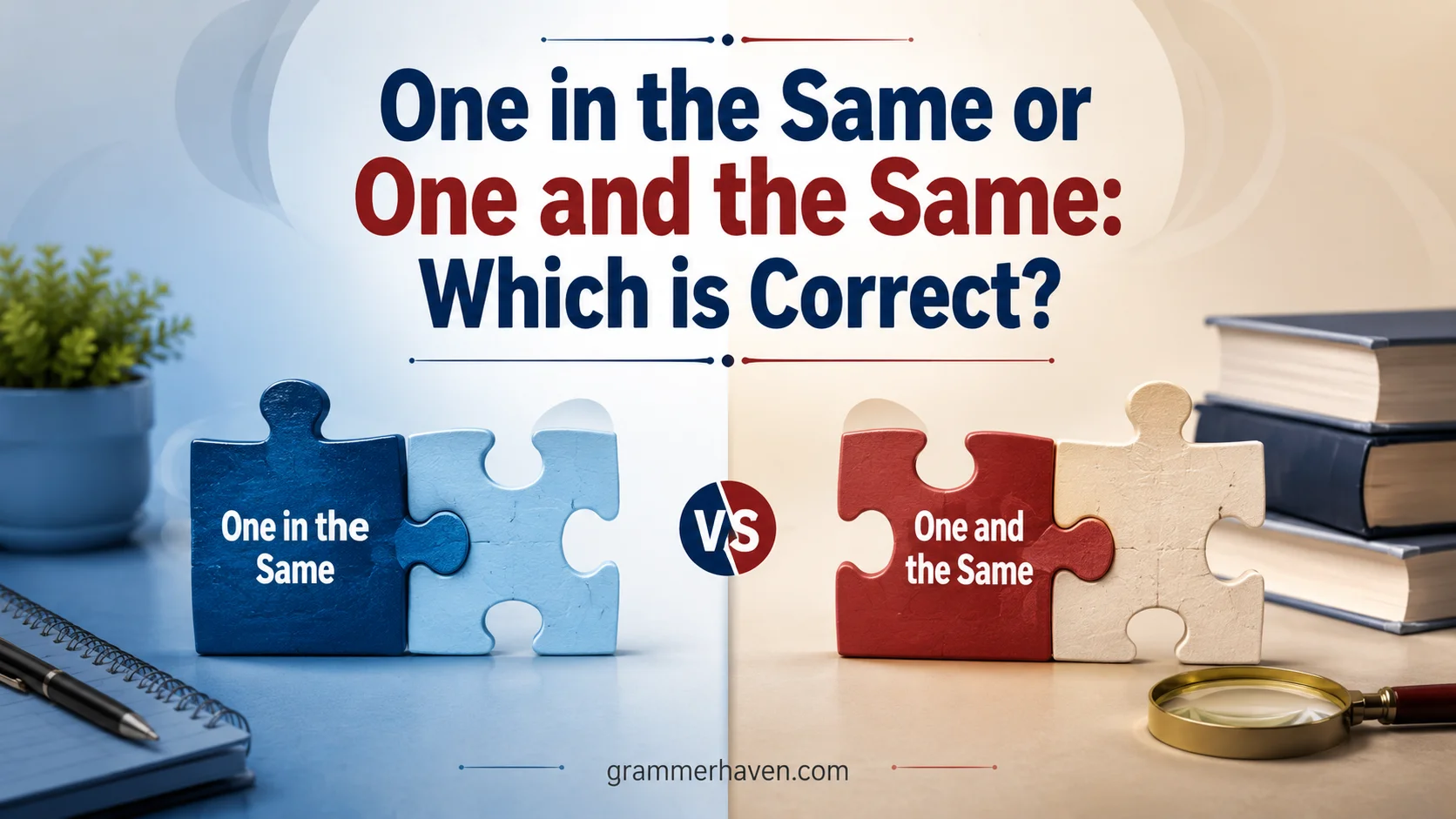
The correct phrase is “one and the same.”
It means that two people, things, identities, roles, or ideas are actually one person or one thing rather than two. Cambridge Dictionary defines one and the same as referring to the same person or thing, while Merriam-Webster defines it as “one person or thing and not two.”
So if you write, “The restaurant’s owner and chef are one and the same,” you’re saying that the owner and chef are actually the same person.
The phrase “one in the same” is a commonly mistaken version. It usually appears because the word can become weak and difficult to hear in natural speech. Merriam-Webster describes this mistaken form as an eggcorn—a word or phrase that people mishear or reinterpret while still producing something that sounds plausible.
One in the Same or One and the Same: Quick Answer
“One and the same” is correct. “One in the same” is not the standard expression.
| Phrase | Correct? | Meaning | Example |
| One and the same | ✅ Yes | Two apparently separate people or things are actually one | The owner and chef are one and the same. |
| One in the same | ❌ No | Usually a mistaken version of the correct phrase | Avoid this spelling in standard writing. |
The key word is and. It connects two references that turn out to identify the same person or thing.
Easy rule: If you mean “two things are actually one,” write one and the same.
For example:
- The mysterious caller and the witness were one and the same.
- Her job and her passion are one and the same.
- The two names refer to one and the same person.
What Does “One and the Same” Mean?
At its heart, “one and the same” means identical in identity. You’re not merely saying that two things resemble each other. You’re saying they are actually the same person, thing, or concept.
Cambridge Dictionary gives the basic meaning as the same thing or person. Collins similarly explains that the phrase applies when two or more people or things seem separate but are actually one single person or thing.
Consider this sentence:
The author and the narrator are one and the same.
This doesn’t mean the author and narrator have similar personalities. It means the author is also the narrator.
That distinction matters.
One and the Same Means Identity
Suppose a detective discovers that Mr. Brown and the mysterious caller are actually the same individual.
You could write:
The mysterious caller and Mr. Brown were one and the same.
The phrase emphasizes the revelation. At first, the reader sees two identities. The sentence then brings them together.
This makes “one and the same” especially useful when you’re clarifying identities, roles, names, or apparently separate concepts.
Examples of “One and the Same”
- The company founder and current CEO are one and the same.
- The anonymous writer and the famous journalist turned out to be one and the same person.
- The two accounts belong to one and the same individual.
- For her, creativity and problem-solving are one and the same.
- The building’s owner and its landlord are one and the same.
- In this case, the cause and the consequence are practically one and the same.
Notice how each example connects two references.
Why Is “One and the Same” Correct?
The construction becomes easier to remember when you look at its individual parts.
Breaking Down “One and the Same”
One indicates a single person or thing.
And connects the two references.
The same identifies that single person or thing as identical to both references.
The basic idea looks like this:
Person A + Person B → actually one person
or:
Thing A + Thing B → actually one thing
For example:
The owner + the chef → one and the same person
The expression doesn’t mean that one thing exists inside another. It means that what appear to be two separate references actually point to one entity.
Why “And” Matters
The conjunction and performs important work.
Compare these ideas:
- The owner and chef are one and the same.
- The owner is in the chef.
The first sentence expresses identity. The second sentence suggests location or containment.
That’s why “in” doesn’t fit the intended meaning.
Merriam-Webster makes the same point: interpreting one in the same literally would suggest that one thing exists inside another, which isn’t what writers normally intend.
Is “One and the Same” Redundant?
At first glance, it might seem repetitive.
After all, one and same both point toward identity. Why not simply say “the same”?
The repetition is actually part of the phrase’s purpose.
Merriam-Webster explains that the redundancy is intentional and compares it with emphatic expressions such as “each and every” and “any and all.”
Consider the difference:
The manager and owner are the same.
versus:
The manager and owner are one and the same.
Both can establish identity, but the second sounds more emphatic. It draws attention to the fact that two apparently separate roles belong to one entity.
Think of it as linguistic highlighter ink. The phrase doesn’t merely state sameness. It spotlights it.
Why Do People Say “One in the Same”?
The mistake largely comes from sound.
When people speak naturally, they often reduce or weaken small function words. The and in “one and the same” can sound more like a quick “n” than a clearly pronounced and.
So:
one and the same
can sound roughly like:
one ’n’ the same
Someone who has heard the expression without seeing it written may reasonably—but incorrectly—interpret that sound as:
one in the same
Merriam-Webster identifies exactly this kind of pronunciation-based misunderstanding as the likely source of the error.
What Is an Eggcorn?
An eggcorn occurs when someone mishears or misinterprets a familiar expression and replaces part of it with another word that sounds plausible.
The mistaken version often feels logical enough to survive for years.
For example, “one in the same” looks grammatically possible because in is a perfectly ordinary English preposition. The problem is that it doesn’t express the intended relationship here.
The expression isn’t describing something being inside something else.
It’s describing identity.
Is “One in the Same” Ever Correct?
If you’re trying to express the standard idiomatic meaning of “one and the same,” use and, not in.
“One in the same” is not the standard form of the idiom.
You may still encounter it in websites, social media posts, articles, transcripts, or other informal writing. Merriam-Webster has documented real-world examples of the mistaken form, but its existence in published material doesn’t turn it into the standard expression.
This distinction is useful:
Commonly used does not automatically mean standard.
English contains countless errors that become familiar through repetition. In careful writing, the established form remains “one and the same.”
How to Use “One and the Same” in a Sentence
The expression works in several useful patterns.
Using “One and the Same” for People
Use it when two names, descriptions, titles, or roles refer to one person.
The actor and director are one and the same.
The anonymous donor and the foundation’s founder were one and the same person.
The suspect and the person seen on the security footage turned out to be one and the same.
This construction works particularly well when you’re revealing an identity.
Using “One and the Same” for Things
You can also use the phrase for physical objects, organizations, locations, or other entities.
The two companies are actually one and the same.
The old building and the new headquarters are one and the same structure.
The two product names refer to one and the same item.
Using “One and the Same” for Ideas
The expression isn’t limited to physical identity.
You can use it when two concepts are treated as essentially identical.
For many entrepreneurs, innovation and growth are one and the same.
In that particular philosophy, freedom and responsibility are one and the same.
To her, quality and durability were one and the same.
Merriam-Webster’s current example collection includes similar conceptual uses, such as treating difficult things and right things as “one and the same.”
“One and the Same” Grammar and Sentence Structure
Although the phrase itself is straightforward, its surrounding sentence can take several forms.
“A and B Are One and the Same”
This is probably the most common structure.
The owner and manager are one and the same.
The two accounts are one and the same.
Because the sentence has two coordinated subjects, it normally fits naturally.
“A and B Were One and the Same”
Use were when you’re describing a past situation.
The two organizations were one and the same at the time.
The writer and editor were one and the same person.
“One and the Same Person”
Adding a person can make the meaning especially clear.
The lawyer and witness were one and the same person.
This version is useful when you’re explicitly discussing identity.
“One and the Same Thing”
The same pattern works with objects or concepts.
The two policies were one and the same thing.
However, you don’t always need things.
The two policies were one and the same.
The shorter version often sounds cleaner.
One and the Same vs. The Same
These expressions overlap, but they aren’t always equally effective.
“The same” is the ordinary way to describe sameness.
“One and the same” adds emphasis and often highlights the surprising fact that two references identify one entity.
| Expression | Main effect | Example |
| The same | States sameness directly | We bought the same model. |
| One and the same | Emphasizes identity between two references | The owner and chef are one and the same. |
| The very same | Adds strong emphasis to a particular thing | That’s the very same car. |
| Identical | Stresses exact sameness | The two documents are identical. |
| Similar | Indicates resemblance without identity | The two documents are similar. |
Cambridge distinguishes same, similar, and identical in much the same way: similar applies when things aren’t entirely the same, while identical indicates exact sameness.
When “The Same” Is Better
Don’t force “one and the same” into every sentence.
For example:
We ordered the same pizza.
That’s natural.
You wouldn’t normally write:
We ordered one and the same pizza.
The second version sounds unnecessarily elaborate unless you have a particular reason to emphasize identity.
When “One and the Same” Is Better
Use it when two references might initially appear to represent separate things.
The CEO and the company’s founder are one and the same.
Here, the expression makes the relationship between two roles explicit.
One and the Same vs. Similar
Here’s another distinction worth remembering: same doesn’t mean similar.
If two objects are similar, they resemble each other. They remain separate objects.
If two objects are one and the same, you’re saying they are actually one object.
Compare These Sentences
The two houses are similar.
This means they resemble each other.
The two addresses refer to one and the same house.
This means both addresses identify one house.
That’s a substantial difference.
Cambridge’s grammar guidance specifically separates similar from identical, noting that similar things aren’t entirely the same while identical things are exactly the same.
Common Mistakes With “One and the Same”
Writing “One in the Same”
This is the biggest mistake.
Incorrect:
The two accounts are one in the same.
Correct:
The two accounts are one and the same.
Confusing Identity With Similarity
Incorrect meaning:
The two designs are one and the same.
If the designs merely resemble each other, say:
The two designs are similar.
Reserve “one and the same” for actual identity or a deliberately emphatic equivalence.
Adding Unnecessary Words
You don’t always need to write:
They are one and the same person.
If the context already makes the identity obvious, this is perfectly natural:
They are one and the same.
Both forms are correct.
Using the Phrase Too Often
Even correct expressions can become clunky when repeated.
If you’ve already established that two things are identical, alternatives such as the same, identical, or equivalent may produce smoother prose.
Good writing isn’t about squeezing one phrase into every available sentence. It’s about choosing the phrase that carries the meaning cleanly.
“One and the Same” in Formal and Everyday English
The expression works comfortably across different types of English.
In Formal Writing
You’ll often see it in:
- Academic discussions
- Legal writing
- Business documents
- Journalism
- Historical analysis
- Essays and opinion writing
For example:
The company’s legal owner and controlling shareholder were one and the same.
That sentence sounds precise and professional.
In Everyday Conversation
It’s also completely natural in ordinary speech:
Wait, your neighbor and your new teacher are one and the same?
That sentence sounds conversational because the expression emphasizes a small revelation.
So “one and the same” isn’t exclusively formal. Context determines how formal it feels.
The History of “One and the Same”
The phrase has a surprisingly long history.
Merriam-Webster traces “one and the same” back to the 16th century and connects it with the classical Latin expression ūnus et īdem, meaning essentially “one and the same.”
That history matters because it shows that “one and the same” isn’t a modern construction invented to make writing sound fancy. It has been part of English usage for centuries.
The mistaken “one in the same” is much better understood as a later pronunciation-based reinterpretation.
In other words, one expression has a long documented history while the other largely arose from hearing the established phrase differently.
One and the Same in American and British English
There’s no meaningful US-versus-UK spelling difference here.
“One and the same” is standard in both American and British English.
Cambridge lists the phrase as an English idiom, while Collins provides the same meaning and examples in its American English dictionary material.
So you don’t need to switch between and and in depending on where your reader lives.
Use “and” in both varieties.
One and the Same Examples in Different Contexts
The phrase becomes much easier to understand when you see it in realistic situations.
Identity
The person using the fake name and the suspect were one and the same.
Aliases
The author writing under the pen name and the bestselling novelist were one and the same person.
Professional Roles
The founder and CEO are one and the same.
Organizations
The two brand names belong to one and the same company.
Relationships
The person who called earlier and your new client are one and the same.
Ideas
In this argument, success and financial independence aren’t necessarily one and the same.
Everyday Situations
The old nickname and her current username are one and the same.
These examples show why the expression remains useful. It can describe people, objects, organizations, identities, roles, and abstract ideas.
One in the Same vs. One and the Same: Comparison Chart
| Point | One and the Same | One in the Same |
| Standard English | ✅ Yes | ❌ No |
| Intended meaning | One person or thing rather than two | Usually intended to express the same idea |
| Dictionary-recognized idiom | ✅ Yes | ❌ No |
| Typical source | Established expression | Mishearing or reinterpretation |
| Works in formal writing | ✅ Yes | ❌ Avoid |
| Works in conversation | ✅ Yes | ❌ Avoid in careful speech |
| Best choice | Use it | Don’t use it |
Merriam-Webster specifically identifies “one in the same” as an eggcorn and explains that ordinary speech can cause and to be heard incorrectly as in.
Easy Ways to Remember “One and the Same”
If this phrase keeps tripping you up, use one of these simple memory tricks.
Think: “Two References, One Identity”
If you’re connecting two references that point to one entity, choose and.
A and B = one and the same.
Remember What “And” Does
The word and joins things.
In this expression, it joins two descriptions:
the owner and the chef
Then one and the same tells you those descriptions identify one person.
Don’t Think About Location
The word in often describes position or inclusion:
- in the box
- in the room
- in the group
But you’re not saying that one thing sits inside another.
You’re saying two references identify one thing.
So:
one and the same ✅
not:
one in the same ❌
Better Alternatives to “One and the Same”
Sometimes another expression will fit your sentence better.
The Same
The two companies are the same.
Simple and direct.
Identical
The two documents are identical.
This emphasizes exact sameness.
Exactly the Same
The two measurements are exactly the same.
Useful when precision matters.
The Very Same
That’s the very same book I mentioned yesterday.
This emphasizes a particular previously identified thing.
Equivalent
The two methods are equivalent.
This can be better when two methods produce the same result without literally being the same object.
Indistinguishable
The replica was indistinguishable from the original.
This describes appearance or detectable difference rather than literal identity.
Choosing the right alternative depends on what you actually mean. “One and the same” expresses identity particularly well, while similar, identical, and equivalent can carry subtly different meanings.
Case Study: Why the Wrong Version Sounds Right
Imagine someone hears this sentence during a conversation:
“The actor and the mysterious stranger are one and the same.”
Because and often gets reduced in connected speech, the listener may hear something closer to:
“The actor and the mysterious stranger are one ’n’ the same.”
Without seeing the sentence written down, the listener might later reproduce it as:
“The actor and the mysterious stranger are one in the same.”
The mistake feels natural because “in” is a real English word and the resulting phrase sounds grammatically familiar.
But meaning provides the clue.
The sentence isn’t saying that one person exists inside another. It’s saying that the two descriptions identify one person.
That’s why “and” is the logical and established choice.
See also: Lier vs Liar: What’s the Difference?
FAQs:
Is “one in the same” correct?
No. “One in the same” isn’t the standard form of the idiom. The correct expression is “one and the same.”
What does “one and the same” mean?
It means that two apparently separate people or things are actually one person or thing.
Why do people say “one in the same”?
The mistake likely comes from pronunciation. In natural speech, and can become reduced and sound like a short “n.” That can lead listeners to interpret it as in.
Is “one and the same” redundant?
It contains intentional repetition. The phrase uses that repetition for emphasis, much like other emphatic expressions such as “each and every.”
Can “one and the same” describe people?
Yes.
The author and narrator are one and the same person.
Can “one and the same” describe things?
Yes. You can use it for objects, organizations, places, roles, and concepts.
Can you say “they are one and the same”?
Absolutely. It’s a common and natural construction.
The two accounts look different, but they’re one and the same.
Is “one and the same” formal?
It can sound slightly emphatic or polished, but it’s not restricted to formal English. People use it in both conversation and writing.
What’s another way to say “one and the same”?
Depending on the context, you could use:
- the same
- identical
- exactly the same
- the very same
- equivalent
However, these alternatives don’t always carry exactly the same emphasis.
Is “one and the same” used in American English?
Yes. It is a standard English expression used in American English as well as British English.
Conclusion:
The correct expression is “one and the same,” not “one in the same.” Use it when two people, things, roles, names, or ideas are actually identical rather than merely similar.The confusion usually comes from pronunciation. In natural speech, and can sound like a quick “n,” making “one and the same” easy to mishear as “one in the same.” Still, standard written English uses and.
If you need a simple memory trick, remember the meaning: two references, one identity. When two descriptions point to the same person or thing, they are one and the same.