If you’re unsure about Sleeve vs Sleave – Which Is Correct?, remember that Sleeve is the correct spelling in modern English and everyday use.
Many people pause when they see Sleeve and Sleave because the words look almost identical, feel similar, and as homophones they sound the same when heard. However, the meaning depends on the context. Sleeve usually refers to the part of a shirt, clothing, or garment that covers the arm or arms. It also describes a protective sleeve for a vinyl record or a mechanical component. Sleave, on the other hand, is an older, archaic, rare, and historically used literary term for untwisted silk, silk fibers, or thread in textile material. A famous example appears in Shakespeare’s Macbeth, so the term still shows up during reading, although it rarely appears in modern writing, product labels, or other products.
To clarify the difference, check the spelling before you finish typing or writing. In modern English, Sleeve is the considered standard for common usage, while Sleave has uncommon usage and mainly sticks around because history has a habit of keeping old expressions alive. If you’re working, talking, or simply trying to avoid confusion, choose Sleeve whenever you’re describing something covering an arm or a protective case. Use Sleave only when discussing its historical roots or the right term found in classic literature.
Sleeve vs Sleave – The Quick Answer You Came For
If you’re in a hurry, remember this:
- Sleeve → modern English, correct spelling, widely used
- Sleave → archaic English, rare, mostly historical or technical textile usage
That’s it.
In 99.9% of writing situations, you will always choose sleeve.
But to really understand why this confusion exists, you need to look at meaning, history, and real usage.
What “Sleeve” Means in Modern English
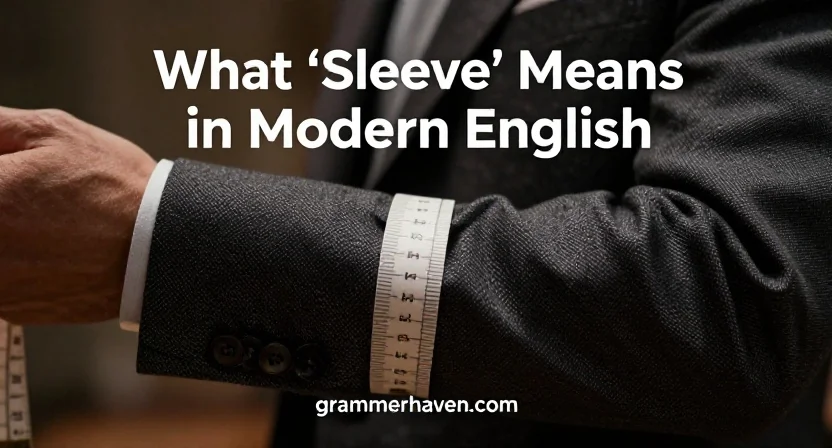
The word sleeve plays a much bigger role than most people realize. It doesn’t just belong in fashion.
Core meaning
A sleeve is the part of a garment that covers your arm.
Simple, right? But it expands far beyond clothing.
Modern uses of “sleeve”
You see the word everywhere:
- Clothing sleeves (shirts, jackets, coats)
- Protective covers (laptop sleeve, tablet sleeve)
- Storage protection (vinyl record sleeves, CD sleeves)
- Packaging and industrial covers (document sleeves, tool sleeves)
Real-world examples
- “He pushed his sleeves up before starting work.”
- “She slid the laptop into its padded sleeve.”
- “The vinyl record sits safely inside its sleeve.”
Why this spelling won
Language experts standardized “sleeve” over time because it became the dominant form in print, literature, and everyday speech. Once printing presses and dictionaries aligned on it, the alternative faded into obscurity.
According to major dictionaries like Merriam-Webster:
Merriam-Webster – Sleeve Definition
“sleeve” consistently appears as the correct modern spelling.
What “Sleave” Actually Means (And Why It Feels So Strange Today)
Now let’s talk about the mysterious twin: sleave.
At first glance, it looks like a typo. But it isn’t. It actually has historical roots.
Historical meaning of “sleave”
In older English usage, “sleave” referred to:
- Untwisting or separating silk fibers
- Working with loose or tangled threads
- Processes in textile production
It appears in older dictionaries and early English literature, but it never survived into modern everyday language.
Where you might still see it
- Old textile manuals
- Historical dictionaries
- Rare literary references
- Academic discussions on language evolution
Example of historical usage
- “The silk was sleaved before spinning into thread.”
Today, that sentence feels almost alien. That’s because modern textile language replaced it completely.
Even Oxford references mark it as archaic or obsolete:
Oxford Learner’s Dictionaries
Sleeve vs Sleave – The Real Difference Explained Simply
Let’s strip everything down to the core.
| Word | Meaning | Usage | Status |
| Sleeve | Part of clothing or protective cover | Everyday English | Active and standard |
| Sleave | Textile process (untwisting fibers) | Historical/rare | Obsolete in modern use |
Simple rule you can trust
If you’re talking about:
- Clothes
- Jackets
- Shirts
- Laptop covers
- Packaging
👉 Use sleeve
If you’re reading old textile history:
👉 You might see sleave, but you don’t need it in modern writing
Etymology – Where Sleeve and Sleave Come From
This is where things get interesting.
The origin of “sleeve”
The word “sleeve” comes from Old English slēf, meaning a garment covering the arm.
Over centuries:
- Old English: slēf
- Middle English: sleve / sleve-like forms
- Modern English: sleeve
The spelling stabilized as English standardized during the printing press era.
The origin of “sleave”
“Sleave” likely developed from textile-related terminology. It described the act of loosening silk fibers before spinning.
Unlike “sleeve,” it didn’t become part of everyday speech, so it slowly faded out.
Why two similar words survived
English often keeps “word twins” alive when meanings diverge. But in this case:
- One meaning stayed useful (sleeve)
- The other became niche (sleave)
- One won, one faded
Why People Confuse Sleeve and Sleave
You’re not alone if you’ve mixed them up. Even native speakers do it.
Here’s why it happens:
1. Visual similarity
They differ by just one letter. That alone causes confusion.
2. Pronunciation overlap
Both sound almost identical in casual speech.
3. Typing speed mistakes
Fast typing often leads to swapping letters without noticing.
4. Autocorrect gaps
Autocorrect sometimes fails because “sleave” exists as a real word, even if rare.
5. Exposure to old texts
If someone reads older material or niche textile content, they may see “sleave” and assume it’s common.
Common Mistakes People Make with Sleeve vs Sleave
Let’s look at real-world errors:
- “I rolled up my sleave before washing dishes.”
- “Phone sleave cases are popular online.”
- “His shirt sleaves were too long.”
All incorrect in modern English.
Correct versions:
- sleeve
- sleeve case
- sleeves
Even small mistakes like this can affect credibility in writing, especially in professional or SEO content.
Memory Tricks to Never Mix Them Up Again
Here are simple mental shortcuts that actually work.
1. The “two arms” trick
Sleeve has two e’s like your two arms.
2. The “modern vs ancient” rule
- Sleeve → modern life
- Sleave → old textile history
3. The “pause test”
Before writing, ask:
“Am I talking about clothes or covers?”
If yes → always sleeve.
Examples in Context (Side-by-Side Clarity)
| Incorrect Usage | Correct Usage |
| I folded my sleave | I folded my sleeve |
| Laptop sleave case | Laptop sleeve case |
| Shirt sleaves are tight | Shirt sleeves are tight |
| Record sleave | Record sleeve |
These small fixes instantly make your writing look more professional and natural.
When You Might Still See “Sleave” Today
Even though it’s rare, “sleave” hasn’t completely vanished.
You may encounter it in:
- Historical textile research papers
- Old English literature
- Archival documents
- Specialized weaving terminology discussions
But here’s the truth:
You can safely ignore it in modern communication.
Case Study: Why Product Listings Get This Wrong
Let’s look at a real-world type of error that shows up online.
Scenario
An online seller lists a product as:
“Waterproof phone sleave with zipper protection”
Problem
Customers search “phone sleeve,” not “sleave.”
Impact
- Lower search visibility
- Reduced clicks
- Confused buyers
- Poor SEO ranking
Fix
Changing “sleave” to “sleeve” immediately improves:
- Search traffic
- Product discoverability
- Customer trust
This small spelling correction can literally affect sales performance.
Sleeve vs Sleave Searches
People search this topic more than you’d expect.
High-volume queries include:
- sleeve vs sleave
- is it sleeve or sleave
- correct spelling of sleeve
- sleave meaning
- laptop sleeve spelling
What this tells us
Most users don’t want theory. They want clarity fast.
That’s why content like this matters—it removes hesitation and confusion in seconds.
Grammar Rule You Can Rely On
English has a simple modern standard:
If a word has a widely accepted modern form, use that form.
For this case:
- Sleeve = standard English
- Sleave = obsolete or niche
So unless you’re studying historical textiles, you always pick sleeve.
Practical Writing Tips to Avoid Mistakes

Here’s how to make sure you never slip up again:
- Type “sleeve” and immediately double-check before sending
- Use Grammarly or similar tools for writing drafts
- Rely on modern dictionaries, not memory alone
- Read the sentence out loud—“sleave” often sounds wrong in context
- Stick with real-world examples you see in stores and products
Quick Reality Check Before You Write
Ask yourself:
- Am I talking about clothing?
- Am I talking about a cover or protective case?
- Does this appear in modern products?
If yes to any of these → use sleeve
If not → you probably don’t need “sleave” at all.
See also: Is It Correct to Say “Very Helpful”? Meaning & Usage Explained
FAQs:
1. Is it Sleeve or Sleave?
Sleeve is the correct spelling in modern English. Sleave is an old and uncommon word that is rarely used today.
2. What does Sleave mean?
Sleave is an archaic literary term that refers to untwisted silk or fine silk thread. Most people only encounter it in historical or literary texts.
3. Why do people confuse Sleeve and Sleave?
The two words look very similar and are pronounced almost the same, making them easy to mix up. However, they have different meanings and usage.
4. Is Sleave a misspelling of Sleeve?
In most modern contexts, yes. If you mean the part of a shirt or a protective cover, writing Sleave is considered a spelling mistake. It is only correct when referring to the historical literary term.
5. Where is the word Sleave still used?
Sleave mainly appears in classic literature, historical writing, and discussions about textiles or older forms of English. It is rarely used in everyday communication.
Conclusion:
The difference between Sleeve and Sleave is simple once you know their history. Sleeve is the correct spelling in modern English and is the word you should use for clothing, protective covers, and everyday writing. Sleave is a rare, archaic term that mainly appears in historical or literary works, especially older texts like Macbeth. If you remember that Sleeve belongs to modern usage while Sleave belongs to historical usage, you’ll avoid this spelling mistake with confidence.