“Next Friday” vs. “This Friday” can create confusion when people discuss dates because next may point to the following week or the upcoming Friday. In everyday English, this Friday usually points to the current week, while Next Friday can mean the later Friday. If today is Tuesday, this Friday is three days later, while Next Friday may be ten days ahead. The speaker, context, calendars, and expression can change how listeners understand the difference.
A classic example occurs on Wednesday, when someone mentions Next Friday while discussing plans, meetings, or an event. One person may understand the date as the first Friday after now, while another may think about the Friday in the following week. Cambridge Dictionary notes that such expressions can depend on context, making clarification useful when the intended date is less clear. Giving the exact date provides a practical answer, prevents a guessing game, and makes the distinction easier to understand.
This difference matters in communication, planning, and everyday scheduling. When asking about Friday, consider the days of the week, the current week, and what the speaker has already said. The following Friday and the upcoming Friday can represent different dates, so correctly figuring out the intended day helps avoid misunderstandings. A simple question such as “Which Friday do you mean?” can provide clarification and keep everyone’s plans aligned.
Quick Answer: “Next Friday” vs. “This Friday”
The usual distinction looks like this:
- This Friday usually means the Friday in the current week.
- Next Friday often means the Friday in the following week.
- Next Friday can also mean the next Friday that occurs, depending on the speaker.
- This coming Friday generally emphasizes the approaching Friday.
- Friday next week clearly points to the Friday in the following week.
- Friday, [exact date] is the clearest option when timing matters.
For example, suppose today is Wednesday, October 7:
| Expression | Common interpretation |
| This Friday | Friday, October 9 |
| Next Friday | Often Friday, October 16 |
| This coming Friday | Usually Friday, October 9 |
| Friday next week | Friday, October 16 |
| Friday, October 9 | Exactly October 9 |
The important word is “usually.” English doesn’t provide a universal rule that makes every speaker interpret “next Friday” identically. Cambridge specifically notes that if today is Wednesday, “next Friday” may require clarification because it could refer to the Friday two days away or the Friday nine days away.
What Does “This Friday” Mean?
The Meaning of “This Friday”
“This Friday” normally connects Friday with the current week or the immediate time frame under discussion.
Imagine it’s Tuesday and someone asks:
“Are you free this Friday?”
Most listeners will understand the question as referring to the Friday coming later that same week.
That interpretation works because “this” anchors the day to the current conversational period. The phrase doesn’t simply identify Friday as a day of the week. It identifies which occurrence of Friday the speaker has in mind.
Friday itself is the weekday after Thursday and before Saturday.
Examples of “This Friday”
Here are some natural examples:
- “Our team meeting is this Friday.”
- “I’m visiting my parents this Friday.”
- “Can you send the report this Friday?”
- “Are you available this Friday evening?”
- “The new restaurant opens this Friday.”
- “We have an exam this Friday.”
In each case, the speaker normally expects the listener to identify the relevant Friday from the current context.
When “This Friday” Is Clear
“This Friday” works especially well when you’re discussing ordinary plans.
For example:
“Want to grab dinner this Friday?”
If you’re having this conversation on Monday, Tuesday, Wednesday, or Thursday, the intended date is usually easy to understand.
The phrase becomes even clearer when the conversation already establishes the week:
“We’re both busy next week. How about dinner this Friday?”
Now the reference point is obvious.
What Does “Next Friday” Mean?
The Basic Meaning of “Next Friday”
“Next Friday” is trickier.
The word “next” generally describes something that follows the present point or something previously mentioned. Cambridge defines “next” as something that is first after the present one or the one just mentioned. It also explains that English uses “next” with future days, weeks, months, and years without a preposition.
That sounds straightforward until you apply it to a weekday.
Suppose today is Wednesday.
Which Friday is “next Friday”?
There are two Fridays you might have in mind:
- Friday in two days
- Friday in nine days
That’s exactly where the ambiguity begins.
Two Common Interpretations of “Next Friday”
One interpretation treats “next Friday” as the next occurrence of Friday.
Under that interpretation:
Today is Wednesday → next Friday = Friday in two days.
Another interpretation treats the calendar in weekly blocks:
This Friday = Friday this week
Next Friday = Friday next week
Under that interpretation:
Today is Wednesday → next Friday = Friday in nine days.
Neither interpretation requires unusual grammar. The problem comes from how speakers organize the calendar mentally.
Why “Next Friday” Can Be Ambiguous
Relative time expressions depend on a reference point.
An exact date such as “October 16” stays the same regardless of when you say it. “Next Friday” doesn’t work that way. Its meaning changes as the days move forward.
Several factors can affect interpretation:
- The current day
- The current week
- The speaker’s personal language habits
- Whether “this Friday” has already been mentioned
- The surrounding conversation
- Whether the speaker thinks in calendar weeks
- Whether the listener expects “next” to mean the immediate occurrence
That’s why a sentence can be grammatically correct while still being unclear.
Is “Next Friday” the Friday After “This Friday”?
Often, yes. But not always.
This is the distinction many people learn:
This Friday = Friday this week
Next Friday = Friday next week
Suppose today is Tuesday, October 6.
- This Friday = October 9
- Next Friday = October 16
This interpretation becomes especially strong when someone contrasts the two expressions:
“I can’t meet this Friday, but I’m free next Friday.”
The speaker has deliberately separated this from next. The listener will usually understand that two different Fridays are being discussed.
However, “next Friday” can also refer to the nearest upcoming Friday in ordinary speech. Cambridge’s language guidance explicitly highlights this potential confusion.
So it’s better to describe the distinction as a common usage pattern, not an absolute grammar rule.
Why “Next Friday” Doesn’t Always Mean Seven Days From Today
Here’s another common misunderstanding.
People sometimes assume:
“Next Friday” = exactly seven days from today.
That’s not necessarily true.
Consider three different situations.
If Today Is Monday
If someone means the Friday of the following week:
- Today: Monday
- This Friday: 4 days away
- Next Friday: 11 days away
So “next Friday” isn’t seven days away under that interpretation.
If Today Is Friday
If someone means the following Friday:
- Today: Friday
- Next Friday: 7 days away
Here, it happens to be exactly one week later.
If Today Is Wednesday
The phrase becomes especially slippery:
- Upcoming Friday: 2 days away
- Following Friday: 9 days away
That’s why Cambridge recommends clarifying which Friday you mean when a Wednesday speaker uses “next Friday.”
Relative time isn’t a mathematical formula. It depends on the reference frame.
“This Friday” vs. “Next Friday” at a Glance
| Phrase | Common meaning | Possible issue | Clearer alternative |
| This Friday | Friday in the current week | Can become unclear around the weekend | “This coming Friday” |
| Next Friday | Often Friday of the following week | Some speakers mean the upcoming Friday | “Friday next week” |
| This coming Friday | The approaching Friday | Context can still matter | Exact date |
| Friday next week | Friday in the following week | Very little ambiguity | Exact date |
| Friday, October 16 | Specific calendar date | Virtually none | — |
The safest lesson is simple: relative phrases are convenient, dates are precise.
“Next Friday” vs. “This Friday” Depending on the Day
The day of the week can change how natural each expression feels.
On Monday
Suppose today is Monday.
“Let’s meet this Friday.”
This usually means the Friday only four days away.
“Let’s meet next Friday.”
Many speakers will understand this as the following Friday. Others may interpret it as the upcoming Friday.
If the meeting matters, specify the date.
On Tuesday
The same distinction generally remains:
This Friday = Friday later this week
Next Friday = often Friday of the following week
A casual conversation may provide enough context to settle the meaning.
On Wednesday
This is where ambiguity becomes particularly obvious.
Suppose today is Wednesday, October 7.
“I’ll call you next Friday.”
Does that mean October 9 or October 16?
Both interpretations are possible in actual usage. Cambridge specifically uses a Wednesday example to explain this ambiguity.
On Thursday
“This Friday” usually points to tomorrow.
For example:
“The presentation is this Friday.”
That’s naturally understood as tomorrow if today is Thursday.
“Next Friday” may instead point to the Friday after tomorrow, although some speakers still use it for tomorrow.
On Friday
Friday itself creates another wrinkle.
If someone says:
“I’ll send it this Friday.”
They may mean today, especially if the conversation happens Friday morning.
But if the conversation happens Friday evening, the listener may wonder whether the speaker means the following Friday.
At that point, “next Friday” or an exact date becomes more useful.
On Saturday or Sunday
The phrase “this Friday” can become particularly awkward because Friday has already passed.
Suppose today is Saturday.
If someone says:
“Let’s meet this Friday.”
Some listeners may interpret that as the Friday that just passed. Others may assume the speaker means the upcoming Friday.
A clearer alternative is:
“Let’s meet Friday next week.”
Or better:
“Let’s meet Friday, October 16.”
One small clarification saves a lot of mental gymnastics.
“This Friday” vs. “This Coming Friday”
What Does “This Coming Friday” Mean?
“This coming Friday” emphasizes the Friday that is approaching.
For example:
“The workshop is this coming Friday.”
If today is Tuesday, the phrase normally points toward the Friday only a few days away.
It can be useful when you want to distinguish the upcoming Friday from a later Friday.
Is “This Coming Friday” Better Than “This Friday”?
It can be clearer in some situations.
Compare:
“I’ll see you this Friday.”
with:
“I’ll see you this coming Friday.”
The second sentence emphasizes the Friday that is coming up.
Still, it isn’t a magic phrase that eliminates every possible misunderstanding. If you’re discussing an important deadline or appointment, the exact date remains stronger.
“Next Friday” vs. “Friday Next Week”
If you mean the Friday in the following week, “Friday next week” can make your intention clearer.
Compare these sentences:
“The interview is next Friday.”
“The interview is Friday next week.”
The first can make the listener pause.
The second explicitly connects Friday to next week.
That distinction matters because “next” can operate differently in a relative weekday expression. Cambridge’s guidance recommends adding clarification when “next Friday” could identify more than one plausible date.
When “Friday Next Week” Works Best
Use it when:
- You specifically mean the following week’s Friday.
- The upcoming Friday is also relevant to the conversation.
- You’re scheduling a meeting.
- You’re discussing a deadline.
- You’re arranging an appointment.
- You’re texting someone who may interpret “next” differently.
For example:
“I can’t make it this Friday. Friday next week works for me.”
That’s much harder to misunderstand.
The Clearest Solution: Use the Exact Date
Sometimes the best grammar advice is refreshingly boring.
Just give the date.
Instead of:
“Let’s meet next Friday.”
Write:
“Let’s meet Friday, October 16.”
Now the listener doesn’t need to interpret this, next, coming, or following.
The calendar does the work.
When You Should Give the Exact Date
Use the exact date when you’re discussing:
- Business meetings
- Project deadlines
- Job interviews
- School assignments
- Exams
- Travel plans
- Appointments
- Reservations
- Legal or financial deadlines
- Event schedules
- Deliveries
- Work shifts
The more expensive a misunderstanding could become, the more useful an exact date becomes.
“Next Friday” vs. “This Friday” in Professional Communication
Workplaces are where this tiny language issue can become a genuine scheduling problem.
Imagine a manager writes:
“Let’s review the proposal next Friday.”
One employee interprets that as October 9. Another puts October 16 on the calendar.
Nobody made a grammar mistake. They simply assigned different dates to the same relative expression.
A Better Professional Version
Instead of:
“Let’s review the proposal next Friday.”
Use:
“Let’s review the proposal Friday, October 16, at 10 a.m.”
Now the message contains:
- The weekday
- The date
- The time
- The specific event
There’s very little left to interpret.
Deadline Example
Unclear:
“Please send the final report by next Friday.”
Clearer:
“Please send the final report by Friday, October 16.”
Even better when time zones or business hours matter:
“Please send the final report by 5 p.m. Friday, October 16.”
The second version isn’t fancy. That’s exactly why it works.
“Next Friday” vs. “This Friday” in Text Messages
Text messages create a special problem because they remove many contextual clues.
Consider:
“See you next Friday!”
If the conversation happened on Wednesday, you might immediately wonder:
Which Friday?
Now compare:
“See you this Friday!”
That’s usually easier to understand if you’re talking about plans for the immediate weekend.
Still, the safest version is:
“See you Friday, October 9!”
Clearer Text Message Examples
| Unclear or potentially ambiguous | Clearer version |
| “Let’s meet next Friday.” | “Let’s meet Friday, October 16.” |
| “I’ll send it this Friday.” | “I’ll send it Friday, October 9.” |
| “See you next Friday night.” | “See you Friday, October 16, at 7 p.m.” |
| “The party is this Friday.” | “The party is Friday, October 9.” |
A five-second clarification can prevent a five-hour scheduling mess.
Real-Life Examples of “This Friday” vs. “Next Friday”
Making Dinner Plans
“Are you free this Friday?”
This normally refers to the upcoming Friday.
If you’re referring to the following week:
“Are you free Friday next week?”
That makes the distinction much clearer.
Scheduling a Work Meeting
“Can we meet next Friday?”
Potentially ambiguous.
Better:
“Can we meet Friday, October 16, at 2 p.m.?”
Setting a Project Deadline
“The first draft is due this Friday.”
If everyone knows which Friday the project schedule refers to, that’s perfectly natural.
If several weeks are being discussed:
“The first draft is due Friday, October 9.”
The date removes the guesswork.
Planning a Trip
“We’re flying out next Friday.”
A travel plan should generally include the date.
“We’re flying out Friday, October 16.”
Flights aren’t the place to test someone’s interpretation of “next.”
Arranging an Appointment
“Your appointment is next Friday.”
That could create unnecessary confusion.
Better:
“Your appointment is Friday, October 16, at 2 p.m.”
Inviting Someone to an Event
“The wedding is this Friday.”
If the recipient already knows the event date, this may be enough.
Otherwise:
“The wedding is Friday, October 9.”
Clear beats clever.
Common Mistakes With “Next Friday” and “This Friday”
Assuming Everyone Uses “Next” the Same Way
This is the biggest mistake.
One person may think “next Friday” means the upcoming Friday. Another may think it means the Friday after this week’s Friday.
Don’t assume the listener shares your calendar convention.
Treating “Next Friday” as Exactly Seven Days Away
That’s another common error.
“Next Friday” can refer to a Friday that is more than seven days away. It depends on whether the speaker means the immediate Friday or the following week’s Friday.
Saying One Interpretation Is Always Correct
Everyday English doesn’t work that neatly.
Actual usage supports more than one interpretation of “next Friday.” Cambridge explicitly warns about this potential ambiguity.
The useful question isn’t:
“Which person is grammatically wrong?”
It’s:
“Which wording makes the intended date unmistakable?”
That’s a much more practical approach.
Using “On” Before “Next Friday”
In standard everyday English, you normally say:
“I’ll call you next Friday.”
Not:
“I’ll call you on next Friday.”
Cambridge explains that English uses “next” with future days of the week without a preposition.
However, when you simply say “Friday,” you normally use “on”:
“I’ll call you on Friday.”
So compare:
- on Friday
- this Friday
- next Friday
- Friday next week
These patterns sound natural in ordinary English.
Is “This Friday” or “Next Friday” Grammatically Correct?
Both are grammatically correct.
The issue isn’t whether either phrase follows English grammar. The issue is which date the speaker intends and which date the listener understands.
“This Friday” uses a demonstrative to identify Friday in relation to the current context.
“Next Friday” uses “next” to locate Friday relative to the present or another reference point.
Cambridge lists “next Friday” as a normal English expression and provides examples of its use.
So don’t tell someone that “next Friday” is grammatically wrong simply because they use it for the upcoming Friday. The real problem is potential ambiguity.
Why Context Matters So Much
Relative expressions depend on shared assumptions.
Consider:
“I’ll see you next Friday.”
If both people have just been discussing an event scheduled for October 16, the meaning may be completely obvious.
Now imagine the same sentence with no context.
Suddenly, the listener has to calculate:
- What day is today?
- Which week are we discussing?
- Does “next” mean the next occurrence?
- Does “next” mean the following week?
- Did the speaker already mention another Friday?
That’s a lot of invisible processing for two little words.
Context acts like a map. Without it, the listener has to draw the map themselves.
A Simple Decision Guide for “Next Friday” vs. “This Friday”
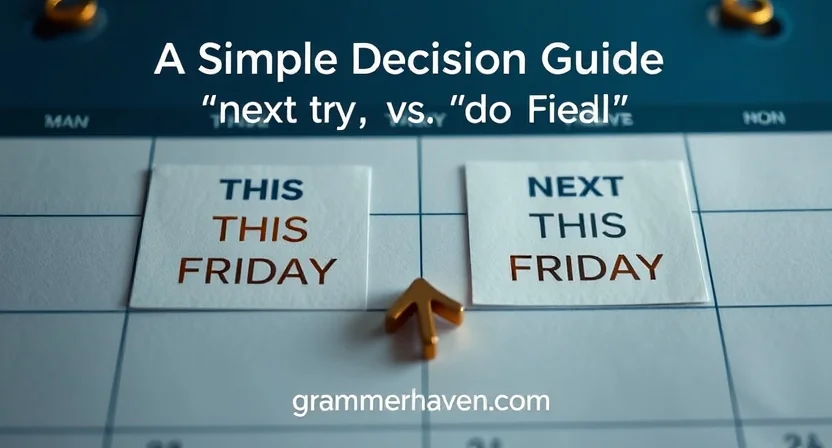
Use this quick guide when you’re writing or speaking:
| If you mean… | Say… |
| The Friday you’re treating as part of this week | This Friday |
| The approaching Friday | This coming Friday |
| The Friday of the following week | Friday next week |
| A date where confusion could cause problems | Friday + exact date |
| A casual plan with obvious context | This Friday or next Friday |
| A formal appointment | Weekday + exact date + time |
The key isn’t memorizing a rigid formula. It’s choosing wording that matches your intended reference point.
A Practical Calendar Example
Suppose today is Wednesday, October 7, 2026.
Here’s how the calendar looks:
| Date | Day | Possible reference |
| October 7 | Wednesday | Today |
| October 8 | Thursday | Tomorrow |
| October 9 | Friday | This Friday |
| October 10 | Saturday | This weekend |
| October 11 | Sunday | This weekend |
| October 12 | Monday | Next week |
| October 16 | Friday | Friday next week |
Now consider:
“Let’s meet next Friday.”
Some speakers will naturally select October 9 because it’s the next Friday they encounter.
Others will select October 16 because they use “this Friday” for October 9 and “next Friday” for the following week’s Friday.
That’s the entire problem in one calendar.
A Useful Rule for Everyday English
Here’s a practical rule you can actually remember:
Use “this Friday” for the Friday you associate with the current week.
Use “next Friday” for a later Friday when your context makes the reference clear.
This approach reflects how people actually use these expressions while acknowledging the ambiguity that English speakers encounter. Cambridge’s guidance similarly recommends clarification when “next Friday” could refer to more than one plausible Friday.
See also: Prooving vs Proving: Which Spelling Is Correct?
FAQs:
Does “Next Friday” Mean This Coming Friday?
It can, depending on the speaker.
Many people use “next Friday” for the Friday following the current week. Others use it to mean the next Friday that occurs. Because both patterns exist, context matters.
Is “This Friday” the Upcoming Friday?
Usually, yes.
When today is Monday through Thursday, “this Friday” normally points to the Friday later in the current week.
Near or after Friday, however, the phrase can become less clear.
Is “Next Friday” Always the Friday After This Friday?
No.
That’s a common interpretation, especially when speakers contrast “this Friday” with “next Friday.” However, some speakers use “next Friday” for the nearest upcoming Friday.
What Is the Clearest Way to Refer to the Following Friday?
Say:
“Friday next week.”
For maximum precision, give the date:
“Friday, October 16.”
Is “This Coming Friday” Clearer Than “Next Friday”?
It can be.
“This coming Friday” strongly emphasizes the approaching Friday. However, an exact date remains clearer when the timing is important.
Should You Use “On Next Friday”?
Usually, no.
Say:
“I’ll see you next Friday.”
Use “on” when the expression is simply “Friday”:
“I’ll see you on Friday.”
Cambridge’s grammar guidance confirms that “next” with a future day of the week does not normally take a preposition.
Conclusion:
Understanding “Next Friday” vs. “This Friday” helps you avoid confusion when discussing dates, plans, or meetings. This Friday usually refers to the Friday in the current week, while Next Friday can refer to the Friday in the following week. Since the meaning can depend on context, the safest approach is to mention the exact date when timing matters. A few extra words can save a lot of guessing and keep everyone on the same calendar.