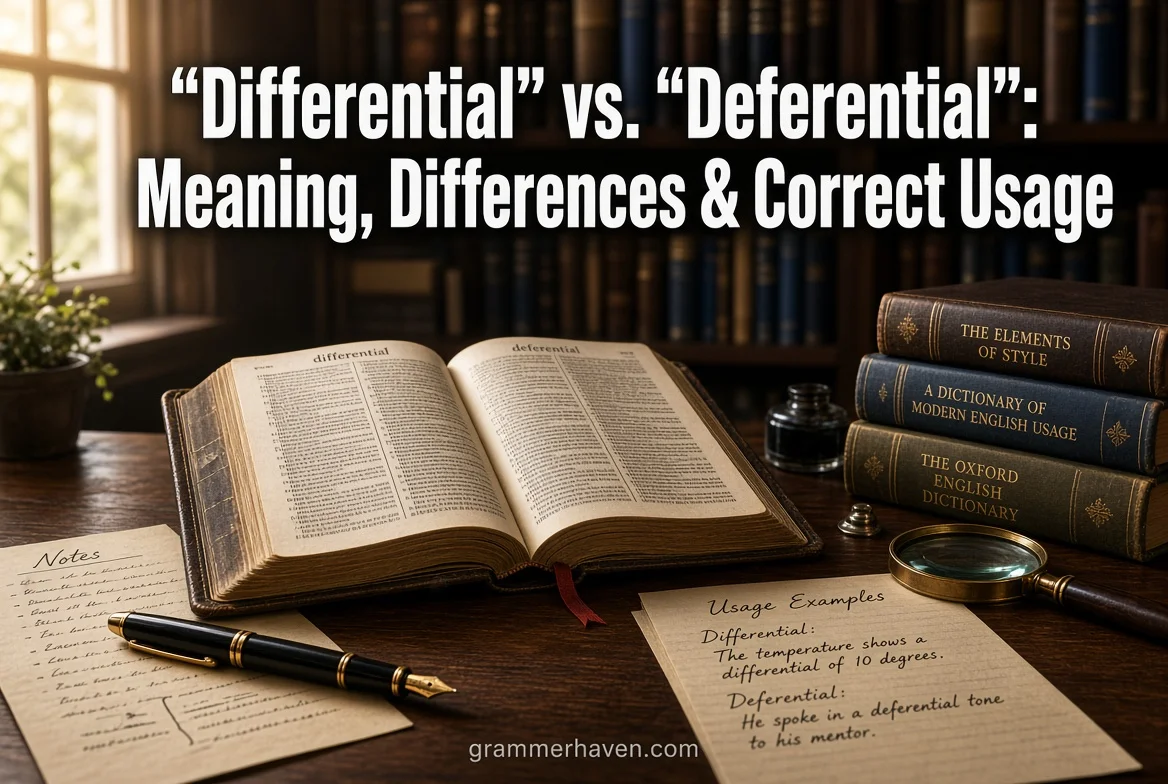
“Differential” vs. “Deferential” explains two similar-sounding English words with different meanings, helping you choose the right word for each sentence.
Differential refers to a difference, variation, or gap between things. Deferential describes respect toward another person, especially someone with authority, experience, or seniority. These definitions help you understand their distinctions in professional writing, academic work, everyday conversations, and formal communication. A company might offer differential pay to employees working different shifts. Differential treatment can create a noticeable difference between two employees. An employee may show a deferential manner when speaking to a company director or boss. The central idea determines the correct word in professional communication, academic writing, or a submission. Checking the intended meaning improves word choice, vocabulary, English usage, and language learning.
This article explores the meanings and uses of both words. Use differential to convey ideas about pay differences or test results. Use deferential to describe someone showing respect, such as a respectful response to a teacher. The context determines which expression fits best. Understanding these terms helps clear up confusion when you start writing. Resources such as Learna Language, svgLearna Language, and twominenglish.com may provide related English topics through hyperlinks. The phrase employees-or-employes may appear in spelling-related references. Differential vs. Deferential remains the article title for this language topic.
Quick Answer: Differential vs. Deferential
Differential means relating to a difference or variation. It can also function as a noun describing the amount of difference between two comparable things.
Deferential means showing respect or deference toward someone or something. It is an adjective commonly used to describe a person’s behavior, attitude, or manner of speaking.
| Feature | Differential | Deferential |
| Meaning | Related to a difference or variation | Showing respect or deference |
| Part of speech | Adjective and noun | Adjective |
| Main idea | Difference | Respect |
| Common contexts | Business, mathematics, science, engineering | Workplace relationships, formal interactions, social situations |
| Common expressions | Differential pay, differential pricing, pressure differential | Deferential attitude, deferential tone, deferential behavior |
| Example | The company offers differential pay for night shifts. | The employee was deferential toward her supervisor. |
| Memory trick | Think of difference. | Think of deference. |
The easiest way to remember the difference: If you’re describing a variation between things, use differential. If you’re describing respectful behavior, use deferential.
What Does “Differential” Mean?
The word differential describes something connected with a difference, distinction, or variation. It frequently appears when people compare prices, wages, measurements, results, or conditions.
According to Cambridge Dictionary, differential can function as both a noun and an adjective. As a noun, it can describe a measurable gap between comparable things. As an adjective, it describes something based on or involving a difference.
Consider these examples:
- The company offers differential pay for employees working overnight shifts.
- Researchers identified differential effects across the three study groups.
- A substantial price differential separates the two products.
- The engineer measured the pressure differential between two chambers.
Each sentence concerns a difference or variation rather than an attitude of respect.
Differential as an Adjective
As an adjective, differential describes something that depends on, reflects, or accounts for differences. It often appears before a noun, especially in formal, scientific, and business writing.
For example, differential pricing refers to a pricing approach in which prices vary according to factors such as customer groups, locations, purchase conditions, or demand.
Similarly, differential treatment describes treating people or groups differently. Depending on the circumstances, that treatment may be justified, unfair, or simply a response to different needs.
Here are more examples:
- Differential rates: The bank applies differential rates to different categories of loans.
- Differential impact: The new policy had a differential impact on small and large businesses.
- Differential response: The plants showed a differential response to changes in temperature.
- Differential pressure: The technician measured the pressure difference between two points.
Notice that the word doesn’t automatically suggest whether the difference is good or bad. The surrounding context supplies that meaning.
Differential as a Noun
As a noun, differential refers to a difference or gap between comparable quantities, rates, or conditions.
You will often encounter this meaning in economics, employment, business, and technical discussions. The noun can describe a numerical difference or a more general distinction between two comparable things.
Examples include:
- Pay differential: The difference in pay between two positions or employee groups.
- Wage differential: The difference between wage rates.
- Price differential: The amount by which one price exceeds another.
- Temperature differential: The difference between two temperature readings.
For instance, suppose one employee earns $24 per hour and another earns $28 per hour. Their hourly pay differential is $4.
The calculation is straightforward:
\[ \$28-\$24=\$4 \]
This example illustrates how a differential can represent a measurable gap rather than a general difference in opinion or behavior.
The noun also has specialized meanings. In automotive engineering, a differential is a gear mechanism that allows a vehicle’s driven wheels to rotate at different speeds, which is especially important when turning. In mathematics, the term has specific meanings connected with calculus and changes in functions.
Common Uses of Differential
The meaning of differential becomes clearer when you examine the fields in which people commonly use it.
| Field | Expression | Meaning |
| Employment | Differential pay | A difference in pay based on a factor such as shift or job conditions |
| Economics | Wage differential | A gap between wage rates |
| Business | Differential pricing | Pricing that varies according to specified factors |
| Science | Differential response | Different responses under different conditions |
| Engineering | Pressure differential | A difference in pressure between two points |
| Mathematics | Differential equation | An equation involving a function and its derivatives |
| Automotive engineering | Vehicle differential | A gear mechanism that allows driven wheels to rotate at different speeds |
These examples show why differential is particularly useful when a writer needs to describe distinctions precisely.
However, don’t use it simply because it sounds more sophisticated than different. In everyday writing, “The two products have different prices” may sound more natural than “The two products have differential prices.” The best choice depends on the sentence and the intended meaning.
What Does “Deferential” Mean?
While differential describes a difference, deferential describes an attitude of respect. You can use it when someone behaves politely toward another person, particularly someone they regard as more experienced, senior, or authoritative.
The Oxford Advanced Learner’s Dictionary defines deferential in terms of showing respect toward someone or something, especially someone older or more senior. The word often appears in descriptions of manners, communication, and professional relationships.
Consider these examples:
- The student was deferential toward her professor.
- The employee used a deferential tone during the meeting.
- He listened to the experienced engineer with a deferential attitude.
- The lawyer remained deferential to the judge while presenting her argument.
Each example describes respect rather than a measurable difference. The word can also suggest that someone recognizes another person’s authority or position in a particular situation.
Deferential as an Adjective
Deferential is an adjective. It describes a person’s attitude, behavior, manner, or way of communicating.
It often appears before a noun or after a linking verb such as be, seem, or remain.
Examples include:
- She maintained a deferential attitude toward her mentor.
- His response was deferential without sounding insincere.
- The new employee adopted a deferential manner during the introduction.
- They remained deferential to the committee’s chairperson.
The word is more specific than polite. Someone can be polite to a stranger without recognizing any difference in status. A deferential person typically shows respect for another person’s authority, experience, judgment, or standing.
However, deferential behavior doesn’t always mean agreement. You can respectfully acknowledge someone’s expertise while questioning their conclusion.
Understanding Deference, Deferential, and Deferentially
These related words share the same central idea, but they perform different grammatical jobs.
| Word | Part of speech | Meaning | Example |
| Deference | Noun | Respect or regard for another person’s authority or judgment | She showed deference to her mentor. |
| Deferential | Adjective | Showing respect or deference | She was deferential toward her mentor. |
| Deferentially | Adverb | In a manner that shows respect | She spoke deferentially to her mentor. |
The noun deference names the attitude. The adjective deferential describes that attitude, while the adverb deferentially explains how someone acts or speaks.
For example, compare these sentences:
- Noun: His deference toward the director was obvious.
- Adjective: His deferential manner impressed the visitors.
- Adverb: He deferentially acknowledged the director’s decision.
Understanding these forms helps you use the word naturally in different sentence structures.
Common Situations Where Deferential Fits
The word deferential works best when respect, authority, or professional standing matters to the meaning.
Workplace communication: A junior employee might adopt a deferential tone when addressing an experienced executive. This describes the employee’s manner, not a difference in salary or responsibilities.
Education: A student may be deferential toward a teacher because they respect the teacher’s knowledge and experience.
Formal settings: A lawyer may use a deferential tone when addressing a judge. The word describes respectful communication within a formal setting.
Expert discussions: A researcher might take a deferential approach to an established expert’s judgment while carefully considering the evidence.
Remember that being deferential doesn’t require you to agree with everything someone says. You can show respect and still express a different opinion.
“Differential” vs. “Deferential”: Key Differences Explained
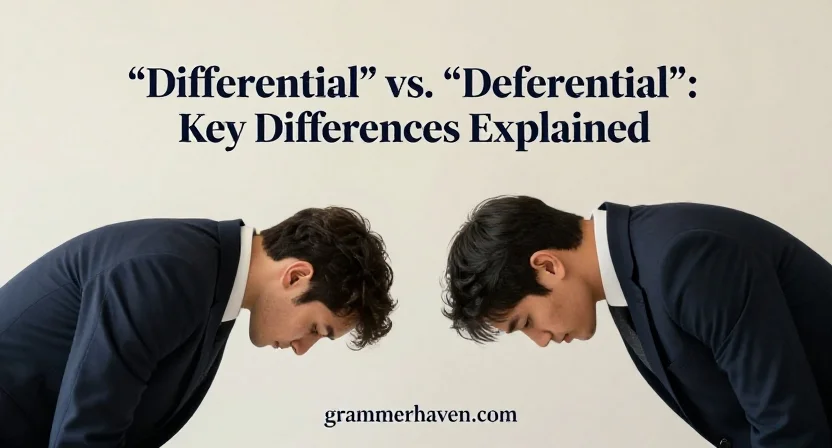
Now that both words have clear definitions, their differences become easier to recognize. The central distinction involves what the word describes: a variation between things or respect toward someone.
Difference in Meaning and Usage
Use differential when your sentence concerns differences, variations, or measurable gaps. Use deferential when it concerns respectful attitudes or behavior.
Compare the following examples:
- Differential: The company introduced differential pay rates for day and night shifts.
- Deferential: The employee was deferential toward the department manager.
The first sentence describes different rates of pay. The second describes how an employee behaves toward a manager.
Here is another comparison:
- Differential: The researchers found differential results across the two groups.
- Deferential: The researchers were deferential toward the senior scientist.
The first sentence concerns variations in results. The second concerns respect for another person’s expertise or position.
Difference in Grammar
Although both words are adjectives in many common sentences, their grammatical patterns differ.
Common patterns with differential
- Differential + noun: differential pricing, differential effects, differential treatment.
- A differential in + noun: a differential in wages, a differential in temperature.
- A differential between + two things: a differential between the two rates.
Examples:
- The report examined differential outcomes among different age groups.
- The company identified a substantial differential in employee compensation.
- The engineer calculated the differential between the two pressure readings.
Common patterns with deferential
- Be deferential to + person: She was deferential to her supervisor.
- Be deferential toward + person: He remained deferential toward his mentor.
- Deferential + noun: a deferential tone, a deferential attitude, deferential behavior.
Examples:
- The student was deferential to the professor.
- She remained deferential toward the committee chair.
- His deferential manner helped keep the conversation respectful.
These patterns provide useful clues when you’re deciding which word fits your sentence.
Difference in Context
The words also appear in different types of writing.
| Context | Differential | Deferential |
| Business | Differential pricing affects product costs. | The employee used a deferential tone with the executive. |
| Education | The study compared differential learning outcomes. | The student was deferential toward the instructor. |
| Science | Researchers measured differential responses to heat. | The researcher was deferential to the senior scientist. |
| Workplace | The report identified a wage differential. | The manager adopted a deferential manner with the client. |
| Formal communication | The analyst described differential effects. | The speaker remained deferential toward the presiding official. |
One word describes a difference in conditions or results. The other describes respect in a relationship or interaction.
Difference in Connotation
Differential is generally descriptive. It identifies a variation without automatically suggesting that the variation is fair, unfair, desirable, or undesirable.
For example, differential treatment means that people receive different treatment. Whether that treatment is appropriate depends on the circumstances.
Deferential carries a social meaning. It suggests respect or regard for another person’s authority, expertise, position, or judgment.
For example, a deferential employee might listen carefully to a senior manager and acknowledge the manager’s experience. However, excessive deference can sometimes suggest submissiveness or reluctance to disagree.
Neither word is inherently better than the other. Each simply communicates a different idea.
Side-by-Side Sentence Comparison
These paired examples demonstrate how replacing one word with the other changes the meaning.
| Differential | Deferential |
| The company introduced differential pay for overnight workers. | The worker was deferential toward the supervisor. |
| The experiment revealed differential responses to light. | The scientist was deferential toward her research mentor. |
| A pressure differential developed between the chambers. | The technician spoke deferentially to the chief engineer. |
| The report examined differential outcomes across regions. | The employee adopted a deferential tone during the presentation. |
| The two products have a substantial price differential. | The customer remained deferential toward the company representative. |
A simple substitution test can help. If the sentence still concerns differences or variations, differential may fit. If it concerns respect or deference, deferential is the better choice.
How to Use “Differential” Correctly in Sentences
The best way to master differential is to examine how writers use it in realistic situations. Its meaning often depends on the noun it modifies or the quantities it compares.
Differential in Business and Economics
In business writing, differential often describes differences in prices, wages, costs, benefits, or rates.
Examples:
- The company offers differential pay to employees who work overnight.
- Economists examined the wage differential between skilled and unskilled workers.
- The retailer introduced differential pricing across its regional markets.
- The report identified a significant price differential between the two suppliers.
Consider a hypothetical company that pays daytime workers $20 per hour and overnight workers $23 per hour. The $3 difference represents a pay differential.
This example illustrates why the term is useful in reports and business discussions. It identifies the difference being measured rather than merely stating that two pay rates are different.
Differential in Science and Engineering
Scientific writing often uses differential to describe variations in measurements, reactions, or outcomes.
Examples:
- The plants showed differential growth under different lighting conditions.
- Researchers observed differential responses to the two treatments.
- The technician measured the pressure differential between two chambers.
- The experiment revealed differential effects across the test groups.
In these sentences, the word highlights differences under specific conditions. It doesn’t automatically explain why the differences occurred.
In mathematics, differential also has specialized meanings related to calculus and differential equations. In automotive engineering, a differential refers to a mechanical gear assembly. These technical uses have precise meanings beyond the word’s everyday connection with difference.
Differential in Academic Writing
Academic writers use differential when comparing how conditions, groups, or factors produce varying results.
For example:
The researchers examined the differential effects of the teaching methods on student performance.
This sentence indicates that the researchers investigated whether the methods affected students differently.
Other examples include:
- The study identified differential outcomes among participants.
- The authors investigated differential access to educational resources.
- The analysis revealed differential responses across the experimental groups.
Use the word when it adds precision. If you simply mean that two things are not alike, different may be clearer.
How to Use “Deferential” Correctly in Sentences
Unlike differential, which often appears in analytical writing, deferential frequently describes interpersonal behavior. It helps readers understand how someone responds to another person’s position, knowledge, or authority.
Deferential in the Workplace
Professional situations often involve different levels of experience or responsibility. In these contexts, deferential can describe respectful communication between colleagues, employees, supervisors, or clients.
Examples:
- The new employee was deferential toward her experienced supervisor.
- He answered the director’s questions in a deferential tone.
- The assistant maintained a deferential attitude during the meeting.
- She was respectful but not excessively deferential when discussing the proposal.
The final example shows an important distinction. Someone can respect a senior colleague without surrendering their own judgment.
For professional writing, consider whether deferential conveys exactly what you mean. If you’re simply describing friendly manners, polite or courteous may be more natural.
Deferential in Social Situations
People may behave deferentially when speaking with elders, community leaders, teachers, or individuals whose experience they value.
Examples:
- The young musician was deferential toward the veteran performer.
- He spoke in a deferential manner to the community leader.
- The guest remained deferential while discussing the host’s traditions.
- She listened respectfully without becoming overly deferential.
These sentences describe the attitude behind the interaction. They don’t suggest that the people involved necessarily disagree or have unequal abilities.
Deferential in Formal and Academic Writing
In formal writing, deferential can describe a respectful attitude toward an authority or an established judgment.
Examples:
- The attorney adopted a deferential tone when addressing the judge.
- The student was deferential toward the professor’s experience.
- The committee took a deferential approach to the specialist’s recommendations.
However, the word can carry a stronger sense of hierarchy than respectful. Choose it when that nuance matters.
For example, “The team was respectful toward the consultant” communicates courtesy. “The team was deferential toward the consultant” suggests a greater willingness to acknowledge the consultant’s authority or expertise.
Common Mistakes When Using Differential and Deferential
These words are easy to mix up because they share a similar ending. Fortunately, a few common mistakes reveal how to distinguish them.
Using Deferential When You Mean Differential
Incorrect: The company introduced deferential pay rates for overnight workers.
Correct: The company introduced differential pay rates for overnight workers.
The corrected sentence works because it describes variations in pay. It doesn’t describe how employees treat one another.
Another example:
Incorrect: The study identified deferential effects across the groups.
Correct: The study identified differential effects across the groups.
The researchers found variations in outcomes. They weren’t necessarily showing respect toward the groups.
Using Differential When You Mean Deferential
Incorrect: The student was differential toward her professor.
Correct: The student was deferential toward her professor.
The corrected sentence describes the student’s respectful attitude.
Another example:
Incorrect: The employee used a differential tone when addressing the director.
Correct: The employee used a deferential tone when addressing the director.
A tone can convey respect or deference. In this context, differential doesn’t express the intended meaning.
Confusing Differential With Different
The words different and differential share a connection with difference, but they aren’t interchangeable in every sentence.
Different is a general adjective meaning not the same. Differential often describes a relationship, variation, or technical concept involving differences.
Compare:
- The two products have different prices.
- The company maintains a price differential between the two products.
Both sentences are correct. The first states that the prices aren’t the same. The second emphasizes the difference between them.
In ordinary conversation, prefer different when it communicates your meaning clearly. Use differential when the context calls for greater precision or a conventional technical expression.
Confusing Deferential With Deferentially
The difference between these words is grammatical.
- Deferential is an adjective: She was deferential toward her supervisor.
- Deferentially is an adverb: She spoke deferentially to her supervisor.
An adjective describes a person, thing, or state. An adverb describes how an action occurs.
For example, you can say, “He gave a deferential response” or “He responded deferentially.” Both sentences communicate respect, but they use different grammatical structures.
Differential vs. Deferential: Synonyms and Related Words
Synonyms can help you express an idea more naturally. However, choose alternatives according to the meaning and tone you want to convey.
Synonyms for Differential
Depending on the context, possible alternatives include:
- Different: Not the same as something else.
- Varying: Changing or differing across conditions.
- Distinct: Clearly separate or distinguishable.
- Unequal: Not equal in amount, value, or degree.
- Disparate: Noticeably different in kind, nature, or quality.
Examples:
- Differential results → varying results
- Differential treatment → different treatment
- A price differential → a price difference
- Disparate outcomes → noticeably different outcomes
These alternatives don’t work equally well in every context. For example, differential equation is an established mathematical term. Replacing it with different equation would change the meaning.
Synonyms for Deferential
Common alternatives include:
- Respectful: Showing regard for another person.
- Courteous: Behaving politely and considerately.
- Polite: Showing good manners.
- Reverential: Showing deep respect or admiration.
- Submissive: Yielding to another person’s authority or control.
Consider the differences:
| Word | Main nuance | Example |
| Respectful | General regard for someone | She was respectful toward her colleagues. |
| Courteous | Polite and considerate behavior | He remained courteous during the discussion. |
| Polite | Good manners | The student gave a polite response. |
| Reverential | Deep respect or admiration | The audience adopted a reverential attitude toward the memorial. |
| Submissive | Yielding to another person’s control | He appeared submissive during the confrontation. |
| Deferential | Respect that acknowledges another person’s standing or authority | She was deferential toward the senior judge. |
Respectful is often the best everyday alternative. Use deferential when you specifically want to emphasize respect for authority, expertise, or seniority.
Easy Ways to Remember Differential vs. Deferential

A short memory trick can prevent most mistakes. Connect each word to the related word that shares its central idea.
- Differential → difference: Think about a gap between prices, wages, measurements, or results.
- Deferential → deference: Think about respect toward a person or authority.
Now compare these examples:
- The company calculated the differential between the two salaries.
- The employee was deferential toward the department head.
The first sentence focuses on a difference in money. The second focuses on respectful behavior.
A Quick Context Test
When you’re unsure which word to use, ask yourself one question: Am I describing a difference or an attitude of respect?
If you’re comparing quantities, conditions, rates, or results, differential may be the right choice.
If you’re describing how someone treats or addresses another person, deferential is more likely to fit.
For instance, a report might discuss differential access to healthcare. A doctor might use a deferential tone when speaking with a respected colleague.
This test works in many everyday situations. Still, consider the full sentence when a technical meaning is involved.
Practice Quiz: Differential or Deferential?
Test your understanding by choosing the correct word for each sentence.
Choose the Correct Word
Fill in each blank with differential or deferential.
- The company offers a night-shift pay ______.
- The student was ______ toward her mentor.
- Researchers measured the ______ effects of the two treatments.
- He adopted a ______ tone while addressing the judge.
- The engineer examined the pressure ______ between the two chambers.
- The employee remained ______ toward the experienced director.
- The report analyzed the wage ______ between the two industries.
- She gave a ______ response that acknowledged the professor’s expertise.
Answers and Explanations
| No. | Correct answer | Explanation |
| 1 | Differential | It describes a difference in pay. |
| 2 | Deferential | It describes respectful behavior toward a mentor. |
| 3 | Differential | It describes variations in treatment effects. |
| 4 | Deferential | It describes a respectful tone. |
| 5 | Differential | It describes a difference in pressure. |
| 6 | Deferential | It describes respect toward an experienced director. |
| 7 | Differential | It identifies a gap between wage levels. |
| 8 | Deferential | It describes a response showing respect for expertise. |
If you answered all eight correctly, you’ve grasped the main distinction. If you missed a few, return to the difference/deference memory trick and try again.
Differential vs. Deferential at a Glance
| Category | Differential | Deferential |
| Definition | Related to a difference or variation | Showing respect or deference |
| Part of speech | Noun and adjective | Adjective |
| Related word | Difference | Deference |
| Common phrases | Differential pay, differential pricing, differential effects | Deferential attitude, deferential tone, deferential behavior |
| Typical context | Business, science, mathematics, engineering | Social interactions, workplaces, formal settings |
| Example sentence | The company calculated the differential between the two rates. | The employee was deferential toward her supervisor. |
| Remember it as | A difference between things | Respect toward someone |
Final takeaway: Differential describes a difference. Deferential describes respect. Remember that distinction, and you’ll be much less likely to confuse the two words.
See also: “I Was Wondering” vs. “I Am Wondering”: Meaning, Differences & Correct Usage
FAQs:
What Is the Main Difference Between Differential and Deferential?
Differential relates to a difference or variation between things. Deferential describes respectful behavior toward someone or something. For example, differential pay refers to a difference in pay rates, while a deferential tone conveys respect.
Is Differential a Noun or an Adjective?
Differential can function as both a noun and an adjective. As a noun, it can mean a gap between comparable amounts, such as a wage differential. As an adjective, it describes something involving differences, such as differential pricing.
Does Deferential Mean Respectful?
Yes. Deferential means showing respect or deference, often toward someone with greater authority, experience, or seniority. It can suggest more recognition of status or expertise than the general word respectful.
Can Differential and Deferential Be Used Interchangeably?
No. Their meanings are different. Use differential to describe variations and gaps. Use deferential to describe respect or deference. Replacing one with the other can make a sentence incorrect or change its intended meaning.
What Is an Easy Way to Remember Differential vs. Deferential?
Connect differential with difference and deferential with deference. If you’re discussing different prices, choose differential. If you’re describing respectful behavior toward a supervisor, choose deferential.
Conclusion:
Understanding the difference between differential and deferential helps you choose the right word in everyday and professional writing. Use differential when describing differences in prices, wages, measurements, results, or conditions. Choose deferential when describing respect toward someone, especially a person with greater authority, experience, or expertise.
Remember this simple trick: differential means difference, while deferential means respect. For example, a company may offer differential pay to night-shift workers, while an employee may use a deferential tone when speaking to a supervisor. Once you recognize these distinct meanings, you’ll use both words more accurately and confidently.













