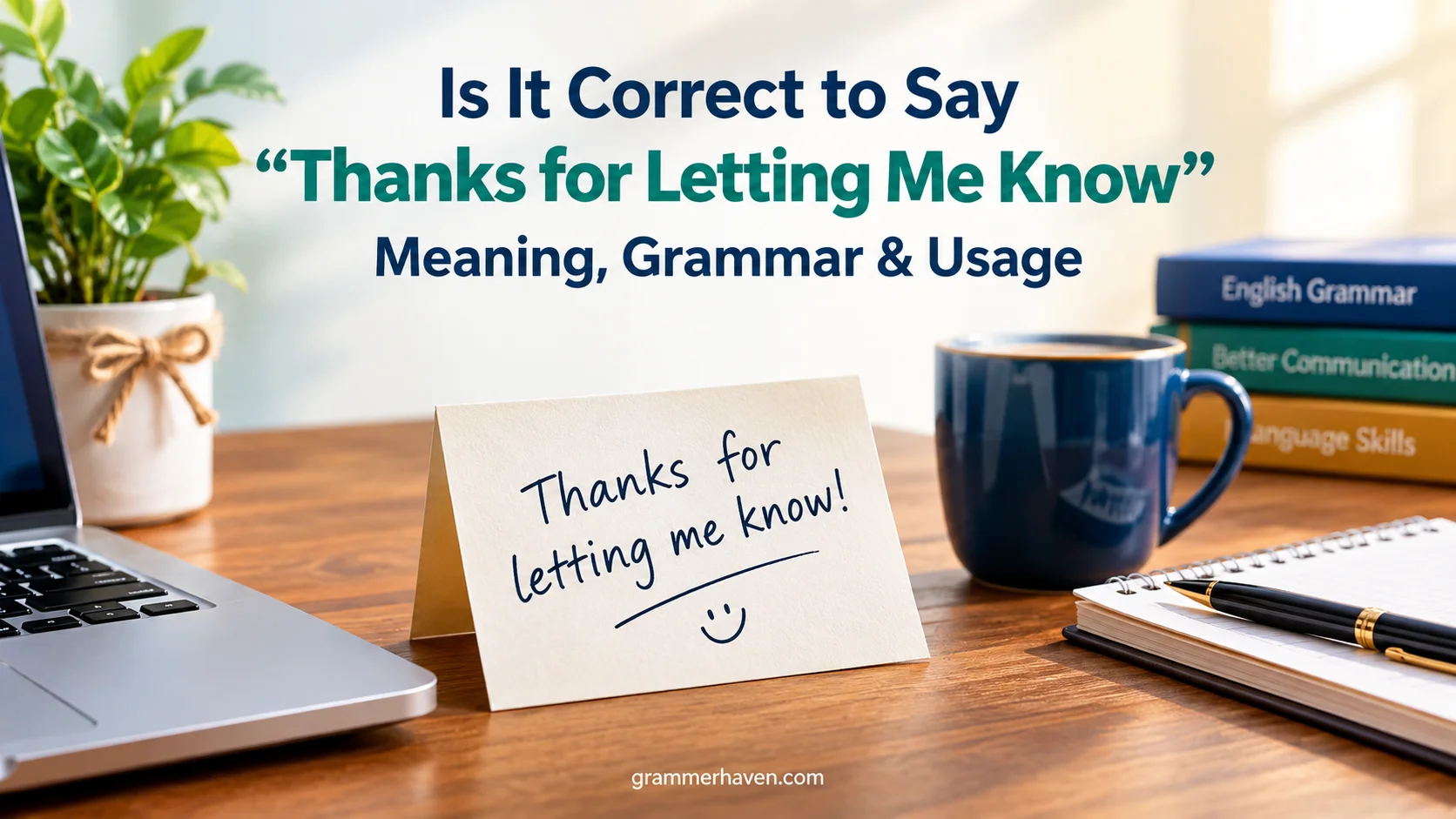
Is It Correct to Say “Thanks for Letting Me Know”? Yes, this phrase is natural English for expressing gratitude when someone shares information or an update.
“Thanks for letting me know” is a correct, natural, and widely accepted phrase in the English language. It is a simple yet powerful way to express gratitude when someone shares information, explains a situation, or tells you about a change. In daily interactions, this expression helps you remain polite and show appreciation without sounding formal or forced. It rolls off the tongue easily, making it suitable for everyday language, spoken communication, and written communication. Saying thank you becomes second nature with practice, although the nuances and subtleties of English can sometimes create doubt about the right way to respond. This common expression is a reliable choice because it helps you acknowledge information politely.
You can use this phrase when a coworker, friend, or family member shares an important update, sends a helpful reminder, announces a schedule change, or delivers disappointing news. In professional emails and workplace conversations, you might write, “Thanks for letting me know about the meeting time.” In text messages or personal communication, you could say, “Thanks for letting me know. I appreciate the heads-up.” Even when you receive bad news, the phrase offers a polite acknowledgment without suggesting that you feel happy about the situation. The best response depends on the other person, the context, and the tone of conversation. Your communication style, social interactions, and situational context can influence how people interpret words. Knowledge of email etiquette, text message etiquette, and workplace etiquette helps you select an appropriate response for different conversations and discussions.
Quick Answer: Is It Correct to Say “Thanks for Letting Me Know”?
Yes, “Thanks for letting me know” is grammatically correct, natural, and widely used in American English. It expresses gratitude to someone who has shared information with you.
You can use it in both casual and professional situations. For example:
- At work: “The meeting has been moved to 3 p.m.” — “Thanks for letting me know.”
- With a friend: “I’m running ten minutes late.” — “Thanks for letting me know!”
- In an email: “The client has requested a few changes.” — “Thank you for letting me know. I’ll review them today.”
The expression follows a standard grammatical pattern: thanks + for + gerund phrase. Because for is a preposition, the verb let takes the -ing form in this construction.
Both “Thanks for letting me know” and “Thank you for letting me know” are correct. The second version often sounds slightly more formal, while the first feels relaxed and conversational.
What Does “Thanks for Letting Me Know” Mean?
The expression “Thanks for letting me know” means “Thank you for telling me” or “I appreciate you sharing that information with me.” You use it when someone communicates something you didn’t know before or gives you an update about a situation.
The phrase combines two ideas: gratitude and acknowledgment. You’re thanking the person for sharing information while showing that you’ve received their message.
For example, imagine your coworker tells you that a client has changed a project deadline. You might reply, “Thanks for letting me know. I’ll adjust my schedule.” Your response acknowledges the update and explains what you’ll do next.
The Meaning of “Thanks”
The word “thanks” expresses gratitude. It’s a common, conversational alternative to “thank you.”
Compare these examples:
- “Thanks for your help.” — Friendly and natural.
- “Thank you for your help.” — Slightly more formal.
- “Many thanks for your help.” — Warm and somewhat more polished.
All three express appreciation. The difference lies mainly in tone and context.
The Meaning of “Letting Me Know”
The expression “let me know” means to tell, inform, or update someone about something. It appears frequently in everyday conversations and professional communication.
Consider these examples:
- “Let me know when you arrive.” — Tell me when you get there.
- “Please let me know if you need assistance.” — Inform me if you need help.
- “Thanks for letting me know about the delay.” — I appreciate you telling me about the delay.
The final example uses the gerund form letting because the phrase follows the preposition for.
What the Full Expression Communicates
Together, the words communicate appreciation for information received. However, they don’t automatically mean that you agree with the information or feel happy about it.
For instance:
“Unfortunately, your application wasn’t approved.”
“Thanks for letting me know. I appreciate the update.”
The response remains polite even though the news is disappointing. This flexibility makes the expression useful in many situations.
Is “Thanks for Letting Me Know” Grammatically Correct?
Yes. “Thanks for letting me know” is grammatically correct and natural in modern English. Its structure follows a common pattern used to express gratitude for an action.
The phrase can stand alone as a complete conversational response. English speakers frequently use such short expressions without stating a full subject and verb.
For example, “Thanks for your help,” “Sounds good,” and “See you soon” all work naturally in everyday communication.
Here’s how the target phrase breaks down:
| Word or phrase | Grammatical function |
| Thanks | Expression of gratitude |
| For | Preposition introducing the reason for gratitude |
| Letting | Gerund form of the verb let |
| Me | Object of letting |
| Know | Base-form verb following let |
The structure is straightforward once you understand how the words work together. For further examples of the same construction, see this English grammar discussion about “thank you for letting me know”.
Why Do We Say “Letting” Instead of “Let”?
The answer comes down to the preposition for. When a verb follows for to name the action being appreciated, English normally uses its gerund form.
A gerund is a verb ending in -ing that functions as a noun.
Look at these examples:
| Correct expression | Incorrect expression |
| Thanks for helping me. | Thanks for help me. |
| Thanks for calling me. | Thanks for call me. |
| Thanks for telling me. | Thanks for tell me. |
| Thanks for letting me know. | Thanks for let me know. |
The correct versions use helping, calling, telling, and letting after for.
Notice that know remains in its base form. That’s because let follows a particular verb pattern: let + object + base-form verb.
For example:
- “My parents let me stay up late.”
- “She let him explain the problem.”
- “Thanks for letting me know.”
You wouldn’t normally say “Thanks for letting me knows” or “Thanks for letting me to know.” Both forms break the established construction.
Is “Thank You for Letting Me Know” Also Correct?
Absolutely. Both expressions are correct, and neither changes the underlying meaning.
The difference is mostly conversational rather than grammatical.
- “Thanks for letting me know.” A little more casual and relaxed.
- “Thank you for letting me know.” A little more formal and polished.
Use either version when responding to a colleague, friend, customer, or family member. Choose the wording that fits your relationship and the situation.
When Should You Say “Thanks for Letting Me Know”?
The phrase works best when someone gives you information that deserves acknowledgment. The information might be helpful, routine, unexpected, or even disappointing.
Here are five common situations where it sounds natural.
When Someone Shares an Important Update
Imagine that your coworker tells you a deadline has changed. You need to acknowledge the update before deciding what to do next.
Example:
Coworker: “The report is due on Friday instead of Thursday.”
You: “Thanks for letting me know. I’ll update my calendar.”
This response shows that you received the information. It also communicates your next step.
When Someone Corrects or Clarifies Something
People sometimes share corrections that prevent misunderstandings. A brief acknowledgment keeps the conversation moving.
Example:
Friend: “The restaurant opens at 6 p.m., not 5 p.m.”
You: “Thanks for letting me know. I’ll plan accordingly.”
The phrase works because you’re appreciating the correction rather than arguing about the original mistake.
When Someone Shares Bad News
You can also use this expression when the information isn’t what you hoped to hear.
Example:
Colleague: “Unfortunately, the client has canceled tomorrow’s meeting.”
You: “Thanks for letting me know. I’ll rearrange my schedule.”
Your response acknowledges the news without pretending to be happy about it.
For sensitive situations, you may want to add a more personal sentence. For example, “Thanks for letting me know. I’m sorry to hear that.”
When Someone Sends a Workplace Notification
Workplace communication often involves quick updates about meetings, deadlines, assignments, and project changes.
Example:
Manager: “The client has requested three changes to the proposal.”
You: “Thanks for letting me know. I’ll review the changes this afternoon.”
This reply is polite and efficient. It also reassures the manager that you’ve understood the message.
When Someone Sends a Casual Text Message
The phrase fits naturally into text messages because it communicates appreciation without requiring a long response.
Example:
Friend: “I’m running about 15 minutes late.”
You: “Thanks for letting me know! See you soon.”
A simple response is enough for routine updates. You don’t need to turn every text exchange into a formal conversation.
Is “Thanks for Letting Me Know” Professional?
Yes. “Thanks for letting me know” is appropriate in most professional settings, including emails, team chats, and everyday workplace conversations.
It strikes a useful balance between politeness and efficiency. You acknowledge the information without sounding stiff or overly formal.
However, context matters. When writing to a new client, responding to a sensitive issue, or communicating in a highly formal setting, you might prefer a slightly more polished version.
Using the Phrase in Professional Emails
The expression works well when a colleague or client shares information that doesn’t require a lengthy response.
For example:
Subject: Updated Project Timeline
Hi Jordan,
Thanks for letting me know about the revised timeline. I’ll update the project schedule accordingly.
Best, Alex
This email acknowledges the update and confirms the next action. It doesn’t waste the recipient’s time with unnecessary wording.
Using the Phrase With Your Boss or Manager
You can use the phrase when your manager shares instructions, schedule changes, or project updates.
For example:
Manager: “Please submit the revised document by Wednesday.”
You: “Thanks for letting me know. I’ll have it ready by Wednesday.”
The response sounds professional because it acknowledges the instruction and confirms your understanding.
Using the Phrase With Clients and Customers
When communicating with clients, the expression can sound friendly and professional. You can also use “Thank you for the update” when you want a slightly more formal tone.
For example:
“Thank you for letting me know about the requested changes. I’ll review them and send you an updated draft.”
This version works particularly well when you need to acknowledge the client’s message and explain what happens next.
When to Choose a More Formal Alternative
A more formal expression may suit situations involving complaints, official notifications, or sensitive business matters.
| Situation | Recommended expression |
| Routine workplace update | Thanks for letting me know. |
| Formal client email | Thank you for the update. |
| Important clarification | I appreciate the clarification. |
| Official notification | Thank you for informing me. |
| Reported problem | Thank you for bringing this to my attention. |
You don’t need to avoid the original phrase in formal communication. Simply choose the version that best fits the relationship and purpose of your message.
“Thanks for Letting Me Know” vs. “Thank You for Letting Me Know”
Both expressions communicate gratitude, but they create slightly different impressions.
| Feature | Thanks for letting me know | Thank you for letting me know |
| Meaning | Appreciation for information | Appreciation for information |
| Tone | Conversational | Slightly more formal |
| Workplace use | Very common | Very common |
| Email suitability | Good for routine communication | Good for polished correspondence |
| Text message suitability | Excellent | Also appropriate |
Consider two situations.
With a close coworker, you might write, “Thanks for letting me know. I’ll fix it.” The wording feels natural and direct.
When replying to a client, you might write, “Thank you for letting me know. I’ll review the details and follow up shortly.” The longer version creates a slightly more formal impression.
Neither expression is inherently better. Choose based on the tone you want to convey.
“Thanks for Letting Me Know” vs. Similar Expressions
Several English expressions communicate similar ideas. However, each one has a slightly different purpose.
Thanks for Letting Me Know vs. Thanks for the Update
“Thanks for letting me know” acknowledges that someone has informed you about something.
For example:
- “Thanks for letting me know about the appointment.”
- “Thanks for the update on the project.”
Both are natural. The second is especially useful when someone keeps you informed about an ongoing task.
Thanks for Letting Me Know vs. Thanks for Informing Me
“Thanks for informing me” sounds more formal in many everyday situations. It works well in official correspondence, though it can feel unnecessarily stiff in casual conversation.
For example:
- Casual: “Thanks for letting me know about the change.”
- Formal: “Thank you for informing me of the revised schedule.”
The second version may suit formal writing, but the first is perfectly acceptable in most workplaces.
Thanks for Letting Me Know vs. I Appreciate You Letting Me Know
“I appreciate you letting me know” places more emphasis on your gratitude. It can sound especially thoughtful when someone shares sensitive information or makes an effort to keep you informed.
For example:
“I appreciate you letting me know about the issue before the meeting.”
This wording works well when you want to recognize the person’s consideration.
Thanks for Letting Me Know vs. Got It, Thanks
“Got it, thanks” is shorter and more casual. It mainly confirms that you’ve received and understood the information.
For example:
Coworker: “Please use the updated spreadsheet.”
You: “Got it, thanks.”
Use this response for routine instructions. If you want to express more appreciation, “Thanks for letting me know” is a better fit.
Thanks for Letting Me Know vs. I Wasn’t Aware of That
“I wasn’t aware of that” communicates that you didn’t previously know something. It doesn’t directly express gratitude.
For example:
“The office will be closed on Monday.”
“I wasn’t aware of that. Thanks for letting me know.”
Combining both expressions works well when the information surprises you.
12 Alternatives to “Thanks for Letting Me Know”
If you use the same phrase repeatedly, try one of these alternatives. Each option fits a slightly different context.
| Alternative | Best situation | Example |
| Thank You for the Update | Professional communication | “Thank you for the update on the project.” |
| I Appreciate the Information | Formal or neutral exchanges | “I appreciate the information you provided.” |
| Thanks for the Heads-Up | Advance warnings | “Thanks for the heads-up about the traffic.” |
| Thanks for Informing Me | Formal notifications | “Thanks for informing me of the change.” |
| I Appreciate You Telling Me | Personal conversations | “I appreciate you telling me what happened.” |
| Thanks for Keeping Me Informed | Ongoing updates | “Thanks for keeping me informed about the application.” |
| Got It, Thanks | Quick confirmations | “Got it, thanks. I’ll make the changes.” |
| Thanks for Bringing This to My Attention | Problems or concerns | “Thanks for bringing this to my attention.” |
| I Appreciate the Clarification | Resolving confusion | “I appreciate the clarification about the deadline.” |
| Thanks for the Reminder | Reminders | “Thanks for the reminder about tomorrow’s meeting.” |
| Thank You for Sharing That With Me | Personal or sensitive information | “Thank you for sharing that with me.” |
| I Appreciate the Update and Will Follow Up | Professional situations requiring action | “I appreciate the update and will follow up with the client.” |
Choose an alternative that matches what the other person actually did. For example, “Thanks for the reminder” fits a reminder, while “Thanks for the heads-up” fits advance notice.
Using a more specific expression can make your reply sound more thoughtful and precise.
How to Respond to “Thanks for Letting Me Know”
If someone thanks you for sharing information, you can respond briefly or continue the conversation. The best choice depends on whether the exchange needs another message.
Casual Responses
Use these expressions with friends, relatives, or coworkers you know well:
- “No problem!”
- “You’re welcome!”
- “Of course!”
- “Anytime!”
- “Happy to help!”
Example:
Friend: “Thanks for letting me know about the change.”
You: “No problem!”
There’s no need to add more unless you have something useful to say.
Professional Responses
In workplace communication, choose a polite response that fits the situation.
- “You’re welcome. Happy to help.”
- “Of course. Let me know if you need anything else.”
- “Glad I could keep you updated.”
- “You’re welcome. I’ll share any further updates as they come in.”
For example, if a colleague thanks you for alerting them to a deadline change, “You’re welcome. I’ll share any further updates as they come in” keeps the exchange professional.
When No Reply Is Needed
Sometimes, the conversation has already reached a natural stopping point. If someone sends “Thanks for letting me know” after receiving a routine update, you don’t always need to reply.
In a live conversation, a smile or nod may be enough. In a work chat, another message may add little value.
Use your judgment. Good communication isn’t about sending the most messages. It’s about making sure the other person has the information they need.
Common Mistakes to Avoid
Although the expression is simple, a few common mistakes can make your writing sound unnatural.
Saying “Thanks for Let Me Know”
This construction is incorrect because the verb after the preposition for should take the gerund form when it names the action being appreciated.
- Incorrect: “Thanks for let me know.”
- Correct: “Thanks for letting me know.”
The same rule applies to similar expressions such as “Thanks for helping me” and “Thanks for telling me.”
Confusing “Let Me Know” With “Letting Me Know”
Both forms are correct, but they serve different grammatical purposes.
Use “let me know” when asking or telling someone to provide information:
- “Please let me know when you arrive.”
- “Let me know if you need anything.”
Use “letting me know” after for when expressing gratitude:
- “Thanks for letting me know when you arrived.”
- “I appreciate you letting me know.”
The surrounding sentence determines which form you need.
Using the Phrase When a Specific Response Is Needed
Sometimes, simply acknowledging information isn’t enough. If someone needs a decision, confirmation, or action, explain what you’ll do next.
For example:
“The supplier has changed the delivery date.”
A basic response is:
“Thanks for letting me know.”
A more useful response might be:
“Thanks for letting me know. I’ll update the delivery schedule and notify the team.”
The second version acknowledges the information and makes your next step clear.
Misreading the Tone
The expression is generally polite, but context can affect how someone interprets it. In a tense conversation, a very brief response might sound dismissive or sarcastic.
For example, “Thanks for letting me know.” could sound sincere after a routine update. In an argument, the same words might feel cold.
If you want to avoid misunderstanding, add a little context:
- “Thanks for letting me know. I appreciate the heads-up.”
- “Thanks for letting me know. I’ll take care of it.”
- “Thanks for letting me know. I’m sorry that happened.”
The extra wording helps communicate your intended tone.
Punctuation and Formatting: How to Write the Phrase Correctly
The phrase doesn’t require special punctuation. Use ordinary sentence punctuation based on how you intend to deliver the message.
Should You Add a Period or Exclamation Point?
Both options are correct.
- “Thanks for letting me know.” Neutral and professional.
- “Thanks for letting me know!” Friendly and enthusiastic.
- “Thanks for letting me know?” Usually expresses uncertainty or asks for confirmation rather than simply offering thanks.
In most professional emails, a period is a safe choice. In casual text messages, an exclamation point can add warmth.
Can You Write “Thanks for Letting Me Know!” in an Email?
Yes. An exclamation point is appropriate when you want your message to sound upbeat or friendly.
For example:
“Thanks for letting me know! I’ll update the calendar now.”
However, you don’t need one in every message. A period often feels more measured when you’re discussing serious issues or formal business matters.
Should “Letting Me Know” Be Capitalized in a Title?
Capitalization depends on the style you choose.
- Title case: Thanks for Letting Me Know
- Sentence case: Thanks for letting me know
In title case, major words generally receive capital letters. In sentence case, you capitalize the first word and any proper nouns. Both styles are acceptable when used consistently.
See also: Fillet vs. Filet: Meaning, Differences, Pronunciation and Examples
FAQs:
Is It Polite to Say “Thanks for Letting Me Know”?
Yes. It’s a polite way to acknowledge information someone has shared. You can use it for routine updates, corrections, reminders, and important news. Add a follow-up sentence when the situation requires empathy or action.
Is “Thanks for Letting Me Know” Formal or Informal?
It’s suitable for both casual and professional communication. The word “thanks” gives it a conversational feel, while “thank you” often sounds slightly more formal. Both are appropriate in many workplace settings.
Can I Say “Thanks for Letting Me Know” to My Boss?
Yes. You can use it when your boss shares instructions, deadlines, or schedule changes. For example, “Thanks for letting me know. I’ll update the report by Friday” acknowledges the information and confirms your next step.
Is It Correct to Say “Thank You for Letting Me Know”?
Yes. “Thank you for letting me know” is grammatically correct and natural. It follows the same structure as “Thanks for letting me know” but often sounds slightly more formal.
What Is a More Professional Way to Say “Thanks for Letting Me Know”?
“Thank you for the update,” “I appreciate the information,” and “Thank you for informing me” are useful alternatives. Choose one based on the context. For routine workplace communication, the original phrase is also professional enough.
Does “Thanks for Letting Me Know” Sound Sarcastic?
Not by itself. The expression is generally neutral and polite. However, a tense conversation, clipped delivery, or additional wording can make it sound sarcastic. If you’re concerned about tone, add a clear and sincere follow-up.
What Should I Reply After Someone Says “Thanks for Letting Me Know”?
You can say “You’re welcome,” “No problem,” or “Happy to help.” If the conversation has naturally ended, you don’t necessarily need to respond. Choose a reply that suits your relationship and the situation.
Conclusion:
“Thanks for letting me know” is a grammatically correct, polite, and natural expression that works in both casual conversations and professional communication. You can use it to acknowledge updates, clarify misunderstandings, respond to reminders, or thank someone for sharing important information.
Remember to use “letting” after “for” because the phrase follows a common English grammatical pattern. If you need a slightly more formal tone, “Thank you for letting me know” or “Thank you for the update” works just as well.
Choose your words based on the situation and the relationship you have with the other person. A simple, sincere response often makes communication clearer and more effective.