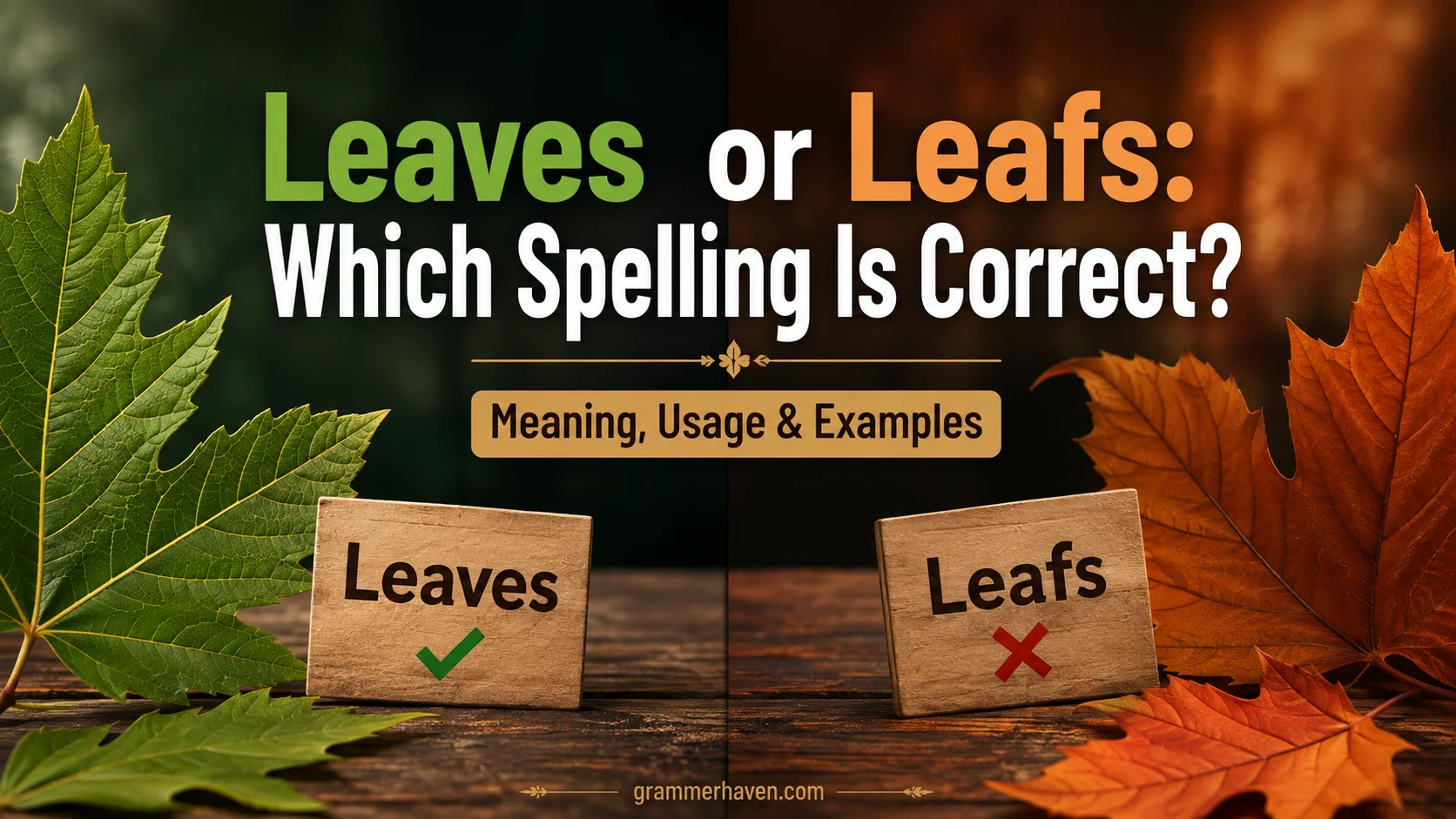
Leaves or Leafs: Which Spelling Is Correct? Meaning, Usage & Examples explains the correct plural form of leaf in the English language for plants, nature, and book pages.
Leaves is the standard plural of leaf. The spelling changes from leaf to leaves when you mean more than one leaf. This form appears in writing, school work, exams, emails, blog posts, and everyday phrases. Learners, students, and native writers may find this grammar question confusing because the word has a different plural form. Simple words, real examples, and clear usage tips can help explain the difference and avoid common mistakes.
Leafs is a correct verb form with a rare usage. The phrase leafs through a book describes someone turning book pages quickly. This meaning makes leafs different from the plural noun leaves. Search online results may show both forms, which can cause confusion when you feel unsure about the right spelling. Context shows whether the word works as a noun or verb. Spellcheck tools, blogs, and article examples can support learning, answers, and advice about proper usage.
Leaves or Leafs: The Quick Answer
The correct plural form of leaf when talking about plant parts is:
✅ Leaves
Example:
The tree lost its leaves during the winter.
Not:
❌ The tree lost its leafs during the winter.
The word leafs has different meanings. It can describe an action or appear in a name.
| Word | Meaning | Example |
| Leaves | Plural of the noun leaf | The leaves are turning yellow. |
| Leafs | Third-person singular form of the verb leaf | The plant leafs out in early spring. |
| Leafs | Part of a proper name | The Leafs won the hockey game. |
The key difference is simple:
- Talking about plant parts? Use leaves.
- Talking about an action or official name? Leafs may be correct.
What Is the Correct Plural of Leaf?
The correct plural of the noun leaf is leaves.
A leaf is a flat, usually green structure that grows from a plant stem. Leaves help plants create energy through photosynthesis, a process where plants use sunlight, water, and carbon dioxide to produce food.
When a plant has more than one leaf, English changes the word:
- One leaf
- Two leaves
- Hundreds of leaves
Examples:
- A single leaf fell from the maple tree.
- The garden was covered with fallen leaves.
- The scientist studied the shapes of different leaves.
This spelling follows a common English pattern where some words ending in -f or -fe change to -ves in their plural form.
Why Does Leaf Change to Leaves?
The change from leaf to leaves comes from older English language patterns.
Over centuries, English developed many irregular plural forms. While some words stayed simple, others changed their spelling because of pronunciation and language evolution.
Words that follow a similar pattern include:
| Singular | Plural |
| leaf | leaves |
| wolf | wolves |
| knife | knives |
| wife | wives |
| life | lives |
| loaf | loaves |
The spelling change usually happens because the f sound changes to a v sound before the plural ending.
For example:
- leaf → leaves
- wolf → wolves
The English language is full of these small surprises. It does not always work like a math equation where adding “s” automatically creates the plural.
Leaves vs. Leafs: Understanding the Difference
Many people search for leaves or leafs because both spellings look believable.
The confusion happens because English uses leafs in limited situations.
Here is the easiest way to separate them:
Leaves = More Than One Plant Leaf
Use leaves when you mean multiple parts of a plant.
Examples:
- The autumn leaves covered the road.
- The gardener removed dead leaves from the flower beds.
- The oak tree has large green leaves.
In these sentences, leaves refer to physical objects growing on plants.
Leafs = A Verb Form
The word leafs can be a verb.
The verb leaf means that a plant grows leaves or develops foliage. When used with a singular subject in the present tense, it becomes leafs.
Examples:
- The tree leafs out earlier than other trees.
- This plant leafs quickly after receiving sunlight.
- The forest leafs over during spring.
Notice the difference:
The tree has many leaves.
The tree leafs out in spring.
The first sentence uses leaves as a noun.
The second sentence uses leafs as a verb.
When Is “Leafs” Correct?
Although leaves is the normal plural form, leafs has legitimate uses.
Leafs as a Verb
The verb form appears when describing plant growth.
The phrase “leaf out” is especially common in gardening and botany.
Examples:
- The maple tree leafs out in April.
- The vines leaf out quickly after warm weather arrives.
- The young plants leafed out after several weeks.
The word describes the process of producing leaves, not the leaves themselves.
Leafs in Names and Titles
Sometimes a word does not follow normal grammar rules because it is part of a proper name.
A famous example is the professional hockey team:
Toronto Maple Leafs
The team name uses Leafs, not Leaves.
This does not mean “leafs” is the normal plural form of leaf. It is simply the official spelling chosen for the organization’s name.
Similar examples appear in many areas:
- Company names
- Sports teams
- Product names
- Brand names
Proper names often follow their own rules.
Common Mistakes With Leaves and Leafs
Mistake: Using Leafs as the Plural of Leaf
This is the most common error.
Incorrect:
The garden is full of colorful leafs.
Correct:
The garden is full of colorful leaves.
The reason is simple: the sentence talks about multiple plant parts.
Mistake: Assuming Every Word Ending in “F” Adds “S”
English has many words where this works:
- roof → roofs
- belief → beliefs
- chef → chefs
But some words change:
- leaf → leaves
- knife → knives
- wolf → wolves
The spelling depends on the word, not just the ending.
Mistake: Thinking Leafs Is Always Wrong
Some people believe leafs never exist.
That is also incorrect.
Examples where leafs works:
- The tree leafs out in May.
- The Toronto Maple Leafs won the game.
The word is not wrong. It simply has a different role.
How to Remember Leaves or Leafs
A simple memory trick can make the difference clear.
Think About Nature
If you can touch it on a tree or plant, use:
Leaves
Examples:
- green leaves
- fallen leaves
- maple leaves
- dried leaves
Think About Action
If the word describes something happening, use:
Leafs
Example:
The plant leafs out after the first warm days of spring.
The plant is doing something. It is not a collection of objects.
Use This Quick Question
Ask yourself:
“Am I talking about more than one leaf?”
If yes:
✅ Leaves
If you are describing growth:
✅ Leafs
Leaves or Leafs Examples in Everyday Sentences
Seeing examples makes the difference easier to remember.
Correct Uses of Leaves
- The wind blew the leaves across the yard.
- Children jumped into piles of leaves during autumn.
- The leaves on the tree turned orange and red.
- The gardener collected fallen leaves.
Correct Uses of Leafs
- The forest leafs out after the rainy season.
- The plant leafs quickly in warm temperatures.
- The Toronto Maple Leafs played a championship match.
Incorrect Uses
❌ The tree has thousands of leafs.
✅ The tree has thousands of leaves.
Leaves or Leafs in Science and Nature
The word leaves appears frequently in biology because leaves play a major role in plant survival.
A plant leaf performs several important functions:
| Function | Description |
| Photosynthesis | Converts sunlight into energy |
| Gas exchange | Allows carbon dioxide and oxygen movement |
| Water control | Helps regulate moisture loss |
| Protection | Supports plant health and growth |
Different plants have different types of leaves:
- Broad leaves on many trees
- Needle-like leaves on pine trees
- Thick leaves on desert plants
- Compound leaves made of smaller leaflets
Scientists often study leaves because their shape, size, and structure reveal information about plant species and environmental conditions.
Why Do Trees Lose Their Leaves?
Many trees lose their leaves during colder months in a process called leaf abscission.
Before leaves fall:
- Trees stop sending nutrients to older leaves.
- Chlorophyll breaks down.
- Green colors fade.
- Leaves change color.
- Leaves detach from branches.
This seasonal change creates the colorful autumn landscapes many people associate with forests.
Examples:
- Maple leaves often turn red or orange.
- Oak leaves may become brown.
- Birch leaves often turn yellow.
Leaves or Leafs: Grammar Rules at a Glance
| Question | Answer |
| What is the plural of leaf? | Leaves |
| Is leafs a word? | Yes |
| Is leafs the normal plural of leaf? | No |
| Can leafs be a verb? | Yes |
| Can leafs appear in names? | Yes |
Other English Words Like Leaf That Change Form
The leaf/leaves pattern belongs to a larger group of irregular plurals.
Learning these words together can improve your spelling.
| Singular | Plural |
| calf | calves |
| half | halves |
| loaf | loaves |
| self | selves |
| shelf | shelves |
However, not every word ending in “f” changes:
| Singular | Plural |
| roof | roofs |
| chef | chefs |
| belief | beliefs |
| chief | chiefs |
English spelling requires learning common patterns along with their exceptions.
See also: Sheath or Sheathe: Learn Meaning & Differences
FAQs:
1. Is “leaves” the correct plural of “leaf”?
Yes. Leaves is the standard and correct plural form of leaf when you mean the parts of plants.
2. Is “leafs” a correct word?
Yes, but leafs is mainly used as a verb. For example, “She leafs through a book” means she quickly turns through its pages.
3. Should I write “leaves” or “leafs” for plants?
Use leaves when talking about more than one plant leaf. For example, “The tree has green leaves.”
4. Why does “leaf” change to “leaves”?
Leaf has an irregular plural spelling. Instead of adding -s, English changes the ending to -ves, giving us leaves.
5. What does “leafs through a book” mean?
Leafs through a book means someone quickly looks through the pages, usually without reading everything carefully.
6. Is “leafs” the plural of “leaf”?
No. Leafs isn’t the standard plural of leaf. The correct plural is leaves.
7. Is “leaves” both a noun and a verb?
Yes. Leaves can be the plural noun for leaf, or it can be a verb meaning someone departs. For example, “She leaves at noon.”
8. What is the easiest way to remember “leaves” vs. “leafs”?
Remember: leaves refers to more than one plant leaf, while leafs can describe the action of looking through a book.
9. Can “leafs” appear in correct English sentences?
Yes. For example, “He leafs through the magazine while waiting.” Here, leafs is a verb, not a plural noun.
10. Which spelling should I use in most writing?
Use leaves when referring to multiple plant leaves. Use leafs only when the sentence needs the verb meaning, such as leafs through a book.
Conclusion:
Leaves is the correct plural of leaf when you’re talking about plant leaves. Leafs has a different grammatical role and is mainly used as a verb in expressions such as “leafs through a book.” Understanding the difference between these two forms makes your writing clearer and helps you avoid a common spelling and grammar mistake.