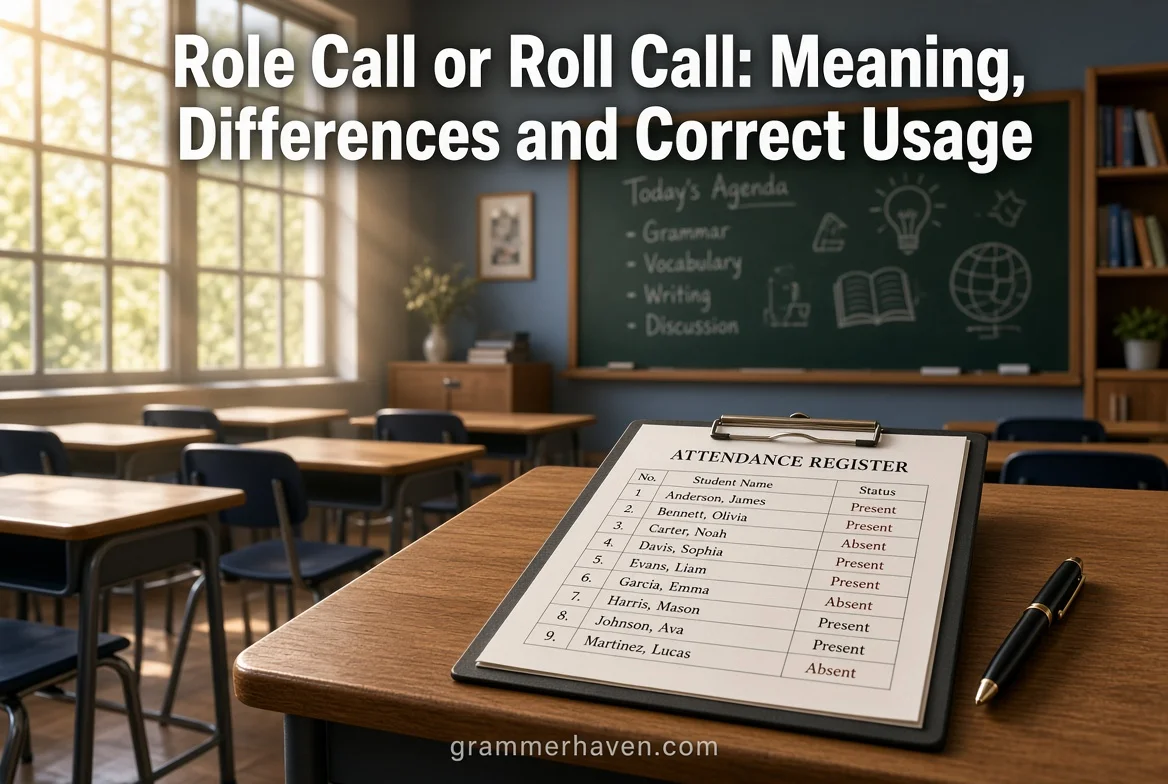
Role Call or Roll Call can confuse English learners because both expressions sound alike but have different meanings in standard American English. These common mix-ups affect native speakers, school assignments, workplace emails, meeting notes, and everyday messages. Understanding context, pronunciation, and word meanings helps you choose the correct phrase and avoid spelling confusion.
The word role means a person’s function or responsibility in a group, organization, or situation. A teacher’s role involves helping students learn, while a manager’s role may include guiding employees. The role meaning and role definition relate to responsibilities and different word functions. The word roll can refer to a list of names used for checking attendance and confirming who’s present. Teachers use a names list during school attendance, and team leaders may check an attendance list during meetings. This practice is called roll call. The roll meaning, roll definition, roll call spelling, and correct attendance terminology relate to attendance records, present individuals, and event participation.
The Role Call or Roll Call distinction depends on meaning, correct spelling, and proper usage. Although role call spelling may seem reasonable, roll call is the correct phrase for attendance checking. Recognizing this spelling distinction prevents common errors, grammar mistakes, and spelling mistakes in written communication, professional communication, and everyday communication. Context clues help improve word selection, correct word choice, and writing accuracy. Use role when discussing responsibilities and roll call when checking presence. This rule supports grammatical correctness, English usage, communication clarity, and accurate writing in school settings, workplace settings, and everyday contexts. Strong communication skills, knowledge of English expressions, and spelling accuracy also improve written English and American English.
Quick Answer: Role Call or Roll Call?
Roll call is the correct expression when someone calls out names to check attendance. The phrase refers to checking who is present, usually by reading names from an official list.
Role call is generally incorrect when you mean an attendance check. The mistake happens because role and roll sound alike in American English.
Compare these examples:
- Correct: The teacher took roll call before starting the lesson.
- Incorrect: The teacher took role call before starting the lesson.
- Correct: She played an important role in organizing the event.
Here’s the difference at a glance:
| Word or phrase | Meaning | Example |
| Roll call | Checking attendance by calling names | The coach conducted roll call before practice. |
| Role | A person’s function, responsibility, or part | He played a major role in the project. |
| Role call | A nonstandard spelling when referring to attendance | Write roll call instead. |
Easy rule to remember: Use roll call when checking who’s present. Use role when describing what someone does or the part they play.
What Does Roll Call Mean?
Roll call is the process of checking attendance by calling the names of people on a list. The person conducting the check usually reads each name aloud and records whether the individual is present or absent.
The phrase appears in schools, military units, workplaces, government meetings, and organized events. Although the setting may change, the basic purpose remains the same: confirming who has arrived or is accounted for.
For example, a teacher might call each student’s name before beginning a lesson. A supervisor might check that every team member has arrived before a safety briefing. In both situations, the person conducting the check is taking roll call.
Roll call can also refer to a formal attendance check itself, rather than just the act of reading names. In a meeting, for instance, the chairperson might announce that roll call will begin before members vote.
Roll Call Examples in Sentences
The following examples show how to use roll call naturally in different situations.
- The teacher completed roll call before handing out the worksheets.
- The soldiers assembled early for morning roll call.
- The committee clerk conducted roll call before the vote.
- Our supervisor took roll call before the emergency drill.
- The coach checked the team’s attendance during roll call.
- Please remain quiet while the instructor takes roll call.
- The meeting began with roll call to confirm which members were present.
Notice that each example involves checking attendance or confirming the presence of a group. That’s the key to recognizing the correct phrase.
Is Roll Call One Word or Two?
The standard spelling is roll call, written as two separate words. It functions as a noun phrase.
For example:
- Correct: The principal announced that roll call would begin at 8:00 a.m.
- Incorrect: The principal announced that rollcall would begin at 8:00 a.m.
You may also encounter the expression call the roll. It carries essentially the same meaning but uses a different grammatical structure.
Compare these sentences:
- The teacher took roll call before class.
- The teacher called the roll before class.
Both sentences describe checking attendance by calling names. The first uses roll call as a noun phrase, while the second uses call the roll as a verb phrase.
What Does Role Mean?
The word role refers to a person’s function, responsibility, position, or part in a particular situation. It can describe someone’s duties at work, contribution to a team, place in a family, or character in a movie or play.
Unlike roll call, which concerns attendance, role focuses on what someone does or the part they fulfill. A person can have several roles at once, such as being a parent, manager, volunteer, and mentor.
For example, a project manager might organize meetings while a designer creates visual materials. Each person has a different role, even though both attend the same meetings.
Role Examples in Sentences
Here are examples that demonstrate the correct use of role:
- She plays an important role in the company’s growth.
- My role is to help new employees understand their responsibilities.
- The actor received the lead role in the school production.
- Parents play a valuable role in children’s education.
- His role during the meeting was to record the main decisions.
- Technology plays a growing role in modern education.
- Every team member has a specific role in the project.
In each sentence, role describes a function, responsibility, or part. None of these examples involves checking attendance.
Common Expressions That Use Role
The word role appears in many everyday and professional expressions. Learning these combinations helps you use it accurately.
| Expression | Meaning | Example |
| Play a role | Contribute to an outcome or situation | Exercise plays a role in maintaining good health. |
| Take on a role | Accept a responsibility or position | Maya took on a leadership role. |
| Fulfill a role | Carry out the duties associated with a position | He fulfilled his role as team coordinator. |
| Assume a role | Begin performing a particular function | She assumed the role of project leader. |
| Role model | Someone whose behavior others admire or imitate | Her coach became a positive role model. |
| Role reversal | A situation in which people exchange their usual responsibilities | The activity encouraged role reversal between students and teachers. |
These expressions reinforce the central meaning of role: a function, position, or part someone plays.
Role Call vs. Roll Call: Key Differences
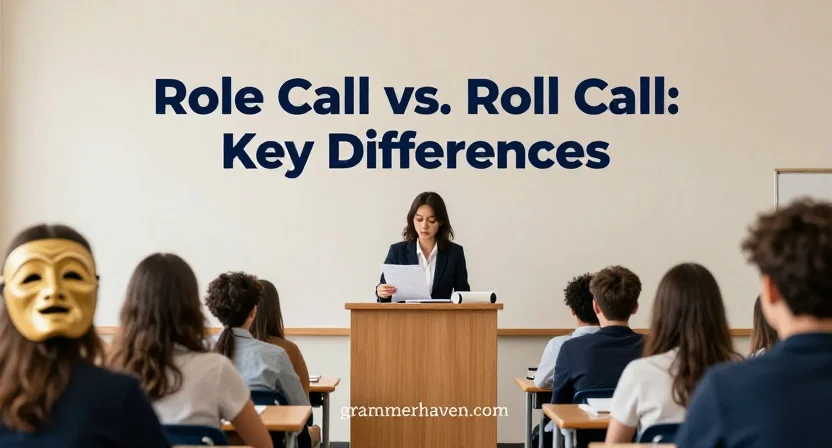
The difference between role call and roll call comes down to spelling, meaning, and context. Both individual words are valid English words, but only roll call is the established expression for checking attendance.
Understanding how each word works independently makes the distinction easier to remember.
Difference in Meaning
Roll can refer to an official list of names. In the expression roll call, someone calls names from that list to check attendance.
Role, on the other hand, describes a function, responsibility, position, or character. It doesn’t mean an attendance register in the expression roll call.
Compare the following sentences:
- The teacher checked the class roll before beginning the lesson.
- The teacher took roll call before beginning the lesson.
- The teacher explained each student’s role in the group activity.
The first two sentences concern attendance. The third describes responsibilities.
Difference in Usage
The phrase roll call commonly appears in attendance-related situations. Writers use it in schools, military settings, meetings, and other organized groups.
The word role appears in conversations about duties, relationships, positions, and performances. You might discuss someone’s role in a company or an actor’s role in a film.
Here are the most useful patterns:
- Roll call: conduct roll call, take roll call, attend roll call, begin roll call.
- Role: play a role, accept a role, take on a role, fulfill a role.
These patterns help you identify the right word before you finish writing a sentence.
Role Call vs. Roll Call Examples
The following table shows common errors and their corrections.
| Incorrect sentence | Correct sentence |
| The teacher started role call. | The teacher started roll call. |
| We took role call before the meeting. | We took roll call before the meeting. |
| The officer conducted role call at sunrise. | The officer conducted roll call at sunrise. |
| Everyone must attend the morning role call. | Everyone must attend the morning roll call. |
| She played an important roll in the project. | She played an important role in the project. |
Notice that the correction depends on the intended meaning. Use roll for the attendance list and role for a person’s function.
Why Is It Called Roll Call?
The expression roll call makes sense when you understand the older meaning of roll. In addition to its meanings involving movement or food, roll can refer to a list or register of names.
Historically, people recorded names on documents that could be rolled up. The word roll became associated with written lists and official registers. Calling names from such a list gave rise to the expression call the roll, which is closely related to the modern noun phrase roll call.
The basic idea remains straightforward: someone reads names from a list and checks who is present.
For example, a teacher might use a class register, while an organization might use a membership list. The documents differ, but the attendance-checking process follows the same principle.
Remember: The word roll in roll call refers to the list, not to the physical act of rolling something.
For historical and lexical context, you can consult Merriam-Webster and Etymonline’s entry for roll.
When Should You Use Roll Call?
The phrase roll call works in several settings. Its purpose is usually to confirm attendance, although the exact procedure depends on the organization.
Roll Call in Schools and Classrooms
Teachers often take roll call at the beginning of a class to identify which students are present. This helps them maintain attendance records and notice absences.
For example:
The teacher took roll call before explaining the assignment.
A school may also use an electronic attendance system instead of calling every name aloud. However, roll call remains appropriate when the teacher or another authorized person calls out names to confirm attendance.
Roll Call in the Military
Military units use roll call to confirm personnel are present or accounted for at designated times. Depending on the unit and situation, the process may happen before training, during a formation, or at the beginning of a shift.
For example:
The sergeant conducted morning roll call before the unit began training.
In some settings, roll call may also accompany a briefing about assignments, schedules, or safety procedures. The details vary by organization.
Roll Call in Meetings and Government
Organizations may take roll call before starting formal business or conducting a vote. A clerk or meeting official can call each member’s name and record attendance.
For example:
The committee began with roll call before discussing the proposal.
In legislative settings, a roll call vote records how individual members vote. This differs from an ordinary attendance check because the record identifies each member’s vote on a specific question.
For further context, the U.S. House of Representatives provides official information about House proceedings and voting records.
Roll Call at Work and Organized Events
Workplaces, volunteer groups, and event teams may use roll call to confirm that everyone has arrived. This can be especially useful before safety drills, field activities, or tasks that require an accurate headcount.
For example:
The supervisor completed roll call before the team entered the work area.
However, not every workplace needs a formal roll call. Some organizations use sign-in sheets, access records, or digital attendance tools instead. Choose the term that accurately describes the process.
Common Mistakes to Avoid With Role Call and Roll Call

Even experienced writers can confuse these words because spell-checking tools may accept both spellings. The problem isn’t always a misspelled word. Sometimes it’s a correctly spelled word used in the wrong context.
Here are the most common mistakes and how to fix them.
Writing Role Call When You Mean Attendance
Incorrect: The instructor completed role call before the exam.
Correct: The instructor completed roll call before the exam.
The sentence refers to checking attendance, so roll call is the correct expression.
Using Role Instead of Roll
Incorrect: Please make sure your name appears on the class role.
Correct: Please make sure your name appears on the class roll.
In this example, roll refers to the class register. However, you could also write, “Please make sure your name appears on the attendance list.” That version may sound more familiar to modern readers.
Using Roll Instead of Role
Incorrect: My roll is to help customers resolve their problems.
Correct: My role is to help customers resolve their problems.
The sentence describes a job responsibility, not a list of names. Therefore, role is the correct choice.
Writing Rollcall as One Word
Incorrect: The coach conducted rollcall before the game.
Correct: The coach conducted roll call before the game.
In standard usage, the phrase consists of two words. Keep them separate in articles, emails, reports, and other formal writing.
Assuming Spell-Check Will Catch Every Error
A spell-checker may accept role call because both role and call are valid words. It might not recognize that the phrase is wrong for the intended meaning.
For example, a document can contain perfectly spelled words and still communicate an error:
The manager conducted role call before the shift.
A spelling checker might not flag this sentence. A grammar checker that considers context may catch it, but you shouldn’t rely on software alone.
The best solution is to check the meaning of the phrase, not just the spelling of individual words.
Easy Ways to Remember Role Call vs. Roll Call
You don’t need to memorize a complicated grammar rule to distinguish these expressions. A simple connection between each word and its meaning will help.
Remember: Roll Means Register
Think of roll as a list of names. When someone calls names from that list, they’re taking roll call.
You can remember the relationship this way:
- Roll = a list or register.
- Call = calling out names.
- Roll call = calling names to check attendance.
For example, a teacher reads a class register and records which students are present. That’s roll call.
Remember: Role Means Responsibility
Connect role with responsibilities, jobs, and the parts people play in different situations.
For example:
- A teacher’s role is to help students learn.
- A manager’s role includes coordinating work.
- An actor’s role is the character played in a production.
If the sentence describes someone’s function or responsibility, role is probably the word you need.
Use the Context Test
When you’re unsure whether to write role call or roll call, ask yourself one question:
Am I checking attendance or describing someone’s function?
If you’re checking attendance, write roll call. If you’re describing a function or responsibility, write role.
Try these examples:
| Sentence | Correct answer | Why |
| The teacher began ___ before class. | Roll call | The teacher is checking attendance. |
| Her ___ involves training new employees. | Role | The sentence describes a responsibility. |
| The officer checked the attendance ___ . | Roll | The word refers to a register or list. |
| He accepted the ___ of team leader. | Role | The word describes a position. |
This method works because it focuses on meaning instead of sound.
Roll Call, Attendance, and Register: What’s the Difference?
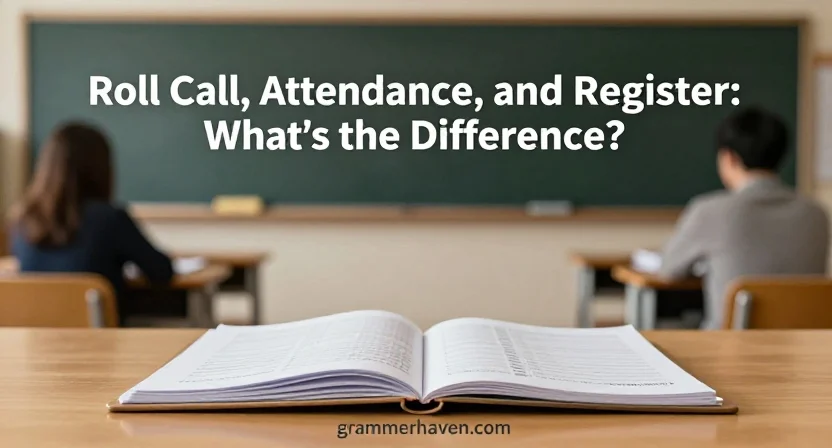
Although roll call, attendance, and register relate to the same general topic, they don’t mean exactly the same thing.
Understanding their differences can help you choose more precise wording in professional and academic writing.
| Term | Meaning | Example |
| Roll call | Calling names to check who is present | The teacher conducted roll call. |
| Attendance | The fact or record of being present | Attendance was required at the meeting. |
| Attendance register | A record used to document presence or absence | The teacher updated the attendance register. |
| Roster | A list of people assigned to a group, duty, or schedule | The supervisor checked the staff roster. |
| Class roll | A list of students enrolled in a class | The student’s name appeared on the class roll. |
These terms overlap, but each emphasizes something different.
For example, a teacher might use an attendance register to record absences. The teacher might conduct roll call to determine who is present. The register is the record, while roll call is the process.
Likewise, a workplace roster may list employees assigned to a shift. It doesn’t necessarily prove that every employee has arrived.
Choosing the right term helps readers understand exactly what happened.
Case Study: Correcting Role Call in Everyday Writing
Consider a school administrator preparing an email for teachers.
The first draft reads:
Please complete role call before the first lesson and update the attendance register afterward.
The message is understandable, but role call is incorrect for the intended meaning.
A corrected version reads:
Please complete roll call before the first lesson and update the attendance register afterward.
The revised sentence makes the same request while using the standard spelling.
Here’s why the correction matters:
- Accuracy: The writer uses the established expression for checking attendance.
- Clarity: Teachers can distinguish the attendance process from their professional roles.
- Consistency: The email follows standard English usage.
- Professionalism: Correct word choice makes workplace communication easier to trust.
The lesson applies beyond schools. Similar corrections can improve meeting agendas, employee instructions, event schedules, and official reports.
Role Call vs. Roll Call at a Glance
| Feature | Roll Call | Role |
| Correct spelling for attendance | Yes | No |
| Main meaning | Calling names to check attendance | A function, position, or responsibility |
| Common settings | Schools, meetings, workplaces, military units | Jobs, relationships, teams, performances |
| Example | The teacher took roll call. | She plays a leadership role. |
| Memory tip | Roll = register | Role = responsibility |
Final reminder: Write roll call when checking attendance and role when describing what someone does.
See also: What Is a Portmanteau? Meaning, Examples and How to Use It
FAQs:
Is It Role Call or Roll Call?
Roll call is correct when you mean checking attendance by calling names from a list. Role call is a common spelling mistake in this context because role refers to a function or responsibility, while roll can refer to a register of names.
Example: The teacher took roll call before starting the lesson.
Why Do People Say Role Call Instead of Roll Call?
People often confuse the two expressions because role and roll are homophones. Homophones sound alike but have different spellings or meanings.
Someone who learns the phrase by hearing it may choose the familiar word role without realizing that roll refers to a list of names. Context helps resolve the confusion.
Is Roll Call One Word or Two?
The standard spelling is roll call, written as two words. You can also use the related expression call the roll.
Examples:
- The teacher conducted roll call.
- The teacher called the roll.
Both expressions describe calling names from a list to check attendance.
What Does Roll Call Mean in School?
In school, roll call is a process teachers use to check which students are present or absent. The teacher may read students’ names aloud and record their attendance.
For example: The substitute teacher took roll call before handing out the worksheets.
Some schools use electronic attendance systems instead, but the purpose remains similar.
Can Role Call Ever Be Correct?
Role call isn’t the standard expression for checking attendance. In ordinary writing, use roll call for that meaning.
Someone could deliberately create role call as a wordplay, title, or unusual phrase referring to people’s roles. However, readers shouldn’t treat that creative use as an accepted alternative spelling of roll call.
Conclusion:
When choosing between role call or roll call, remember that roll call is the correct expression for checking attendance. Teachers, supervisors, and meeting officials use it to confirm who is present by calling names from a list. In contrast, role refers to a person’s function, responsibility, or position in a particular situation.
For example, a teacher takes roll call before class, while a student may play an important role in a group project. Both words are correct, but they serve different purposes. The easiest way to remember the difference is simple: roll means a list, while role means a responsibility. Use this rule whenever you’re writing emails, reports, school assignments, or professional documents.