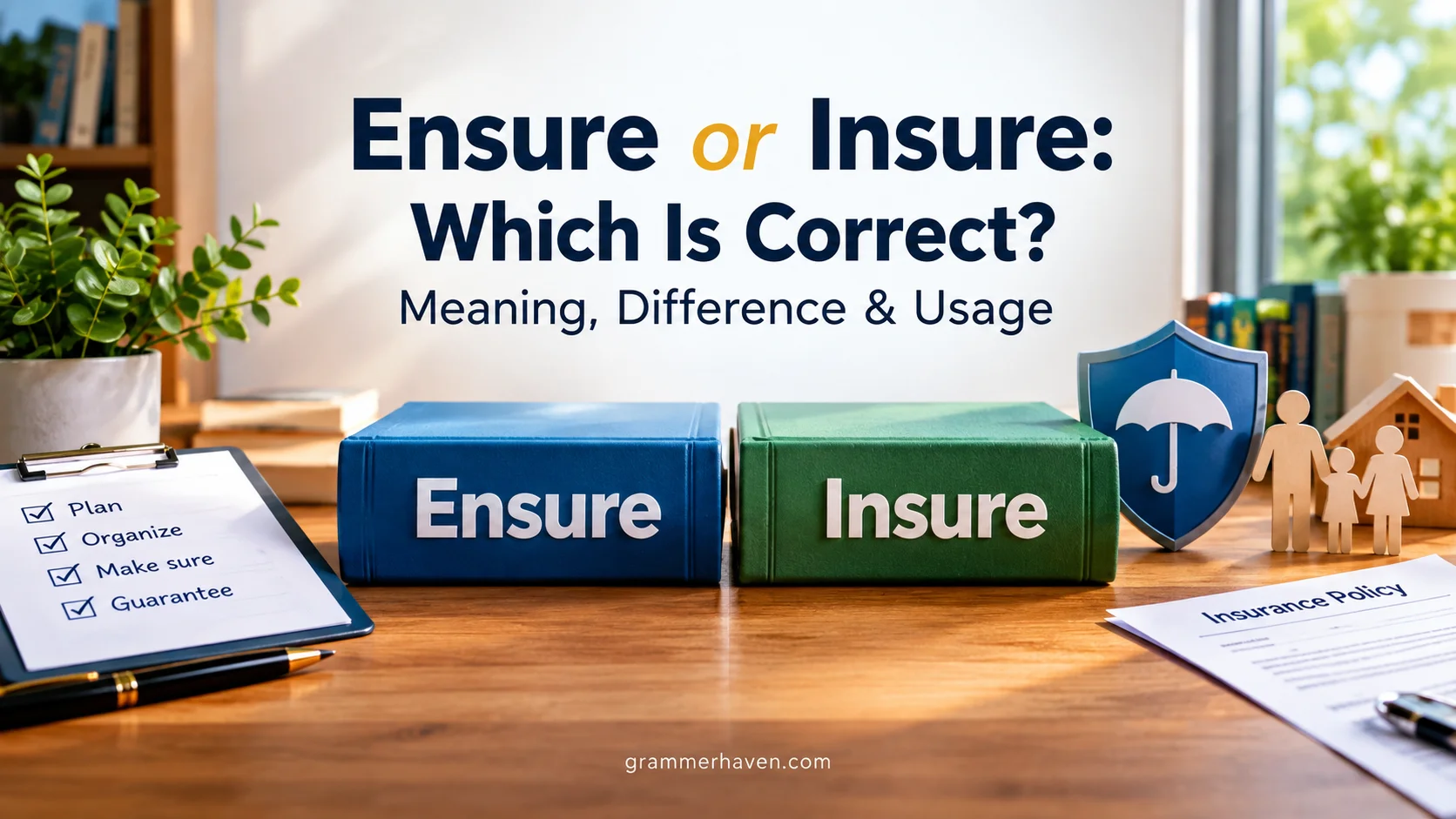
Ensure or Insure: students, writers, and professionals often face confusion when choosing between these tricky words because they sound nearly identical. Ensure and insure have different purposes in modern US English.
A simple way to remember the simple difference is to connect insure with insurance and ensure with make certain. This quick guide helps students, writers, and professionals write clearly and correctly in English. Knowing the target and purpose of each word can build confidence and make word choice easier.
Quick Answer: Ensure or Insure?
Use ensure when you mean “make certain” or “make sure.”
Please ensure that all the information is accurate.
Use insure when you mean “protect against financial loss through insurance.”
They insured the house against fire.
A useful rule is:
| Word | Meaning | Example |
| Ensure | Make something certain | Please ensure that the door is locked. |
| Insure | Protect through insurance | We insured the car against theft. |
| Assure | Give someone confidence | She assured me that everything was ready. |
There is one important wrinkle: insure can also mean “make certain” in some US English usage. Cambridge explicitly lists this sense. Still, ensure is usually the clearest choice when you simply mean “make certain.”
What Does Ensure Mean?
Ensure is a verb meaning to make certain that something happens or remains true. Cambridge defines it as making something certain to happen and gives examples involving safety, laws, delivery, and education.
Think of ensure as taking an action that removes uncertainty.
For example:
- Check the measurements to ensure accuracy.
- Follow the instructions to ensure safety.
- Save the document to ensure that your work isn’t lost.
- The manager reviewed the schedule to ensure timely delivery.
In each example, nobody is purchasing insurance. The action simply helps make a particular result certain.
Common Structures With Ensure
You can use ensure in several common sentence patterns.
Ensure + Noun
The inspection will ensure safety.
The checklist helps ensure accuracy.
Here, the noun identifies the result you want to make certain.
Ensure + That-Clause
Please ensure that every employee receives the notice.
We checked the equipment to ensure that everything worked properly.
This construction works especially well when you need to explain the exact outcome.
Ensure + Object + Result
The victory ensured the team a place in the final.
This structure appears in formal and professional writing. Cambridge also documents the pattern of using ensure with an object and a resulting benefit or outcome.
What Does Insure Mean?
Insure usually relates to insurance. It means protecting a person, property, or other valuable interest against specified loss or damage through an insurance arrangement.
For example:
We insured our home against fire.
The company insures commercial vehicles.
They decided to insure the equipment against theft.
The key idea is financial protection against risk. Someone pays for coverage or provides that coverage in case a specified loss occurs.
Cambridge gives the insurance sense as protecting yourself or your property against damage or loss by making payments to an insurance company.
Common Structures With Insure
Insure + object
The company insured the building.
Insure + object + against + risk
They insured the property against flooding.
Insure + object + for + amount
She insured the artwork for $50,000.
These patterns make the insurance meaning easy to recognize.
Ensure vs. Insure: The Main Difference
The simplest distinction comes down to certainty versus insurance.
Ensure focuses on making an outcome certain.
Insure focuses on protecting against financial risk.
Consider these two sentences:
The technician checked the brakes to ensure the car was safe.
The owner insured the car against theft.
The first sentence concerns an outcome. The second concerns financial protection.
That difference matters because replacing one word with the other can change the meaning.
Compare These Examples
| Sentence | Correct Word | Why |
| Please ___ that the report is complete. | ensure | The goal is certainty. |
| They ___ their house against flooding. | insure | The subject involves insurance. |
| The checklist helps ___ accuracy. | ensure | Accuracy is an intended result. |
| The company ___ its delivery trucks. | insure | The trucks receive insurance coverage. |
| We tested the system to ___ reliability. | ensure | The goal is a reliable result. |
| She ___ the jewelry against theft. | insured | The jewelry has insurance protection. |
A quick substitution test can help:
Can you replace the word with “make sure”?
If yes, ensure will usually be the better choice.
Can you replace it with “provide insurance for”?
If yes, insure is the natural choice.
Ensure vs. Insure vs. Assure
The third member of this confusing trio is assure.
Although the words overlap, a practical distinction makes them easier to remember:
- Ensure → make an outcome certain.
- Insure → protect against financial loss.
- Assure → give a person confidence.
Microsoft’s style guidance recommends exactly this distinction for clearer worldwide communication.
Ensure: Focus on an Outcome
The backup system helps ensure data security.
The sentence focuses on the result: data security.
Insure: Focus on Risk
The business insured its equipment against theft.
The sentence focuses on financial protection from a specific risk.
Assure: Focus on a Person
The manager assured the customer that the problem would be fixed.
The manager isn’t making the outcome legally certain or buying insurance. Instead, the manager is giving the customer confidence.
A Simple Three-Word Memory Trick
Ensure = outcome.
Insure = insurance.
Assure = person.
This isn’t a complete description of every historical or dictionary use. It is a practical guide for modern writing.
When Should You Use Ensure?
Choose ensure when your sentence describes an action intended to make something certain.
Common contexts include:
- Safety
- Accuracy
- Quality
- Compliance
- Completion
- Reliability
- Delivery
- Success
- Security
- Proper procedures
- Correct results
Examples of Ensure
Double-check the figures to ensure accuracy.
Please ensure that your application is complete.
The safety inspection helps ensure that the equipment works properly.
We arrived early to ensure that we had enough time.
The company changed its process to ensure consistent quality.
Notice the pattern. None of these sentences involves an insurance policy.
When Should You Use Insure?
Choose insure when the sentence concerns insurance coverage or protection against financial loss.
Common contexts include:
- Homes
- Cars
- Property
- Businesses
- Equipment
- Valuable possessions
- Life insurance
- Liability coverage
- Theft
- Fire
- Accidental damage
- Other insured risks
Examples of Insure
They insured their home against fire.
The business insures its company vehicles.
She decided to insure the painting for its full value.
The company insured its equipment against accidental damage.
The policy insures the property against certain covered losses.
Here, insure has a clear insurance connection.
Can Insure Mean Ensure?
Yes. This is one of the most important nuances in the ensure vs. insure debate.
Cambridge lists insure as having a US English meaning of “make something certain” and provides examples where it functions similarly to ensure.
So a sentence such as:
We checked the figures to insure accuracy.
can appear in American English.
However, that doesn’t mean ensure and insure are equally useful in every context.
For general writing, ensure gives readers a cleaner signal that you mean make certain rather than provide insurance.
That’s particularly helpful in business, academic, technical, and professional writing.
Why Use Ensure When Both Can Work?
The answer is clarity.
Compare:
The procedure will insure accuracy.
with:
The procedure will ensure accuracy.
The second sentence immediately communicates the intended meaning. There’s no reason for the reader to wonder whether insurance is involved.
Microsoft’s style guidance similarly recommends ensure for “make sure” or “guarantee” and reserves insure for providing insurance.
Can Ensure Mean Insure?
Generally, no.
While ensure can mean making something certain, it doesn’t normally carry the specific insurance meaning that insure does.
For example:
We insured the building against fire.
You wouldn’t normally replace insured with ensured because the sentence concerns an insurance policy.
Likewise:
The company insured its fleet of vehicles.
Here, the company obtained or provided insurance coverage.
The distinction becomes especially important when discussing contracts, policies, premiums, claims, and financial protection.
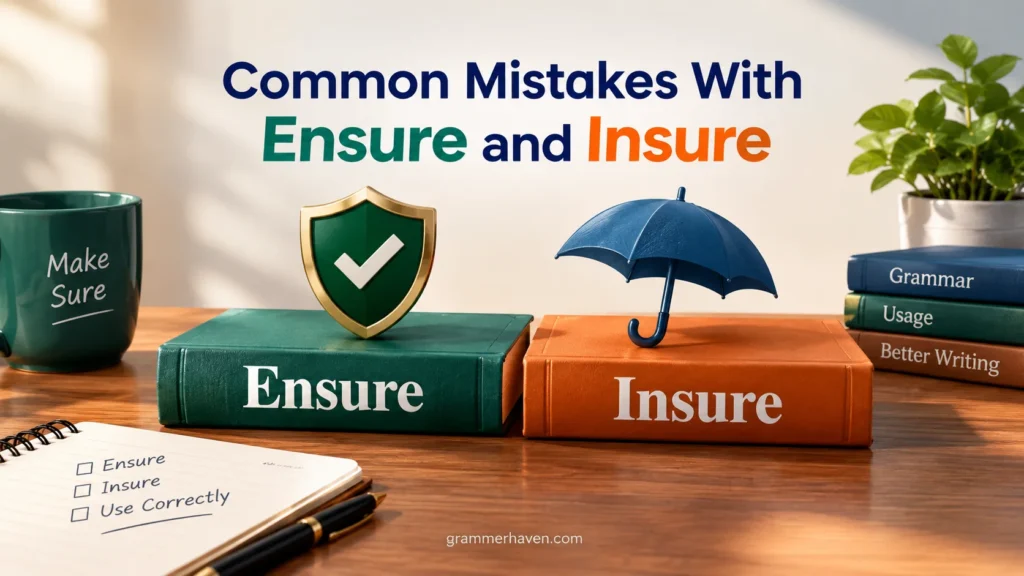
Common Mistakes With Ensure and Insure
Mistake: Using Insure When You Mean Make Sure
Please insure that the form is complete.
Although this usage can occur, ensure is the clearer choice in standard professional writing:
Please ensure that the form is complete.
Mistake: Using Ensure for Insurance
They ensured the house against fire.
That’s not the usual modern choice when you mean an insurance policy.
Better:
They insured the house against fire.
Mistake: Confusing Assure With Ensure
The safety system assured the building was secure.
If the subject is a system or process that makes an outcome certain, ensure usually fits better:
The safety system ensured that the building was secure.
But if you’re giving a person confidence, use assure:
The manager assured us that the building was secure.
The difference is subtle but useful.
Ensure or Insure in American English
American English makes this distinction especially interesting because insure can sometimes appear with the “make certain” meaning.
Cambridge explicitly recognizes insure as a US usage meaning “make something certain.”
Even so, ensure remains the safest and clearest choice when you mean “make certain.”
For professional content, consistency matters more than chasing every possible dictionary variation.
Microsoft’s style guide recommends:
Ensure = make sure or guarantee
Insure = provide insurance
Assure = state positively or make someone confident
That distinction works well for business writing, technical documentation, websites, and everyday communication.
Ensure or Insure in British English
British English also uses ensure for making something certain.
For example:
Please ensure that all forms are completed.
Cambridge defines ensure as making something certain and provides examples involving safety, law, delivery, and other outcomes.
Insure, meanwhile, strongly carries the insurance meaning in ordinary modern usage.
So if you’re writing for an international audience, ensure is usually the clearer choice whenever you mean “make certain.”
Why Are Ensure and Insure So Similar?
The similarity isn’t accidental.
Both words have long histories connected with ideas of certainty, security, and making something sure. Their meanings developed and overlapped over time.
That history helps explain why dictionaries don’t always draw an airtight wall between them.
Modern usage, however, has created a strong practical distinction:
Ensure commonly handles certainty.
Insure commonly handles insurance.
This distinction gives modern readers a useful semantic shortcut even though historical usage is more complicated.
Ensure vs. Insure Examples in Real Situations
Seeing the difference in context makes the rule much easier to remember.
Workplace Example
A supervisor wants every employee to follow a safety procedure.
The supervisor reviewed the instructions to ensure everyone understood them.
No insurance exists in this sentence. The supervisor wants a particular outcome.
Homeowner Example
A homeowner wants financial protection against fire.
The homeowner insured the house against fire.
Here, insurance is the central idea.
Business Example
A company wants consistent product quality.
The company introduced inspections to ensure consistent quality.
The inspections are intended to produce a reliable result.
Valuable Property Example
A collector owns an expensive painting.
The collector insured the painting against theft and damage.
The sentence concerns financial protection.
Reassurance Example
A customer worries that an order won’t arrive.
The representative assured the customer that the order was on its way.
The representative gives the customer confidence. That’s assure, not ensure or insure.
Case Study: One Situation, Three Different Words
Imagine a company preparing to transport expensive equipment.
First, the company checks every crate and confirms the delivery schedule.
The company took several steps to ensure a safe delivery.
Next, it purchases coverage against accidental damage.
The company insured the equipment against damage during transit.
Finally, a customer becomes worried about the shipment.
The representative assured the customer that the equipment would arrive on schedule.
The situation hasn’t changed. The purpose of the action has changed.
That’s the real key.
Ensure deals with making the outcome certain.
Insure deals with financial protection.
Assure deals with confidence.
A Practical Decision Guide
When you’re unsure which word belongs in a sentence, ask what you’re actually trying to say.
Ask Yourself:
- Do I mean “make sure”?
- Use ensure.
- Am I talking about an insurance policy or financial protection?
- Use insure.
- Am I giving someone confidence or reassurance?
- Use assure.
Quick Decision Tree
Are you talking about insurance?
→ Yes: Use insure.
→ No: Are you making something certain?
This simple test handles most everyday situations without requiring you to memorize complicated grammar rules.
Ensure vs. Insure: Common Sentence Corrections
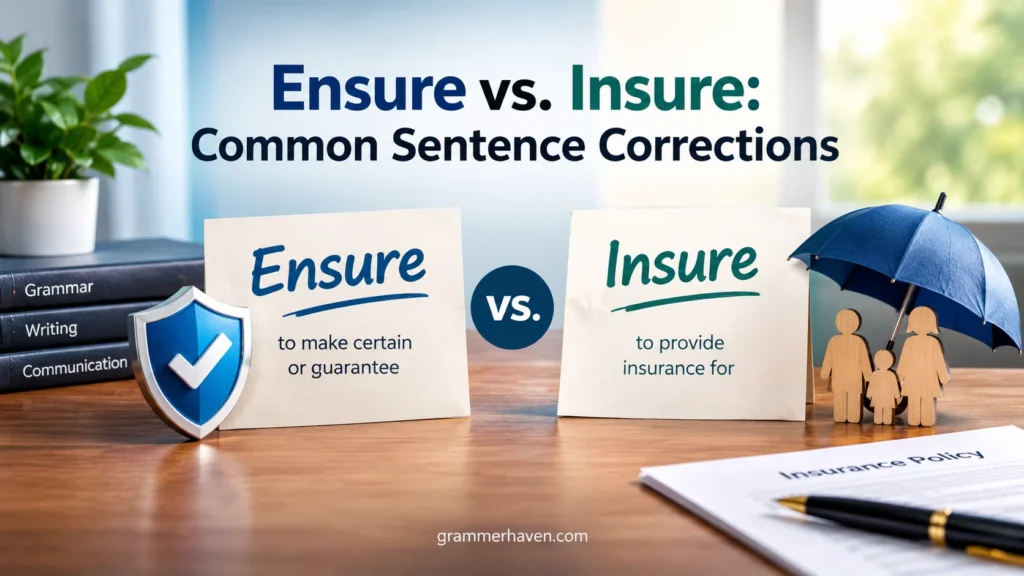
| Less suitable sentence | Better sentence | Explanation |
| Please insure that the door is locked. | Please ensure that the door is locked. | “Make certain” meaning |
| The company ensured the building against fire. | The company insured the building against fire. | Insurance meaning |
| The checklist insures accuracy. | The checklist ensures accuracy. | General certainty |
| They insured the employees that everything was fine. | They assured the employees that everything was fine. | Reassuring people |
| We insured that all documents were correct. | We ensured that all documents were correct. | Making something certain |
| They insured their equipment against theft. | They insured their equipment against theft. | Insurance protection |
The important point is that context determines the correct word.
Facts to Remember About Ensure and Insure
- Ensure is a verb meaning to make something certain.
- Insure commonly refers to providing or obtaining insurance.
- Insure can also mean “make certain” in some US English usage.
- Assure generally focuses on giving a person confidence.
- Ensure commonly appears before a noun or a that-clause.
- Insure commonly appears with objects such as homes, vehicles, property, and equipment.
- Ensure is generally the clearer choice when you mean “make sure.”
- The three words overlap historically, which explains some dictionary variation.
- Microsoft recommends distinguishing them for clearer worldwide communication.
How to Remember Ensure vs. Insure
Here’s the easiest memory trick:
Ensure the result. Insure the risk. Assure the person.
Picture three different scenes.
Ensure: A technician checks a machine to make sure it works.
Insure: A homeowner buys coverage for the house.
Assure: A manager tells an employee that everything will be fine.
Once you connect each word with its target, the spelling becomes much easier to remember.
See also: Whose vs Who’s: Meaning, Difference, Examples and Usage
FAQs:
Is “ensure” or “insure” correct?
Both are correct words, but they usually serve different purposes. Use ensure for making something certain and insure for insurance-related protection.
What is the difference between ensure and insure?
Ensure generally means “make certain.” Insure generally means to protect someone or something through insurance.
Can insure mean the same as ensure?
Sometimes. Cambridge recognizes insure with the “make certain” meaning in US English. However, ensure ” is usually clearer when you simply mean “make certain.”
Is insure correct in American English?
Yes. American English uses insure for insurance and sometimes for the broader sense of making something certain. Context determines the intended meaning.
When should you use ensure?
Use ensure when you’re talking about making an outcome certain, such as safety, accuracy, completion, quality, or compliance.
When should you use insure?
Use insure when someone obtains or provides insurance protection against risks such as theft, fire, damage, or loss.
What is the difference between assure, ensure, and insure?
A useful modern distinction is:
- Assure someone.
- Ensure an outcome.
- Insure against a financial risk.
Microsoft recommends this distinction for clearer communication.
Can you say “ensure against”?
It’s generally better to use insure against when you mean protection through insurance.
The company insured the warehouse against fire.
For general certainty, use ensure without an insurance meaning.
Is ensure related to insurance?
The words share historical connections involving certainty and security. Their modern meanings have become more distinct, which is why ensure now commonly means “make certain” while insure commonly refers to insurance.
How can you easily remember ensure vs. insure?
Remember:
Ensure = make sure.
Insure = insurance.
If a person needs reassurance, add the third word:
Assure = reassure.
Conclusion:
Understanding ensure or insure becomes easier when you focus on the purpose of each word. Use ensure when you mean to make certain that something happens, and use insure when talking about financial protection or an insurance policy. Remembering this simple distinction can help you write more clearly and correctly in English and avoid common confusion.