What Is a Portmanteau? It is a word formed when two words blend their sounds or meanings to create a new expression. Words are pieces of a puzzle, coming together to paint a vivid picture in our minds. This linguistic phenomenon shows the magic of language, transforming how we communicate one syllable at a time. A portmanteau combines parts of two words instead of simply mashing letters together. This creative process creates something entirely new and gives birth to expressions with their own meanings.
Have you caught yourself saying brunch instead of specifying breakfast or lunch? You have encountered a portmanteau! This clever wordplay combines parts of two words to express a shared idea in a shorter form. Brunch blends breakfast and lunch to describe a meal between the two. Portmanteaus also shape everyday language by making communication more creative and natural. Once you understand their origins and meanings, you can notice them in conversations, advertisements, and online discussions. These blended words reveal how language changes as people find new ways to express ideas.
Quick Answer: What Is a Portmanteau?
A portmanteau is a word formed by blending parts of two or more words to create a new word with a combined meaning.
For example, brunch combines breakfast and lunch. Similarly, smog blends smoke and fog, while motel combines motor and hotel.
Writers, speakers, businesses, and advertisers use portmanteaus to describe combined ideas, name products, create memorable expressions, and introduce new concepts. In linguistics, a portmanteau is also commonly called a blend word.
What Is a Portmanteau in English Grammar?
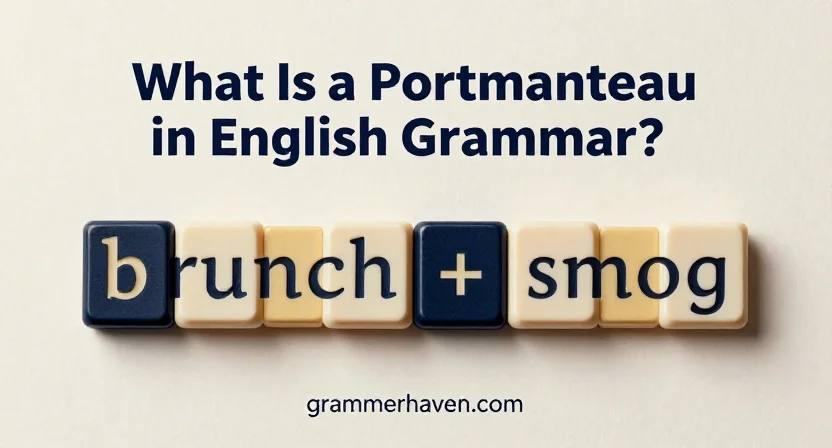
A portmanteau is a type of word formation in which parts of two or more words merge into a single expression. The new word typically carries meaning from its original components.
Unlike a phrase that simply places two words together, a portmanteau blends their forms. This process often shortens the original words while preserving enough of their sounds or letters to suggest their identities.
Consider the word brunch. Instead of saying “a meal between breakfast and lunch,” you can use one convenient word. The blend captures the connection between both meals without requiring a longer explanation.
Here are three familiar examples:
- Brunch = breakfast + lunch
- Smog = smoke + fog
- Motel = motor + hotel
Each example illustrates how a portmanteau combines elements of existing words to express a related concept.
However, not every portmanteau follows the same pattern. Some combine the beginning of one word with the ending of another. Others overlap sounds or retain larger portions of their source words.
The essential feature is the blending of word forms, rather than simply placing complete words next to each other.
What Does Portmanteau Mean?
The word portmanteau has both an ordinary meaning and a linguistic meaning.
In its original sense, a portmanteau was a type of traveling case. In modern English grammar, the term describes a word that combines elements of other words.
The linguistic meaning is especially useful when discussing vocabulary, creative writing, and language development.
For example, smog combines the meanings of smoke and fog. The resulting word describes a polluted haze associated with smoke and other airborne pollutants. Instead of using both source words separately, English speakers use one established term.
Similarly, webinar combines web and seminar to describe an online seminar or presentation.
A portmanteau can therefore do more than shorten a phrase. It can give a new concept a recognizable name that people can use repeatedly.
Where Does the Word Portmanteau Come From?
The history of portmanteau explains why the term fits blended words so well.
The Original Meaning of Portmanteau
The word portmanteau comes from French and originally referred to a traveling case used to carry clothing. Traditional portmanteaus opened into two compartments, allowing travelers to pack their belongings together in one piece of luggage.
The image of two separate compartments inside one case later became a useful metaphor for blended words. Just as the case holds two sections together, a portmanteau word brings elements of different words into a single expression. Collins English Dictionary describes a portmanteau word as a combination of two words in both form and meaning.
How Lewis Carroll Popularized the Linguistic Meaning
English writer Lewis Carroll popularized the linguistic use of portmanteau in his 1871 book Through the Looking-Glass.
In the book, the character Humpty Dumpty explains unusual words from Carroll’s poem Jabberwocky. One example is slithy, which combines lithe and slimy. Another is mimsy, which combines miserable and flimsy.
Carroll compares these words to a portmanteau because they pack two meanings into one word. His explanation helped establish the term in discussions of word formation.
Carroll also created other blends that became part of English vocabulary. Chortle, formed from chuckle and snort, is a lasting example of his playful approach to language.
How Does a Portmanteau Work?
A portmanteau works by combining recognizable parts of existing words. The writer or speaker selects sounds, syllables, or letter sequences that form a new word with a related meaning.
For example, breakfast and lunch produce brunch. The new word keeps the opening sound of breakfast and the ending of lunch, while dropping other parts of both words.
However, English has no single formula for creating every portmanteau. Pronunciation, spelling, meaning, and common usage all influence the final result.
Combining the Beginning of One Word With the End of Another
This is one of the most familiar ways to form a portmanteau. A word retains part of its first source word and part of its second source word.
Examples include:
- Brunch = breakfast + lunch
- Smog = smoke + fog
- Motel = motor + hotel
In each case, the blend removes some material from the original words. The result is shorter and easier to use in ordinary conversation.
Overlapping Sounds or Letters
Some portmanteaus connect words through shared or similar sounds. This approach can make the blend sound more natural because the two source words fit together smoothly.
For example, slithy combines slimy and lithe in a way that suits its literary context. The word retains elements of both sources while creating a new expression.
Sound overlap can help a blend feel natural, but it isn’t required. The main goal is to create a recognizable and meaningful word.
Combining Larger Parts of Words
Some blends preserve more than a single syllable from each source word. Others combine a shortened word with a complete word.
Consider webinar, formed from web and seminar. The first component remains intact while the second contributes its ending. The resulting word describes a seminar conducted online.
This flexibility makes portmanteaus useful for naming new technologies, services, products, and cultural trends.
What Are the Different Types of Portmanteaus?
Portmanteaus appear in many areas of life. Although their structures may overlap, grouping them by context helps you understand how people use them.
Everyday Portmanteaus
Everyday blends describe familiar objects, activities, or conditions. Many have become so common that speakers no longer notice their unusual construction.
Examples include:
- Brunch: A meal that combines breakfast and lunch.
- Smog: A polluted haze associated with smoke and other airborne pollutants.
- Motel: A lodging establishment originally designed for motorists.
- Spork: An eating utensil combining features of a spoon and a fork.
These words show how a successful blend can become an ordinary part of English vocabulary.
Technology and Internet Portmanteaus
Technology creates new products and activities that often need concise names. Word blending provides a practical way to describe these developments.
- Blog: A shortened blend associated with web log.
- Webinar: Web + seminar.
- Netiquette: Internet + etiquette.
These words help people discuss online publishing, virtual events, and digital behavior without repeatedly explaining the underlying concepts.
Business and Marketing Portmanteaus
Businesses often use portmanteaus to describe advertising formats, services, and new product categories.
- Advertorial: Advertisement + editorial.
- Infomercial: Information + commercial.
- Frenemy: Friend + enemy, sometimes used to describe a complicated personal or business relationship.
A memorable blend can make a concept easier to recognize. However, businesses should consider clarity before choosing a clever name. A word that sounds catchy but confuses customers may do more harm than good.
Informal and Cultural Portmanteaus
Popular culture frequently produces blends that describe celebrities, entertainment, and social trends.
- Bollywood: Bombay + Hollywood.
- Mockumentary: Mock + documentary.
- Brangelina: Brad Pitt + Angelina Jolie, a celebrity couple nickname.
Some cultural blends remain popular for years. Others fade when the trend or relationship that inspired them disappears.
Remember that these categories describe common uses rather than strict linguistic classifications. A word may belong to more than one category.
Portmanteau Examples in Everyday English
The following table shows established blends and explains how their meanings relate to their source words.
| Portmanteau | Original words | Meaning |
| Brunch | Breakfast + lunch | A meal combining breakfast and lunch |
| Smog | Smoke + fog | A polluted haze |
| Motel | Motor + hotel | Lodging originally designed for motorists |
| Spork | Spoon + fork | A utensil combining features of both |
| Infomercial | Information + commercial | A commercial presented in an informational format |
| Advertorial | Advertisement + editorial | Advertising presented in an editorial style |
| Webinar | Web + seminar | An online seminar |
| Blog | Web + log | An online publication or regularly updated website |
| Mockumentary | Mock + documentary | A fictional work presented in documentary style |
| Chortle | Chuckle + snort | To laugh in a way that combines chuckling and snorting |
| Sitcom | Situation + comedy | A comedy series built around recurring characters and situations |
| Staycation | Stay + vacation | Time off spent at home or close to home |
| Podcast | iPod + broadcast | A digital audio program, now distributed through many platforms |
| Netiquette | Internet + etiquette | Accepted behavior and manners online |
| Oxbridge | Oxford + Cambridge | A collective term for the two British universities |
Important distinction: Not every example combines the same amount of each source word. Some blends retain only small fragments, while others preserve a complete component. Their shared feature is the merging of word forms to create a new expression.
Portmanteau vs. Compound Word: What’s the Difference?
Portmanteaus and compound words both involve word formation, but they combine their components differently.
A portmanteau blends parts of source words. A compound word generally combines complete words or established word forms.
| Feature | Portmanteau | Compound word |
| Formation | Blends parts of words | Combines complete words or established forms |
| Example | Brunch = breakfast + lunch | Toothbrush = tooth + brush |
| Word structure | At least one component is usually shortened or merged | Both components generally remain recognizable |
| Purpose | Often names a combined or related concept | Often identifies an object, person, place, or idea through its components |
For example, brunch combines breakfast and lunch into a new word. By contrast, toothbrush joins two complete words without blending their forms.
Some cases require closer examination because English word formation isn’t always perfectly tidy. Still, the difference between blending and combining complete words provides a useful starting point.
Portmanteau vs. Blend Word
In most everyday explanations, portmanteau and blend word mean the same thing. Both describe a word created by merging parts of other words.
Linguists often use blend as the broader technical term for this process. The phrase portmanteau word emphasizes the idea that two meanings are packed into one expression.
For example:
- Brunch is a blend of breakfast and lunch.
- Smog is a blend of smoke and fog.
- Spork is a blend of spoon and fork.
You can use either term when discussing these examples. However, portmanteau is particularly common in general English vocabulary lessons.
Portmanteau vs. Contraction
A contraction shortens a word or phrase, often by removing letters and using an apostrophe. A portmanteau blends elements of separate words into a new expression.
Consider these examples:
| Word | Type | Explanation |
| Can’t | Contraction | Shortens cannot |
| I’m | Contraction | Shortens I am |
| Brunch | Portmanteau | Blends breakfast and lunch |
| Smog | Portmanteau | Blends smoke and fog |
The difference lies in how the new form is created. Can’t represents a shortened form of an existing expression, while brunch combines parts of two words to name a meal.
Although both processes produce shorter forms, they serve different purposes in English.
Portmanteau vs. Acronym and Initialism
Acronyms and initialisms use letters from longer names or phrases. They don’t usually blend the source words in the same way as portmanteaus.
An acronym forms a word from initial letters and is pronounced as a word. An initialism uses initial letters pronounced individually.
For example, NASA is an acronym formed from National Aeronautics and Space Administration. FBI is an initialism for Federal Bureau of Investigation.
Compare these with brunch, which combines parts of breakfast and lunch rather than their initial letters.
A useful rule is to look at the structure:
- Portmanteau: Combines parts of words.
- Acronym: Forms a pronounceable word from initials.
- Initialism: Uses initials pronounced as separate letters.
Acronyms may become ordinary vocabulary over time, but that doesn’t automatically make them portmanteaus.
How to Create a Portmanteau Word
Creating a portmanteau requires more than cutting two words in half and joining the pieces. A good blend should sound natural, communicate a clear idea, and make sense to its intended audience.
Follow these steps when creating your own portmanteau.
Choose Two Related Words
Start with two words that share a meaningful connection. They might describe related activities, combine two ideas, or identify a new product.
For example, breakfast and lunch work well together because both describe meals. Their connection makes brunch easy to understand.
Unrelated words can also produce creative blends, but the intended meaning may be harder to recognize.
Identify Useful Word Parts
Look at the beginnings, endings, and sounds of both words. Try different combinations until you find one that feels natural.
For example, motor and hotel produce motel. The blend preserves enough of both words to suggest its original components.
You don’t need to retain equal portions of each source word. The best combination depends on pronunciation and clarity.
Combine the Words Naturally
Read your possible blends aloud. If a combination feels awkward or difficult to pronounce, try another arrangement.
A successful portmanteau should be easy to say and reasonably easy to spell. Avoid unnecessary letters that make the word confusing.
Check the Meaning and Context
Make sure the new word communicates the idea you intend. Consider whether readers might mistake it for another word or interpret it differently.
For example, a business might create a blend for a new service. Before adopting it, the company should check whether the term already has an established meaning.
Test It With Your Audience
Share your proposed word with a few people who represent your intended audience. Ask what they think it means without explaining it first.
If most people understand the intended connection, the blend may work well. If they struggle to identify the concept, consider revising it.
Remember: Anyone can invent a portmanteau, but widespread use determines whether it becomes an established part of the language.
Why Do People Use Portmanteaus?
Portmanteaus serve several practical purposes. They help people describe combined ideas, name new products, and communicate more efficiently.
They Make Communication More Concise
A well-known blend can replace a longer explanation. For instance, webinar communicates the idea of an online seminar in a single word.
Once readers understand the term, they can use it without repeating the full explanation.
They Help Name New Concepts
New inventions and cultural trends often need new vocabulary. Word blending gives speakers a way to label ideas that existing words don’t describe precisely.
Smog, for example, gives a name to a polluted haze associated with smoke and fog. The word is more convenient than repeatedly describing the combination.
They Make Words Memorable
Portmanteaus can be playful, catchy, or surprising. This quality makes them useful in advertising, entertainment, and creative writing.
A product name that combines two related ideas may be easier to remember than a long descriptive phrase. However, memorability alone doesn’t guarantee that a word will become popular.
They Reflect Changes in Language
English continually develops as people invent technologies, adopt new habits, and respond to cultural changes. Portmanteaus provide one way to describe these developments.
Some blends become standard vocabulary. Others remain informal expressions or disappear when their original context loses relevance.
Advantages and Disadvantages of Portmanteaus
Portmanteaus can make communication more effective, but they don’t work equally well in every situation.
Advantages of Portmanteaus
- Conciseness: They express combined concepts in a single word.
- Creativity: They allow writers to develop fresh expressions.
- Memorability: A distinctive blend can stick in readers’ minds.
- Convenience: Established portmanteaus reduce the need for lengthy explanations.
- Versatility: They appear in everyday speech, business, technology, and literature.
Disadvantages of Portmanteaus
- Ambiguity: Readers may not recognize the original words.
- Overuse: Too many invented blends can make writing feel forced.
- Limited clarity: Unfamiliar expressions may need an explanation.
- Audience differences: A term that works in one community may confuse another.
- Short-lived popularity: Some blends depend on trends that eventually disappear.
The best approach is to use familiar portmanteaus when they communicate clearly. When introducing a new blend, provide enough context for readers to understand it.
How to Use Portmanteaus in a Sentence
Portmanteaus work like other nouns or verbs, depending on the word. You can use established blends naturally in conversations, articles, business communications, and creative writing.
Portmanteau Examples in Everyday Conversation
Here are examples that show how familiar blends work in context.
- “Let’s meet for brunch around eleven.”
- “The weather report warned residents about heavy smog.”
- “We booked a motel near the highway.”
- “I used a spork to eat my lunch during the picnic.”
- “We’re planning a staycation instead of traveling abroad.”
Each sentence uses the portmanteau as a normal part of the conversation. You don’t need to explain its source words when your audience already understands the term.
Portmanteaus in Professional Writing
Portmanteaus can also appear in business and educational settings.
- “The company hosted a webinar to introduce its latest software.”
- “The publication labeled the sponsored article as an advertorial.”
- “The marketing team tested a new product name with potential customers.”
In professional writing, clarity matters more than cleverness. If your audience might not recognize a blend, explain it the first time you use it.
Portmanteaus in Creative Writing
Writers use portmanteaus to invent fictional terms, create humor, and give unusual concepts distinctive names.
Lewis Carroll’s slithy combines slimy and lithe, creating a word that suits the imaginative language of Jabberwocky. His work demonstrates how a blend can communicate an impression even when readers encounter it for the first time.
You can use the same technique in fiction, poetry, or storytelling. Just make sure the surrounding text gives readers enough clues to understand your intended meaning.
Common Mistakes to Avoid When Using Portmanteaus
Understanding the definition is only part of using portmanteaus correctly. You should also recognize what they aren’t and avoid forcing them into unsuitable contexts.
Treating Every Shortened Word as a Portmanteau
A shortened word isn’t automatically a portmanteau. Can’t is a contraction of cannot, while brunch blends breakfast and lunch.
The distinction depends on the process used to form the word.
Confusing Portmanteaus With Compound Words
A compound word usually retains its complete components. For example, toothbrush combines tooth and brush, while motel blends parts of motor and hotel.
Looking at the structure helps you identify the difference.
Assuming Every Blend Sounds Natural
Not every combination of two words creates a useful expression. Some blends are awkward to pronounce or difficult to understand.
Choose combinations that preserve recognizable sounds and communicate a clear meaning.
Using Unfamiliar Blends Without Explanation
A newly invented word might make perfect sense to its creator but confuse everyone else. If you introduce a specialized or playful blend, explain it briefly when needed.
Treating Every Portmanteau as a Standard Word
Some blends have established meanings, while others remain informal, experimental, or temporary. Don’t present a newly invented term as universally recognized without evidence.
Assuming Every Portmanteau Combines Equal Parts
A blend doesn’t need to preserve the same number of letters or syllables from each source word. Webinar, for example, keeps web intact and combines it with part of seminar.
The goal is a meaningful, usable word rather than a mathematically equal division.
15 Portmanteau Examples at a Glance
| Portmanteau | Source words | Meaning |
| Brunch | Breakfast + lunch | A meal combining breakfast and lunch |
| Smog | Smoke + fog | A polluted haze |
| Motel | Motor + hotel | Lodging originally designed for motorists |
| Spork | Spoon + fork | A spoon-and-fork combination |
| Webinar | Web + seminar | An online seminar |
| Blog | Web + log | An online publication |
| Infomercial | Information + commercial | An informational-style advertisement |
| Advertorial | Advertisement + editorial | Advertising presented like editorial content |
| Mockumentary | Mock + documentary | Fiction presented in documentary style |
| Chortle | Chuckle + snort | A laugh combining a chuckle and snort |
| Sitcom | Situation + comedy | A comedy series based on recurring situations |
| Staycation | Stay + vacation | Time off spent at home or nearby |
| Podcast | iPod + broadcast | A digital audio program |
| Netiquette | Internet + etiquette | Online manners and behavior |
| Oxbridge | Oxford + Cambridge | A collective name for two British universities |
These examples illustrate how word blending creates concise expressions for meals, objects, media, places, and cultural concepts. Some blends are so familiar that their original components are easy to overlook.
See also: Feel or Felt: Meaning, Differences and Correct Usage
FAQs:
What Is a Portmanteau in Simple Words?
A portmanteau is a word made by blending parts of two or more words into one new word. For example, brunch combines breakfast and lunch. The new word carries an idea connected to both original words.
What Is a Common Example of a Portmanteau?
Brunch is one of the most familiar examples. It combines breakfast and lunch to describe a meal that typically takes place between the usual breakfast and lunch times. Other common examples include smog and motel.
Is a Portmanteau the Same as a Compound Word?
No. A portmanteau blends parts of words, while a compound word generally combines complete words. For example, brunch blends breakfast and lunch, whereas toothbrush combines tooth and brush without blending their forms.
Can a Portmanteau Contain More Than Two Words?
Yes. Although most familiar portmanteaus combine two source words, some blends draw on more than two. The defining feature is the merging of word forms and meanings into one expression rather than the number of source words alone.
Who Coined the Term Portmanteau in Linguistics?
Lewis Carroll popularized the linguistic use of portmanteau in his 1871 book Through the Looking-Glass. In the book, Humpty Dumpty explains how a word such as slithy combines elements of slimy and lithe. Carroll used the image of a two-compartment traveling case to explain how one word can hold two meanings.
Why Are Portmanteaus Used in English?
Portmanteaus help speakers name new concepts, shorten expressions, and create memorable vocabulary. They appear in everyday conversations, advertising, technology, literature, and popular culture. Their success depends on whether people find them clear and useful.
Conclusion:
A portmanteau combines parts of two or more words to create a new word with a blended meaning. Familiar examples like brunch (breakfast + lunch), smog (smoke + fog), and motel (motor + hotel) show how word blending makes English more expressive and concise.
Understanding portmanteaus also helps you distinguish them from compound words, contractions, acronyms, and initialisms. Each follows a different word-formation process. When creating your own blend, focus on clear meaning, natural pronunciation, and the needs of your audience.
As English continues to evolve, portmanteaus will remain a useful way to name new ideas, describe cultural trends, and express complex concepts in fewer words.