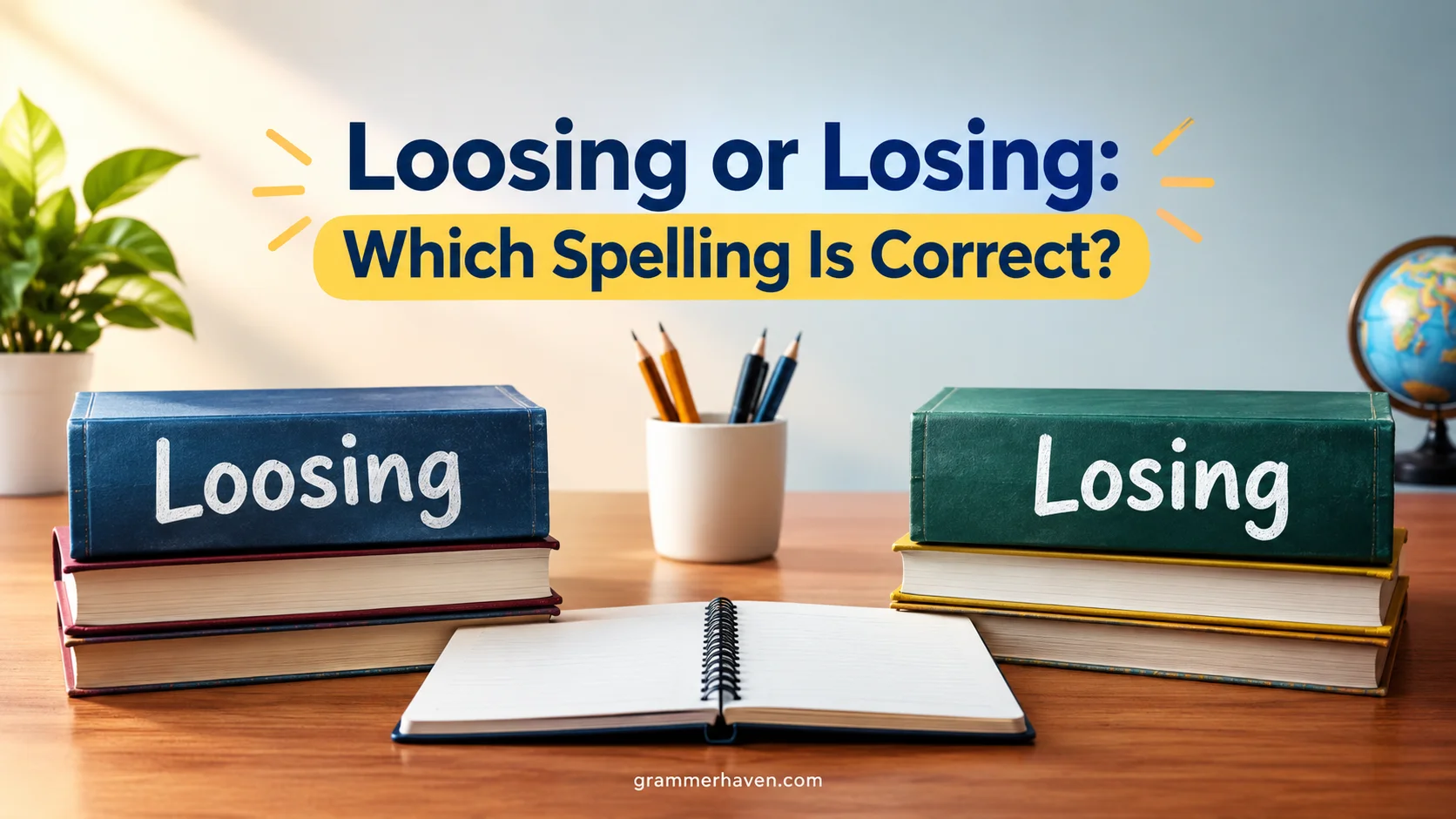
Loosing or Losing confuses many people because both forms look similar and appear in informal writing, yet losing is the grammatically correct form for loss, defeat, or misplacement. The two forms aren’t interchangeable in standard English, and knowing their difference can improve spelling accuracy, writing clarity, overall English, and communication skills. Losing is the correct form for something related to loss, defeat, or misplacement.
Loosing is a different verb that means release or set free. A comparison can clarify which form is appropriate. This confusion often occurs because loosing and losing are homophones, or words that sound alike while having different meanings. Their pronunciation can cause a common mix-up, while their meaning and use differ. The English language contains many similar-sounding words, making this distinction crucial for clear communication.
The spelling offers a useful clue because loosing has one letter more than losing, and that extra letter changes its meaning. Losing refers to loss, defeat, or misplacement. Remembering this can reduce the chance that you confuse these forms. This understanding of language, spelling, and meaning supports stronger communication and clarity when you use English.
Quick Answer: Loosing or Losing?
Losing is correct when you mean experiencing a loss, failing to win, misplacing something, or no longer having something.
Loosing is also a correct word, but it has a different meaning. It is the present participle of loose, meaning to release, free, untie, detach, or let something fly.
| Word | Correct? | Comes From | Meaning | Example |
| Losing | Yes | lose | Failing to keep, win, find, or maintain something | “We’re losing the game.” |
| Loosing | Yes | loose | Releasing or freeing something | “The archer is loosing an arrow.” |
| Losing for releasing | No | — | Wrong word choice | “He is losing the dogs.” ❌ |
| Loosing for suffering defeat | No | — | Wrong word choice | “They are loosing the match.” ❌ |
So, if you’re writing “losing weight,” “losing money,” “losing a game,” or “losing my keys,” use losing.
If you’re describing an archer loosing an arrow or someone loosing an animal, loosing may be the right choice.
Merriam-Webster lists losing as the present participle of lose, while its dictionary entry for loose lists loosing as the present participle of the verb loose.
What Does “Losing” Mean?
Losing comes from the verb lose.
The verb lose has several related meanings. You can lose something you owned, lose a competition, lose control, lose an opportunity, or lose a particular feeling or ability.
Merriam-Webster gives meanings for lose that include failing to keep something, misplacing something, suffering deprivation, failing to win, wasting something, and failing to maintain something.
Cambridge Dictionary similarly defines lose in contexts such as no longer having something, being unable to find something, having less of something, stopping a feeling, and failing to win a game.
Losing Means Failing to Keep Something
When you can no longer keep something you previously had, you can use losing.
For example:
- “I’m losing my patience.”
- “She’s losing confidence.”
- “The company is losing customers.”
- “He’s losing interest in the project.”
The underlying idea is loss.
Something is disappearing from your possession, control, experience, or advantage.
Losing Can Mean Failing to Win
In sports, games, elections, competitions, and other contests, losing means failing to win.
Consider these examples:
- “Our team is losing the game.”
- “She is losing the race.”
- “They were losing by three points.”
- “The candidate is losing support.”
- “The company is losing market share.”
This is one of the most common uses of the word.
Losing Can Mean Misplacing Something
You also use losing when you can’t find something because you’ve misplaced it.
For example:
“I keep losing my keys.”
You aren’t releasing your keys. You’re failing to keep track of where you put them.
Other examples include:
- “She’s always losing her phone.”
- “I’m losing my wallet everywhere.”
- “He worries about losing important documents.”
- “Stop losing your glasses!”
Cambridge specifically includes being unable to find something among the meanings of lose.
What Does “Loosing” Mean?
Loosing comes from the verb loose.
That’s where things get interesting.
Most people encounter loose as an adjective:
- loose clothing
- a loose tooth
- a loose screw
- a loose knot
- loose soil
However, loose also functions as a verb.
As a verb, loose can mean to release, free, detach, untie, discharge, or let something fly. Merriam-Webster lists forms including loosed and loosing for this verb.
Cambridge also identifies loosing as the present participle of loose and gives uses involving releasing, firing an arrow or gunshots, freeing something, and making something less tight.
Loosing Means Releasing Something
Suppose someone releases an animal from restraint.
You could say:
“The handler is loosing the dogs.”
Here, loosing means releasing the dogs.
You could also write:
- “The soldiers were loosing the hounds.”
- “The keeper was loosing the animals.”
- “The captor was loosing the prisoners.”
However, modern writers often choose releasing, freeing, or letting loose because those alternatives sound more natural in everyday English.
Loosing Can Mean Firing an Arrow
One of the clearest traditional uses of loosing involves archery.
An archer can loose an arrow, meaning release it from the bow.
For example:
“The archer drew the bow and began loosing arrows.”
This usage is legitimate. Cambridge specifically defines loose as a verb meaning to fire an arrow from a bow or shots from a gun.
Merriam-Webster also lists let fly and discharge among the meanings of the verb loose.
Loosing Can Mean Making Something Less Tight
There is another, less obvious use.
Loosing can mean making something less tight.
For example:
“She was loosing the knot.”
That said, loosening usually sounds more natural in contemporary American English when you mean making something less tight.
Compare:
- “He is loosing the knot.” — grammatically possible, but uncommon.
- “He is loosening the knot.” — natural and familiar.
- “He is untieing the knot.” — technically the intended action, although untying is the correct spelling.
Cambridge lists loosen as a synonym in this sense of loose.
Losing vs. Loosing: What’s the Difference?
The easiest way to understand losing vs. loosing is to look at their base verbs.
Lose → losing
Loose → loosing
That’s the entire foundation of the distinction.
| Base Word | Present Participle | Main Idea |
| lose | losing | Experiencing a loss |
| loose | loosing | Releasing or freeing |
Think of the difference this way:
Lose deals with something going away from you.
Loose deals with something being set free.
That simple contrast covers most situations.
Lose → Losing
Use losing for situations such as:
- losing a game
- losing money
- losing weight
- losing your keys
- losing your job
- losing interest
- losing patience
- losing control
- losing confidence
- losing an opportunity
- losing time
- losing touch
Cambridge’s examples include losing keys, losing jobs, losing weight, losing interest, and losing patience.
Loose → Loosing
Use loosing when loose acts as a verb and means:
- releasing something
- freeing something
- letting something loose
- firing an arrow
- discharging something
- detaching something
- making something less tight
These uses are much less common.
That’s why loosing often looks like a typo even when it isn’t one.
Why Do People Confuse Losing and Loosing?
The spelling creates a trap.
Lose contains one o.
Loose contains two o’s.
Because the words look closely related, writers sometimes assume that losing should contain two o’s as well.
That produces the common error:
“I’m loosing weight.”
The problem isn’t the suffix. The problem is the base word.
The sentence comes from lose, not loose:
lose → losing
It does not come from:
loose → loosing
The meaning settles the question immediately. Losing weight means having less body weight. It doesn’t mean releasing weight.
Why Is “Losing” Spelled With One O?
The spelling becomes easier when you start with the correct base verb.
The base word is:
lose
When you form its present participle, the final e drops before -ing:
lose + ing → losing
You can see the same general spelling pattern in other verbs:
- make → making
- write → writing
- hope → hoping
- use → using
- move → moving
So:
lose → losing
The spelling doesn’t change the underlying pronunciation of the first vowel. The important point is that losing comes from lose.
Merriam-Webster lists the forms of lose as lost, losing, and loses.
Why Is “Loosing” Spelled With Two O’s?
The answer is simpler: loosing comes from loose.
The base verb already contains two o’s:
loose
Add -ing:
loose + ing → loosing
The spelling therefore retains the oo from loose.
Merriam-Webster explicitly lists loosed; loosing under the verb loose.
This gives you a useful spelling comparison:
| Verb | -ing Form |
| lose | losing |
| loose | loosing |
| loosen | loosening |
The third word deserves special attention because loosing and loosening aren’t interchangeable in every context.
Losing vs. Loosing Pronunciation
Pronunciation provides another useful clue.
Losing is pronounced approximately:
LOO-zing
The middle consonant has a /z/ sound.
Loosing is generally pronounced approximately:
LOO-sing
The middle consonant reflects the /s/ sound in loose.
Merriam-Webster gives lose as /ˈlüz/ and loose as /ˈlüs/, which helps explain this distinction.
So when spoken clearly:
- losing → LOO-zing
- loosing → LOO-sing
The difference is subtle but useful.
However, meaning remains the stronger test. Don’t rely on pronunciation alone.
Common Examples of Losing or Loosing
The fastest way to master these words is to see them in real sentences.
“I’m Losing Weight”
Correct: “I’m losing weight.”
Why?
Because the person is becoming lighter. The verb is lose.
Cambridge lists lose weight as a standard use of lose.
Incorrect: “I’m loosing weight.”
The second version suggests that someone is somehow releasing weight, which isn’t the intended meaning.
“We’re Losing the Game”
Correct: “We’re losing the game.”
The team isn’t winning.
Incorrect: “We’re loosing the game.”
Unless the sentence means something extraordinarily different, loosing doesn’t belong here.
“I’m Losing My Keys”
Correct: “I’m losing my keys.”
The speaker means the keys keep becoming misplaced or difficult to find.
Incorrect: “I’m loosing my keys.”
The sentence doesn’t mean that the speaker is releasing the keys.
“The Archer Is Loosing an Arrow”
Correct: “The archer is loosing an arrow.”
Here, the archer is releasing the arrow from the bow.
This is one of the clearest examples where loosing is genuinely correct.
“She’s Losing Her Patience”
Correct: “She’s losing her patience.”
The person is gradually becoming less patient.
This follows the same pattern as:
- losing confidence
- losing hope
- losing interest
- losing control
- losing focus
Common Mistakes With Losing
“Loosing Weight” vs. “Losing Weight”
The correct expression is:
losing weight
Not:
loosing weight
The phrase refers to a reduction in body weight. It has nothing to do with releasing or freeing something.
“Loosing the Game” vs. “Losing the Game”
The correct expression is:
losing the game
A team loses when its opponent wins.
Therefore:
lose → losing
Not:
loose → loosing
“Loosing My Phone” vs. “Losing My Phone”
If you can’t find your phone, you’re:
losing your phone
The word describes misplacing something.
Cambridge specifically uses lose for situations where someone can no longer find something.
“Losing the Dogs” vs. “Loosing the Dogs”
This example changes the answer.
If someone accidentally can’t find the dogs:
“He is losing the dogs.”
If someone deliberately releases the dogs:
“He is loosing the dogs.”
The second sentence is grammatical, although releasing the dogs or letting the dogs loose would usually sound more natural today.
That’s an important lesson: context determines the correct word.
Losing, Loosing, Loose, and Loosen Compared
These four words often get mixed together.
| Word | Word Type | Meaning | Example |
| lose | Verb | Fail to keep, find, or win | “Don’t lose your keys.” |
| loose | Adjective | Not tight or securely attached | “The screw is loose.” |
| loose | Verb | Release or free | “Loose the dogs.” |
| losing | Verb form | Experiencing loss | “She’s losing money.” |
| loosing | Verb form | Releasing or freeing | “He’s loosing an arrow.” |
| loosen | Verb | Make less tight | “Loosen the knot.” |
| loosening | Verb form | Making something less tight | “The knot is loosening.” |
Merriam-Webster identifies loose as both an adjective and a verb. As a verb, it can mean releasing, freeing, untieing, detaching, or letting something fly.
Losing vs. Loosing in Different Contexts
The surrounding words often make the correct choice obvious.
Sports and Competitions
Use losing:
- losing a game
- losing a match
- losing a race
- losing a tournament
- losing the lead
- losing the championship
Example: “The team is losing the match.”
The meaning involves defeat or failure to win.
Money and Business
Use losing:
- losing money
- losing customers
- losing revenue
- losing sales
- losing market share
- losing business
For example:
“The company is losing customers.”
Cambridge’s Business English Dictionary includes uses such as losing market share and losing business.
Possessions
Use losing:
- losing your wallet
- losing your phone
- losing your keys
- losing your passport
- losing your documents
These all involve no longer having something or being unable to find it.
Emotions and States
Use losing:
- losing patience
- losing hope
- losing confidence
- losing interest
- losing control
- losing focus
- losing your temper
These expressions describe a decline or disappearance of a particular feeling, state, or ability.
Release and Restraint
Loosing can work when something gets released:
- loosing an arrow
- loosing the hounds
- loosing an animal
- loosing someone from restraint
Cambridge documents these release-related meanings, including firing arrows, setting animals free, and making something less tight.
Is “Loosing” a Real Word?
Yes. Absolutely.
Calling every use of loosing a spelling mistake would be inaccurate.
Dictionaries recognize it as the present participle of loose. Merriam-Webster gives loose as a verb with the forms loosed and loosing, while Cambridge explicitly defines loosing as the present participle of loose.
The real issue isn’t whether loosing exists.
It does.
The issue is whether loosing expresses the meaning you intend.
That’s why these two sentences can both be grammatically correct:
“The team is losing the game.”
“The archer is loosing an arrow.”
The first sentence describes defeat.
The second describes release.
Why Is “Loosing” So Uncommon?
Although loosing is a legitimate word, modern English doesn’t use it very often.
In everyday writing, speakers usually choose more familiar verbs such as:
- releasing
- freeing
- letting go
- untying
- firing
- discharging
For example, instead of:
“The soldier was loosing the prisoners.”
A modern writer might choose:
“The soldier was freeing the prisoners.”
Instead of:
“The archer was loosing arrows.”
You might see:
“The archer was firing arrows.”
The original word remains correct in the right context. It simply has a narrower and more specialized role.
Is “Loosing” Ever Correct in Modern English?
Yes.
It can still appear in modern English when loose functions as a verb.
For example:
- “The archer is loosing another arrow.”
- “The handlers are loosing the hounds.”
- “The speaker is loosing a torrent of criticism.”
- “The rope is being loosed from the post.”
Cambridge documents modern examples involving firing, releasing, expressing emotions, and making something less tight.
However, correct doesn’t always mean common.
That’s an important distinction in English.
A word can be grammatically sound while still sounding unusual in casual conversation.
A Simple Trick to Remember Losing vs. Loosing
Here’s an easy memory trick:
Lose = loss.
If something involves a loss, use losing.
Think:
Lose → Loss → Losing
Examples:
- losing money
- losing a game
- losing time
- losing your keys
- losing confidence
- losing an opportunity
Now remember:
Loose = release.
If something gets freed or released, loosing may be appropriate.
Think:
Loose → Release → Loosing
Examples:
- loosing an arrow
- loosing the hounds
- loosing something from restraint
This isn’t a complete grammar rule, but it provides a useful shortcut when you’re writing quickly.
A Practical Test for Choosing the Right Word
When you’re unsure about loosing or losing, don’t stare at the spelling.
Look at the meaning.
Ask yourself:
Am I talking about something being lost?
If yes, use losing.
Am I talking about something being released or set free?
If yes, loosing may be correct.
Consider these examples:
| Sentence | Correct Word | Why? |
| “I’m ___ weight.” | losing | Your weight is decreasing. |
| “They’re ___ the game.” | losing | They’re failing to win. |
| “She’s ___ her keys.” | losing | She can’t keep track of them. |
| “He’s ___ patience.” | losing | His patience is disappearing. |
| “The archer is ___ an arrow.” | loosing | The arrow is being released. |
| “The keeper is ___ the hounds.” | loosing | The hounds are being set free. |
| “She is ___ the knot.” | loosing | The knot is being made less tight. |
The meaning acts like a compass. Once you know what the sentence means, the spelling usually follows.
Case Study: Why One Letter Changes the Meaning
Consider this pair:
“The team is losing.”
This means the team is suffering defeat.
Now change one letter:
“The team is loosing.”
The second sentence doesn’t naturally communicate the same idea. It would require loose to function as a verb with a completely different meaning.
Now try a different pair:
“The archer is losing the arrow.”
This suggests the archer is somehow misplacing or no longer retaining the arrow.
“The archer is loosing the arrow.”
Now the meaning is clear: the archer is releasing the arrow.
The spelling difference isn’t cosmetic. It changes the underlying verb and therefore changes the meaning.
Losing vs. Loosing in Formal Writing
For most professional and academic writing, losing will appear much more frequently.
You might write:
- “The company is losing market share.”
- “The patient is losing consciousness.”
- “The team is losing its competitive advantage.”
- “The study examines why participants are losing interest.”
Loosing is more specialized.
You may encounter it in:
- historical writing
- literary prose
- poetry
- archery discussions
- military descriptions
- biblical or religious language
- writing about animals being released
- descriptions of something being discharged or set free
When clarity matters more than stylistic flavor, a familiar alternative often works better.
For example:
Less familiar: “The archer was loosing arrows.”
Clearer: “The archer was releasing arrows.”
Both can communicate the intended action, but the second requires less interpretation from a modern reader.
Key Facts About Losing and Loosing
- Losing comes from lose.
- Loosing comes from loose.
- Losing usually describes a loss, defeat, misplacement, or reduction.
- Loosing usually describes releasing, freeing, untieing, detaching, or firing.
- “Losing weight” is correct.
- “Losing the game” is correct.
- “Losing my keys” is correct.
- “Loosing an arrow” is correct when the intended meaning is firing or releasing it.
- Loosing is a real word, not merely a misspelling.
- Loosing is much less common than losing.
- Loosing and loosening can have different meanings.
- The safest way to choose between the words is to identify the base verb and intended meaning.
See also: Is It Gray or Grey? Which Spelling Is Correct?
FAQs:
Is “loosing” a misspelling of “losing”?
Not always. Loosing is a legitimate word derived from loose. However, it’s incorrect when you mean suffering a loss, misplacing something, or failing to win.
Is “loosing weight” correct?
No. The standard expression is “losing weight.”
You lose weight because you have less body weight than before. Cambridge lists lose weight as a normal use of lose.
Is “loosing the game” correct?
No, if you mean failing to win.
Write:
“The team is losing the game.”
Is “loosing an arrow” correct?
Yes.
Loosing an arrow means releasing or firing it from a bow. Both Cambridge and Merriam-Webster recognize this verb use of loose.
Is “loosing” the same as “loosening”?
No.
Loosing means releasing or freeing something.
Loosening usually means making something less tight.
For example:
- “The guard is loosing the prisoner.” = releasing the prisoner.
- “The mechanic is loosening the bolt.” = making the bolt less tight.
Which is more common: losing or loosing?
Losing is much more common in ordinary English.
People frequently lose games, money, possessions, opportunities, patience, time, and confidence. Loosing has a much narrower set of uses.
Why do people write “loosing” instead of “losing”?
The similar spelling of lose and loose causes much of the confusion.
Because loose has two o’s, writers sometimes incorrectly transfer that spelling to losing. The meaning, however, comes from the base verb lose.
Conclusion:
Losing is the correct choice when you mean loss, defeat, or misplacement, while loosing means releasing or setting free. Although the two words look and sound similar, their meanings differ. Understanding this distinction will improve your spelling accuracy, writing clarity, and communication skills.