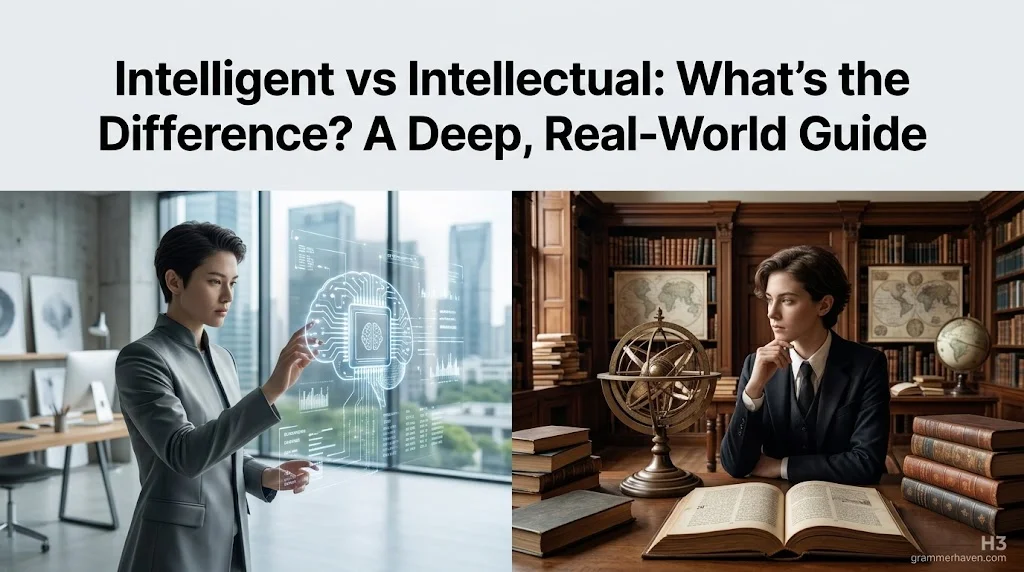
Intelligent vs Intellectual: What’s the Difference? explains the key difference between intelligence and intellect, helping people gain a clearer understanding.
Many people use these words interchangeably, but the differences become clear when you compare an intelligent and an intellectual person. One usually solves problems, handles different situations, and uses practical approaches, while the other enjoys thinking, exploring ideas, gaining deeper knowledge, reading books, and joining thoughtful conversations. From what I have seen, someone may quickly deal with challenges, while another prefers to discuss, write, read, and keep knowing more about the world. That contrast sets them apart, although both have valuable abilities and interests.
In today’s day and age, especially in the dating world, most people have a checklist with criteria and qualities for a potential partner. A high place on the list often goes to stable finances, strong family values, a sense of humor, good physical attributes, and positive traits. Talking on the phone, exchanging texts, or noticing how someone write can tell you a lot, but it is still complicated to decipher whether they are intelligent versus intellectual. It is easy to guess, yet real conversations help build trust and show whether first impressions truly fit the bigger picture.
Whether you choose a partner or evaluate yourself, it is important not to stick to the same expectations for everyone. Some characteristics deserve a higher priority, while others depend on personal goals and values. Distance learning, everyday learning, continuous reading, and curiosity can break old habits and strengthen intelligence as well as the intellectual side. The key differences become more interesting when you compare both, and by the end, you may stop wondering which quality matters more because each offers something valuable.
Intelligent vs Intellectual: Clear Definitions That Actually Make Sense
What Does “Intelligent” Really Mean?
Being intelligent refers to your ability to:
- Learn quickly
- Solve problems effectively
- Adapt to new situations
- Apply logic in real time
- Process information efficiently
Think of intelligence as mental horsepower in action.
A person with high intelligence often:
- Spots patterns quickly
- Makes fast decisions
- Learns new systems with less repetition
- Solves practical problems under pressure
A simple way to put it:
Intelligence is how effectively you navigate problems in real time.
Psychology often links intelligence to cognitive abilities measured in areas like reasoning, memory, and problem-solving. For example, IQ tests (where the average score is set at 100 with a standard deviation of 15) attempt to estimate this ability, though they don’t capture the full picture of human capability.
Still, intelligence is mostly about performance in action, not just thinking deeply.
What Does “Intellectual” Really Mean?
Being intellectual is different. It refers to your tendency to:
- Explore ideas deeply
- Question beliefs and systems
- Engage in abstract thinking
- Study theories and concepts
- Enjoy philosophical or analytical discussion
An intellectual mind doesn’t just solve problems—it asks:
- Why does this problem exist?
- What does it mean in a larger system?
- How does this connect to other ideas?
A simple way to put it:
Intellectual behavior is about exploring meaning, not just solving problems.
An intellectual person often enjoys:
- Reading complex material
- Debating ideas
- Analyzing history, politics, philosophy, or science theory
- Thinking in layers instead of quick answers
So while intelligence is about execution, intellectualism is about exploration.
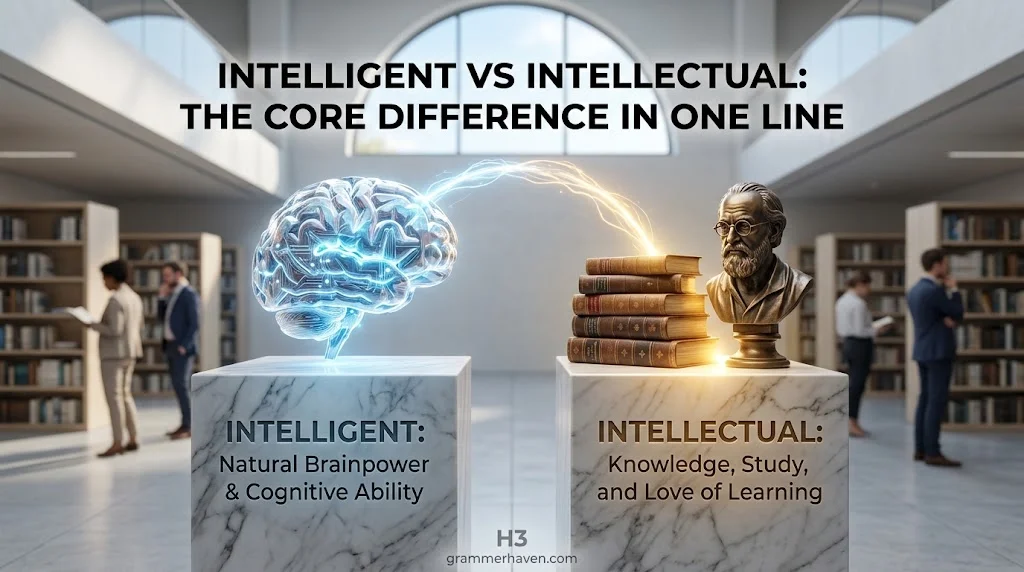
Intelligent vs Intellectual: The Core Difference in One Line
Here’s the simplest distinction you’ll ever need:
Intelligent = solving problems efficiently.
Intellectual = exploring ideas deeply.
That’s it. Everything else expands from this foundation.
Intelligent vs Intellectual: Side-by-Side Comparison
To make things even clearer, here’s a structured breakdown:
| Aspect | Intelligent | Intellectual |
| Core focus | Problem-solving | Idea exploration |
| Thinking style | Fast, practical | Slow, reflective |
| Strength | Execution | Analysis |
| Motivation | Results | Understanding |
| Output | Solutions | Insights |
| Learning style | Hands-on | Theory-heavy |
| Strength under pressure | High | Variable |
| Communication style | Direct and solution-focused | Analytical and exploratory |
This table reveals something important: neither is “better.” They simply operate in different directions.
Real-Life Examples of Intelligent vs Intellectual Thinking
Workplace Scenario
Imagine a company system breaks down.
- The intelligent employee quickly identifies the bug, fixes the issue, and restores operations.
- The intellectual employee steps back and asks why the system failed in the first place and how to redesign it so it never happens again.
Both are valuable. One saves time now. The other prevents future breakdowns.
Daily Life Example
Let’s say you move to a new city.
- An intelligent person navigates quickly using maps, shortcuts, and observation.
- An intellectual person studies the city’s layout, transportation systems, and urban planning logic.
One focuses on getting there fast.
The other focuses on understanding how it all works.
Social Situation Example
During a debate:
- The intelligent person responds with sharp, effective arguments.
- The intellectual person explores underlying assumptions and broader implications.
One wins the point.
The other expands the conversation.
Can Someone Be Both Intelligent and Intellectual?
Yes—but not automatically.
These traits develop through different habits.
A person can be:
- Highly intelligent but not intellectually curious
- Highly intellectual but not quick in execution
- Balanced in both areas (rare but powerful)
People who develop both tend to become:
- Strong strategists
- Thoughtful leaders
- Innovative problem-solvers
- Deep analysts who can also act quickly
We often call this combination a “thinker-doer” profile.
They don’t just understand ideas. They also apply them.
Common Misconceptions About Intelligent vs Intellectual
Let’s clear up confusion that shows up everywhere.
Misconception: Intellectual means smarter
Not true. Intellectual behavior reflects interest in ideas, not raw cognitive power.
A person can be highly intelligent without enjoying abstract debates or theory-heavy subjects.
Misconception: Intelligent people don’t think deeply
Also false. Many intelligent individuals think deeply—but they prioritize solutions over discussion.
They ask:
- “What works?”
Not:
- “What does it mean?”
Misconception: Degrees make someone intellectual
A degree shows education, not intellectual depth.
Some graduates stop questioning once exams end. Others continue exploring ideas for life.
Misconception: IQ defines intelligence fully
IQ measures certain cognitive skills, not creativity, emotional understanding, or intellectual curiosity.
Human thinking is far more complex than a single number.
Psychological Perspective: How These Traits Actually Work
Psychologists separate cognitive ability and intellectual engagement.
Intelligence
Linked to:
- Logical reasoning
- Working memory
- Pattern recognition
- Processing speed
Intellectual behavior
Linked to:
- Curiosity
- Openness to experience
- Desire for conceptual understanding
- Enjoyment of abstract thinking
A key insight:
You can have the ability to think deeply without choosing to do so regularly.
That’s where intelligence and intellectualism diverge.
One is capacity.
The other is direction of interest.
Education vs Real-World Performance
Here’s where things get interesting.
Education systems often reward intellectual behavior
- Essays
- Theory analysis
- Reading comprehension
- Concept explanation
Students who enjoy ideas tend to perform well here.
Real-world environments often reward intelligence
- Fast decisions
- Problem-solving under pressure
- Adaptability
- Execution
Workplaces care more about results than theory.
The mismatch creates confusion
A student who excels academically may be called “intellectual,” but struggle in fast-paced environments.
Meanwhile, a practical problem-solver may outperform others but get underestimated in academic settings.
Where Intelligent and Intellectual Traits Overlap

Some roles require both:
- Scientists → need deep theory + practical experiments
- Engineers → need conceptual design + real-world implementation
- Writers → need idea exploration + clear execution
- Entrepreneurs → need strategy + fast decision-making
In these cases, the two traits blend into one powerful skill set.
Case Studies: Real-World Differences in Action
Case Study 1: The Software Bug Fix
A tech company faces a system crash.
- Engineer A (intelligent): Locates bug, patches code, restores system in 30 minutes.
- Engineer B (intellectual): Investigates architecture flaws and proposes a system redesign.
Result:
- A solves immediate problem
- B prevents long-term failure
Both matter, but at different stages.
Case Study 2: The University Debate Club
Two students prepare for a debate competition.
- Student A builds sharp, fast rebuttals.
- Student B studies philosophical frameworks behind the topic.
Outcome:
- Student A performs better in live exchanges
- Student B dominates conceptual framing
One wins arguments.
The other reshapes the discussion.
Case Study 3: Startup Decision-Making
A startup founder must choose a direction quickly.
- Founder A (intelligent): Analyzes data and picks the fastest profitable route.
- Founder B (intellectual): Explores market theory, industry history, and long-term societal impact.
Outcome:
- A grows faster early
- B builds deeper long-term strategy
Both approaches can succeed depending on timing and context.
See also: Do You Ask or Pose a Question? Understanding the Difference in English
FAQs:
1. What is the main difference between intelligent and intellectual?
An intelligent person is good at understanding, reasoning, and solving problems, while an intellectual person enjoys learning, reading, discussing ideas, and gaining knowledge.
2. Can someone be both intelligent and intellectual?
Yes. Many people are both intelligent and intellectual. They combine strong problem-solving skills with a genuine interest in learning and exploring new ideas.
3. Is being intellectual the same as being intelligent?
No. Although the terms are often used interchangeably, they describe different qualities. Intelligence focuses on ability, while intellectualism focuses on curiosity and knowledge.
4. Which is more important: intelligence or intellect?
Neither is universally more important. The better quality depends on the situation, your goals, and what skills or traits are most valuable at the time.
5. How can you tell if someone is intellectual?
You may notice that they enjoy reading, discussing complex topics, asking thoughtful questions, exploring different viewpoints, and continuously learning about the world.
Conclusion:
Understanding Intelligent vs Intellectual: What’s the Difference? helps you use both terms correctly. An intelligent person is usually skilled at solving problems and adapting to new situations, while an intellectual person enjoys learning, exploring ideas, and building knowledge. Neither quality is better than the other because they often work together. Knowing the difference lets you describe people more accurately and appreciate the unique strengths that both intelligence and intellect bring to everyday life.
Latest Post:
- Result In or Result To: Which Is Correct? (With Examples)
- A Dime a Dozen: Meaning, Definition, Origin and Real-Life Usage
- Hooplehead Definition, Meaning, Usage and Examples
- Whole vs Hole: What’s the Difference?
- Acumen vs Acuity vs Acuteness: What’s the Difference?