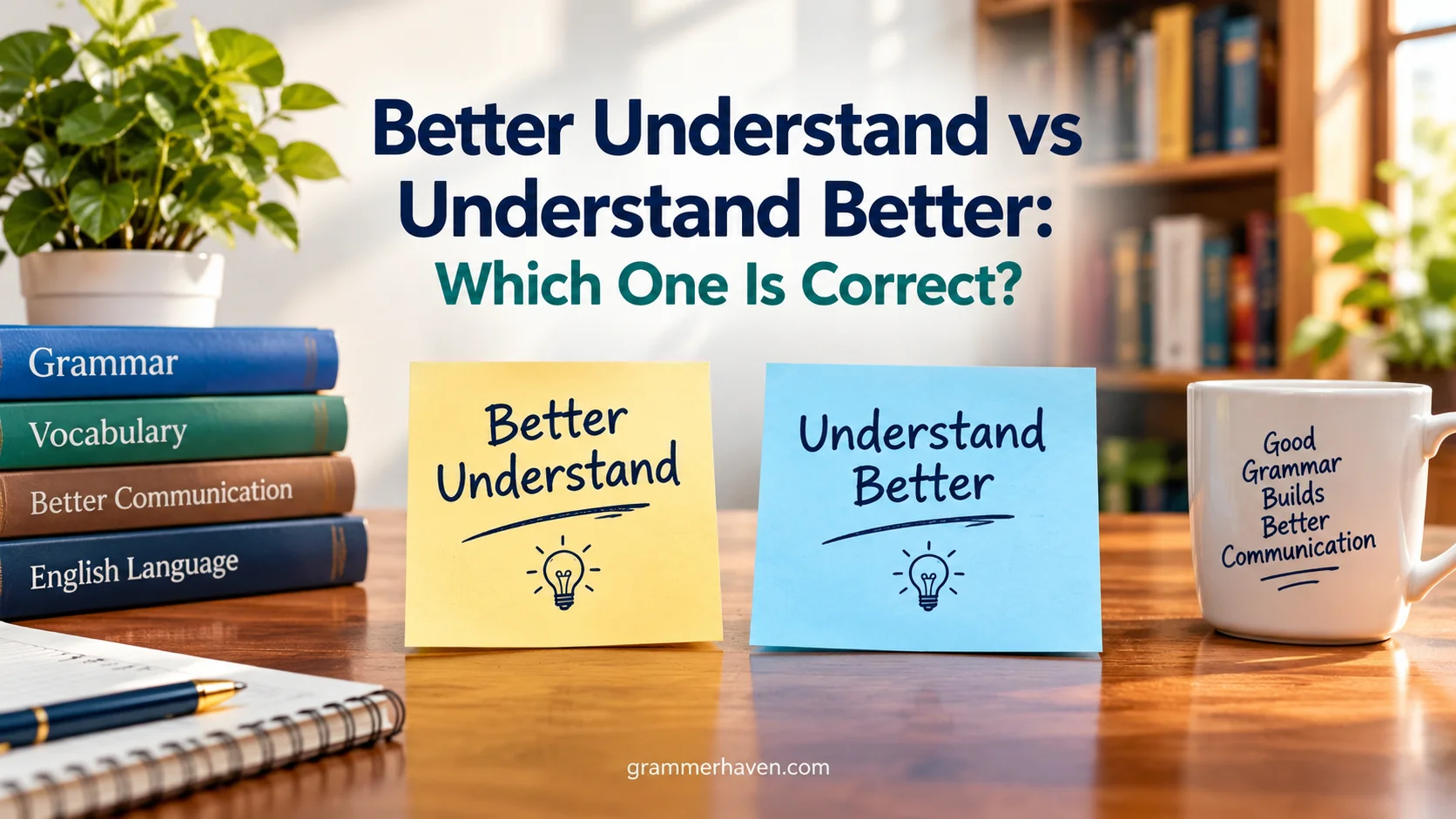
Better Understand vs Understand Better: Which One Is Correct? explains English language nuances where word order shifts can change meaning clearly. These two phrases are commonly confused because they look similar, but they differ in tone, context, and purpose. Native speakers use them naturally in writing and speech depending on whether they want a concise, direct expression or one that adds emphasis to improvement.
The main distinction between them comes from placement in a clause. Better Understand is often used at the beginning of a sentence, such as “To better understand this concept, let’s look closely.” It focuses on gaining more understanding. Understand Better is usually used at the end of a sentence, like “I need more information to understand something better.” The choice depends on structure, and both forms can work when used correctly.
When choosing these forms, consider communication and clarity. The addition of to may be needed in some sentences, and the right form makes your message easier to follow. A useful guide is to pick the phrase that sounds natural for your sentence. The key difference is how each phrase emphasizes what you want to express. This approach can help you see why these expressions work differently while still aiming to improve understanding.
Why “Better Understand vs Understand Better” Confuses So Many People
English gives you flexibility with word order, especially with adverbs like “better.” That freedom creates confusion.
You don’t just learn one fixed structure. You see multiple versions in real life:
- I want to better understand this topic.
- I want to understand better next time.
- I need to understand it better before I decide.
All of them sound fine. That’s the problem.
So your brain asks:
“If both are correct, why do they feel different?”
The answer lies in sentence rhythm and emphasis, not grammar rules.
English doesn’t punish you here. It just shifts tone depending on placement.
The Simple Answer: Which One Is Correct?
Both are correct.
But usage patterns look like this:
- Understand better → more common in everyday English
- Better understand → slightly more formal or written tone
There is no grammar rule that says one is wrong.
Think of it like two roads leading to the same place. One feels smoother in conversation. The other feels slightly more structured.
Grammar Breakdown Without the Confusion
Let’s strip this down to its core parts.
- Understand = main verb
- Better = adverb (modifies the verb)
Now English allows adverbs to move around in many cases.
So you get two valid structures:
Before the verb
- I want to better understand the situation.
After the verb
- I want to understand the situation better.
Both follow correct grammar logic. The placement just changes emphasis slightly.
A simple way to think about it:
Word order in English often controls focus, not correctness.
Does Word Order Change Meaning?
Not really. The meaning stays the same.
But tone shifts slightly.
“Better understand”
- Feels more intentional
- Sounds slightly formal
- Often used in writing or structured communication
“Understand better”
- Feels more natural in speech
- Sounds conversational
- Often used in daily communication
Example comparison
- I want to better understand your concerns.
- I want to understand your concerns better.
Same meaning. Different rhythm.
If you read both out loud, you’ll feel the difference instantly.
What Native Speakers Actually Use
Here’s something interesting.
Native speakers don’t consciously choose rules here. They follow flow.
In everyday speech:
- People naturally say “understand better” more often
- It fits the natural subject → verb → object rhythm
In writing:
- You’ll often see “better understand”
- It gives a slightly polished tone
Real-world observation
If you scan blogs, emails, or articles, you’ll notice:
- Conversational writing → “understand better” dominates
- Academic writing → “better understand” appears more often
This isn’t a rule. It’s just habit and style.
Formal vs Informal Usage (Clear Comparison Table)
| Context Type | Better Understand | Understand Better | Which Sounds Better |
| Academic writing | Common | Less common | Better understand |
| Business reports | Common | Common | Both work |
| Emails | Less common | Common | Understand better |
| Daily conversation | Rare | Very common | Understand better |
| Instructions | Common | Common | Both work |
The key takeaway is simple:
You won’t sound wrong in either case. You just adjust tone.
Real-Life Examples That Show the Difference Clearly
Let’s look at how both forms work in real situations.
Workplace communication
- I want to better understand the project requirements before we proceed.
- I want to understand the project requirements better before we proceed.
Both work. The second feels more natural in spoken updates.
Academic writing
- Researchers aim to better understand human decision-making under stress.
This version fits research tone better. It sounds structured and formal.
Everyday speech
- I need to understand you better.
- I need to better understand you.
The first one sounds more natural in conversation. The second sounds slightly stiff but still correct.
Instructional context
- To better understand this process, follow each step carefully.
- Follow each step carefully to understand the process better.
Both are fine. The first sounds like a guidebook. The second sounds more like spoken advice.
Common Mistakes People Make With “Better Understand”
Even though both forms are correct, mistakes still happen.
Mistake: thinking one is wrong
Many learners assume:
- “Better understand is incorrect grammar.”
That’s not true. It’s fully acceptable.
Mistake: using awkward sentence structure
- ❌ I better understand this now
This changes meaning completely and sounds unnatural.
You need:
- ✔ I understand this better now
- ✔ I better understand the situation now (formal tone, still okay in writing)
Mistake: overusing one form
Writers sometimes stick to only one version. That makes writing repetitive.
Better approach:
- Mix both depending on tone
- Let sentence rhythm guide you
How Word Order Changes Emphasis in English
This is where things get interesting.
English often uses word order to shift focus subtly.
Compare:
- I quickly understood the lesson
- I understood the lesson quickly
Same meaning. Different emphasis.
Now apply the same idea:
- I want to better understand the issue
- I want to understand the issue better
In the first sentence, attention starts with improvement.
In the second, attention starts with the action.
That’s why both exist.
It’s not about correctness. It’s about focus.
Simple Rule You Can Always Use
If you feel stuck, use this rule:
- Use “understand better” in conversation
- Use “better understand” in formal writing
But here’s the honest truth:
If you mix them, nobody will notice or care.
English speakers care more about clarity than structure perfection.
Case Study: How This Changes Real Writing
Let’s look at three writing scenarios.
Case 1: Student essay
A student writes:
The goal of this study is to better understand how sleep affects memory.
This sounds polished and academic. Teachers expect this tone.
Case 2: Workplace email
A manager writes:
I want to understand the delay better so we can fix it quickly.
This sounds natural and direct. It fits workplace communication.
Case 3: IELTS speaking answer
A candidate says:
I watch documentaries because I want to understand the world better.
This sounds fluent and natural. It flows easily in speech.
Each version works. Each version fits its context.
Quick Comparison Summary
Here’s the simplest breakdown:
- Better understand → slightly formal, written tone
- Understand better → natural, spoken tone
- Meaning → identical
- Grammar correctness → both correct
- Best choice → depends on context
See also: What Does Restive Mean? Complete Guide, Usage & Real Examples
FAQs:
1. Is “Better Understand” grammatically correct?
Yes, Better Understand is grammatically correct. It is commonly used when it comes before a noun or idea, especially in phrases like “to better understand a topic.” It shows the purpose of gaining deeper knowledge.
2. Is “Understand Better” also correct?
Yes, Understand Better is also correct. It is often used when you want to show that someone’s level of understanding has improved, such as “I understand the lesson better now.”
3. What is the main difference between “Better Understand” and “Understand Better”?
The main difference is their placement and emphasis. Better Understand usually focuses on the action of gaining understanding, while Understand Better focuses on the improved result of understanding something.
4. Can I use “Better Understand” at the end of a sentence?
Although it is possible, it may sound less natural in many situations. Native speakers usually prefer placing Better Understand near the beginning, especially in phrases like “to better understand the issue.”
5. Which phrase should I use in formal writing?
Both phrases can be used in formal writing. However, Better Understand often sounds more polished when introducing an explanation, while Understand Better works well when describing progress or improved knowledge.
Conclusion:
Understanding the difference between Better Understand and Understand Better helps you use English more naturally and clearly. Both phrases express the idea of gaining improved knowledge, but their placement, tone, and sentence structure create slight differences. Better Understand often works well when introducing a goal or explaining a concept, while Understand Better usually fits when describing an improved level of understanding. By paying attention to context and sentence flow, you can choose the phrase that sounds more natural and communicates your meaning effectively.
Latest Post:
- Result In or Result To: Which Is Correct? (With Examples)
- A Dime a Dozen: Meaning, Definition, Origin and Real-Life Usage
- Hooplehead Definition, Meaning, Usage and Examples
- Whole vs Hole: What’s the Difference?
- Acumen vs Acuity vs Acuteness: What’s the Difference?