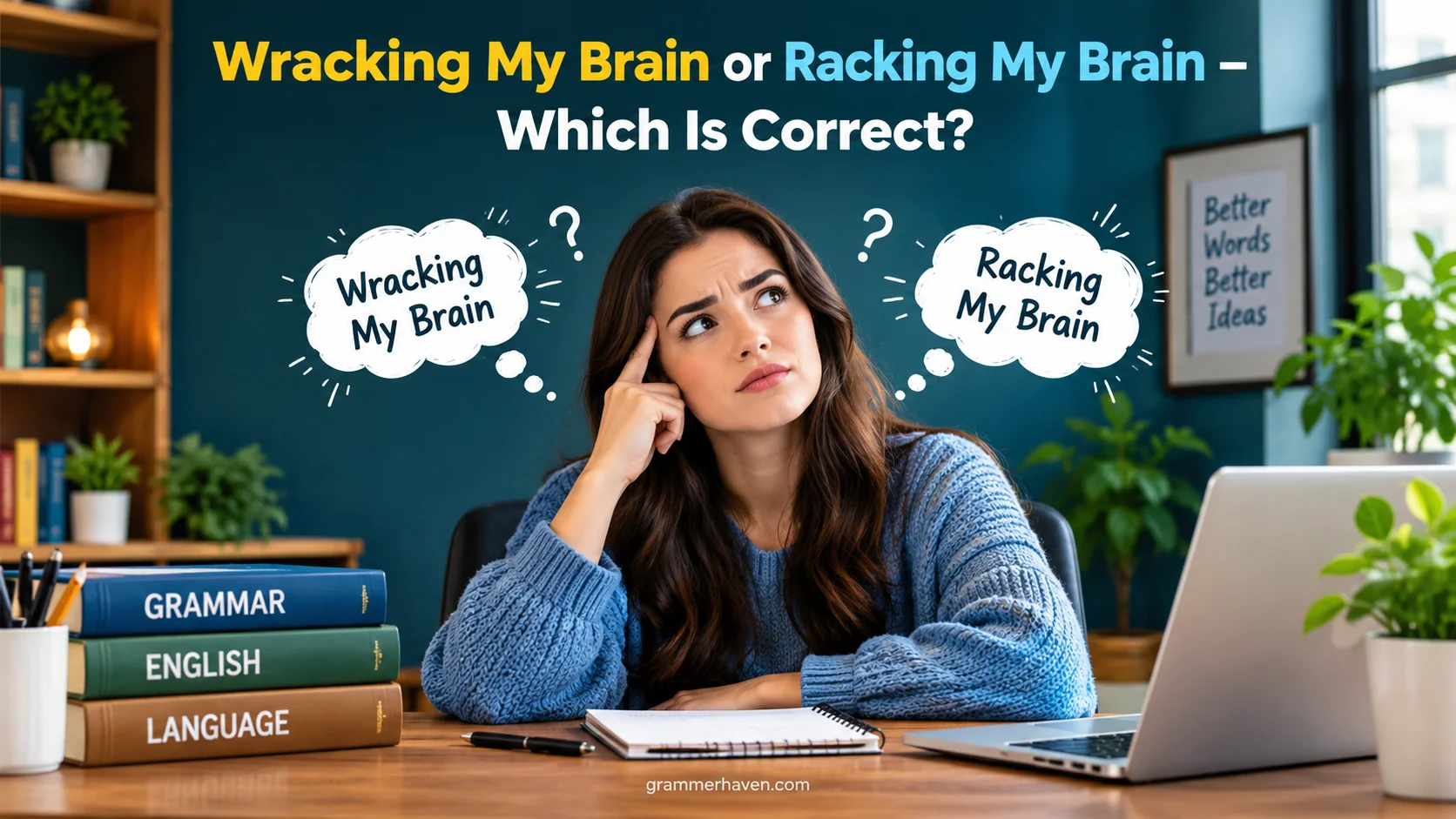
Understanding Wracking My Brain or Racking My Brain – Which Is Correct? helps English learners explore this phrase and its correct usage.
As a diligent learner of English, you may notice how the language has sneaky exceptions that make a simple word or phrase confusing. In this grammar guide, the expression Wracking My Brain and Racking My Brain often becomes a common bone of contention among English speakers and writers with a vast vocabulary. This mix-up happens because rack and wrack look similar, but their meanings have a clear difference. The phrase racking my brain means thinking very hard to remember something, solve a problem, or find an answer when your mind is working overtime to discover a solution.
The correct version in modern English, formal writing, and everyday writing is Racking My Brain. This idiom describes intense mental effort, while wrack connects more with destruction, ruin, and damage. Although Wracking My Brain became a popular variation as language evolves and expressions change through repeated use, the linguistically correct usage remains racking my brain. This grammar comparison explains why people frequently question the spelling choice, spelling error, and valid variation. To crack open this nut, you need to understand the origin, word origin, and history behind these terms. Once you have discovered the meaning, the answer becomes clear. These commonly confused words may stick or fade into obscurity, but examples of correct writing show that Racking My Brain works best. A careful comparison of these forms and usage reveals the final solution.
What Does “Racking My Brain” Mean in Real English Usage?
Before we compare spellings, we need to understand the phrase itself.
When someone says “I’m racking my brain,” they mean:
They are thinking extremely hard to remember something or solve a problem.
It usually carries a tone of frustration or mental strain. You’re not just thinking—you’re actively digging through your memory like it’s a messy attic.
Simple meaning breakdown
- You’re searching your memory
- You’re trying hard to recall information
- You may feel stuck or mentally pressured
Everyday examples
- “I’ve been racking my brain all morning for her name.”
- “He racked his brain trying to solve the puzzle.”
- “We’re racking our brains for a good idea for the campaign.”
It’s a very natural phrase in both spoken and written English.
Quick Answer: Wracking My Brain or Racking My Brain?

Let’s make this crystal clear:
✅ Correct form
- Racking my brain
⚠️ Common but incorrect form
- Wracking my brain (seen sometimes, but not standard)
Why this matters
Most modern dictionaries and style guides favor “racking.” That means if you’re writing essays, blogs, emails, or professional content, you should stick with it.
If you use “wracking,” people will still understand you—but it may look like a spelling mistake.
Why “Racking My Brain” Is the Correct Form
This is where things get interesting.
The word “rack” in this phrase comes from an old meaning of strain or torture. Historically, a “rack” was even a medieval device used for stretching the body.
That’s intense—but it fits the metaphor perfectly.
The logic behind it
When you “rack your brain,” you’re essentially:
- Stretching your memory
- Straining your thinking
- Forcing your mind to produce information
Think of it like pulling tightly on a rope connected to your thoughts. You’re applying mental pressure to extract something hidden.
Why it stuck in English
English loves metaphors that come from physical actions. “Racking your brain” survived because it paints a vivid mental picture.
Why People Say “Wracking My Brain”
Now here’s where most confusion starts.
The word “wrack” exists in English, and it means:
- To destroy
- To ruin
- To cause severe damage
So, logically, “wracking my brain” feels correct to many people. It sounds like:
“My brain is being wrecked from thinking so hard.”
That emotional logic makes sense—but grammar doesn’t always follow intuition.
The real issue
- “Wrack” and “rack” sound identical in many accents
- People associate mental effort with damage
- Over time, the incorrect spelling spread through informal writing
Important note
Modern usage strongly prefers “racking my brain,” especially in:
- Academic writing
- Professional communication
- Editorial content
You may still see “wracking” in casual posts, but it’s not the standard form.
Racking vs Wracking: Side-by-Side Comparison
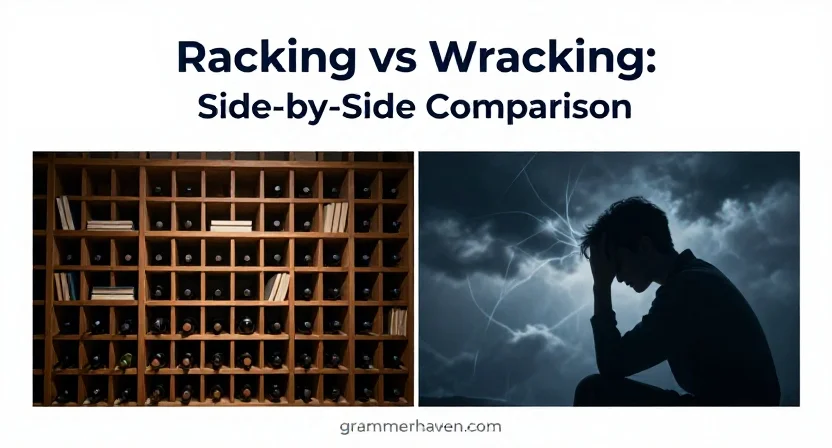
Here’s a clear breakdown so you can see the difference at a glance.
| Phrase | Correct Usage | Meaning | Tone | Acceptance |
| Racking my brain | ✅ Standard | Thinking hard to recall or solve something | Neutral, natural | Widely accepted |
| Wracking my brain | ⚠ Non-standard | Same idea, but implies destruction | Informal, mistaken | Not preferred |
Real Examples: Correct vs Incorrect Usage
Let’s make this practical. Seeing both versions helps lock the rule in your memory.
Correct usage
- I’ve been racking my brain for the answer all day.
- She racked her brain before the exam.
- We are racking our brains for a solution to this problem.
Incorrect usage
- I’ve been wracking my brain for the answer all day.
- She wracked her brain before the exam.
Even though the second set is understandable, it doesn’t follow standard English usage.
A Simple Memory Trick to Never Get It Wrong
Here’s an easy way to remember it:
“Rack = think hard, like stacking thoughts on a mental rack.”
Now imagine your brain has shelves. You’re going through each shelf carefully to find one missing idea.
That mental image sticks better than memorizing rules.
Another trick
- Rack = recall
- Both start with “R”
Simple, fast, and effective.
A Closer Look at the Word “Rack”
To understand why this phrase works, it helps to break down the word itself.
Meanings of “rack”
- To strain or stretch something
- To torture (historical usage)
- To move or search through something
In modern idioms
- Rack your brain
- Rack your nerves
- Rack and ruin (old phrase meaning destruction)
The “strain” meaning connects directly to mental effort.
Where “Wrack” Actually Belongs

Let’s not ignore “wrack” completely. It does exist in English, just not in this phrase.
Wrack means:
- Shipwreck debris (old usage)
- Destruction or ruin
Example usage
- “The storm left the coast in wrack and ruin.”
Notice how it carries a strong sense of damage. That’s why it doesn’t fit the idea of thinking carefully. Thinking hard is not destruction—it’s effort.
Case Studies: How Writers Actually Use It
Let’s look at how this phrase appears in real writing situations.
Case Study 1: Academic Writing
A student writing an essay might say:
“I racked my brain trying to interpret the theory.”
Why it works:
- Clear, formal, and correct
- Shows mental effort without sounding casual
Case Study 2: Business Communication
A marketing manager writes:
“We racked our brains to come up with a campaign that stands out.”
Why it works:
- Professional tone
- Natural phrasing in workplace communication
Case Study 3: Creative Writing
A novelist might write:
“He racked his brain, searching for a memory that refused to surface.”
Why it works:
- Adds emotional tension
- Fits storytelling rhythm
Common Mistakes People Make
Even confident writers slip up here. Watch out for these:
Mixing spelling mid-text
- Wrong: “racking/wracking my brain” used inconsistently
- Fix: Pick one (always “racking”)
Overusing the phrase
- It loses impact if repeated too often
- Try alternatives like:
- “thinking hard”
- “trying to remember”
- “puzzling over it”
Confusing similar expressions
- “Wrecking my brain” ❌ (not standard)
- “Breaking my head” ❌ (incorrect English)
Related Expressions You Can Use Instead

Sometimes variety improves your writing. Here are strong alternatives:
Casual alternatives
- I’m thinking it through
- I can’t quite remember
- I’m trying to figure it out
Formal alternatives
- I am considering the details
- I am analyzing the information
- I am reviewing the matter
Idiomatic alternatives
- It’s on the tip of my tongue
- I’m drawing a blank
- I’m at a loss
Each one carries a slightly different tone, so choose based on context.
When You Should Use “Racking My Brain”
This phrase works best in situations where:
- You want to sound natural
- You’re describing mental effort
- The tone is informal or conversational
Good examples
- Emails
- Blog posts
- Storytelling
- Conversations
Less ideal situations
- Legal documents
- Highly technical academic writing
- Formal research papers
In those cases, simpler alternatives often work better.
See also: Better Understand vs Understand Better: Which One Is Correct?
FAQs:
1. Is “Racking My Brain” the correct phrase?
Yes, Racking My Brain is the correct phrase when you mean thinking very hard, remembering something, or trying to solve a difficult problem.
2. Is “Wracking My Brain” a spelling mistake?
Wracking My Brain is not usually treated as a simple spelling mistake because many people use it due to confusion between rack and wrack. However, Racking My Brain is the preferred and standard form.
3. What does “Racking My Brain” mean?
Racking My Brain means using a lot of mental effort to remember information, find an answer, or solve a challenging problem.
4. What is the difference between rack and wrack?
Rack can mean to strain, stretch, or cause mental effort, while wrack usually refers to destruction, ruin, or damage. This difference explains why Racking My Brain is the correct idiom.
5. Can I use “Wracking My Brain” in formal writing?
It is better to avoid Wracking My Brain in formal writing. Use Racking My Brain because it is the accepted expression in modern English and is more likely to be considered correct by readers and editors.
Conclusion:
The confusion between Wracking My Brain and Racking My Brain comes from the similarity between the words rack and wrack. However, when you talk about deep thinking, searching your memory, or trying hard to solve a problem, Racking My Brain is the correct and widely accepted expression. Although Wracking My Brain appears in modern writing because of language evolution and common mix-ups, it is considered a less accurate variation. Understanding the difference between these commonly confused words helps you improve your grammar, writing accuracy, and overall command of English.
Latest Post:
- Result In or Result To: Which Is Correct? (With Examples)
- A Dime a Dozen: Meaning, Definition, Origin and Real-Life Usage
- Hooplehead Definition, Meaning, Usage and Examples
- Whole vs Hole: What’s the Difference?
- Acumen vs Acuity vs Acuteness: What’s the Difference?