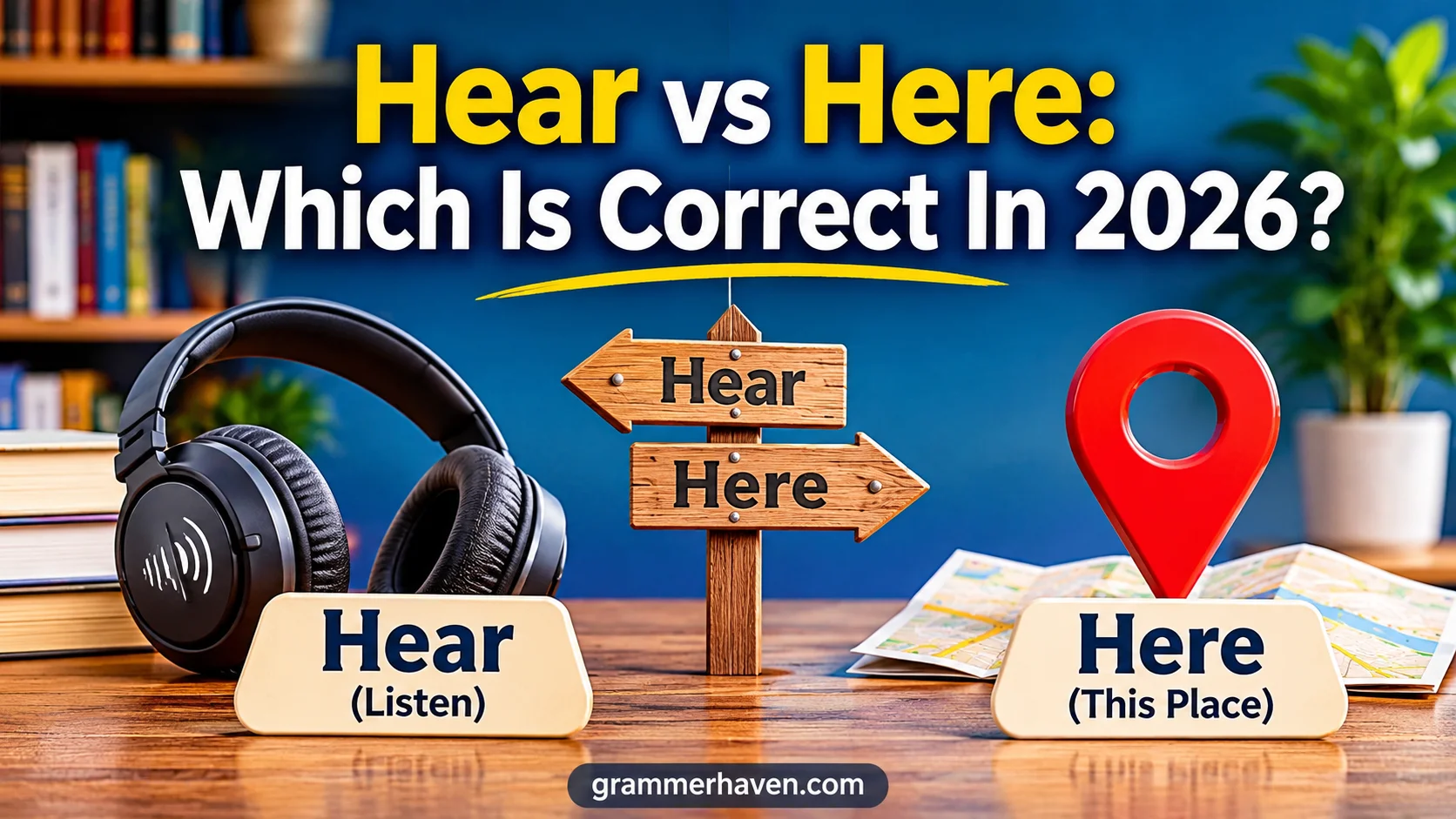
Hear vs Here: The Complete Guide helps you avoid a common mistake by showing the real difference between hear and here in simple English.
Many English learners and seasoned speakers commonly mix this word pair because both words have the same, identical, or similar sound through shared pronunciation. These homophones have a unique meaning, meanings, and definition, so the answer lies in knowing the difference, distinction, and contextual meaning instead of depending only on pronunciation. I have made this common mistake while writing, and one tiny slip can turn a simple sentence into something that makes readers scratch their head. An easy way to handle it is to remember that here shows a location, place, or position, while hear relates to listening, what you listen to, and spoken English.
Every word carries meaning, and the right word choice keeps communication clear. Good spelling, correct spellings, and learning to spell each word correctly improve grammar, English grammar, vocabulary, reading, written English, and accurate writing. Following usage, usage rules, proper usage, and paying attention to context while distinguishing one word from another will ensure your message stays grammatically correct. As you understand the different uses, your understanding, confidence, and ability to distinguish the pair continue to improve. The art of mastering this tricky topic grows through language learning. Read English aloud, use audio, pronounce each word, and practice often to master these commonly confused words, reduce confusion, avoid confuse errors, strengthen effective communication, move ahead, and write with greater clarity.
Hear vs Here Homophones: Why These Words Confuse So Many People
English loves chaos. That’s the honest truth.
The language contains many homophones, which are words that sound the same but carry different meanings and spellings. That’s exactly why hear and here cause trouble.
You hear them the same way in conversation. So your brain doesn’t get any visual clues. You rely on context instead.
Here’s where the confusion shows up in real life:
- “Can you here me?” (wrong)
- “I’ll be hear soon.” (wrong)
- “I can’t hear you clearly.” (correct)
- “I’ll be here soon.” (correct)
The issue isn’t intelligence. It’s speed and sound. When people type quickly, they trust how a sentence sounds, not what it means.
That’s the trap.
What Are Homophones in Hear vs Here Homophones
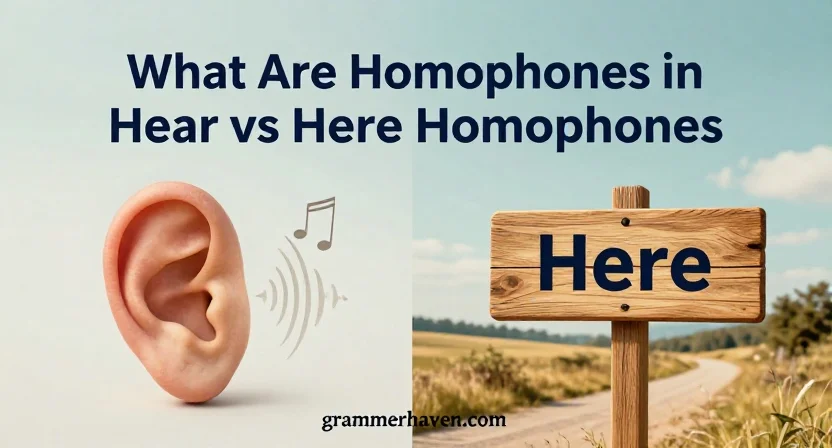
Before you master hear vs here homophones, you need a simple understanding of homophones themselves.
Homophones are words that:
- Sound identical when spoken
- Have different meanings
- Use different spellings
English has hundreds of them. Some common ones include:
- Their / There / They’re
- To / Too / Two
- Right / Write
- Son / Sun
But hear vs here stands out because it’s extremely common in daily conversation.
You use both words often. That increases the chance of mixing them up.
Think of homophones like twins with different jobs. They look similar at first glance, but they live completely different lives.
Hear vs Here Homophones: Understanding “Hear” in Detail
Let’s start with hear, the sound word.
Definition of Hear
Hear means to perceive sound using your ears.
It is an action word, which makes it a verb.
You don’t control hearing the same way you control looking. Sounds reach you, and your brain processes them.
How Hear Works in Real Life
You use “hear” when:
- Someone speaks to you
- Music plays in the background
- A sound reaches your ears
- You receive information verbally
Hear Examples That Make It Clear
Here are real, natural sentences:
- I hear footsteps outside the door.
- Did you hear that loud noise?
- She can hear the rain hitting the roof.
- I didn’t hear what you said.
- We hear birds every morning near the window.
Key Idea Behind Hear
Think of it like this:
Hear = sound enters your ears
A simple mental shortcut:
- If it involves noise → it’s hear
Common Hear Situations in Daily Life
You’ll often see “hear” in:
- Conversations
- Instructions
- Music discussions
- Alerts and notifications
- Classroom or work settings
Example:
“Did you hear the announcement about the meeting?”
That’s pure sound processing. No location involved.
Hear vs Here Homophones: Understanding “Here” in Detail
Now let’s flip to the other twin: here.
Definition of Here
Here means a place or location close to the speaker.
It is usually an adverb, because it tells you where something is happening.
How Here Works in Real Life
You use “here” when:
- You point to a location
- You talk about presence
- You describe where something is
- You give directions
Here Examples in Everyday English
- I am here waiting for you.
- Put your bag here on the table.
- Here is your phone.
- Stay here until I return.
- We live here in this city.
Key Idea Behind Here
Think of it like this:
Here = this place
A simple mental shortcut:
- If it involves location → it’s here
Where You Commonly See “Here” Used
You’ll find “here” in:
- Instructions
- Directions
- Conversations
- Presentations
- Emails and messages
Example:
“Click here to download the file.”
That “here” points to a place, not sound.
Hear vs Here Homophones: The Core Difference Explained Clearly
This is where everything clicks.
Let’s break it down simply.
Hear vs Here Meaning Comparison
| Word | Meaning | Type | Core Function |
| Hear | To receive sound | Verb | Listening |
| Here | In this location | Adverb | Position |
Simple Memory Rule
- Hear = ears = sound
- Here = place = location
That’s it.
If you remember nothing else, remember this pattern.
Real-Life Comparison Sentences
Let’s compare both words in similar sentences:
- I can hear music.
- I am here with music.
- Did you hear that?
- Stay here now.
- I hear voices.
- Come here quickly.
Same rhythm. Different meaning.
Why Hear vs Here Homophones Get Mixed Up So Often
You might wonder why such simple words cause so many mistakes.
Here’s why:
They Sound Identical
In most accents, both words sound exactly the same.
So your brain skips spelling checks.
Typing Speed Causes Errors
When people text fast, they rely on sound memory.
That leads to mistakes like:
- “I can’t here you”
- “I’ll be hear in 5 minutes”
Context Gets Ignored
People sometimes focus on how a sentence sounds, not what it means.
That’s a big problem in writing.
Auto-Correct Isn’t Perfect
Phones sometimes “guess” wrong words if both are valid.
So errors slip through unnoticed.
Hear vs Here Homophones in Real-Life Mistakes (Case Study Section)
Let’s look at how these mistakes show up in real communication.
Case Study 1: Text Message Confusion
A student texts:
“I can’t here you clearly.”
The receiver reads it and pauses. The sentence looks wrong.
What the student meant:
“I can’t hear you clearly.”
One letter changes meaning completely.
Case Study 2: Workplace Email Error
An employee writes:
“Please come hear for the meeting.”
This creates confusion in a professional setting.
Correct version:
“Please come here for the meeting.”
Small mistake. Big impact on clarity.
Case Study 3: Classroom Communication
A teacher says:
“If you can hear me, come here.”
Students understand both meanings instantly because context helps.
But written mistakes still happen often in notes and assignments.
Hear vs Here Homophones: How to Choose the Right Word Every Time
You don’t need grammar rules memorized. You need thinking patterns.
Step-by-Step Check Method
Ask yourself:
Step 1: Am I talking about sound?
- Yes → use hear
Step 2: Am I talking about place?
- Yes → use here
Quick Replacement Trick
Try replacing the word mentally:
- If you can replace it with “listen” → use hear
- If you can replace it with “this place” → use here
Example:
- I can ___ you → I can listen you (makes sense → hear)
- Come ___ → Come this place (makes sense → here)
Hear vs Here Homophones: Common Mistakes You Should Watch For
Here are mistakes people make most often:
Mistake 1: Mixing in Text Messages
- Wrong: I’ll be hear soon
- Correct: I’ll be here soon
Mistake 2: Writing “here” instead of “hear”
- Wrong: I here music
- Correct: I hear music
Mistake 3: Ignoring Context
Some sentences require careful reading:
- “Can you hear me?”
- “Can you come here?”
One letter changes everything.
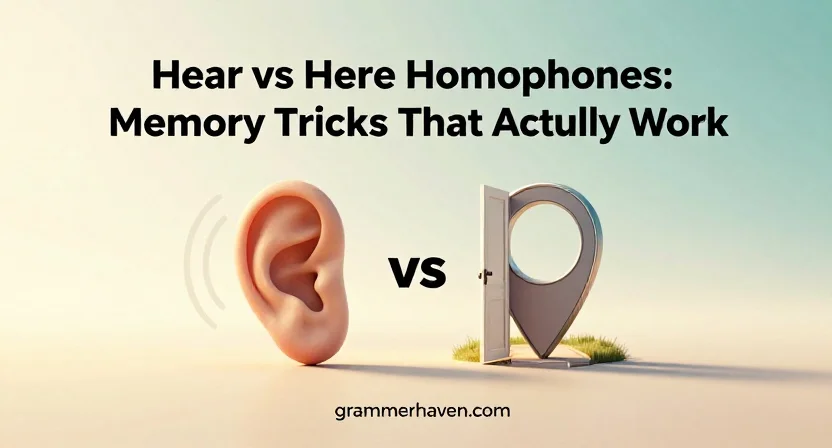
Hear vs Here Homophones: Memory Tricks That Actually Work
Let’s make this stick permanently.
Trick 1: Ear Inside Hear
The word “hear” contains ear.
Your ears help you hear sounds.
That connection is strong and easy to remember.
Trick 2: Here = “Hero Location” Trick
Think of “here” as pointing to a spot like a hero standing somewhere.
It anchors meaning to a place.
Trick 3: Sound vs Space Rule
- Hear = sound world
- Here = physical world
Keep those two worlds separate in your mind.
Hear vs Here Homophones Practice Section
Let’s test your understanding.
Fill in the blanks
- Can you ___ me now?
- I am ___ waiting for you.
- Did you ___ the alarm?
- Come ___ immediately.
Spot the Error
Find the mistake:
- I can’t here what you said.
- Put the bag hear on the chair.
Correct Answers
- hear
- here
- hear
- here
See also: Wracking My Brain or Racking My Brain – Which Is Correct?
FAQs:
1. What is the difference between hear and here?
Hear is a verb that means to perceive sound or listen. Here is an adverb that refers to a place or location.
2. Why do people confuse hear and here?
People confuse them because they are homophones. They have the same pronunciation but different spellings and meanings.
3. How can I remember when to use hear and here?
Think of hear as something connected to your ears and sound. Think of here as a word that points to a place, such as “Come here.”
4. Are hear and here commonly tested in English grammar?
Yes. They are among the most commonly confused words in English and often appear in grammar lessons, spelling exercises, and language tests.
5. Can native English speakers mix up hear and here?
Yes. Even native speakers occasionally make this mistake, especially when typing quickly. Proofreading your writing helps catch these errors before you share your work.
Conclusion:
Understanding the difference between hear and here is easier than it first appears. Although these two words sound exactly the same, they have completely different meanings and uses. Hear relates to listening or sound, while here refers to a place or location. By paying attention to context and practicing with real examples, you can avoid common mistakes, improve your grammar, and write with greater confidence. The more you use these words correctly, the more natural they will become in both spoken and written English.
Latest Post:
- Result In or Result To: Which Is Correct? (With Examples)
- A Dime a Dozen: Meaning, Definition, Origin and Real-Life Usage
- Hooplehead Definition, Meaning, Usage and Examples
- Whole vs Hole: What’s the Difference?
- Acumen vs Acuity vs Acuteness: What’s the Difference?