Laying or Lying causes confusion because lay, laying, lie, and lying are verbs with different meaning, usage, spelling, and grammatical roles. Lay is a transitive verb that always takes a direct object, while lie is an intransitive verb that doesn’t take a direct object.
The direct object test works as a litmus test for deciding the correct verb in a given sentence. “Lay the book down” and “laying the book on the table” show transitive usage because the book is the object receiving the action. “Lie on the couch” describes position or rest and has no direct object. This grammar rule helps you choose the correct usage when you write sentences and face confusion between these related verbs.
The past tense and progressive form create more tricky forms. The past tense of lie is lay, so “I lie on the couch” changes to “I lay on the couch.” The present tense -ing form is lying, as in “I’m lying down” or “She was lying down.” Laying requires an object, as in “I’m laying the book on the table.” The direct object rule makes this grammar problem easier: use laying when you put or place something, and use lying when you rest in a horizontal position. “I’m laying down” is incorrect usage when you mean resting; “I’m lying down” is the correct usage. This usage rule can be used to apply the distinction to every sentence.
The examples show how the grammatical distinction works in real sentences. “She went to lay the book down” has a direct object, while “She went to lie down” does not. “He walked in, followed by his sister” has no lay/lie issue.
Laying or Lying: Quick Answer
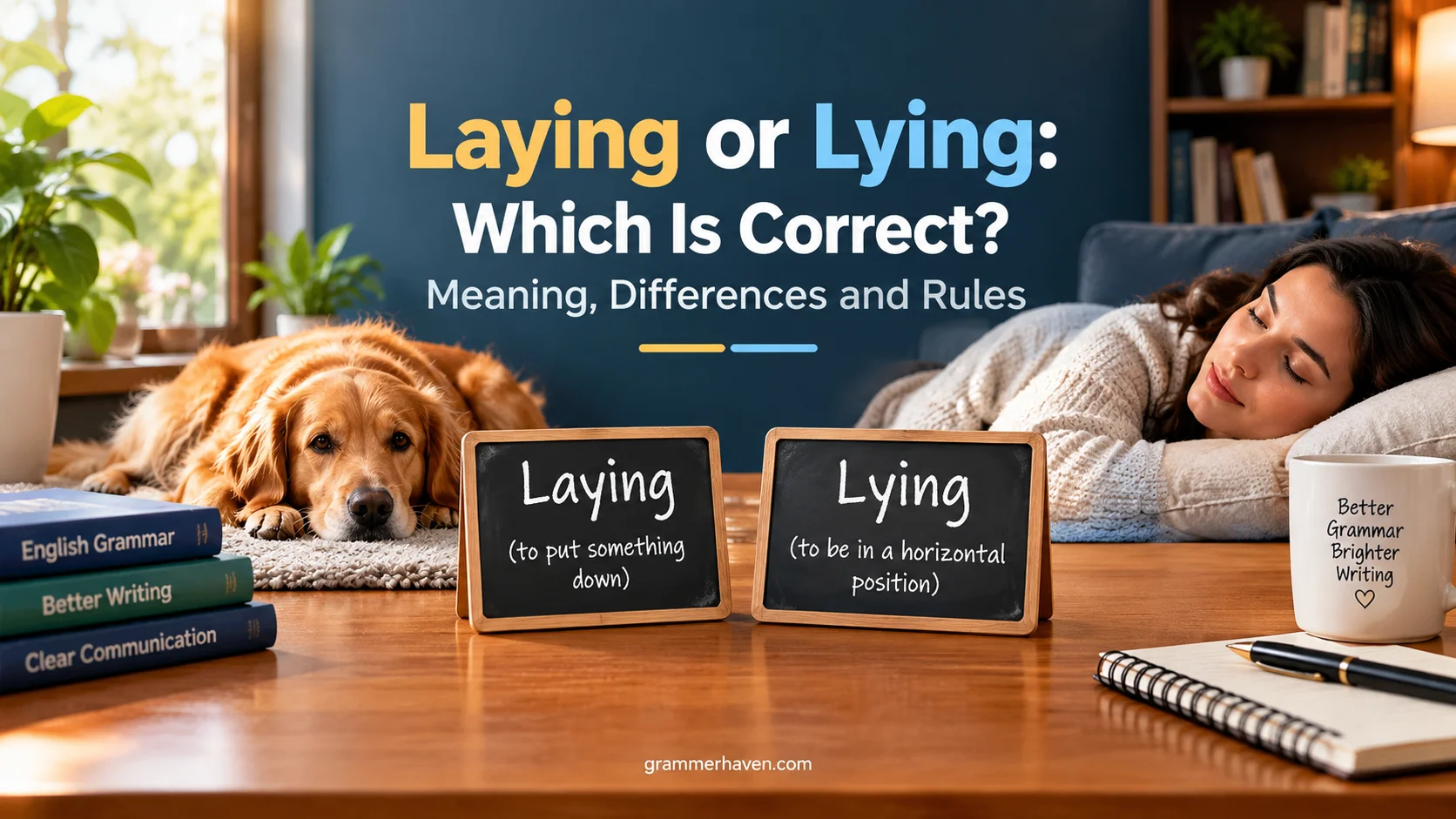
Laying is generally correct when you mean putting or placing something somewhere.
Lying is generally correct when you mean resting, reclining, or being in a horizontal position.
| Word | Verb | Meaning | Example |
| Laying | lay | Putting or placing something | She is laying the book on the desk. |
| Lying | lie | Resting or reclining | She is lying on the couch. |
| Laying | lay | Producing or depositing eggs | The hen is laying eggs. |
| Lying | lie | Telling something untrue | He is lying about what happened. |
The simplest rule is:
You lay something down, but you lie down yourself.
That rule won’t explain every use of these verbs, but it solves the most common laying vs. lying mistakes.
What Does Laying Mean?
Laying is the present participle of lay when lay means to put, place, or set something down.
Unlike lie, this verb normally takes a direct object. In other words, something receives the action.
For example:
- She is laying the book on the table.
- He is laying the blanket on the floor.
- They are laying the tiles in the kitchen.
- I am laying the papers on your desk.
- The workers are laying the foundation for the building.
Notice the pattern. In every example, you can ask:
“Laying what?”
The answer gives you the object.
She is laying the book.
He is laying the blanket.
They are laying the tiles.
That direct-object test makes laying much easier to identify. Cambridge Dictionary explains that lay means to put something down and that it requires an object.
Laying Examples in Everyday English
Consider a few ordinary situations.
If you’re arranging clothes on your bed, you might say:
I’m laying my clothes on the bed.
If you’re preparing a table:
She is laying the plates on the table.
If you’re building a road:
The crew is laying asphalt.
If you’re putting a child into a crib:
He is laying the baby in the crib.
In each case, someone is placing something or someone somewhere.
What Does Lying Mean?
Lying is the present participle of lie when lie means to rest, recline, or remain in a horizontal position.
Unlike lay, this verb doesn’t require a direct object in this sense. The person or thing simply occupies a position.
For example:
- I am lying on the bed.
- She is lying on the couch.
- The dog is lying on the floor.
- They are lying on the beach.
- The papers are lying on the desk.
Here, nothing is being placed by the subject.
The subject is simply in a position.
Cambridge describes lie as an irregular verb meaning to be in a horizontal position. Its present participle is lying, its past tense is lay, and its past participle is lain.
Why “I’m Laying Down” Is Usually Wrong
Suppose you’re tired after a long day and want to rest.
You say:
I’m lying down.
Not:
I’m laying down.
Why?
Because you’re not placing an object somewhere. You are assuming a horizontal position yourself.
Now change the sentence:
I’m laying the baby down.
That sentence works because the baby is the object being placed in a horizontal position.
The distinction becomes clear:
- I’m lying down. → I am reclining.
- I’m laying the baby down. → I am placing the baby down.
Merriam-Webster makes the same core distinction: lay requires an object, while lie describes someone or something being in a position without taking an object.
Laying vs. Lying: The Main Difference
The central difference is placing something versus being positioned.
| Situation | Correct word | Example |
| You place a book somewhere | laying | I am laying the book on the table. |
| You rest on a couch | lying | I am lying on the couch. |
| You place a baby in a crib | laying | She is laying the baby in the crib. |
| A baby rests in a crib | lying | The baby is lying in the crib. |
| You place clothes on a bed | laying | He is laying the clothes on the bed. |
| Clothes are already on the bed | lying | The clothes are lying on the bed. |
A useful way to think about it is this:
Laying involves an action directed at something. Lying describes a position.
That’s the heart of the distinction.
The Object Test: The Easiest Way to Choose
When you’re unsure about laying or lying, ask one question:
Is there a person or thing being placed?
If the answer is yes, laying is probably the form you need.
If the answer is no and the subject is resting or remaining in a position, lying is usually correct.
Example
She is laying the phone on the desk.
Ask:
Laying what?
Answer: the phone.
Therefore, laying works.
Now consider:
She is lying on the sofa.
Ask:
Lying what?
There isn’t an object. She’s simply resting.
Therefore, lying works.
This simple test won’t cover every meaning of lay, but it handles the everyday distinction remarkably well.
Lay and Lie Verb Forms Explained
Here’s where things get complicated.
The forms of lay and lie don’t follow the neat pattern many learners expect.
Forms of Lay
When lay means “put or place,” its forms are:
| Form | Verb | Example |
| Present | lay | I lay the book on the desk. |
| Present participle | laying | I am laying the book on the desk. |
| Past | laid | I laid the book on the desk. |
| Past participle | laid | I have laid the book on the desk. |
Notice that laying doesn’t become laying because of a special spelling trick. It is simply the -ing form of lay.
Also note the spelling of the past forms:
laid, not layed.
Cambridge specifically identifies laid as both the past simple and past participle of lay.
Forms of Lie
When lie means “rest or recline,” its forms are:
| Form | Verb | Example |
| Present | lie | I lie on the couch. |
| Present participle | lying | I am lying on the couch. |
| Past | lay | I lay on the couch yesterday. |
| Past participle | lain | I have lain on the couch for an hour. |
That middle form causes most of the trouble.
Lay is the past tense of lie.
So:
Today, I lie on the couch.
becomes:
Yesterday, I lay on the couch.
But:
Today, I lay the book on the couch.
becomes:
Yesterday, I laid the book on the couch.
It’s an odd-looking system. Yet once you separate the two verbs, it becomes manageable.
Why Laying and Lying Are So Confusing
The confusion isn’t simply caused by people being careless with grammar. The verbs themselves create a genuine trap.
First, lay is the present-tense verb meaning “put something down.”
Second, lay is also the past tense of lie.
Third, laying and lying look like they should form a simple pair. They don’t.
Finally, everyday speech often uses lay where traditional standard grammar expects lie. Merriam-Webster notes that the use of lay for lie has a long history and has troubled English speakers for centuries.
So if you’ve ever mixed them up, you’re wrestling with one of English’s more stubborn verb pairs.
Laying Down vs. Lying Down
This is probably the most common practical question.
Use “Lying Down” When You Rest
Use lying down when the subject itself is reclining.
Examples:
- I am lying down.
- She is lying down for a nap.
- The dog is lying down beside me.
- We were lying down after lunch.
Use “Laying Down” When You Place Something
Use laying down when you place an object or person somewhere.
Examples:
- I am laying the blanket down.
- She is laying the baby down.
- He is laying the cards down.
- They are laying the books down.
The difference is tiny in sound but important in grammar.
I am lying down.
I am laying the blanket down.
In the first sentence, I am reclining.
In the second, I am placing the blanket somewhere.
Laying or Lying on the Bed?
The correct choice depends on what you’re trying to say.
If You Are Resting
Say:
I am lying on the bed.
You are describing your position.
If You Are Putting Something on the Bed
Say:
I am laying the clothes on the bed.
Here, the clothes are being placed.
Compare these two sentences:
| Sentence | Meaning |
| I am lying on the bed. | I am resting there. |
| I am laying the clothes on the bed. | I am putting clothes there. |
The bed itself doesn’t determine the verb. The action does.
Common Mistakes With Laying and Lying
“I’m Laying on the Couch.”
In standard edited English, use:
I’m lying on the couch.
You’re describing your own position.
“She Is Lying the Book on the Table.”
Use:
She is laying the book on the table.
The book receives the action.
“I Laid Down Yesterday.”
When you mean that you reclined yesterday, the standard form is:
I lay down yesterday.
Remember, lay is the past tense of lie.
“She Was Laying in Bed.”
If she was resting in bed, write:
She was lying in bed.
However:
She was laying the baby in bed.
is correct because she was placing the baby there.
“He Layed the Book on the Desk.”
This spelling is incorrect.
Use:
He laid the book on the desk.
The past tense of lay is laid, not layed.
Laying Eggs Is Correct
Here’s an important point that a simple “laying means putting something down” rule doesn’t fully explain.
Laying eggs is completely correct.
For example:
The hen is laying eggs.
The verb lay also means to produce and deposit an egg. Merriam-Webster lists this as one of the established meanings of lay.
You’ll also see:
- The turtle is laying eggs.
- The bird is laying eggs.
- The duck is laying eggs.
- The fish are laying eggs.
So don’t assume that laying always means physically placing an object on a surface. The verb has several established meanings.
Lying Can Mean Something Completely Different
There are actually two different verbs spelled lie.
One means to recline or remain in a position.
The other means to say something that isn’t true.
That’s why context matters.
Lying as Resting
She is lying on the floor.
Here, lying comes from lie meaning to recline.
Lying as Being Dishonest
She is lying about the money.
Here, lying comes from lie meaning to tell an untruth.
The verb forms are different:
| Meaning | Present | Past | -ing Form |
| Recline/rest | lie | lay | lying |
| Tell an untruth | lie | lied | lying |
Cambridge and Merriam-Webster both distinguish these two verbs.
That means lying can describe either someone’s physical position or someone’s dishonesty.
Laying vs. Lying in Real-Life Situations
The distinction becomes much easier when you see it in context.
At Home
I’m lying on the couch.
You are resting.
I’m laying the pillows on the couch.
You are placing the pillows.
With a Baby
The baby is lying in the crib.
The baby is already there.
The mother is laying the baby in the crib.
The mother is placing the baby there.
At Work
The documents are lying on the desk.
The documents are already positioned there.
The assistant is laying the documents on the desk.
The assistant is putting them there.
Outdoors
We were lying on the grass.
You were reclining.
We were laying blankets on the grass.
You were placing blankets there.
The same pattern keeps appearing. Position = lying. Placement = laying.
A Closer Look at “Lay” as the Past Tense of “Lie”
This is where even experienced writers can stumble.
Consider this timeline:
Present:
I lie on the beach.
Past:
Yesterday, I lay on the beach.
Past participle:
I have lain on the beach for hours.
Present participle:
I am lying on the beach.
Now compare that with the other verb:
Present:
I lay the towel on the beach.
Past:
I laid the towel on the beach.
Past participle:
I have laid the towel on the beach.
Present participle:
I am laying the towel on the beach.
The crucial distinction is:
| Verb | Present | Past | Past Participle | -ing Form |
| Lie = recline | lie | lay | lain | lying |
| Lay = place | lay | laid | laid | laying |
| Lie = tell an untruth | lie | lied | lied | lying |
The CDC’s Clear Writing guidance also highlights this exact distinction, noting that lie is used for assuming a horizontal position while lay takes an object.
Case Study: One Family, Three Different Sentences
Consider a parent putting a child to bed.
First:
The child is lying in bed.
The child is already resting.
Next:
The father is laying the child in bed.
The father is putting the child there.
Later:
The father lay beside the child for a few minutes.
Now we’re talking about the father’s past position. Therefore, lay is correct because it’s the past tense of lie.
Three sentences. Three forms.
That’s why memorizing one isolated rule isn’t enough. You need to understand the relationship between the verbs.
A Simple Memory Trick for Laying vs. Lying
If the grammar table feels like a plate of tangled spaghetti, use this shortcut:
You lay something down. You lie down yourself.
Then ask:
What is receiving the action?
If there’s a direct object, think laying.
If the subject is simply resting, think lying.
Compare
I am laying the jacket on the chair.
What am I laying?
The jacket.
I am lying on the chair.
What am I lying?
Nothing. I’m simply resting there.
This trick won’t replace a full understanding of the verb forms, but it’s excellent for everyday writing.
Laying vs. Lying: Side-by-Side Examples
| Sentence | Correct? | Explanation |
| I am lying on the bed. | ✅ | You are resting. |
| I am laying the book on the bed. | ✅ | You are placing the book. |
| She is lying on the floor. | ✅ | She is reclining. |
| She is laying the blanket on the floor. | ✅ | She is placing the blanket. |
| The baby is lying in the crib. | ✅ | The baby is resting there. |
| The mother is laying the baby in the crib. | ✅ | The mother is placing the baby. |
| I am laying on the sofa. | ❌ in standard usage | Use lying when you mean resting. |
| He is lying the papers on the desk. | ❌ | Use laying because the papers are being placed. |
| I lay down yesterday. | ✅ | Lay is the past tense of lie. |
| I laid the book down yesterday. | ✅ | Laid is the past tense of lay. |
| The hen is laying eggs. | ✅ | Lay also means to produce and deposit eggs. |
How to Choose Between Laying and Lying in Seconds
When you’re writing and don’t want to stop for a grammar history lesson, use this quick process.
Ask What the Subject Is Doing
If the subject is placing something, choose laying.
If the subject is resting or reclining, choose lying.
Look for a Direct Object
Words such as these can signal the use of laying:
- book
- blanket
- clothes
- baby
- papers
- cards
- tiles
- foundation
For example:
She is laying the papers on the desk.
The papers are the direct object.
Check the Time
If you’re talking about the past, don’t automatically choose laid.
Ask which verb you’re using.
I lay down yesterday.
I laid the book down yesterday.
That single distinction prevents one of the most common mistakes with these words.
See also: Quit or Quite: What’s the Difference?
Final Cheat Sheet: Laying or Lying?
| If you mean… | Use | Example |
| Put something somewhere | laying | She is laying the book down. |
| Place a person somewhere | laying | He is laying the baby in the crib. |
| Rest or recline | lying | He is lying on the sofa. |
| Remain in a horizontal position | lying | The dog is lying by the door. |
| Produce or deposit eggs | laying | The hen is laying eggs. |
| Tell an untruth | lying | He is lying to his parents. |
| Past tense of lie = recline | lay | I lay down yesterday. |
| Past tense of lay = place | laid | I laid the book down yesterday. |
FAQs:
Is it “laying down” or “lying down”?
Lying down is correct when you mean reclining yourself.
I’m lying down for a few minutes.
Laying down is correct when you’re putting something or someone down.
She’s laying the baby down.
Is “I am laying down” grammatically correct?
In standard usage, use “I am lying down” when you mean that you’re reclining.
Use “I am laying down” when an object is understood or explicitly stated, such as “I am laying the blanket down.”
Is “laying on the bed” correct?
It can be correct if laying has an object.
I am laying the clothes on the bed.
If you mean that you’re resting on the bed, use:
I am lying on the bed.
What is the past tense of “lie”?
When lie means to rest or recline, its past tense is lay.
I lay on the couch yesterday.
Its past participle is lain.
I have lain here for an hour.
What is the past tense of “lay”?
The past tense of lay is laid.
She laid the book on the table.
Is “laying eggs” correct?
Yes. Laying eggs is standard English.
The hen is laying eggs.
Here, lay means to produce and deposit eggs.
Is “I laid down” correct?
Not when you mean “I reclined.” In standard usage, write:
I lay down.
However, “I laid the book down” is correct because book is the object.
Why is “lay” the past tense of “lie”?
English inherited these forms from older stages of the language, and the distinction has persisted for centuries. Modern speakers still use lay as the past form of lie.
Is “lying” always related to resting?
No. Lying can also mean telling an untruth.
The dog is lying on the rug.
versus:
The witness is lying about what happened.
Context tells you which meaning applies.
What’s the easiest way to remember the difference?
Remember:
Lay something down. Lie down yourself.
Then check whether the verb has a direct object.
Conclusion:
Lay and lie have similar forms, but their grammatical roles are different. Use lay or laying when you put or place something, and use lie or lying when someone or something rests or remains in a horizontal position. The direct object test gives you a simple way to make the right choice and avoid common grammar mistakes.