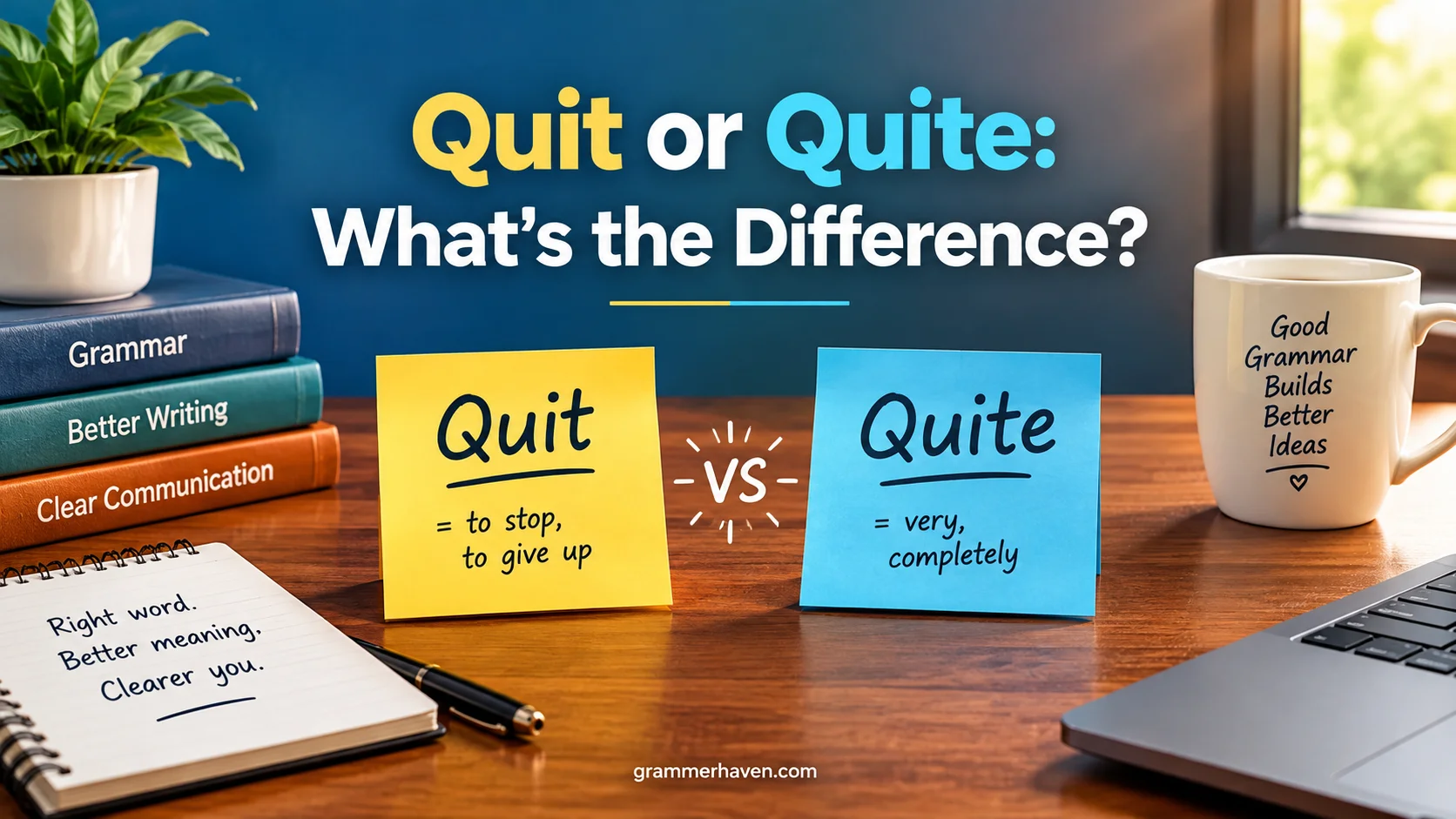
Quit or Quite: Meaning, Difference And Uses helps explain the difference between these homophones. Quit is a verb meaning leave, stop, or discontinue a job or action. Quite is an adverb that shows degree, extent, or quality. Their spelling and sounds are similar, but their meanings and functions are different. Quiet is another word that means calm, silent, or peaceful.
For ESL and EFL learners, context, pronunciation, and simple grammar rules can prevent confusion and mistakes. In writing, speech, classroom exercises, and daily communication, using the correct word helps you express your intended meaning. For example, you can quit a job, but you can be quite happy with it. Writers, students, and learners can improve their language skills, writing skills, and confidence by practicing these words.
A simple memory trick is to remember that quit means to stop or leave, while quite adds degree or emphasis. Learning their meanings, word usage, verb usage, adverb usage, and common examples makes the difference easier to remember.
Quick Answer: Quit or Quite?
If you’re looking for the answer in a hurry, use this rule:
| Word | Meaning | Part of Speech | Example |
| Quit | Stop, leave, or give up | Verb | I decided to quit my job. |
| Quite | To some degree, very, or completely | Adverb | The test was quite difficult. |
| Quiet | Having little noise or activity | Adjective | The library was quiet. |
The easiest way to remember them
Quit = stop.
Quite = degree or extent.
Quiet = silence.
That three-word distinction handles most everyday mistakes.
However, quite deserves a closer look because its meaning can shift with context. In some sentences, it means fairly or moderately. In others, it means very or completely. That subtle difference makes quite more interesting than its deceptively simple spelling suggests.
What Does “Quit” Mean?
Quit is primarily a verb. It commonly means to stop doing something, leave something, or give something up.
Consider these examples:
- I quit smoking last year.
- She quit her job yesterday.
- He quit the team after the argument.
- Please quit complaining.
In each example, something comes to an end. That’s the central idea behind quit.
Quit Means “Stop”
When you use quit to describe an activity, you mean that you stop doing it.
For example:
She quit drinking soda.
The sentence doesn’t mean that she left a physical place. It means she stopped the activity.
The same pattern appears in everyday expressions:
- quit smoking
- quit drinking
- quit complaining
- quit arguing
- quit talking
- quit trying
- quit playing
Quit Means “Leave a Job”
Quit also commonly describes leaving employment.
Marcus quit his job after accepting another position.
This use is especially common in everyday American English. In a more formal setting, you might use resign instead:
- I quit my job. — direct and conversational
- I resigned from my position. — more formal
- I left the company. — neutral and broad
These expressions can describe the same basic event, but their tone differs.
Quit Can Mean “Give Up”
Quit can also describe abandoning an effort or activity.
Don’t quit when you’re close to finishing.
Here, quit means give up or stop trying.
That’s why phrases such as these sound natural:
- Don’t quit now.
- Never quit trying.
- He quit the competition.
- She refused to quit.
The word often carries a sense of stopping before something reaches its intended conclusion.
How to Use “Quit” in a Sentence
The grammar of quit is fairly straightforward. It can appear with a noun, an activity, or an -ing form.
Quit + Noun
Use quit before a noun when you’re talking about leaving or abandoning something.
Examples:
- She quit her job.
- He quit the team.
- They quit the competition.
- I quit the club.
Quit + -ing Verb
Use quit before an -ing form when you mean stop an activity.
Examples:
- I quit smoking.
- She quit complaining.
- He quit playing.
- They quit arguing.
A common mistake is adding to before the verb:
❌ I quit to smoke.
✅ I quit smoking.
The second sentence correctly describes stopping the activity.
What Does “Quite” Mean?
Now comes the tricky one.
Quite is an adverb. It doesn’t mean stop, leave, or give up. Instead, it modifies another word or phrase to express degree, extent, emphasis, or completeness.
For example:
The movie was quite interesting.
Here, quite modifies interesting. It tells you something about the degree of interest.
Other examples include:
- The restaurant was quite expensive.
- She’s quite talented.
- That sounds quite unusual.
- The assignment was quite difficult.
- I’m quite certain.
The precise strength of quite depends on context and the word it modifies. Cambridge explains that quite can mean “a little” or “moderately” with gradable adjectives, while it can mean “very,” “totally,” or “completely” with non-gradable adjectives and adverbs.
How to Use “Quite” Correctly
The best way to understand quite is to look at its common grammatical patterns.
Quite + Adjective
One of the most common structures is:
quite + adjective
Examples:
- quite difficult
- quite interesting
- quite expensive
- quite unusual
- quite impressive
- quite tired
Consider:
The exam was quite difficult.
Depending on context, this could mean the exam was fairly difficult or very difficult.
That’s an important point. Defining quite as simply “very” doesn’t tell the whole story.
Why Does “Quite” Sometimes Mean “Fairly”?
Some adjectives allow different degrees.
For example:
- slightly difficult
- fairly difficult
- quite difficult
- very difficult
- extremely difficult
Here, difficult is gradable. You can have something that is a little difficult, moderately difficult, or extremely difficult.
Cambridge notes that quite with gradable adjectives generally means something like fairly, rather, or moderately.
Quite + Strong or Non-Gradable Words
The meaning can become stronger when quite modifies an extreme or non-gradable expression.
For example:
The answer is quite impossible.
Or:
She was quite certain.
Here, quite can carry the sense of completely or totally.
This distinction explains why the sentence “It was quite good” doesn’t always mean exactly the same thing as “It was quite impossible.”
The surrounding word matters.
Quite + Adverbs
Quite can also modify an adverb.
Examples:
- She speaks quite clearly.
- He finished quite quickly.
- They arrived quite early.
- The machine works quite efficiently.
Again, quite tells you about the degree of the action or quality.
For example:
She explained the problem quite clearly.
The word quite strengthens or qualifies the adverb clearly.
Quite + Nouns
Another useful structure is:
quite a/an + adjective + noun
Examples:
- quite a surprise
- quite a challenge
- quite an achievement
- quite an unusual experience
- quite a difficult question
For example:
That was quite a surprise.
Here, quite adds emphasis to the noun phrase.
You can also say:
She made quite an impression.
The phrase suggests that the impression was notable or significant.
Quite a Few, Quite a Lot, and Quite a Bit
These expressions deserve special attention because they can confuse learners.
Quite a few
Quite a few means a fairly large number or, in many contexts, simply a lot.
We have quite a lot of work to finish.
Quite a bit
Quite a bit also refers to a substantial amount.
She knows quite a bit about photography.
These expressions don’t mean that the quantity is tiny. In fact, quite a few and quite a bit often suggest a surprisingly large amount. Cambridge specifically lists these constructions as established uses of quite.
“Not Quite” Has a Special Meaning
One of the most useful expressions to learn is not quite.
It usually means not completely or almost, but not entirely.
Examples:
- I’m not quite ready.
- That’s not quite right.
- The project is not quite finished.
- I don’t quite understand.
- That’s not quite what I meant.
Consider this exchange:
“Are you ready?”
“Not quite.”
The speaker isn’t saying “no” in an absolute sense. They’re saying they’re almost ready but not completely ready.
Cambridge specifically identifies not quite as a construction meaning “not completely.”
Quit vs. Quite: The Main Difference
The easiest comparison looks like this:
| Feature | Quit | Quite |
| Grammar | Verb | Adverb |
| Main idea | Stopping or leaving | Degree or emphasis |
| Common meaning | Stop, leave, give up | Fairly, very, completely |
| Typical use | Quit a job | Quite difficult |
| Example | I quit smoking. | I quite agree. |
| Pronunciation | /kwɪt/ | /kwaɪt/ |
The grammatical difference is particularly useful.
If the word describes an action of stopping, you probably need quit.
Quit vs. Quite Pronunciation
The spelling difference becomes easier to remember once you hear the pronunciation difference.
Quit
Quit is pronounced /kwɪt/.
Its vowel sound is the short i sound found in words such as:
- sit
- fit
- hit
- bit
Quite
Quite is pronounced /kwaɪt/.
Its vowel sound is the same broad diphthong heard in:
- right
- light
- night
- white
So although quit and quite look remarkably similar, they don’t sound the same.
The difference is not merely visual. Their pronunciation and meanings diverge as well.
Quit vs. Quite vs. Quiet
Here’s where English throws in one more curveball.
Quiet looks similar to both words, but it has a completely different meaning.
| Word | Pronunciation | Meaning | Example |
| Quit | /kwɪt/ | Stop or leave | I quit my job. |
| Quite | /kwaɪt/ | Degree or emphasis | It was quite difficult. |
| Quiet | /ˈkwaɪət/ | Little noise or activity | The room was quiet. |
Cambridge distinguishes quiet from quite both in spelling and pronunciation. Quiet functions as an adjective describing little noise or activity.
Think of the Three Words This Way
Quit → stop
Quite → degree
Quiet → silence
That is the mental shortcut worth remembering.
For example:
I quit my job because the office wasn’t quiet, although the work was quite interesting.
Each word has a completely different job.
Common Quit and Quite Mistakes
The fastest way to master the difference is to examine mistakes that people actually make.
“I Quite My Job”
❌ I quite my job.
✅ I quit my job.
The intended meaning is “I left my job.” Therefore, quit is the correct verb.
“The Movie Was Quit Good”
❌ The movie was quit good.
✅ The movie was quite good.
Here, the writer needs an adverb to modify good.
“I Quite Smoking”
❌ I quite smoking.
✅ I quit smoking.
The sentence describes stopping an activity. Use quit.
“Please Be Quit”
❌ Please be quit.
If you mean “make less noise,” the correct word is:
✅ Please be quiet.
Quiet is an adjective describing the state of having little noise.
“She Is Quite”
This sentence is usually incomplete if the intended meaning is “silent.”
❌ She is quite.
If you mean she isn’t making much noise:
✅ She is quiet.
If you use quite, it normally needs something to modify:
✅ She is quite tired.
Quit or Quite in Everyday Situations
Understanding context makes the distinction much easier.
At Work
I quit my job last Friday.
The person left the job.
My new job is quite demanding.
The speaker is describing the degree of difficulty.
At School
He quit the course halfway through the semester.
He stopped participating.
The course was quite challenging.
The speaker describes its difficulty.
During an Argument
Quit arguing with me.
This means stop arguing.
That’s quite an interesting point.
This means the point has a notable degree of interest.
At Home
The children finally quit shouting.
They stopped shouting.
The house became quiet afterward.
The noise disappeared.
Notice how three similar-looking words can work together naturally without overlapping in meaning.
Is “Quit” the Past Tense of “Quit”?
Yes.
One useful feature of quit is that the same form can function as the present and past tense in standard modern English.
For example:
- I quit my job today.
- I quit my job last year.
- She has quit smoking.
You don’t normally need to change quit to create the simple past.
What About “Quitted”?
Quitted exists as a form in English, but quit is the normal form in ordinary modern usage.
For everyday writing, these are the natural choices:
- She quit her job.
- He quit smoking.
- They have quit the project.
That means learners generally don’t need to reach for quitted.
Is “Quite” the Same as “Very”?
Not always.
This is one of the most important nuances in understanding quite.
In some contexts, especially with certain adjectives, quite can mean something close to fairly or moderately.
The movie was quite good.
In another context, it can express a stronger degree:
She was quite certain about the answer.
Cambridge explains that the interpretation depends partly on whether the following adjective or adverb is gradable or non-gradable.
American English also uses quite in senses that include “to a large degree,” “completely,” and “really or truly.”
So don’t memorize quite = very as an absolute rule. English rarely rewards that kind of shortcut.
A Simple Case Study: One Letter, Three Meanings
Imagine a student writing this sentence:
“I quite my job because the office wasn’t quite, but my new workplace is quite nice.”
Three words have collided.
The intended meaning might be:
“I quit my job because the office wasn’t quiet, but my new workplace is quite nice.”
Now the sentence makes sense:
- quit = left the job
- quiet = not noisy
- quite = fairly or very
This is why spelling alone isn’t enough. You need to identify the meaning and grammatical role first.
How to Choose Between Quit and Quite
When you’re unsure, ask yourself one simple question:
Are you talking about stopping?
Use quit.
- quit smoking
- quit working
- quit the job
- quit the team
- quit the game
Are you describing degree or extent?
Use quite.
- quite difficult
- quite interesting
- quite expensive
- quite clearly
- quite a few
Are you talking about noise?
Use quiet.
- a quiet room
- a quiet street
- a quiet child
- a quiet afternoon
This three-part check takes only a few seconds.
Quick Reference: Quit, Quite, and Quiet
| Word | Core Meaning | Part of Speech | Example |
| Quit | Stop, leave, give up | Verb | She quit smoking. |
| Quite | Fairly, very, completely, or emphatically | Adverb | The task was quite difficult. |
| Quiet | Having little noise or activity | Adjective | The street was quiet. |
Remember the Pattern
- Quit something.
- Quite modifies something.
- Quiet describes something.
That grammatical distinction can be more reliable than trying to memorize spelling tricks.
See also: Anyway or Anyways: Which Is Correct?
FAQs:
Is “quite” a verb?
No. Quite is primarily an adverb. It commonly modifies adjectives, adverbs, verbs, and noun phrases to express degree or emphasis.
Is “quit” a verb?
Yes. Quit commonly means to stop, leave, or give something up.
Is “I quit” correct?
Yes. I quit is correct when you mean that you stopped doing something or left something.
For example:
I quit my job.
Is “I quite my job” correct?
No. If you mean that you left your job, use quit:
I quit my job.
Is “quite good” correct?
Yes. Quite good is grammatically correct. Depending on context and variety of English, quite can express a moderate or stronger degree.
Are quit and quite pronounced the same?
No.
Quit has /ɪ/ while quite has /aɪ/. Their pronunciation differs along with their meanings.
What is the difference between quiet and quite?
Quiet relates to little noise or activity. Quite expresses degree, extent, or emphasis.
The room was quiet.
The room was quite large.
What does “not quite” mean?
Not quite usually means not completely or almost, but not entirely.
I’m not quite ready.
That’s not quite correct.
Cambridge specifically identifies this use as meaning “not completely.”
Is “quite a few” a small number?
No. Quite a few generally refers to a relatively large number.
Quite a few students attended the lecture.
Similarly, quite a lot and quite a bit can refer to substantial quantities.
Conclusion:
Although quit and quite look and sound similar, they have completely different meanings. Quit is usually a verb meaning to stop, leave, or give up, while quite is an adverb used to mean “very,” “fairly,” “completely,” or “rather,” depending on the context.
The easiest way to remember the difference is to focus on their roles in a sentence: quit = stop or leave, while quite = to a certain degree or completely. Once you understand this distinction, you’ll be much less likely to confuse these two commonly mixed-up words.
So, if you mean “stop,” use quit. If you mean “very,” “fairly,” or “completely,” use quite.