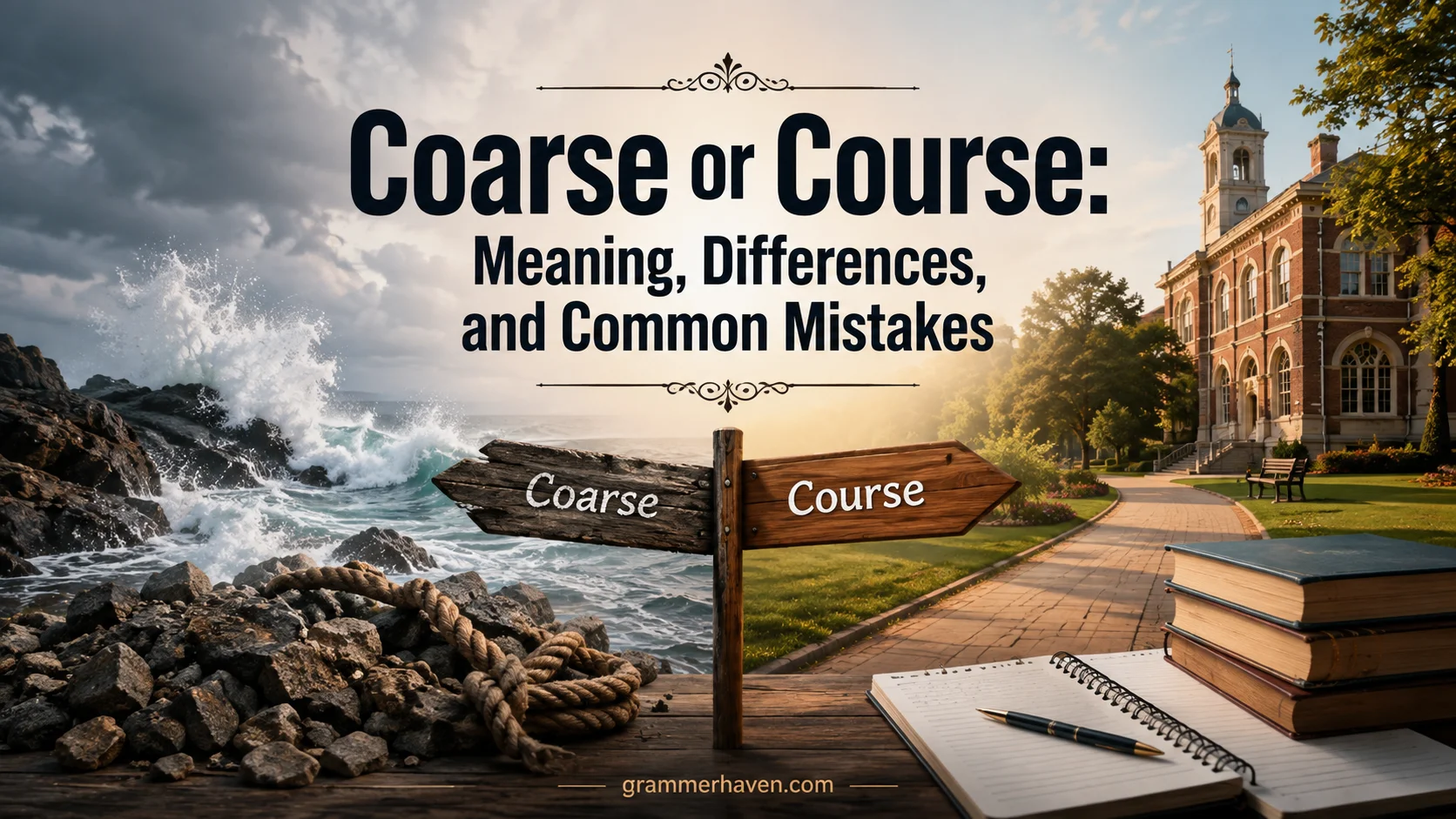
Coarse or Course: Meaning, Differences, and Common Mistakes explains why these commonly confused words have a different meaning despite having the same sound and similar spelling.
Coarse describes something rough or lacking refinement. A course can mean a class, direction, path, or series of lessons. These words have almost the same pronunciation, but one letter creates a huge difference in their meanings. Examples can help you understand the difference and avoid confusion when using them in the English language.
Choosing the wrong word can accidentally change your meaning. Calling someone rude and writing a course instead of coarse creates a spelling mistake. A course can describe a class, path, or race, while coarse can describe rough texture or behavior. Learning these English spelling rules can make the difference easier to remember.
Coarse or Course: The Quick Difference
The easiest way to separate these words is to remember what they describe.
| Word | Meaning | Type of Word | Example |
| Coarse | Rough, harsh, thick, or lacking refinement | Adjective | The fabric has a coarse texture. |
| Course | A class, route, direction, sequence, or part of a meal | Noun (usually) | She completed an online course. |
The simple rule:
Coarse = rough
Course = a path, class, or progression
If you can replace the word with rough, use coarse.
If you can replace it with class, route, or journey, use a course.
What Does Coarse Mean?
The word coarse describes something that lacks smoothness, softness, or refinement. It usually talks about physical texture, but it can also describe behavior, language, or manners.
The word comes from the Old French term cors, meaning rough or ordinary. Over time, English speakers began using it for anything considered harsh, thick, or unpolished.
Coarse Meaning and Definition
According to standard English usage, coarse means:
- Rough to the touch
- Made of large or thick particles
- Not delicate or refined
- Offensive or vulgar in speech or behavior
Unlike course, which often refer to movement or learning, coarse focuses on quality and texture.
Common Uses of Coarse
Coarse Texture
The most common use of coarse describes something physically rough.
Examples:
- The beach sand felt coarse beneath my feet.
- This towel became coarse after many washes.
- Coarse salt has larger crystals than table salt.
A useful comparison:
| Texture | Example |
| Smooth | Silk fabric |
| Fine | Powdered sugar |
| Coarse | Rock salt or rough sand |
Coarse Materials
Many natural and manufactured materials can have a coarse texture.
Examples include:
- Coarse wool
- Coarse hair
- Coarse gravel
- Coarse sand
- Coarse fabric
A carpenter might describe rough wood as coarse before sanding it down.
A chef might choose coarse salt because larger grains dissolve differently during cooking.
Coarse Language or Behavior
The word does not only describe physical objects. It can also describe speech and actions.
Examples:
- The comedian apologized for using coarse language.
- His coarse comments made people uncomfortable.
- The movie contained coarse humor.
In these cases, coarse means rude, crude, or lacking good manners.
What Does Course Mean?
The word course has several meanings, which is why it appears so often in everyday English.
It can describe education, movement, time, food, and decisions.
Course Meaning and Definition
A course can mean:
- A class or educational program
- A path or direction
- A series of events
- A part of a meal
- A planned approach or action
The meaning depends entirely on context.
Common Meanings of Course
Course as a Class or Educational Program
This is one of the most common meanings today.
A course is a structured learning program designed to teach a specific subject.
Examples:
- She signed up for a graphic design course.
- He completed a computer programming course.
- The university offers a business management course.
A course may last:
- A few hours
- Several weeks
- A semester
- Multiple years
Examples of Courses
| Field | Course Example |
| Technology | Web development course |
| Business | Marketing course |
| Language | Spanish course |
| Health | Nutrition course |
| Arts | Photography course |
Course as a Direction or Route
A course can also mean the direction something follows.
This meaning appears often in travel and navigation.
Examples:
- The ship changed course because of the storm.
- The pilot adjusted the aircraft’s course.
- The hikers stayed on course.
Think of a course as an invisible line showing where something is going.
Course as a Period of Time or Progression
The phrase over the course of means during a specific period.
Examples:
- She improved her writing skills over the course of six months.
- The company grew rapidly over the course of a decade.
- The project changed over the course of development.
Here, course means a continuing process.
Course as Part of a Meal
In restaurants, a course refers to one section of a meal.
Examples:
- The first course was soup.
- The main course included grilled chicken.
- Dessert was the final course.
A traditional multi-course meal might include:
| Course | Example |
| First course | Appetizer |
| Second course | Soup or salad |
| Main course | Main dish |
| Final course | Dessert |
Coarse vs Course: Side-by-Side Comparison
Seeing both words together makes the difference easier to remember.
| Feature | Coarse | Course |
| Pronunciation | Same | Same |
| Meaning | Rough or crude | Path, class, sequence |
| Word type | Adjective | Mostly noun |
| Describes texture? | Yes | No |
| Describes education? | No | Yes |
| Example | Coarse sand | College course |
How to Choose Between Coarse and Course
When you are unsure, look at the meaning of the sentence.
Ask yourself:
Am I describing something rough?
If yes, choose:
✅ Coarse
Example:
The carpet feels coarse.
The carpet has a rough texture.
Am I talking about learning, movement, or a sequence?
If yes, choose:
✅ Course
Examples:
I registered for a writing course.
The river changed its course.
The meal had three courses.
Easy Memory Tricks for Coarse and Course
Many people remember words better when they connect them with images.
Memory Trick: Coarse Has “A” for Abrasive
The word coarse contains an A.
Think:
Coarse = Abrasive
Sandpaper is abrasive because it feels rough.
Memory Trick: Course Connects to Class
A school class is a course.
Think:
Course = Classroom
If you can imagine students learning something, you probably need course.
Memory Trick: Follow the Path
A course is something you follow.
You can follow:
- A course in school
- A course on a map
- A course through life
You cannot follow something coarse.
Common Mistakes With Coarse and Course
Mistake: Writing “Coarse” for Education
Incorrect:
I started a computer coarse.
Correct:
I started a computer course.
Why?
A computer class teaches skills. It does not describe roughness.
Mistake: Writing “Course” for Texture
Incorrect:
The blanket feels course.
Correct:
The blanket feels coarse.
Why?
The blanket has a rough texture.
Mistake: Using “Of Coarse”
Incorrect:
Of coarse I will attend.
Correct:
Of course I will attend.
The phrase of course means naturally, certainly, or obviously.
Common Expressions With Course
The word course appears in many everyday phrases.
Of Course
Meaning:
Certainly or naturally.
Examples:
- Of course I remember your name.
- Of course you can join us.
Stay the Course
Meaning:
Continue with a plan despite difficulties.
Example:
The team stayed the course despite early setbacks.
Change Course
Meaning:
Choose a different direction or strategy.
Example:
The company changed course after customer feedback.
Crash Course
Meaning:
A short and intensive learning program.
Example:
She took a crash course in basic coding before starting her job.
Run Its Course
Meaning:
Continue naturally until completion.
Example:
The storm eventually ran its course.
Par for the Course
Meaning:
Something expected or normal.
Example:
Technical problems are par for the course when launching new software.
Common Expressions With Coarse
Although less common than course, coarse appears in several useful phrases.
Coarse Salt
Large salt crystals used in cooking.
Example:
Many chefs use coarse salt when seasoning grilled foods.
Coarse Hair
Hair with thicker strands or rougher texture.
Example:
Some hair products are designed specifically for coarse hair.
Coarse Language
Rude or offensive speech.
Example:
The manager warned employees against using coarse language.
Coarse Material
A rough fabric or substance.
Example:
The jacket was made from coarse material designed for outdoor use.
Why Do People Confuse Coarse and Course?
The main reason is simple:
They are homophones.
Homophones are words that sound the same but have different meanings and spellings.
Other examples include:
| Homophones | Difference |
| Two / Too / To | Number, also, direction |
| Their / There / They’re | Possession, location, contraction |
| Right / Write | Correct, create text |
| Sea / See | Ocean, observe |
| Coarse / Course | Rough, path/class |
Because these words sound identical, pronunciation alone cannot help you choose.
You need context.
Real-Life Examples of Coarse and Course
Workplace Example
Incorrect:
I completed a leadership coarse.
Correct:
I completed a leadership course.
A leadership program teaches skills, so course is correct.
Travel Example
Correct:
The captain changed the ship’s course.
The ship changed direction.
Food Example
Correct:
The restaurant served a five-course meal.
The meal contained several sections.
Everyday Example
Correct:
The old wooden table had a coarse surface.
The surface felt rough.
Practice Quiz: Coarse or Course?
Choose the correct word.
Questions
- She enrolled in a photography ______.
- The rope had a ______ texture.
- The ship changed its ______.
- The speaker used ______ language.
- The dinner included four ______.
Answers
- Course
A photography class is a course. - Coarse
A rough texture is coarse. - Course
A route or direction is a course. - Coarse
Rude speech is coarse language. - Courses
Meal sections are courses.
See also: Setup or Set Up: Which Is Correct? Meaning, Usage & Examples
Quick Cheat Sheet: Coarse or Course?
| If You Mean… | Use This Word |
| Rough texture | Coarse |
| A class | Course |
| A route | Course |
| Rude behavior | Coarse |
| A meal section | Course |
| A progression of events | Course |
| Thick material | Coarse |
FAQs:
1. What is the difference between coarse and course?
Coarse describes something rough, harsh, or lacking refinement. Course can mean a class, direction, path, or series of lessons.
2. Is coarse a correct word?
Yes. Coarse is a correct English word used for rough textures, rough behavior, or something lacking refinement.
3. Is course a correct word?
Yes. Course is a common English word that can refer to a class, route, direction, or sequence of events.
4. Do coarse and course sound the same?
Yes. Coarse and course are pronounced the same in standard English, which makes them easy to confuse.
5. What does coarse mean?
Coarse means rough or not smooth. It can also describe language, behavior, or manners that are considered rude or offensive.
6. What does course mean?
Course has several meanings. It can refer to a class of study, a route or direction, a series of events, or the path followed by something.
7. How can I remember coarse vs. course?
Think of coarse as describing something rough or rude. Think of course as something you can take, follow, or complete.
8. Which is correct: coarse language or course language?
The correct phrase is coarse language because it describes language that is rude, offensive, or vulgar.
9. Which is correct: college coarse or college course?
The correct phrase is college course. It refers to a class or subject that you study at college.
10. Why are coarse and course commonly confused?
They’re commonly confused because they have the same pronunciation but different spellings and meanings. Remembering their uses helps prevent mistakes.
Conclusion:
Coarse and course may sound identical, but their meanings are quite different. Use coarse for something rough, harsh, or lacking refinement, and use course for a class, route, direction, or sequence. Learning this simple distinction can help you avoid a common spelling mistake and use both words with confidence.