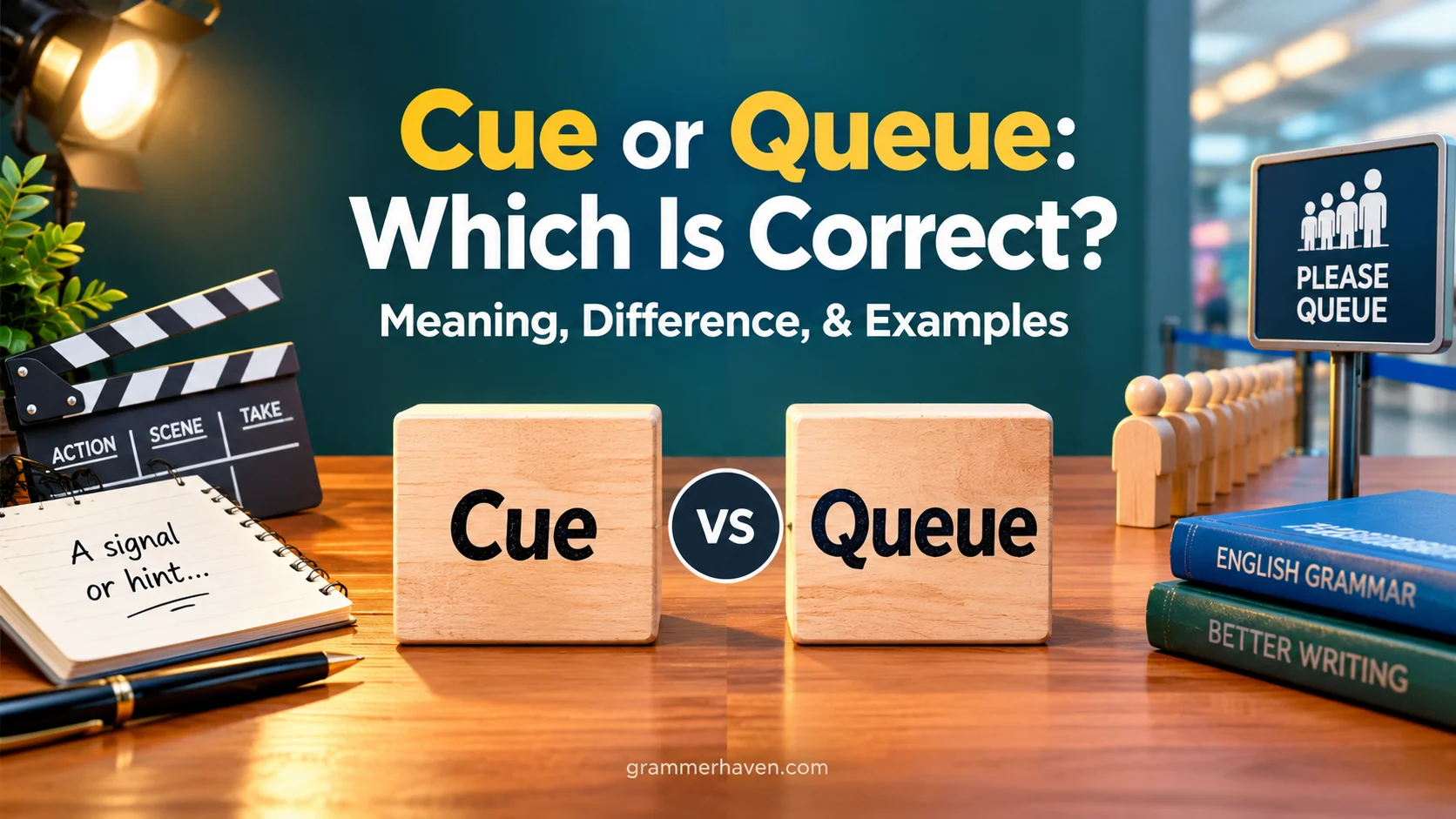
Cue or Queue can confuse readers because both words sound exactly the same when spoken aloud, yet their spellings and meanings differ. In standard English, they have identical pronunciations and are homophones. A cue means a signal or indication that tells you it is time to act or leave, while a queue means a line of people or things waiting for a turn. The distinction comes from the situation and intended meaning.
The difference is clear in American English and the United States. Americans often say line when talking about people waiting somewhere, while queue appears often in computing and technical contexts. In writing, knowing what the word should describe helps you choose the correct word. The answer depends on what you mean, not only on how the word sounds.
Cue also refers to equipment used in a game, especially billiards. The cue can describe the equipment itself, while a queue describes a line or sequence. Using the wrong spelling in writing can invite ridicule, even when the pronunciation is identical. Checking the same thing, the situation and meaning, helps you use each word correctly.
Cue or Queue: Quick Answer
Cue means a signal, prompt, indication, or sign that tells someone to do something. It can also mean the stick used to play pool or billiards.
Queue means a line or sequence of people, vehicles, tasks, files, calls, or other things waiting their turn. In everyday American English, line is usually more natural when you mean people waiting.
| Word | Meaning | Example |
| Cue | A signal or prompt | “The bell was our cue to leave.” |
| Cue | A pool or billiards stick | “He picked up his cue.” |
| Queue | A line of people or vehicles | “We waited in the queue for tickets.” |
| Queue | A sequence of waiting tasks or data | “The file is in the print queue.” |
| Line | Common American term for waiting people | “We waited in line for tickets.” |
The easiest rule is simple:
A cue tells you when to act. A queue tells you when it’s your turn.
What Does “Cue” Mean?
The word cue has several meanings, but they share an important idea: something provides a signal, prompt, or means to initiate an action.
In theater, for example, an actor might wait for another character to say a particular line. That line becomes the actor’s cue to begin speaking.
The word also works far beyond the stage. A facial expression, sound, gesture, event, or change in circumstances can serve as a cue.
Cue as a Signal or Prompt
A cue is something that tells a person what to do or when to do it.
For example:
- “The director gave the actor a cue.”
- “The alarm was my cue to leave.”
- “Her smile was a cue that everything was fine.”
- “The music provided a cue for the dancers.”
- “His silence was my cue to stop talking.”
Notice the common thread. In every example, something signals an action or response.
That makes cue useful in everyday conversation. You don’t need a stage, microphone, or script to have a cue.
If a friend checks the time repeatedly while you’re talking, you might take that behavior as a cue to wrap up the conversation.
Cue as an Indication or Sign
A cue can also mean a clue or indication that helps you understand what is happening.
For example:
“The dark clouds were a cue that a storm was approaching.”
The clouds don’t literally tell you what to do. Instead, they provide information that helps you interpret the situation.
You can find cues in many areas:
- Body language: A crossed-arm posture may be a social cue.
- Conversation: A change in someone’s tone can be a cue.
- Sports: A player’s movement can cue a teammate.
- Education: A visual prompt can cue a student.
- Marketing: Colors and images can provide visual cues.
- Film: Music can cue the audience to expect something dramatic.
This broader meaning explains why phrases such as social cues, visual cues, audio cues, and behavioral cues are so common.
Cue as a Pool or Billiards Stick
There’s another completely different meaning of cue.
A cue is the long, slender stick used to strike the ball in games such as pool, billiards, and snooker. Cambridge lists this as a separate noun meaning.
For example:
- “He bought a new pool cue.”
- “She chalked her cue before taking the shot.”
- “The cue ball rolled toward the corner pocket.”
This meaning has nothing to do with signals. Context makes the intended meaning clear.
Cue as a Verb
Cue can also function as a verb.
When you cue someone, you give that person a signal to do something.
For example:
- “The director cued the actor to enter.”
- “She cued the musicians to begin.”
- “He cued me when it was time to speak.”
The verb also appears in cue someone in, which means to give someone the information they need.
“Can you cue me in on what happened?”
The related forms are cued and cueing.
What Does “Queue” Mean?
Unlike cue, the central meaning of queue involves waiting or arranging things in sequence.
A queue can contain people. It can contain cars. It can even contain computer files or requests waiting to be processed.
Queue as a Line of People
In British English, queue commonly means a line of people waiting for something. Cambridge marks this everyday sense as mainly British and notes that American English usually uses line.
For example:
- “We joined the queue for tickets.”
- “There was a long queue outside the theater.”
- “She waited patiently in the queue.”
- “Someone tried to jump the queue.”
In American English, these would usually become:
- “We joined the line for tickets.”
- “There was a long line outside the theater.”
- “She waited patiently in line.”
- “Someone tried to cut the line.”
Neither queue nor line changes the basic idea. The difference largely reflects regional usage.
Queue as a Sequence of Things
A queue doesn’t have to contain people.
You can have a queue of:
- vehicles
- customer requests
- phone calls
- documents
- emails
- orders
- computer processes
- print jobs
- data packets
This meaning becomes especially important in technology.
For instance, if ten documents are waiting to print, the computer can place those documents in a print queue. The system then processes them according to its rules.
Cambridge specifically defines a computing queue as a series of data, files, calls, or similar items waiting to be handled.
Queue as a Verb
Queue also works as a verb.
In British English, someone can queue or queue up when they wait in line. American English normally uses stand in line or line up instead.
For example:
- British English: “We queued for two hours.”
- American English: “We stood in line for two hours.”
In computing, queue has another verbal use. A system can queue files, calls, or tasks so they can be handled in sequence.
Cue vs. Queue: What’s the Main Difference?
The spelling becomes much easier when you focus on the meaning.
| If you mean… | Use… |
| A signal to do something | cue |
| A theatrical prompt | cue |
| A sign or indication | cue |
| A social signal | cue |
| A pool or billiards stick | cue |
| A line of waiting people | queue |
| A line of vehicles | queue |
| Waiting computer tasks | queue |
| A series of files waiting for processing | queue |
| Everyday waiting line in US English | line |
Think of it this way:
Cue → action.
Queue → waiting.
That tiny mental distinction can prevent most spelling mistakes.
Why Do Cue and Queue Sound the Same?
Cue and queue are homophones. They have different spellings and meanings, but they share the same pronunciation.
Both are pronounced approximately /kjuː/. Cambridge gives this pronunciation for both words in its US English entries.
That’s why someone can say either word aloud and leave you guessing about the spelling.
Consider this sentence spoken aloud:
“That was my cue.”
Now compare:
“That was my queue.”
The two sentences sound identical, but only the first makes sense if the speaker means a signal to act.
The same problem occurs with Q, the name of the letter. Q, cue, and queue all have the same basic pronunciation.
The solution isn’t to memorize their sounds. Listen for the meaning.
Cue or Queue in American English
For American readers, one distinction deserves special attention.
Cue works normally in American English for signals, prompts, indications, and billiards equipment.
Queue also belongs to American English. However, Americans generally don’t use it as the everyday word for a line of people. They usually say line. Cambridge explicitly labels queue as mainly British in this sense and identifies line as the usual US term.
Here’s how the regional difference looks:
| Situation | American English | British English |
| People waiting | line | queue |
| Wait in a line | stand in line | queue |
| Arrange people in a line | line up | queue up |
| Computer processing list | queue | queue |
| Signal to act | cue | cue |
This distinction matters when writing for a particular audience.
If you’re writing for readers in the United States, “We waited in line” will usually sound more natural than “We waited in the queue.”
However, don’t assume queue is somehow wrong in American English. It remains standard in technical vocabulary, especially when discussing computers and systems.
Cue vs. Queue Examples in Sentences
Seeing the words in context makes the difference much clearer.
Examples With “Cue”
- “The ringing phone was her cue to leave.”
- “The director gave the actor his cue.”
- “The lights dimmed as a cue for the performance to begin.”
- “His raised eyebrow was a subtle cue that something was wrong.”
- “The coach used a hand signal as a cue.”
- “The music provided a cue for the dancers.”
- “She took his silence as a cue to change the subject.”
- “He picked up his cue and approached the pool table.”
Examples With “Queue”
- “The customers formed a queue outside the store.”
- “We waited in the queue for tickets.”
- “The printer has three documents in its queue.”
- “Your request has been added to the processing queue.”
- “Several calls were waiting in the telephone queue.”
- “The traffic queue stretched for several miles.”
For American readers, replace queue with line when you’re talking about ordinary people waiting.
Common Expressions With “Cue”
The word cue appears in several useful expressions.
“On Cue”
On cue means that something happens at exactly the expected or appropriate moment. Cambridge defines the phrase as something happening just after it has been expected or mentioned.
For example:
“Right on cue, the rain started.”
The phrase often carries a playful tone. You might say it when something predictable happens at almost suspiciously perfect timing.
“Take Your Cue From”
To take your cue from someone means to use that person’s words or behavior as guidance for what to do.
For example:
“Take your cue from the host and wait before sitting down.”
The idea is simple: observe someone and let their behavior guide your response.
“Cue Someone In”
To cue someone in means to give them information about something they don’t yet know.
For example:
“Can you cue me in on the new schedule?”
It’s especially common in casual conversation.
“Cue Something Up”
Cue something up can mean preparing something so it is ready to play or use.
For example:
“Cue up the next presentation.”
You might hear this phrase when someone controls music, video, slides, or other media.
Common Expressions With “Queue”
The word queue has its own set of expressions.
“Queue Up”
Queue up means to join a line or arrange things so they wait in sequence. In British English, it’s common for people waiting in line.
Example:
“Fans queued up outside the stadium.”
In American English, you’d more naturally say:
“Fans lined up outside the stadium.”
“Jump the Queue”
To jump the queue means to move ahead of people who have already been waiting.
For example:
“Nobody likes it when someone jumps the queue.”
American English usually says cut the line.
“At the Head of the Queue”
Someone at the head of the queue stands at the front.
For example:
“She was at the head of the queue when the doors opened.”
The American equivalent is generally at the front of the line.
Common Mistakes With Cue and Queue
These words cause mistakes because spelling can’t be predicted from pronunciation.
Mistake: “That Was My Queue to Leave”
If you mean a signal, queue is incorrect.
Correct:
“That was my cue to leave.”
The situation gave you an indication that it was time to go.
Mistake: “We Waited in a Cue”
If you mean a line, cue is incorrect.
Correct:
“We waited in a queue.”
For standard American usage, this is even more natural:
“We waited in a line.”
Mistake: Using “Cue” for Computer Tasks
A computer doesn’t put files in a cue.
It puts them in a queue.
For example:
“The print job is in the queue.”
This technical meaning is especially important because queue remains common in American computing terminology.
Mistake: Choosing the Spelling From Sound
This is the biggest trap.
Because cue and queue sound identical, pronunciation won’t tell you which spelling to choose.
Instead, ask:
What does the word mean in this sentence?
If the answer is signal, choose cue.
If the answer is waiting sequence, choose queue.
A Simple Way to Remember Cue vs. Queue
A good memory trick should be quick enough to use without stopping your writing.
Try this:
Cue = signal.
Queue = waiting.
You can also remember:
A cue tells you when to act. A queue tells you when to wait.
There’s another useful American English shortcut:
People waiting → line.
Computer tasks waiting → queue.
That distinction covers a surprisingly large percentage of real-world situations.
Cue vs. Queue vs. Q
These three terms sound alike, but their functions couldn’t be more different.
| Term | Meaning | Example |
| Cue | Signal or prompt | “That was my cue to leave.” |
| Cue | Pool or billiards stick | “He grabbed his cue.” |
| Queue | Waiting line or sequence | “The request is in the queue.” |
| Q | Letter of the alphabet | “Q comes after P.” |
The pronunciation creates the confusion. The context solves it.
If you’re writing the word, don’t ask how it sounds. Ask what you’re describing.
Why Is “Queue” Spelled With So Many Letters?
The spelling queue looks unusual because English inherited it through French. The word ultimately traces back through French queue, meaning “tail,” and earlier forms. Its meaning developed through the idea of things arranged one after another, eventually producing the modern sense of a line of people or things.
That history also explains why the spelling doesn’t look particularly intuitive to modern English speakers.
English has many words whose spellings preserve traces of their linguistic history. Queue is one of the more memorable examples.
The good news? You don’t need to memorize its etymology to spell it correctly.
Just remember:
A queue is a line where things wait their turn.
Cue or Queue: A Practical Decision Guide
When you’re unsure, run through these questions.
Are you talking about a signal or prompt?
→ Use cue.
Are you talking about a pool or billiards stick?
→ Use cue.
Are people waiting in a line?
→ Use queue in British English.
→ Use line in American English.
Are files, calls, data, or tasks waiting to be processed?
→ Use queue.
This gives you a reliable shortcut without memorizing dozens of rules.
A Real-World Comparison: Theater vs. Ticket Line
Imagine you’re attending a play.
Before the show begins, hundreds of people wait outside the theater.
That’s a queue in British English or a line in American English.
Once you enter the theater, an actor waits backstage.
The director gives a signal.
That’s the actor’s cue.
So, within one evening, you could encounter both concepts:
People waiting outside → queue/line
Signal to enter the stage → cue
The pronunciation doesn’t change. The meaning does.
Cue or Queue Practice
Try choosing the correct word before checking the answers.
- The director gave the actor his ___.
- We waited in ___ for coffee.
- The document is in the print ___.
- Her sudden smile was a ___ that everything was fine.
- The dancers moved when they received their ___.
- Several files are waiting in the processing ___.
- He picked up his pool ___.
- Everyone lined up to join the ___.
Answers
- cue
- queue or line in American English
- queue
- cue
- cue
- queue
- cue
- queue or line in American English
The pattern should now be clear. Cue relates to signals and prompts. Queue relates to waiting or sequencing.
See also: Rhythm or Rythm: Which Spelling Is Correct?
FAQs:
Is “cue” or “queue” correct?
Both are correct words. They simply have different meanings. Use cue for a signal, prompt, indication, or billiards stick. Use queue for a waiting line or sequence of tasks and items.
What is the difference between cue and queue?
A cue is a signal that prompts an action. A queue is a line or sequence in which people or things wait their turn.
Do cue and queue sound the same?
Yes. Both are pronounced approximately /kjuː/ in standard English.
Is queue used in American English?
Yes. Queue is standard American English, especially in technical and computing contexts. However, Americans generally use line for a physical line of waiting people.
Should Americans say queue or line?
For people waiting somewhere, line usually sounds more natural in American English. For computer processes, files, calls, and similar technical sequences, queue remains standard.
What does “on cue” mean?
On cue means that something happens at the expected or appropriate moment.
What does “queue up” mean?
In British English, queue up means to stand in line and wait. In American English, line up is normally preferred for people.
Is “cue” a verb?
Yes. Cue can mean to give someone a signal to begin an action.
Is “queue” a verb?
Yes. Queue can mean to wait in line or arrange tasks in sequence for processing.
Is a computer queue the same as a waiting line?
The concepts are closely related. A computer queue contains tasks, files, requests, or data waiting to be processed. It uses the same basic idea of taking turns in sequence.
Conclusion:
Understanding Cue or Queue becomes easier when you focus on meaning, not just pronunciation. Use cue for a signal, indication, or billiards equipment, and use queue for a line of people or things waiting for a turn. Although these homophones sound identical, their spelling and usage are completely different.