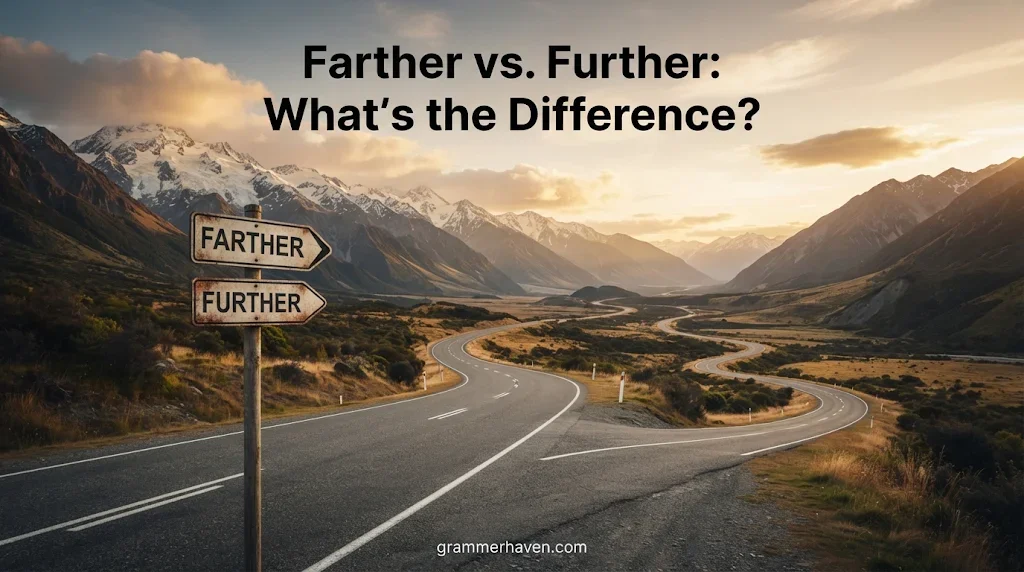
Farther vs. Further confuses many readers because these similar words describe physical distance, extra details, and different kinds of meaning. Farther refers to an actual distance between two physical locations. Further refers to additional information, extra details, or an abstract idea. You can use farther when discussing miles, meters, travel, or a journey.
You can use further when talking about a discussion, explanation, or something that needs more attention. For instance, “The store is farther than I expected” describes a measurable distance. “We need to discuss this matter further” refers to adding more information. These practical examples make the grammar distinction easier to understand. In everyday English, correct word choice improves sentence clarity, grammar accuracy, and communication.
Understanding contextual meaning helps English learners avoid common grammar mistakes in spoken English, written English, and everyday writing. A simple grammar guide with useful sentence examples can improve language learning without complicated rules or unnecessary memorization. The same patterns apply to modern English, school grammar, English lessons, and language practice. Learning the difference supports better English usage, sentence structure, and polished English. Resources such as Learna Language and svgLearna Language can support your grammar learning process and help you develop confidence in English writing and English speech.
Farther vs. Further: Why This Confuses So Many People
At first glance, these words look like twins with slightly different outfits. They share the same root idea of “distance,” which is exactly why people mix them up.
But English does something interesting here. It splits them into two different types of distance:
- Farther = physical distance
- Further = abstract or figurative distance
That simple split explains most of what you need to know.
Still, English rarely stays that tidy. Usage has evolved, and context sometimes blurs the line. That’s why people second-guess themselves even after learning the rule.
Let’s fix that for good.
Farther vs. Further Meaning Explained in Plain English
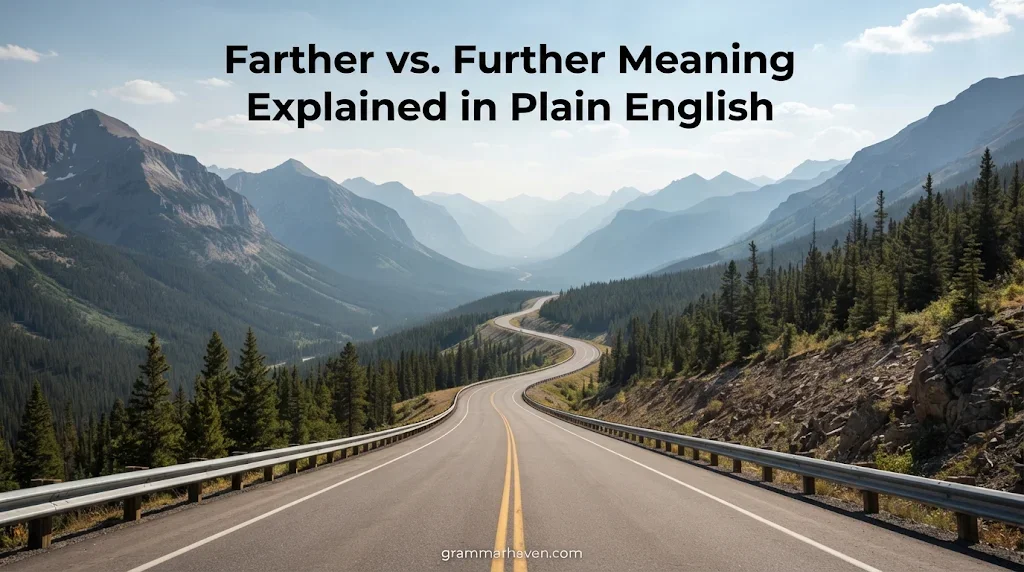
Farther = measurable physical distance
Use farther when you can literally measure space between two points.
Think:
- Miles
- Kilometers
- Steps
- Blocks
- Travel distance
It answers one simple question: How far physically?
Examples:
- The next town is farther than I expected.
- She ran farther than anyone else in the race.
- We moved farther away from the city center.
A useful mental image is a measuring tape. If you can stretch it out and measure it, farther fits.
Further = abstract progress or non-physical distance
Use further when you are talking about ideas, progress, or metaphorical movement.
Think:
- Knowledge
- Discussion
- Time
- Effort
- Career growth
It answers a different question: How much more or to what extent?
Examples:
- We need to discuss this further.
- He studied further after finishing college.
- The company plans to further expand its services.
Here, nothing physical is being measured. Instead, something is being developed or extended conceptually.
The Simple Rule That Actually Works in Real Life
Forget complicated grammar explanations for a moment. This rule works almost every time:
- If you can physically measure it, use farther
- If you cannot measure it physically, use further
A quick memory trick
- Farther = far distance you can see
- Further = future ideas moving forward
That small association helps you choose quickly without hesitation.
Where Farther vs. Further Gets Confusing
Here’s where things get tricky. Even native speakers mix these up.
The overlap problem
In modern English, especially spoken English, people often use further for everything, including physical distance.
Example:
- How much further is the airport?
Technically, many grammar guides prefer farther here because it is physical distance. But in real conversation, “further” is widely accepted.
So what does that mean for you?
It means:
- The rule exists
- But usage is flexible in casual English
Why this overlap exists
Three main reasons:
- Language evolves naturally over time
- Speakers prioritize clarity over strict grammar rules
- Style differences exist between regions and publications
So instead of thinking in absolutes, think in preferred usage vs accepted usage.
The Hidden Rule: Further Works as a Verb (Farther Does Not)
This is the part most people never learn properly.
Only further can act as a verb.
Further as a verb means:
To advance, promote, or help something progress.
Examples:
- She worked hard to further her career.
- The research furthered medical understanding.
- He hopes to further his education abroad.
Try replacing “further” with “farther” in these sentences and it breaks instantly.
🚫 “He hopes to farther his education.”
This is incorrect in standard English.
This single rule alone makes further more versatile than farther.
US vs UK Usage: Small but Noticeable Differences
English does not behave exactly the same everywhere.
American English usage
In the United States:
- Farther = physical distance
- Further = abstract meaning + verb use
American writing styles like AP Style tend to reinforce this distinction.
British English usage
In British English:
- The distinction is less strict
- Further often covers both meanings in everyday speech
So you might hear:
- “How much further is it?” in both literal and figurative contexts
This flexibility often confuses learners who switch between media sources from both regions.
What Major Style Guides Actually Say
Let’s ground this in real editorial standards.
AP Stylebook (widely used in journalism)
- Farther = measurable physical distance
- Further = figurative meaning and verb form
Chicago Manual of Style
- Encourages the same distinction
- Allows flexibility when clarity is not affected
Practical takeaway
Professional writers often follow the rule but bend it when:
- The sentence sounds awkward
- The meaning is still clear without strict separation
So grammar is a guideline, not a cage.
Farther vs. Further Examples Side by Side
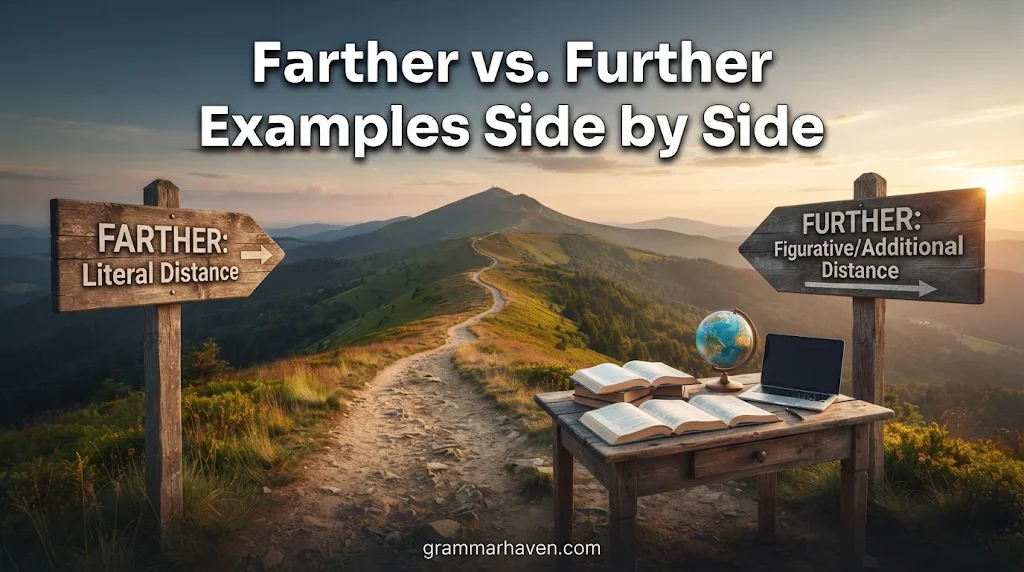
Seeing them together makes the difference obvious.
| Context | Correct Word | Example Sentence |
| Physical distance | Farther | He walked farther than I did. |
| Physical distance | Farther | The store is farther down the road. |
| Abstract progress | Further | Let’s discuss this further. |
| Education or development | Further | She studied further in law school. |
| Business growth | Further | The company further expanded globally. |
Once you see patterns like this, choosing becomes automatic.
Real-World Case Study: How Misuse Can Change Tone
Imagine a travel article describing a hiking trail:
Incorrect usage:
- “The trail goes further into the mountains.”
Correct and clearer version:
- “The trail goes farther into the mountains.”
Now imagine a business report:
Correct usage:
- “The team will further analyze the data.”
If you swapped words here, the meaning would still be understandable, but it would feel slightly off in tone.
This is where precision matters most:
- Travel writing → prefers farther
- Academic or business writing → prefers further
Memory Tricks That Actually Stick
Forget boring grammar drills. Use mental shortcuts instead.
Trick 1: The “FAR test”
- If it’s physically FAR → farther
Trick 2: The “future idea test”
- If it’s about ideas or progress → further
Trick 3: Visualization method
- Farther = a road stretching ahead
- Further = a conversation going deeper
These mental images stick better than definitions.
Common Mistakes People Make
Let’s fix the biggest errors quickly.
Mistake 1: Using “farther” for abstract ideas
- Incorrect: Let’s discuss this farther
- Correct: Let’s discuss this further
Mistake 2: Avoiding “further” completely
Some learners overcorrect and only use “farther.” That creates awkward sentences.
Mistake 3: Overthinking casual speech
In real conversation, clarity matters more than strict grammar.
So instead of stressing, focus on meaning first.
Quick Practice Test: Farther or Further?
Try these:
- How much ___ do we need to drive?
- Let’s take this conversation ___
- She ran ___ than anyone else
- He wants to ___ his career
Answers:
- farther
- further
- farther
- further
If you got most right, you’ve already mastered the rule.
Etymology: Where These Words Come From
Understanding origin helps the distinction feel less random.
Farther
- Comes from Old English further and feorr
- Evolved into comparative form of “far”
- Eventually specialized into physical distance use
Further
- Comes from Old English furthor
- Originally meant “more forward” or “additional”
- Expanded into abstract and verbal meanings over time
Historically, they started closer together. Over centuries, usage split based on clarity needs in communication.
See also: Result In or Result To: Which Is Correct? (With Examples)
FAQs:
Can I use further for distance?
Yes, especially in casual English. But “farther” is more precise for physical measurement.
Is farther outdated?
Not at all. It remains standard in formal writing and measurement contexts.
Why do people mix them up so often?
Because both words come from the same root idea of “distance,” and modern English allows overlap.
Which one sounds more formal?
“Further” often appears in formal writing, especially academic and business contexts.
Is the rule strict?
Not anymore. It is more of a preference guideline than a hard rule.
Conclusion:
Understanding Farther vs. Further becomes easier when you focus on the meaning of each word. Use farther for physical distances that you can measure in miles or meters. Choose further when discussing additional information, deeper explanations, or abstract ideas. Both words have important roles in everyday English, spoken conversations, and professional writing. Learning this simple grammar distinction helps you avoid common mistakes, improve word choice, and write clearer sentences. With regular practice and attention to context, you can use both words naturally and develop stronger English communication skills.
Latest Posts
- Is It Correct to Say “A Big Congratulations”? The Complete Grammar Guide
- Two Crows Being an Attempted Murder: Meaning, Origins & Real Behavior
- Farther vs. Further: What’s the Difference?
- Result In or Result To: Which Is Correct? (With Examples)
- A Dime a Dozen: Meaning, Definition, Origin and Real-Life Usage