“A Big Congratulations”? is a common English phrase used in casual conversations, social media posts, graduation messages, and professional emails. People use this expression to celebrate someone’s success and express excitement about their achievements. It adds warmth, pride, and joy when congratulating someone. The words carry an enthusiastic weight and give the message extra punch and grandeur. The expression sounds natural in everyday conversation, but it can create confusion in formal writing. Writers often question whether it is correct English or an example of the flexible nature of the English language. Grammar experts consider it grammatically questionable under standard English grammar, even though it remains widely accepted in informal communication.
The main grammatical issue concerns the word congratulations, which functions as an uncountable noun in this expression and is usually used on its own. It does not normally have a singular form or a separate plural form. This creates an interesting difference between everyday language and grammatical correctness. A closer look through the rules of English grammar makes the problem clear.
You can use simpler alternatives to avoid this linguistic faux pas while keeping your message natural and meaningful. “Congratulations,” “many congratulations,” and “heartfelt congratulations” are suitable expressions for different situations. These phrases help you recognize achievements and share a positive message without unnecessary grammatical questions. In my experience with everyday English, straightforward expressions make communication clearer and more effective. You can express genuine enthusiasm without making your writing complicated. Understanding these small grammatical exceptions also helps writers use English with greater confidence.
Is “A Big Congratulations” Grammatically Correct?
If you follow traditional English grammar rules, “a big congratulations” is generally not considered the best choice.
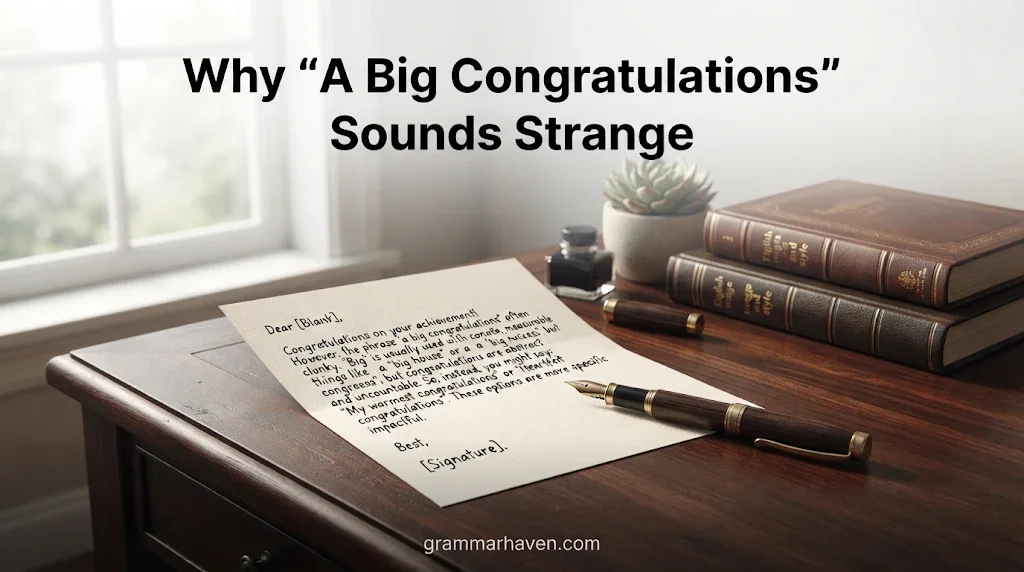
The issue lies in the word “congratulations.” Although it refers to a single message or expression of praise, English treats it as a plural noun in most contexts.
Because the article “a” usually accompanies singular countable nouns, combining it with “congratulations” creates a grammatical mismatch.
Consider these examples:
| Phrase | Grammatical Status |
| A congratulations | Incorrect |
| A big congratulations | Questionable |
| Congratulations | Correct |
| Many congratulations | Correct |
| Heartfelt congratulations | Correct |
Examples
❌ A big congratulations to Sarah on her promotion.
✅ Congratulations to Sarah on her promotion.
✅ Many congratulations to Sarah on her promotion.
Even though many native speakers use “a big congratulations,” grammar-focused editors often replace it with a more conventional alternative.
Why “A Big Congratulations” Sounds Strange
To understand the problem, it helps to examine the word itself.
Understanding the Word “Congratulations”
The word “congratulations” comes from the verb “congratulate,” which means to express pleasure about someone’s achievement, success, or good fortune.
Interestingly, English usually uses “congratulations” as a fixed plural expression.
For example:
- Congratulations on your graduation.
- Congratulations on your new job.
- Congratulations on the birth of your child.
Notice that nobody normally says:
- Congratulation on your graduation.
That sounds unusual because modern English overwhelmingly prefers the plural form.
Similar Expressions in English
Several English expressions work the same way:
| Expression | Common Usage |
| Congratulations | Standard |
| Greetings | Standard |
| Regards | Standard |
| Thanks | Standard |
| Best wishes | Standard |
These words often function as complete expressions even though they appear in plural form.
Because of this pattern, adding the singular article “a” feels unnatural to many speakers.
Why the Article “A” Creates a Problem
The article “a” generally introduces a singular countable noun.
Examples include:
- A book
- A car
- A message
- A letter
However, “congratulations” is not typically treated as a singular noun.
When you say “a big congratulations,” the sentence combines:
- A singular article (“a”)
- A plural noun (“congratulations”)
That combination creates tension between standard grammar rules and everyday speech.
A Simple Comparison
| Correct Pattern | Incorrect Pattern |
| A big achievement | A big congratulations |
| A heartfelt message | A heartfelt congratulations |
| A sincere note | A sincere congratulations |
This comparison helps explain why some grammar experts dislike the phrase.
Why Do People Say “A Big Congratulations”?
If the phrase is grammatically questionable, why is it so popular?
The answer lies in how language evolves.
People do not always speak according to strict grammatical rules. Instead, they often prioritize emotion, emphasis, and ease of communication.
The Desire to Add Emphasis
Imagine your friend wins an Olympic medal.
Simply saying:
Congratulations!
might feel too short.
As a result, people naturally try to strengthen the expression:
- Big congratulations!
- Huge congratulations!
- Massive congratulations!
These versions add excitement and emotional weight.
Social Media’s Influence
Platforms such as LinkedIn, Facebook, Instagram, and X have helped popularize phrases like:
- A big congratulations to our team!
- A huge congratulations to our graduates!
- A massive congratulations to the winners!
These expressions attract attention and sound enthusiastic, which explains their widespread use.
Marketing and Corporate Communication
Businesses frequently favor energetic language.
For example:
A big congratulations to our Employee of the Month!
While this may not satisfy every grammar purist, many audiences understand the message immediately.
Communication often succeeds even when grammar bends slightly.
What Dictionaries and Grammar Authorities Say
Most dictionaries define “congratulations” as an expression used to praise someone’s success or achievement.
The key point is that dictionaries generally present it in its plural form.
Examples often include:
- Congratulations on your success.
- Congratulations on passing the exam.
- Congratulations on your wedding.
You will rarely find dictionaries recommending “a congratulations” as standard usage.
What Professional Editors Prefer
Editors commonly recommend:
- Congratulations
- Many congratulations
- Warm congratulations
- Heartfelt congratulations
These options avoid the grammatical concerns associated with “a big congratulations.”
A Practical Rule
When writing:
- Academic papers
- Business reports
- Professional correspondence
- Published articles
Choose “congratulations” rather than “a big congratulations.”
Better Alternatives to “A Big Congratulations”
Fortunately, English offers many excellent alternatives.
Congratulations
This is the simplest and most universally accepted option.
Example:
Congratulations on your promotion.
Many Congratulations
This expression appears frequently in British English and international English.
Example:
Many congratulations on your achievement.
Heartfelt Congratulations
Ideal for personal milestones and meaningful accomplishments.
Example:
Heartfelt congratulations on your wedding.
Warm Congratulations
Professional yet friendly.
Example:
Warm congratulations on your new position.
Sincere Congratulations
Useful in formal communication.
Example:
Sincere congratulations on receiving the award.
Huge Congratulations
Informal but widely accepted.
Example:
Huge congratulations to the championship team.
Comparison of Common Alternatives
| Expression | Formality Level | Naturalness | Recommended |
| Congratulations | High | Very High | Yes |
| Many congratulations | High | Very High | Yes |
| Heartfelt congratulations | High | High | Yes |
| Warm congratulations | Medium-High | High | Yes |
| Sincere congratulations | High | High | Yes |
| Huge congratulations | Medium | High | Yes |
| Big congratulations | Medium | High | Usually |
| A big congratulations | Low | Debated | Generally No |
This table makes one thing clear.
You have many stronger alternatives available.
Is “Big Congratulations” Correct Without “A”?
Interestingly, many language experts view “big congratulations” more favorably than “a big congratulations.”
Why?
Because removing the article eliminates the singular-versus-plural conflict.
Examples
- Big congratulations to the entire team.
- Big congratulations on your success.
- Big congratulations to everyone involved.
These examples sound more natural than:
- A big congratulations to the entire team.
Why It Feels Better
The adjective “big” simply modifies the expression without introducing the problematic article.
As a result, many speakers find this version smoother and more acceptable.
“A Big Congratulations” vs “Big Congratulations”
The difference may seem small, but it matters.
| Phrase | Grammar | Common Usage | Formal Writing |
| A Big Congratulations | Questionable | Common | Not Recommended |
| Big Congratulations | Generally Acceptable | Very Common | Sometimes Acceptable |
| Congratulations | Fully Correct | Extremely Common | Recommended |
If your goal is accuracy and professionalism, “congratulations” remains the strongest choice.
Real-World Examples of Correct Usage
Understanding grammar becomes easier when you see practical examples.
Workplace Achievements
When a colleague receives a promotion, consider these options:
- Congratulations on your promotion.
- Many congratulations on your new role.
- Warm congratulations on this well-deserved achievement.
These phrases sound polished and professional.
Academic Success
Students often celebrate:
- Graduations
- Scholarships
- Awards
- Research accomplishments
Suitable expressions include:
- Congratulations on graduating with honors.
- Heartfelt congratulations on your academic success.
- Many congratulations on earning your degree.
Sports Victories
Athletes receive congratulations after:
- Winning championships
- Breaking records
- Earning medals
Examples:
- Huge congratulations on your victory.
- Congratulations on an outstanding performance.
- Warm congratulations to the champions.
Personal Milestones
Life events often call for more personal language.
Examples:
- Congratulations on your engagement.
- Congratulations on your new home.
- Heartfelt congratulations on the birth of your child.
These expressions sound genuine without introducing grammatical concerns.
Common Mistakes Related to “Congratulations”
Many writers make similar errors when using congratulatory expressions.
Understanding them can improve your English immediately.
Mistake: Saying “A Congratulations”
Incorrect:
A congratulations to everyone involved.
Correct:
Congratulations to everyone involved.
The article creates the same problem discussed earlier.
Mistake: Using “Congratulation” by Itself
Incorrect:
Congratulation on your success.
Correct:
Congratulations on your success.
Modern English overwhelmingly favors the plural form.
Mistake: Overloading the Sentence
Sometimes writers try too hard to add emphasis.
Example:
A huge massive gigantic congratulations to everyone.
This sounds awkward.
A cleaner version works better:
Congratulations to everyone.
Or:
Huge congratulations to everyone.
Simple language often creates a stronger impact.
British English vs American English
Another source of confusion involves regional preferences.
British English
British speakers frequently use:
Many congratulations.
This phrase appears in:
- Newspapers
- Professional correspondence
- Academic settings
- Everyday conversation
It sounds completely natural in the United Kingdom.
American English
American speakers generally prefer:
Congratulations.
The shorter form dominates business communication and casual speech.
What Both Varieties Agree On
Despite minor differences, both British and American English largely agree on one point:
“Congratulations” is the safest and most accepted expression.
Neither variety strongly endorses “a congratulations.”
The Evolution of Informal English
Language changes constantly.
Words and expressions that once sounded incorrect sometimes become accepted over time.
For example:
- Email became a standard word.
- Google became a verb.
- Text became a verb.
Because language evolves, some people argue that frequent use of “a big congratulations” may eventually increase its acceptance.
However, widespread usage does not automatically make a phrase grammatically standard.
A Useful Analogy
Think of language like a busy city.
Grammar provides traffic rules.
Everyday speakers occasionally take shortcuts.
Some shortcuts eventually become official roads.
Others remain unofficial paths.
At present, “a big congratulations” sits somewhere in the middle.
People use it regularly, yet many grammar authorities still prefer traditional alternatives.
When Can You Use “A Big Congratulations”?
There are situations where the phrase may not cause problems.
Casual Social Media Posts
Examples include:
- Instagram captions
- Facebook updates
- LinkedIn celebrations
- Community announcements
In these contexts, readers focus more on enthusiasm than grammar.
Friendly Messages
You might write:
A big congratulations to my best friend on her new job!
Most readers will understand the sentiment immediately.
Team Celebrations
Organizations often prioritize positivity and energy.
As a result, phrases like:
A big congratulations to our sales team!
appear frequently.
When You Should Avoid “A Big Congratulations”
Certain situations require greater grammatical precision.
Avoid the phrase in:
- Academic papers
- University assignments
- Research publications
- Formal business reports
- Professional proposals
- Official correspondence
- Legal documents
In these contexts, use standard alternatives instead.
Quick Decision Guide
Use this simple chart whenever you’re unsure.
| Situation | Best Choice |
| Formal email | Congratulations |
| Business announcement | Congratulations |
| Academic writing | Congratulations |
| Wedding card | Heartfelt congratulations |
| Promotion message | Warm congratulations |
| Social media post | Big congratulations |
| Casual text message | Big congratulations |
| Formal publication | Congratulations |
Examples You Can Copy
Professional
Congratulations on your well-deserved promotion.
Warm congratulations on this remarkable achievement.
Sincere congratulations on receiving this prestigious award.
Personal
Heartfelt congratulations on your wedding day.
Congratulations on your new home.
Many congratulations on the arrival of your baby.
Informal
Big congratulations to everyone who made this happen!
Huge congratulations on passing the exam!
Congratulations! You earned it.
See also: Two Crows Being an Attempted Murder: Meaning, Origins & Real Behavior
FAQs:
Is “a big congratulations” grammatically correct?
Many grammar experts consider it grammatically questionable because “congratulations” functions as a plural noun while “a” is a singular article.
Is “big congratulations” better than “a big congratulations”?
Yes. Many writers prefer “big congratulations” because it removes the article that creates the grammatical conflict.
Can “congratulations” be singular?
In modern English, the plural form dominates. The singular form “congratulation” appears rarely and sounds unnatural in most everyday situations.
Is “many congratulations” correct?
Yes. It is widely accepted and especially common in British English.
What is the most professional way to congratulate someone?
Simply saying “Congratulations” remains the safest and most professional option.
What sounds most natural to native speakers?
In most contexts, native speakers prefer:
- Congratulations
- Many congratulations
- Heartfelt congratulations
- Warm congratulations
These expressions sound natural and grammatically solid.
Conclusion:
The phrase “a big congratulations” is common in casual conversations, social media posts, and everyday messages. However, it is not considered grammatically correct in standard English because congratulations does not normally take the article “a.” You can use “many congratulations,” “heartfelt congratulations,” or simply “congratulations” to express happiness and appreciation for someone’s achievements. These alternatives sound more natural and work well in both professional and informal communication. Understanding this small grammar difference helps you choose the right expression and communicate with greater confidence.
Latest Posts
- Is It Correct to Say “A Big Congratulations”? The Complete Grammar Guide
- Two Crows Being an Attempted Murder: Meaning, Origins & Real Behavior
- Farther vs. Further: What’s the Difference?
- Result In or Result To: Which Is Correct? (With Examples)
- A Dime a Dozen: Meaning, Definition, Origin and Real-Life Usage