This Is She or This Is Her can cause confusion when a friend calls and says, “May I speak with Emma?” You may hesitate while answering because both are common expressions. In traditional grammar, she is the subject form of the pronoun, while her can be an object or possessive determiner. The formal rule expects she, making This is she the accepted choice in formal situations. It identifies the person speaking and uses a subject pronoun that matches the implied subject of the sentence. Here, this refers to I, so you are referring to yourself and identifying yourself.
Everyday English shows a different pattern in real conversations. Modern conversational English frequently uses This is her, and many speakers consider it more natural. The difference depends on the kind of English, context, and formality. The Chicago Manual of Style supports the formal pattern associated with traditional grammar, while actual usage shows both forms in real communication. When someone asks for you over the phone, you can respond with This is she when you want to sound grammatically correct in formal speech. This is her uses the object pronoun her, which does not fit the traditional grammatical analysis of the subject, though it is widely heard when talking about yourself in conversation.
In today’s world, making a good impression over the phone can matter as much as in person. The words you say reveal how you use English, but don’t worry if you are not sure which right pronoun to use. You are not alone because people often stumble over this question. English has tricky rules and different constructions, so knowing the answer makes your response easier. The key point is simple: This is she follows the formal, traditional rule, while This is her reflects common actual usage in conversational English. Grammatically speaking, the traditional form remains This is she.
Quick Answer: Is It “This Is She” or “This Is Her”?
“This is she” is the traditional formal construction. “This is her” is extremely common in everyday spoken English.
When someone calls and asks for you by name, you can say:
“May I speak with Sarah?”
“This is she.”
That follows the traditional grammatical analysis.
In ordinary conversation, however, many people naturally say:
“May I speak with Sarah?”
“This is her.”
The Chicago Manual of Style notes that “This is she” follows the traditional grammar of a linking verb, while common usage has made the alternative widespread.
| Expression | Grammar tradition | Everyday usage | Tone |
| This is she. | Traditionally preferred | Less common | Formal or traditional |
| This is her. | Traditionally disputed | Very common | Conversational |
| This is Sarah. | Clear and standard | Very common | Neutral |
| Sarah speaking. | Standard | Very common | Natural and direct |
So, if you’re writing something formal or following traditional grammar rules, “This is she” is the safer choice. If you’re having a casual conversation, “This is her” sounds perfectly natural to many English speakers.
What Does “This Is She” Mean?
“This is she” means that the person speaking is the female person someone has asked for or identified.
For example:
“May I speak with Ms. Carter?”
“This is she.”
The speaker means:
“You are speaking with Ms. Carter.”
The phrase uses she, the subject form of the pronoun. Traditional grammar analyzes she as a subject complement after the linking verb is. In this construction, is connects this with she rather than describing an action performed on an object.
That’s why traditional grammar treats the sentence differently from a sentence such as:
“I called her.”
In that sentence, her receives the action of called. It functions as an object.
With “This is she,” the pronoun identifies the subject rather than receiving an action.
When Should You Use “This Is She”?
“This is she” works especially well when you want a formal or traditional tone.
You might use it when:
- Answering a professional phone call
- Responding to a formal inquiry
- Writing dialogue that intentionally sounds formal
- Following traditional grammar rules
- Taking a grammar examination that expects the traditional construction
For example:
“May I speak with Dr. Wilson?”
“This is she.”
The sentence sounds polished and somewhat formal.
That tone isn’t necessarily a problem. In fact, it can be useful in professional settings. However, it may sound more formal than ordinary conversation requires.
What Does “This Is Her” Mean?
“This is her” can also identify a particular woman or girl. The difference lies mainly in the pronoun form and the grammatical analysis behind it.
Consider this conversation:
“Which person in the photograph is your sister?”
“This is her.”
Here, her sounds completely natural in everyday English.
You might also hear:
“Is Maria there?”
“Yes, this is her.”
The expression is widespread in spoken English. A Voice of America English discussion from 2002 explained that “This is she” follows the traditional grammatical rule, while “This is her” had become more natural in common usage.
That distinction remains useful today: grammar books and style guides can preserve traditional rules even while everyday speech moves toward different patterns.
Why Do People Say “This Is Her”?
English speakers don’t always use pronouns according to the strict patterns taught in traditional grammar lessons.
Compare these pairs:
- It is I. → traditional/formal
- It is me. → ordinary modern speech
- This is she. → traditional/formal
- This is her. → ordinary modern speech
- That is he. → traditional/formal
- That’s him. → ordinary modern speech
The pattern becomes easier to recognize when you look at familiar expressions.
Most people naturally say:
“It’s me.”
Few people use:
“It is I.”
The same shift helps explain why “This is her” feels natural even though traditional grammar favors “This is she.”
The Grammar Behind “This Is She”
To understand the debate, you need to understand linking verbs.
A linking verb connects a subject with information that identifies or describes that subject. Forms of be, such as is, am, are, was, and were, commonly work this way.
Consider:
“Sarah is the manager.”
The verb is connects Sarah with the manager. The second part identifies the first.
Now consider:
“This is she.”
The traditional analysis treats she as a complement that identifies this.
The Chicago Manual of Style explains this traditional reasoning by noting that be acts as a linking verb and connects the subject with its complement.
Subject Pronouns vs. Object Pronouns
The distinction becomes clearer when you compare pronoun forms.
| Subject Pronoun | Object Pronoun | Example |
| I | me | I called her. |
| you | you | You called me. |
| he | him | He called her. |
| she | her | She called him. |
| we | us | We invited them. |
| they | them | They invited us. |
She belongs to the subject column.
Her belongs to the object column.
For example:
She called John.
Here, she performs the action.
John called her.
Here, her receives the action.
The unusual part comes when the verb is be. That’s where traditional grammar treats the following pronoun as a complement rather than an ordinary object.
“This Is She” vs. “This Is Her”: Side-by-Side Comparison
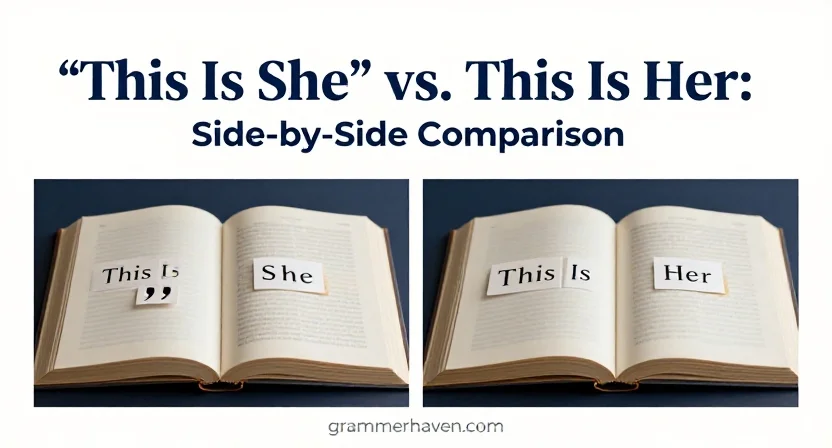
The easiest way to see the distinction is to compare the two expressions directly.
| Feature | This Is She | This Is Her |
| Pronoun form | Subject | Object |
| Traditional grammar | Preferred | Less preferred |
| Modern conversation | Less common | Very common |
| Tone | Formal or traditional | Casual and natural |
| Phone identification | Grammatically traditional | Common in speech |
| Informal identification | Can sound stiff | Usually sounds natural |
| Formal writing | Suitable | Context-dependent |
| Meaning | Identifies the woman | Identifies the woman |
The key point is that the meaning usually remains the same. The difference mainly concerns grammatical analysis and register.
Think of it like clothing. “This is she” can sound like formal business attire. “This is her” sounds more like everyday clothes. Both communicate the same basic identity, but they create different impressions.
Is “This Is Her” Grammatically Correct?
The answer depends on what you mean by correct.
Under a traditional prescriptive grammar rule, “This is she” is preferred because she functions as the complement of the linking verb is. That’s the approach reflected in traditional grammar references.
However, real English usage doesn’t always follow that traditional pattern.
“This is her” is widespread in modern spoken English. It isn’t an obscure mistake that nobody uses. Native speakers regularly use object-form pronouns in constructions involving be, especially in informal conversation.
The practical distinction is therefore:
- Traditional formal grammar: “This is she.”
- Modern conversational English: “This is her.”
- Neutral alternative: “This is Sarah.”
The third option is especially useful when you don’t want to think about pronoun case at all.
Is “This Is She” Outdated?
Not exactly.
“This is she” remains grammatically recognized and useful. However, it can sound formal, stiff, or old-fashioned in casual conversation.
Imagine a friend calls you:
“Hey, is this Rachel?”
You could answer:
“This is she.”
That’s grammatically traditional, but it may sound unusually formal for a casual call.
You could instead say:
“Yep, this is her.”
Or simply:
“Speaking.”
The latter choices fit relaxed conversation more naturally.
So “this is she” isn’t wrong simply because it sounds formal. Formality and grammaticality aren’t the same thing.
“This Is She” or “This Is Her” on the Phone
Telephone conversations are where this question appears most often.
Suppose someone calls your office and asks:
“May I speak with Jennifer?”
If you’re Jennifer, you could answer:
“This is she.”
That’s the traditional formal response.
You could also say:
“This is Jennifer.”
That’s clear, professional, and avoids the pronoun question.
In casual conversation, you might hear:
“This is her.”
All three communicate the same basic idea.
Phone Call Examples
Formal:
Caller: “May I speak with Ms. Davis?”
Ms. Davis: “This is she.”
Neutral:
Caller: “May I speak with Ms. Davis?”
Ms. Davis: “This is Ms. Davis.”
Conversational:
Caller: “Is this Emma?”
Emma: “Yes, this is her.”
Very natural:
Caller: “Can I speak with Emma?”
Emma: “Speaking.”
The best response depends on the relationship and setting.
“This Is She” or “This Is Her” When Identifying Someone
The situation changes slightly when you’re identifying another person rather than announcing your own identity.
For example:
“Which woman is your sister?”
A natural response is:
“This is her.”
You could point toward the woman while saying it.
Now imagine trying:
“This is she.”
That sounds much more formal and may feel unnatural in ordinary conversation.
You can also avoid the issue completely:
“This is my sister, Maria.”
That’s often the clearest option because the person’s name provides the identification directly.
A Useful Distinction
Compare these sentences:
This is her.
This identifies the woman.
This is her coat.
This shows possession.
The word her has different functions in those sentences. In the second example, her clearly works as a possessive determiner.
Common Examples of “This Is She”
Here are several situations where the traditional form works naturally.
Professional Phone Call
“May I speak with Mrs. Taylor?”
“This is she.”
Formal Identification
“Are you Dr. Morgan?”
“Yes, this is she.”
Formal Dialogue
“We were told to contact Ms. Green.”
“This is she.”
Negative Identification
“Is this Ms. Parker?”
“No, this isn’t she.”
The expression can sound formal because modern speakers often prefer different constructions in casual speech.
Common Examples of “This Is Her”
Now compare those examples with ordinary conversational English.
Identifying Someone in a Photo
“Who is standing beside you?”
“This is her.”
Pointing Someone Out
“Which woman is your manager?”
“This is her.”
Casual Phone Conversation
“Is this Megan?”
“Yes, this is her.”
Talking About Someone
“Which person did you meet yesterday?”
“This is her.”
In these contexts, “this is her” can sound much more relaxed and natural.
What About “This Is Him” and “This Is He”?
The same issue appears with masculine pronouns.
Traditional grammar favors:
“This is he.”
Modern conversation often uses:
“This is him.”
The pattern is identical:
| Traditional form | Conversational form |
| This is she. | This is her. |
| This is he. | This is him. |
| It is I. | It is me. |
| That is they. | That’s them. |
These examples show that the issue isn’t really about she and her alone. It reflects a broader pattern in English involving pronoun case after linking verbs.
What About “It’s She” and “It’s Her”?
You may encounter the same debate with “It’s she” and “It’s her.”
Traditional grammar generally favors the subject form:
“It is she.”
Modern English strongly favors:
“It’s her.”
The difference becomes obvious when you compare it with “It’s me.”
Most speakers find:
“It’s me.”
completely natural.
The more traditional:
“It is I.”
sounds formal to many modern speakers.
This doesn’t mean traditional grammar has disappeared. Instead, spoken English has developed patterns that differ from older prescriptive rules.
Common Mistakes With “This Is She” and “This Is Her”
Using “Her” as a Subject
Don’t confuse her with she when the pronoun performs an action.
Incorrect:
“Her called me yesterday.”
Correct:
“She called me yesterday.”
The person performs the action, so she is required.
Using “She” as an Ordinary Object
When the woman receives the action, use her.
Incorrect:
“I called she yesterday.”
Correct:
“I called her yesterday.”
This is a straightforward subject-object distinction.
Assuming “This Is Her” Is Always Wrong
That rule is too broad.
“This is her” is widespread in modern spoken English. Treating every conversational use as an outright error ignores actual English usage.
Assuming “This Is She” Sounds Natural Everywhere
The opposite mistake is also common.
Although “This is she” follows the traditional formal rule, it can sound overly formal in a relaxed conversation.
Grammar isn’t only about structure. Register matters too.
How to Choose Between “This Is She” and “This Is Her”
Use the situation as your guide.
Choose “This Is She” When:
- You’re following traditional grammar.
- You’re in a formal professional setting.
- You’re answering a formal telephone inquiry.
- You’re writing dialogue with a formal tone.
- A grammar exercise specifically tests subject-complement pronouns.
Choose “This Is Her” When:
- You’re speaking casually.
- You’re identifying someone in conversation.
- You’re pointing someone out in a photo.
- You’re talking with friends or family.
- You want a relaxed, natural tone.
For example:
“This is Sarah.”
That sentence is simple, direct, and difficult to misinterpret.
“This Is She” or “This Is Her” in Formal Writing
Formal writing requires more care because readers may judge word choice more strictly than listeners do.
If you’re writing a business email or professional script, consider alternatives that sound polished without forcing a pronoun construction.
Instead of:
“This is she.”
you could write:
“This is Sarah.”
Or:
“Sarah speaking.”
Or:
“You’re speaking with Sarah.”
These alternatives remove the grammatical debate entirely.
If you deliberately want the traditional construction, however, “This is she” remains appropriate.
The Chicago Manual of Style explicitly recognizes “This is she” as grammatically correct while noting that actual usage has broadened to include the alternative.
“This Is She” or “This Is Her” in Everyday English
Everyday speech tends to favor expressions that feel quick and effortless.
That’s why you commonly hear:
- “It’s me.”
- “That’s him.”
- “This is her.”
- “That’s them.”
These forms don’t necessarily follow the strictest traditional rules. Yet they communicate clearly and efficiently.
English changes through repeated everyday use. Once a pattern becomes widespread, speakers stop hearing it as unusual. That’s one reason “This is her” feels completely ordinary to many people today.
Meanwhile, “This is she” survives because formal grammar, professional communication, teaching materials, and traditional style continue to preserve it.
A Simple Case Study: Answering a Work Call
Imagine that you work at a law firm. Your phone rings.
The caller says:
“Good morning. May I speak with Ms. Anderson?”
You have several options.
Option 1: Traditional formal
“This is she.”
This follows the traditional grammar rule and sounds formal.
Option 2: Professional and neutral
“This is Ms. Anderson.”
This sounds clear and avoids the pronoun issue.
Option 3: Direct
“Ms. Anderson speaking.”
This is concise and professional.
Now imagine a friend calls your personal phone.
“Hey, is this Laura?”
You might simply answer:
“Yep, this is her.”
The difference isn’t about whether one speaker knows grammar and another doesn’t. The situation changes the natural choice.
Quick Facts About “This Is She” and “This Is Her”
- “This is she” follows the traditional subject-complement analysis.
- “This is her” is widely used in modern spoken English.
- She is the subject form of the pronoun.
- Her is normally the object form or a possessive determiner.
- The verb is functions as a linking verb in the traditional analysis.
- The phrase often appears when someone identifies themselves on the phone.
- “This is Sarah” avoids the pronoun issue altogether.
- Formality plays a major role in choosing between the two expressions.
- Modern spoken English often differs from older prescriptive grammar rules.
See also: At the Same Day or On the Same Day? The Correct Phrase
FAQs:
Is “This is she” grammatically correct?
Yes. “This is she” is the traditional grammatically preferred construction when she identifies the subject after the linking verb is. The Chicago Manual of Style supports this traditional analysis.
Is “This is her” grammatically correct?
“This is her” is widely used in modern conversational English. Traditional grammar prefers “This is she” in identification constructions, but actual spoken usage commonly uses her instead.
Should I say “This is she” when answering the phone?
You can. It’s the traditional formal choice.
For everyday calls, you can also say “This is Sarah,” “Sarah speaking,” or “Speaking.” These options sound natural and avoid the pronoun question.
Which is more natural: “This is she” or “This is her”?
In many casual conversations, “This is her” sounds more natural. “This is she” generally carries a more formal or traditional tone.
Is “This is she” old-fashioned?
It can sound old-fashioned or formal in casual conversation, but it isn’t simply outdated or incorrect. It remains a valid traditional construction.
What’s the easiest way to avoid the “she” or “her” problem?
Use the person’s name.
Instead of:
“This is she.”
or:
“This is her.”
say:
“This is Sarah.”
It’s clear, natural, and suitable for almost any setting.
Conclusion:
Both “This is she” and “This is her” can identify a woman, but they have different tones. “This is she” follows traditional grammar and sounds more formal. “This is her” is common in everyday conversation and feels more natural to many speakers. When you want a simple option that works almost anywhere, use the person’s name, such as “This is Sarah.”