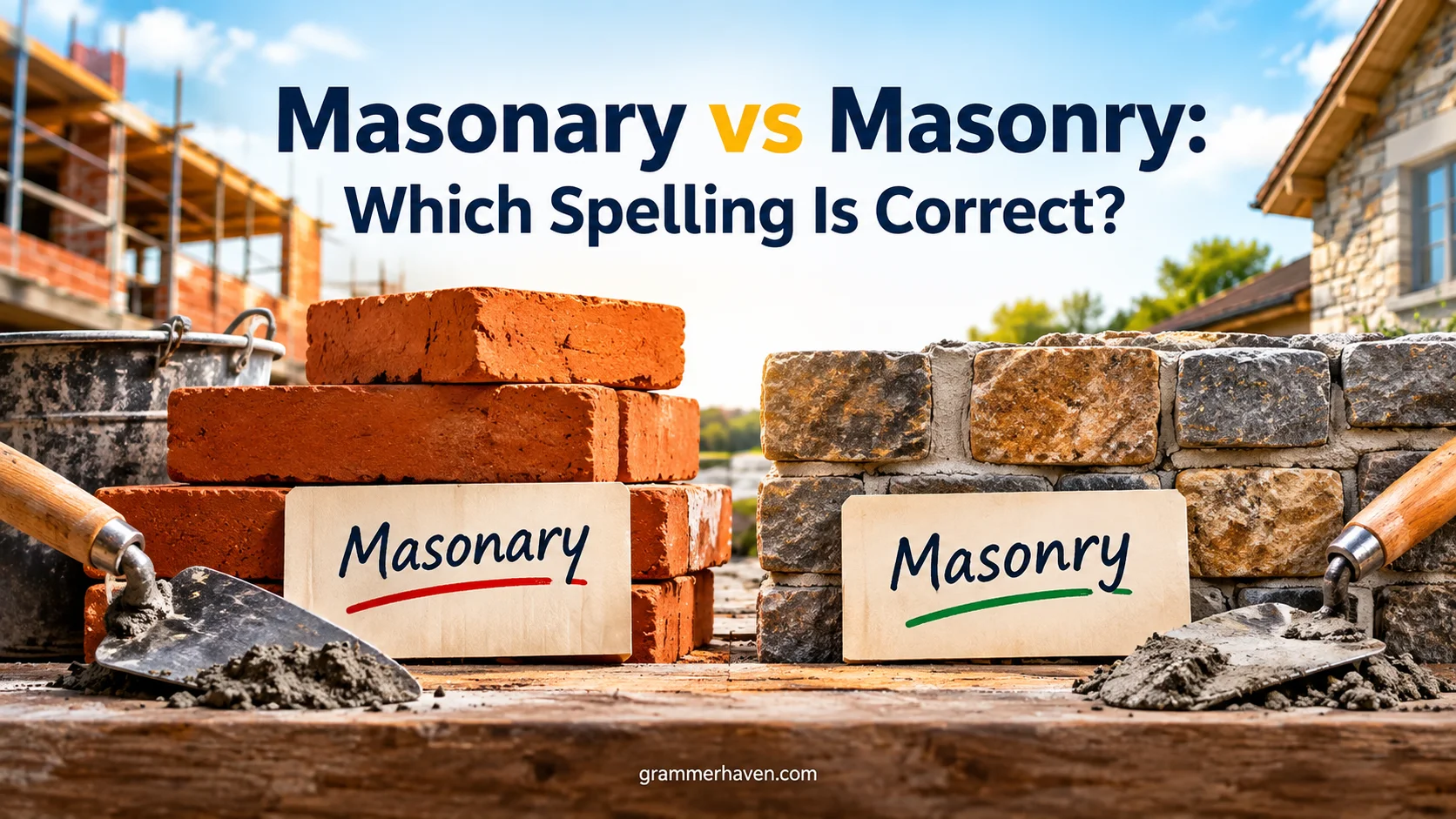
Masonary vs Masonry explains the spelling difference between the incorrect masonary form and the correct term, masonry today. The two forms look remarkably similar, but masonry is the standard word in standard English. The error comes from an extra a before the ending “-ry.” Dictionaries, including Cambridge and Collins, list masonry as the accepted form. In writing, this spelling error can happen when the words are typed quickly. If you misspell the term, use the correct spelling.
Masonry names a craft used in building structures with materials such as brick, stone, and concrete masonry units. Individual units are laid and bound with mortar to create finished construction. A mason may work in the building trade on different construction projects. Technical language needs accurate terms in a construction report, academic paper, website, estimate, or architectural description. Correct terminology gives your writing greater clarity and professionalism.
The correct word matters in professional contexts, including a professional email, job applications, and academic settings. Accurate spelling is essential for clear communication. An example is “He works in masonry,” rather than “He works in masonary.” This choice improves accuracy and avoids a misspelling caused by an extra letter. The error is a common mistake, so checking the correct spelling helps maintain clear formal contexts and everyday contexts.
Quick Answer: Masonary vs Masonry
Masonry is the correct spelling.
Masonary is a common misspelling of masonry and isn’t the standard spelling used in English dictionaries.
| Spelling | Correct? | Meaning |
| Masonry | ✅ Yes | The craft, work, or construction involving brick, stone, concrete blocks, and similar units |
| Masonary | ❌ No | Common misspelling of masonry |
For example:
The contractor inspected the masonry wall for cracks.
Not:
The contractor inspected the masonary wall for cracks.
A useful spelling trick is simple:
MASON + RY = MASONRY
Don’t insert an a before the r.
Masonry: The Correct Spelling
Masonry is a noun that describes the craft or occupation of a mason. It can also refer to construction made from individual units such as bricks, stones, or concrete blocks. Cambridge defines it both as building material used in structures and as the skill of building with brick and stone.
In construction, the word has a broader meaning than just “brickwork.” Masonry can involve several materials and techniques. The American Concrete Institute defines masonry as construction made from shaped or molded units such as stone, ceramic brick or tile, concrete, glass, and adobe.
That distinction is useful because people sometimes assume masonry means only brick walls. It doesn’t.
What Does Masonry Mean?
In everyday construction language, masonry can describe:
- The craft of building with masonry units
- The finished work produced by a mason
- Walls made from brick, stone, or concrete masonry units
- Stonework on historic buildings
- Brick construction
- Concrete block construction
- Certain architectural features made from masonry materials
For instance, if a historic building has thick stone walls, you might describe those walls as stone masonry.
Likewise, a contractor might discuss brick masonry, concrete masonry, or masonry repair.
Collins also defines masonry as the craft or occupation of a mason and as work constructed by a mason, particularly stonework.
Masonry in Construction
Masonry construction involves assembling individual units into walls or other structural and architectural elements. Depending on the system, those units may be connected with mortar, grout, mechanical methods, or other joining techniques.
The American Concrete Institute notes that masonry has important structural uses in bearing walls and is also widely used for enclosure walls, partition walls, and infill within framed structures.
Common masonry materials include:
- Brick
- Natural stone
- Concrete masonry units
- Concrete brick
- Clay units
- Glass block
- Adobe
- Ceramic masonry units
The exact material affects the wall’s appearance, strength, durability, moisture behavior, and maintenance requirements.
For example, a brick veneer on a modern house serves a different structural role from a load-bearing masonry wall. Calling both “masonry” can still be correct, but the construction details aren’t identical.
Examples of Masonry in Sentences
Here are several natural examples:
- The historic courthouse has beautiful stone masonry.
- The contractor repaired the damaged brick masonry.
- Moisture can cause long-term problems in poorly maintained masonry walls.
- The architect incorporated exposed masonry into the interior design.
- The old chimney contains deteriorated masonry joints.
- Workers carefully restored the building’s original masonry facade.
Notice how naturally the word fits construction, architecture, restoration, and maintenance contexts.
Masonary: The Common Misspelling
Masonary is usually an incorrect spelling of masonry.
The mistake is understandable because English contains many familiar words ending in -ary. When people see mason, they may instinctively construct the longer form as masonary.
That spelling feels logical at first glance.
It isn’t the standard form, though.
If you’re writing about construction, architecture, engineering, or historic buildings, use masonry.
Is “Masonary” a Word?
In standard English usage, masonary is generally treated as a misspelling of masonry rather than the standard form of the word.
Major English dictionaries list masonry, not masonary, for the construction-related meaning. Cambridge gives the standard spelling as masonry and provides its pronunciation as /ˈmeɪ.sən.ri/ in American English.
So if a spell checker flags masonary, it isn’t being overly picky. The standard spelling really is masonry.
Why Do People Spell It “Masonary”?
The error probably comes from how English spelling patterns work.
Consider words such as:
- stationary
- visionary
- customary
- ordinary
- revolutionary
These words contain -ary, so writers may naturally assume that mason follows the same pattern.
But masonry follows a different spelling pattern.
The word comes historically through French maçonnerie, related to mason. Collins traces the English word to Middle English masonerie and Old French maçonnerie.
The modern spelling settled as masonry, not masonary.
Masonry vs Masonary: Key Differences
The difference becomes straightforward when you put the two forms side by side.
| Feature | Masonry | Masonary |
| Standard English spelling | Yes | No |
| Dictionary-recognized construction term | Yes | No |
| Refers to a mason’s craft | Yes | No |
| Refers to masonry construction | Yes | No |
| Recommended in professional writing | Yes | No |
| Common spelling error | No | Yes |
The important point isn’t a difference in meaning. Masonary doesn’t normally represent a separate construction concept. In most cases, someone who writes masonary intends to write masonry.
Why Is Masonry Spelled Without the “A”?
This is where the spelling becomes easier to remember.
Word Formation and Spelling
Think of the word as:
MASON + RY = MASONRY
The spelling contains:
M-A-S-O-N-R-Y
It does not contain an extra A after the N.
The historical development of the word also helps explain why the modern spelling doesn’t simply follow a “mason + ary” pattern. Collins gives the word’s origin through French maçonnerie.
You don’t need to memorize its entire history to spell it correctly, though.
A simple visual pattern works better:
mason → masonry
Notice that the n connects directly to r.
A Simple Way to Remember the Spelling
Use this memory trick:
MASON + RY = MASONRY
Think of the word as the work associated with a mason plus -ry.
You can also remember the incorrect form by spotting its extra letter:
Masonary ❌
Masonry ✅
If you see mason + ary, pause and check it.
The correct form drops that extra a.
How to Pronounce Masonry
The standard American English pronunciation is approximately /ˈmeɪ.sən.ri/. Cambridge lists this pronunciation for both its British and American dictionary entries, with the American notation shown as /ˈmeɪ.sən.ri/.
The word has three syllables:
ma-son-ry
The first syllable receives the main stress.
That pronunciation can contribute to spelling confusion because spoken English doesn’t always reveal every letter relationship clearly. A writer may hear a sound sequence and unconsciously spell it according to a familiar -ary pattern.
That’s one reason masonary can look tempting even though masonry is correct.
Masonry in Different Contexts
The word becomes easier to understand when you see how professionals actually use it.
Masonry in Construction
Construction professionals use masonry when discussing walls, structures, materials, repairs, and building systems.
For example:
- Masonry walls
- Masonry construction
- Masonry units
- Masonry joints
- Masonry repair
- Masonry reinforcement
- Masonry veneer
- Structural masonry
The American Concrete Institute identifies masonry units, mortar, grout, and reinforcement as important components in masonry construction.
So the term covers more than the visible bricks or stones.
Masonry as a Trade or Craft
Mason and masonry are closely related, but they aren’t interchangeable.
A mason is the person who performs the work.
Masonry is the craft, work, or construction associated with that work.
For example:
The mason repaired the damaged wall.
The masonry required extensive repair.
The first sentence identifies the worker. The second describes the work or construction.
Masonry in Architecture and Historic Buildings
Architects, preservation specialists, and historians often use masonry when discussing older structures.
Historic churches, castles, bridges, fortifications, civic buildings, and homes may contain extensive brick or stone masonry.
Restoration work can involve:
- Repointing mortar joints
- Replacing damaged masonry units
- Repairing cracks
- Cleaning masonry surfaces
- Replacing deteriorated stone
- Matching new brick to historic brick
- Addressing water penetration
The term therefore appears frequently in architectural conservation and building restoration.
Common Phrases With “Masonry”
Learning common combinations makes the correct spelling easier to remember.
Brick Masonry
Brick masonry refers to masonry construction that uses brick units.
Example:
The building’s original brick masonry remains remarkably well preserved.
Stone Masonry
Stone masonry refers to construction or finished work using natural or manufactured stone units.
Example:
The retaining wall features traditional stone masonry.
Masonry Wall
A masonry wall is a wall constructed using masonry units.
Example:
The engineer examined the masonry wall after the earthquake.
Masonry Construction
Masonry construction describes a building method that uses masonry units assembled into structural or nonstructural elements.
Autodesk’s current construction guide describes masonry construction as building structures from individual units such as brick, stone, or concrete block.
Masonry Work
Masonry work is a broad phrase for work involving masonry construction, installation, repair, or restoration.
Example:
The renovation budget includes extensive masonry work.
Masonry vs Related Words
The spelling becomes even clearer when you understand how related terms differ.
Mason vs Masonry
These words describe different things.
| Word | Meaning | Example |
| Mason | A person who works with masonry | The mason repaired the wall. |
| Masonry | The craft, work, or construction | The masonry needs repair. |
A mason can perform masonry.
That’s the simplest relationship to remember.
Masonry vs Brickwork
Brickwork is more specific than masonry.
Brickwork focuses on brick construction or brick structures. Masonry covers a wider group of materials, including brick, stone, and concrete masonry units.
So:
Brickwork can be masonry, but masonry isn’t limited to brickwork.
That’s an important distinction in technical writing.
Masonry vs Carpentry
Masonry generally involves materials such as brick, stone, and concrete masonry units.
Carpentry focuses primarily on wood and wood-based construction work.
A building can contain both. For example, a house might have masonry exterior walls with timber roof framing.
Masonry in Example Sentences
Context helps lock the spelling into memory. Here are examples from several writing situations.
Everyday Example
The old house has beautiful masonry around the front entrance.
Construction Example
The contractor inspected the masonry before beginning the renovation.
Architecture Example
The architect preserved the building’s original stone masonry.
Maintenance Example
Water damage can weaken masonry over time.
Historical Example
The fortress is known for its massive stone masonry.
Technical Example
The engineer evaluated the masonry wall for structural damage.
Professional Email Example
Please include the cost of masonry repairs in the revised estimate.
Each sentence uses masonry naturally. None needs the extra a found in the common misspelling.
Incorrect vs Correct Examples
Seeing the mistake beside the correction makes the pattern obvious.
| Incorrect | Correct |
| The building has old stone masonary. | The building has old stone masonry. |
| He specializes in brick masonary. | He specializes in brick masonry. |
| The masonary wall needs repair. | The masonry wall needs repair. |
| We hired a company for masonary work. | We hired a company for masonry work. |
| The historic masonary is deteriorating. | The historic masonry is deteriorating. |
| The project requires skilled masonary workers. | The project requires skilled masonry workers. |
A Quick Editing Test
When proofreading, search your document for masonary.
If you find it, replace it with masonry unless a very unusual proper-name context specifically requires otherwise.
For construction documents, this simple search can catch the error before publication.
A Practical Case Study: Fixing “Masonary” in a Construction Description
Imagine you’re preparing a property renovation report.
Your first draft says:
The exterior masonary shows signs of cracking and water damage.
The sentence has a spelling error.
A corrected version reads:
The exterior masonry shows signs of cracking and water damage.
Now consider a slightly more precise version:
The exterior brick masonry shows cracking and signs of moisture-related deterioration.
The third version gives the reader more useful information because it identifies the masonry material.
This illustrates an important writing principle: correcting the spelling is only the first step. Good technical writing should also use the most precise term available.
Why Correct Spelling Matters in Professional Writing

A single spelling error rarely changes the meaning of a sentence. Still, repeated errors can affect how readers perceive a document.
In construction and engineering, terminology carries extra weight. Specifications, estimates, inspection reports, architectural descriptions, and maintenance documents often need precise language.
Using masonry correctly helps you:
- Avoid obvious spelling errors
- Produce cleaner professional documents
- Communicate clearly with construction professionals
- Write accurate architectural descriptions
- Improve the credibility of technical content
- Avoid inconsistent terminology across a document
The goal isn’t to sound fancy. It’s to make the meaning unmistakable.
Masonary vs Masonry: At a Glance
| Question | Answer |
| Correct spelling | Masonry |
| Common misspelling | Masonary |
| Part of speech | Noun |
| Main meaning | Craft, work, or construction involving masonry units |
| Common materials | Brick, stone, concrete block, and similar units |
| Related person | Mason |
| Pronunciation | /ˈmeɪ.sən.ri/ |
| Correct example | “The masonry wall needs repair.” |
| Easy memory trick | Mason + ry = masonry |
See also: Is It Correct to Say “Safe Travels”? Meaning, Grammar & Usage
FAQs:
Is Masonary or Masonry Correct?
Masonry is correct.
Masonary is a common misspelling. Use masonry in standard English writing.
Is Masonary a Correct Word?
No, masonary isn’t the standard spelling of the construction term. Standard dictionaries recognize masonry for the craft, work, or construction associated with a mason.
What Is the Meaning of Masonry?
Masonry means the craft or work of building with materials such as brick, stone, concrete, or other masonry units. It can also refer to the resulting construction itself.
How Do You Spell Masonry?
The correct spelling is:
M-A-S-O-N-R-Y
Remember:
Mason + ry = masonry.
Why Do People Write Masonary Instead of Masonry?
The mistake likely comes from familiar English spelling patterns involving -ary endings. Since masonary looks visually plausible, writers sometimes add an unnecessary a.
The standard form is masonry.
What Is the Difference Between a Mason and Masonry?
A mason is the person who performs masonry work.
Masonry is the craft, work, or construction itself.
For example:
The mason repaired the damaged masonry.
How Do You Remember the Spelling of Masonry?
Use this simple formula:
MASON + RY = MASONRY
The key is to avoid adding an a between n and r.
Is Masonry Only Made From Brick?
No. Masonry can involve brick, natural stone, concrete masonry units, ceramic units, glass, adobe, and other similar materials. The American Concrete Institute gives a broad technical definition covering several types of masonry units.
Conclusion:
When it comes to masonary vs masonry, masonry is the correct spelling. Masonary is a common spelling mistake and should be avoided in formal or professional writing.
Remember the simple pattern: mason + ry = masonry. Whether you’re talking about brick, stone, or concrete construction, always use masonry.