Foul or Fowl is a classic English spelling confusion because these words sound alike but have different meanings. Foul can describe something unpleasant, offensive, dirty, smelly, or against the rules, including a foul smell from water that smelled foul or a chicken-like smell. In sports, a referee may call a foul for a sports violation, an unfair move, or an illegal action during a game.
Fowl means a bird, especially one raised for meat or eggs, including chickens and ducks. The spelling difference can completely change the meaning of a sentence, making this tricky pair easy to mix up because of their same sound. Fowl connects with birds and dinner; foul connects with a bad smell, dirty condition, or rule-breaking action. This distinction makes it easier to remember which word fits your daily conversations and writings.
English has an ocean of vocabulary, yet cracking this code gives you a clear understanding of the origins and uses of these confusing words. The twist becomes simple when you connect each spelling with its meaning, helping build confidence with foul vs. fowl.
Quick Answer: Foul vs. Fowl
Foul means unpleasant, dirty, offensive, morally wrong, or against the rules. It can work as an adjective, noun, or verb.
Fowl means a bird, especially a bird raised for meat or eggs. It is mainly used as a noun.
| Word | Meaning | Common Examples |
| Foul | Unpleasant, dirty, offensive, or against rules | foul smell, foul language, foul weather, sports foul |
| Fowl | A bird, especially a domestic or edible bird | chicken, turkey, duck, domestic fowl |
| Pronunciation | Usually the same | Both commonly sound like “fowl” |
Cambridge lists foul as an adjective meaning extremely unpleasant, a noun for a sports violation, and a verb meaning to violate a rule or make something dirty. It defines fowl as a bird used for producing meat or eggs, while also noting its older broader meaning of “bird.”
The easiest way to remember them
Foul means bad. Fowl means bird.
That simple distinction handles most everyday situations.
What Does Foul Mean?
Foul has several related meanings, but they generally point toward something unpleasant, offensive, dirty, unfair, or improper.
As an adjective, it can describe a terrible smell, offensive language, unpleasant weather, or something morally wrong. As a noun, it commonly describes a violation in sports.
Foul as an Adjective
When foul works as an adjective, it often describes something unpleasant or offensive.
For example:
- “The kitchen had a foul smell.”
- “The garbage produced a foul odor.”
- “They were trapped outside in foul weather.”
- “He was criticized for using foul language.”
- “She woke up in a foul mood.”
The word can describe more than physical dirt or bad smells. It can also express something morally objectionable or deeply unpleasant.
Cambridge gives examples involving foul odors, foul moods, foul weather, and offensive language.
Foul as a Noun
In sports, foul commonly refers to an action that violates the rules.
You might hear:
- “The referee called a foul.”
- “The defender committed a foul.”
- “The player was charged with a personal foul.”
- “That was an obvious foul.”
The exact rules differ from sport to sport. In basketball, for example, a foul can involve illegal physical contact. In baseball, foul also appears in the term foul ball, referring to a batted ball that lands outside the fair territory under the applicable rules.
Foul as a Verb
Foul can also function as a verb.
It can mean to make something dirty, polluted, or contaminated:
- “The chemical spill fouled the river.”
- “Oil fouled the shoreline.”
- “The waste fouled the water.”
It can also describe breaking a sports rule:
- “The defender fouled the striker.”
- “The player fouled his opponent.”
Cambridge specifically recognizes both the sports meaning and the meaning of making something dirty or damaging it through contamination.
What Does Fowl Mean?
Fowl is primarily a noun connected with birds.
In modern English, it commonly refers to birds kept for meat or eggs. Chickens are the most familiar example, although the category can include other domestic birds. Cambridge gives fowl the plural forms fowl and fowls.
Examples include:
- “The farmer raises fowl.”
- “The market sells fresh fowl.”
- “Several types of fowl live on the farm.”
- “The family keeps chickens and other fowl.”
Historically, fowl had a much broader meaning. It once referred generally to birds. Over time, the everyday word bird became more common for the broad category, while fowl developed a narrower association with domestic or edible birds.
Is Fowl Singular or Plural?
This point can trip readers up.
Fowl can function as either a singular count noun or an uncountable noun, depending on context. Fowls can also serve as the plural form when referring to individual birds.
For example:
- “A fowl was wandering around the yard.”
- “The farmer keeps several fowls.”
- “The farmer raises fowl for food.”
The Cambridge Dictionary lists both fowl and fowls as plural forms.
In everyday American English, however, chicken, duck, turkey, or poultry will often sound more natural than the broader word fowl.
Foul vs. Fowl: The Main Difference
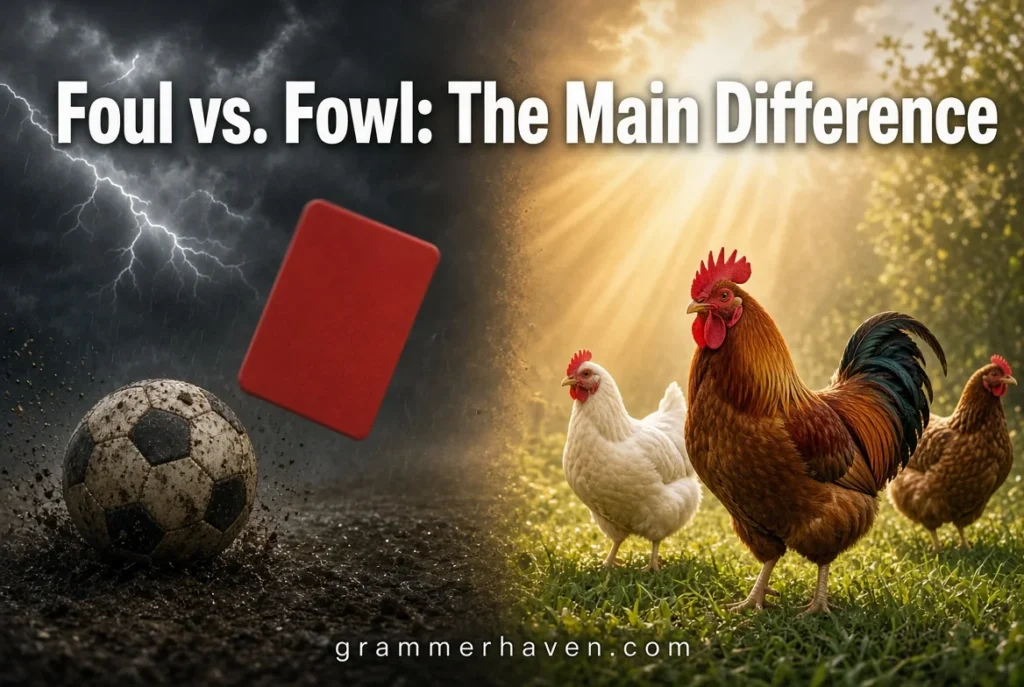
The difference becomes clear when you place the words beside their common contexts.
| Context | Correct Word | Example |
| Bad smell | Foul | “There was a foul odor.” |
| Offensive language | Foul | “The character used foul language.” |
| Sports violation | Foul | “The referee called a foul.” |
| Unpleasant weather | Foul | “Foul weather delayed the flight.” |
| Polluted water | Foul | “The spill fouled the river.” |
| Domestic birds | Fowl | “The farm has several types of fowl.” |
| Birds raised for food | Fowl | “The farmer sells fowl.” |
| Poultry | Fowl | “The restaurant serves fish and fowl.” |
A useful rule emerges from the table:
If you’re talking about something bad, unpleasant, dirty, or against the rules, use foul. If you’re talking about a bird, use fowl.
Foul or Fowl in Common Expressions
Some phrases make the difference especially easy to see.
Foul Language
Foul language means rude, offensive, vulgar, or shocking language.
Examples:
- “The movie contains foul language.”
- “The teacher warned the students about foul language.”
- “He apologized for using foul language.”
Here, foul describes the nature of the language. It has nothing to do with birds.
Foul Play
Foul play refers to dishonest, unfair, or improper behavior. It can also describe behavior that violates rules or involves wrongdoing.
For example:
“The investigators suspected foul play.”
The standard expression is foul play, not fowl play.
Foul Smell
A foul smell is a very unpleasant odor.
For example:
“A foul smell came from the kitchen.”
Here, foul relates to unpleasantness.
Foul Weather
Foul weather means unpleasant or difficult weather conditions.
For example:
“The boat stayed in port because of foul weather.”
This use has a long history. The word foul has been associated with bad or unfavorable weather since the Middle English period.
Fowl Play
Fowl play isn’t the standard spelling of the expression above.
Instead, writers sometimes use fowl play deliberately as a pun involving birds. A headline about chickens getting into trouble might use the phrase for comic effect.
For normal writing, however, remember:
foul play = wrongdoing
fowl = bird
Foul or Fowl in Sports
Sports provide one of the clearest uses of foul.
A foul occurs when a player commits an action prohibited by that sport’s rules. The exact violation depends on the game.
Basketball
You might hear:
- “He committed a personal foul.”
- “The referee called a foul.”
- “She was sent to the free-throw line after the foul.”
Soccer
Common examples include:
- “The referee called a foul.”
- “The defender was penalized for a foul.”
- “The tackle resulted in a foul.”
Baseball
Baseball has several uses of foul, including foul ball. Cambridge notes that the noun can refer to a ball hit outside the playing area.
So:
“The batter hit a foul ball.”
Not:
“The batter hit a fowl ball.”
Unless the ball happens to involve a very unfortunate bird-related joke, fowl doesn’t belong there.
Foul or Fowl When Talking About Birds
When the subject is a bird, fowl is the word you want.
Consider these examples:
- “The farmer raises fowl.”
- “The barn contains several domestic fowl.”
- “The market sells fowl for cooking.”
- “Chickens are common examples of domestic fowl.”
The term can cover birds raised for food, particularly domestic birds. Cambridge defines it specifically as a bird of a type used to produce meat or eggs.
Common Types of Fowl
Depending on context, fowl can include:
- Chickens
- Turkeys
- Ducks
- Geese
- Other domestic or edible birds
However, don’t assume that fowl is simply a perfect synonym for every use of bird. Modern English usually uses bird as the broad everyday term.
Why Do People Confuse Foul and Fowl?
The biggest reason is simple: they sound alike.
Both are commonly pronounced /faʊl/. Cambridge gives this pronunciation for both words.
Words that sound alike but have different meanings and spellings are called homophones.
English contains plenty of these pairs:
- right / write
- sea / see
- flour / flower
- brake / break
- foul / fowl
When you’re speaking, you can’t see the spelling. Context has to carry the meaning.
When you’re writing, however, the spelling becomes essential.
Their Similar Appearance Adds to the Confusion
The words also look remarkably similar:
foul
fowl
Only one letter changes position.
That tiny spelling difference carries a completely different meaning. It’s similar to putting the wrong key into a lock. The key may look almost identical, but it still won’t open the door.
Context Usually Solves the Problem
Look at the surrounding words:
- foul odor → something smells terrible
- foul language → offensive speech
- foul weather → unpleasant weather
- foul committed → sports violation
- domestic fowl → bird
- fowl for dinner → edible bird
Once you identify the context, the correct spelling usually becomes obvious.
Foul vs. Fowl: Word Origins
The two words aren’t simply different spellings of the same old word. They developed from different historical roots.
Origin of Foul
Foul comes from Old English ful, which carried meanings associated with being rotten, unclean, vile, corrupt, or offensive to the senses. Its Germanic relatives include words found in several other Germanic languages.
The modern meanings developed over centuries.
The word eventually gained associations with:
- Bad smells
- Dirt
- Unpleasant conditions
- Offensive behavior
- Unfair conduct
- Rule violations
Its sporting sense meaning something irregular or contrary to established rules is recorded from the late 18th century. Foul play, however, is much older.
Origin of Fowl
Fowl comes from Old English fugol, meaning a bird. That word traces back to a Germanic word for bird.
Interestingly, fowl originally had a much broader meaning than it does today.
The modern narrower sense involving barnyard or domestic birds developed later. Etymological records place this narrower sense around the 16th century.
So the two words have completely different histories:
| Word | Historical Root | Core Historical Idea |
| Foul | Old English ful | Rotten, unclean, offensive |
| Fowl | Old English fugol | Bird |
That distinction explains why their meanings don’t overlap despite their similar sound.
How to Remember the Difference Between Foul and Fowl
You don’t need a complicated mnemonic.
Think “Foul = Bad”
Associate foul with things that are unpleasant or wrong:
- Foul smell
- Foul language
- Foul weather
- Foul play
- Sports foul
If something is disgusting, offensive, unfair, or against a rule, foul is usually the right choice.
Think “Fowl = Bird”
Associate fowl with birds:
- Chicken
- Duck
- Turkey
- Goose
- Poultry
A simple memory line works well:
Foul means bad. Fowl means bird.
That’s short enough to remember when you’re writing quickly.
Foul vs. Fowl Example Sentences
Seeing the words in realistic sentences makes the distinction stick.
Examples With Foul
- The refrigerator had a foul odor.
- The player committed a foul during the game.
- The room was filled with foul smoke.
- He apologized for his foul language.
- The sailors struggled through foul weather.
- The factory waste fouled the nearby river.
- The referee stopped play after a serious foul.
- She was in a foul mood after the argument.
- The water became foul after the contamination.
- The team was penalized for a foul.
Examples With Fowl
- The farmer raises fowl for eggs.
- Chickens are common domestic fowl.
- The market sells fresh fowl.
- Ducks and geese can be kept as domestic fowl.
- The farmer feeds the fowl every morning.
- The restaurant serves fish and fowl.
- Several fowl gathered near the pond.
- The barn was built to protect the fowl from predators.
Notice how the surrounding nouns and verbs make the intended meaning clear.
Common Mistakes With Foul and Fowl
These errors often happen because the words sound identical.
Mistake: “The referee called a fowl.”
Correct: “The referee called a foul.”
A sports violation is a foul.
Mistake: “The farmer raises foul.”
Correct: “The farmer raises fowl.”
The sentence concerns birds, so fowl is correct.
Mistake: “The room had a fowl smell.”
Correct: “The room had a foul smell.”
The smell is unpleasant, so use foul.
Mistake: “The chicken is foul.”
This sentence isn’t automatically grammatically wrong. Its meaning simply changes.
“The chicken is foul” could mean the chicken is unpleasant, contaminated, rotten, or otherwise objectionable.
If you mean that the chicken is a bird, write:
“The chicken is a fowl.”
Context matters enormously here.
Foul vs. Fowl vs. Foal
Another word sometimes enters this spelling mix-up: foal.
These three words sound different, although learners sometimes confuse their spellings.
| Word | Meaning | Example |
| Foul | Bad, unpleasant, offensive, or against rules | “The smell was foul.” |
| Fowl | A bird, especially domestic or edible | “The farm raises fowl.” |
| Foal | A young horse or other equine | “The mare had a foal.” |
A foal is an animal. A fowl is a bird. A foul describes something unpleasant or improper.
Keeping those three meanings separate prevents another common spelling headache.
Foul vs. Fowl vs. Poultry
Fowl and poultry overlap, but they’re not always interchangeable.
Poultry generally refers to domesticated birds kept for food, particularly meat and eggs. The word can describe these birds collectively.
Fowl can carry a similar meaning, especially when referring to domestic or edible birds. However, it can sound more traditional or formal in some contexts.
For example:
- “The farmer raises poultry.”
- “The farmer raises fowl.”
- “Chicken is a common type of poultry.”
- “Chicken is a common domestic fowl.”
The best choice depends on context and style.
The historical word poultry itself developed from Old French terms associated with domestic fowl.
Foul or Fowl: At-a-Glance Comparison
| Feature | Foul | Fowl |
| Main meaning | Unpleasant, dirty, offensive, or improper | Bird, especially domestic or edible bird |
| Part of speech | Adjective, noun, verb | Mainly noun |
| Sports use | Yes | No |
| Bird meaning | No | Yes |
| Smell | Foul smell | Not normally used |
| Language | Foul language | Not normally used |
| Weather | Foul weather | Not normally used |
| Farming | Not normally used for birds | Domestic fowl |
| Common phrase | Foul play | Waterfowl |
| Example | “The referee called a foul.” | “The farmer keeps fowl.” |
See also: Masonary vs Masonry: Which Spelling Is Correct?
FAQs:
Is it foul or fowl play?
The standard expression is foul play. It refers to dishonest, unfair, or improper behavior.
Fowl play can appear as a deliberate pun involving birds, but it isn’t the standard expression.
Is a chicken a fowl?
Yes. A chicken can be described as a fowl, particularly when discussing domestic or edible birds.
In everyday conversation, however, chicken is usually more specific and natural.
What is the difference between foul and fowl?
Foul describes something unpleasant, offensive, dirty, morally wrong, or against rules. Fowl refers to a bird, especially one raised for meat or eggs.
Is foul a bird?
No. Foul doesn’t mean bird.
Fowl is the bird-related word.
Why do foul and fowl sound the same?
They are commonly homophones. They share pronunciation in many varieties of English but have different spellings and meanings. Cambridge gives both words the pronunciation /faʊl/.
What is the plural of fowl?
The plural can be fowl or fowls.
For example:
- “The farmer keeps several fowl.”
- “Several fowls were gathered near the barn.”
Cambridge lists both forms.
Can foul be a verb?
Yes. Foul can mean to make something dirty or polluted. It can also mean to commit a violation in sports.
For example:
- “The spill fouled the water.”
- “The defender fouled the attacker.”
Conclusion:
Foul and fowl sound alike, but they have different meanings. Foul describes something unpleasant, dirty, offensive, or against the rules. Fowl refers to a bird, especially a domestic bird such as a chicken, duck, or turkey.
A simple way to remember the difference is: foul means bad, while fowl means bird. Once you understand this distinction, choosing the correct word becomes much easier.













