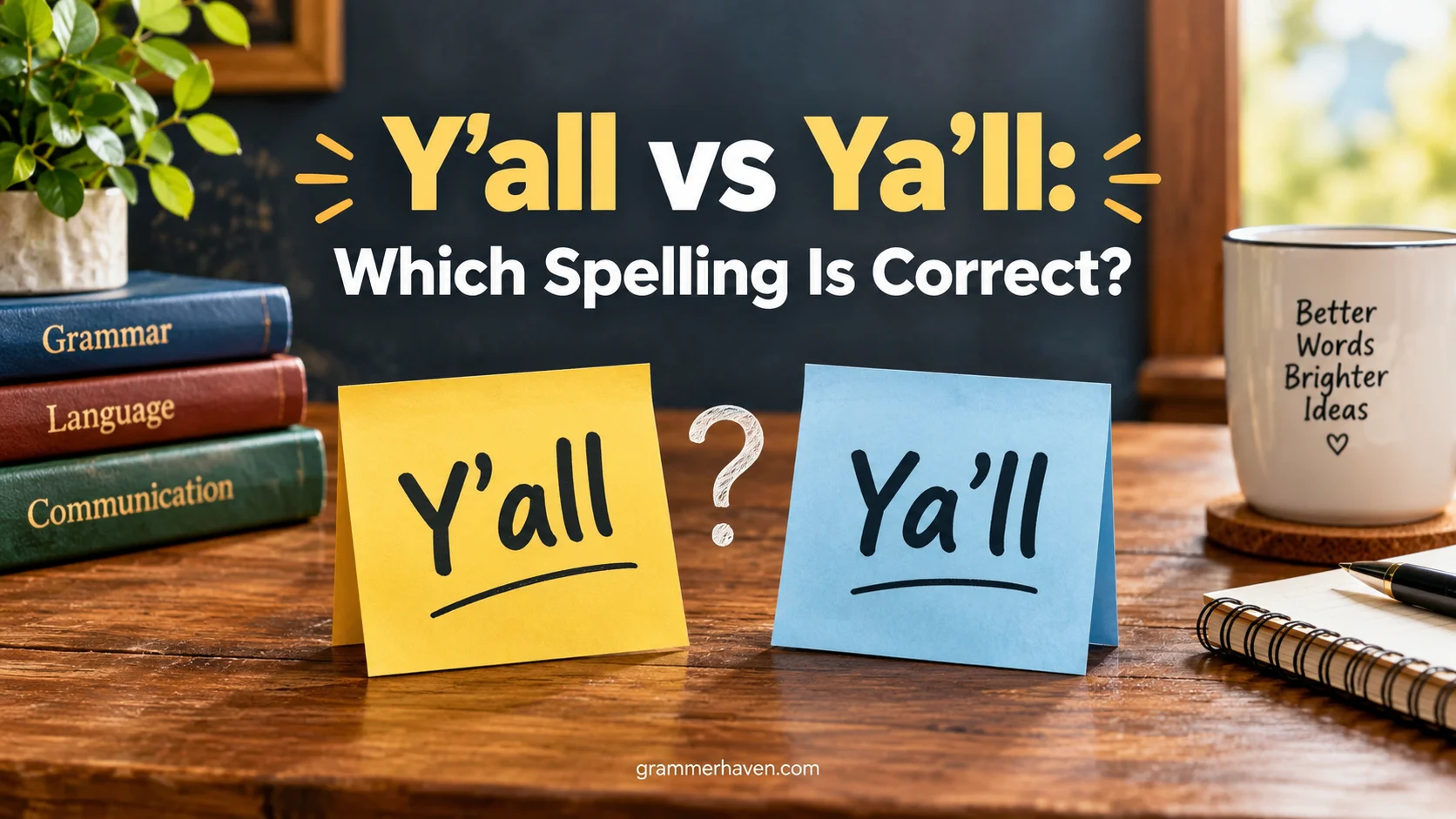
Y’all vs Ya’ll compares two spellings, but only one is the standard form in English writing. Y’all is the correct form of the contraction you all. The apostrophe marks the letters omitted from the original phrase. It works as an informal, second-person, plural pronoun when addressing two or more people. Ya’ll is a misspelling and a common misspelling because the apostrophe sits in the wrong place. Merriam-Webster recognizes y’all as a variant of you-all. The form is closely associated with Southern U.S. English and the South. In my experience with English writing, the easiest way to remember the spelling is to connect you all directly with y’all.
The confusion around these contractions becomes stronger when typing quickly. The spelling can feel tricky, and thousands of people search for the answer every month. Autocorrect can add to the confusing nature of the choice. It may feel tempting to type ya’ll because both forms look almost identical. Strict rules support y’all as the standard spelling. In speech, the word is commonly used as part of regional usage, while its spread has carried it into many other settings. You can find y’all in a text, social media post, casual email, or dialogue. Writers who have hesitated over this spelling usually need only one simple distinction: y’all represents you all.
You can sound correct and confident by choosing y’all when an informal plural form fits the context. Its role as a plural pronoun makes it useful when speaking to two or more people. Writing, typing, and speech can show different levels of regional usage, but the standard spelling remains y’all. To avoid common mistakes, remember the correct form whenever you feel uncertain. The English contractions behind this word follow clear rules, even though the spelling looks confusing at first. The word can appear across everyday communication, including social media, messages, and informal conversations, without changing its basic spelling.
Y’all vs Ya’ll: Quick Answer
Y’all is correct. Ya’ll is incorrect.
The difference comes down to the apostrophe.
| Spelling | Correct? | Meaning | Explanation |
| y’all | ✅ Yes | you all | Standard contraction |
| ya’ll | ❌ No | — | Apostrophe is misplaced |
| yall | ⚠️ Informal | you all | Common online omission of the apostrophe |
| you all | ✅ Yes | you all | Full form |
The easiest rule is simple:
You all → y’all
The apostrophe replaces the omitted o and u from you. It doesn’t belong between ya and ll.
That makes ya’ll the wrong construction.
Why Is Y’all Correct?
Think about familiar contractions:
- do not → don’t
- cannot → can’t
- I am → I’m
- you are → you’re
- you will → you’ll
- you all → y’all
In each case, the apostrophe signals missing letters.
With y’all, the word you loses ou, producing y’ before all:
you all → y’all
The spelling ya’ll suggests a different construction that doesn’t accurately represent the contraction. That’s why it isn’t the standard form.
What Does Y’all Mean?
Y’all means “you all.” It normally refers to two or more people being addressed.
For example:
Are y’all ready to leave?
This means:
Are you all ready to leave?
The meaning stays essentially the same. The contracted version simply sounds more conversational.
Oxford describes y’all as an informal pronoun used especially in the Southern United States when speaking to more than one person. It gives the pronunciation as /jɔːl/.
Y’all as a Second-Person Plural Pronoun
Modern English uses you for both singular and plural meanings.
Consider these sentences:
- Are you coming?
- Are you all coming?
- Are y’all coming?
The first sentence could address one person or several people. The second and third make the plural meaning clearer.
That’s one reason y’all has remained useful. It gives English speakers a compact way to distinguish a group from an individual.
Merriam-Webster’s entry for you confirms that modern you can refer to one person or multiple people.
Does Y’all Always Mean More Than One Person?
Traditionally, y’all refers to two or more people. That’s the safest meaning to use in standard explanations.
However, actual language use can be more flexible. Speakers sometimes use y’all when addressing one person who represents a group, organization, household, or broader audience. Other speakers strongly prefer to reserve it for genuine plural reference.
For everyday writing, the clearest rule remains:
Use y’all when you’re addressing multiple people.
Why Is “Ya’ll” Incorrect?
The confusion usually comes from pronunciation.
When people say y’all, it can sound like one quick syllable: yawl. That pronunciation makes the spelling less obvious. Someone who hears the word may naturally imagine ya’ll.
But pronunciation doesn’t determine where the apostrophe belongs.
The apostrophe represents omitted letters. Since y’all comes from you all, the missing letters are o and u.
Therefore:
you all → y’all
Not:
you all → ya’ll
Here’s another way to see it:
YOU ALL
↓
Remove OU from you
↓
Y’ALL
The apostrophe tells the reader that something has been removed.
A Simple Memory Trick
When you’re unsure, expand the contraction.
If you mean you all, write:
y’all
If you mean you will, write:
you’ll
Those two contractions are easy to confuse because they look and sound somewhat similar.
Y’all vs You’ll: Don’t Mix Them Up
Y’all and you’ll have completely different meanings.
| Word | Full Form | Meaning | Example |
| y’all | you all | a group of people | Y’all should come over. |
| you’ll | you will / you shall | future action | You’ll enjoy the movie. |
Merriam-Webster defines you’ll as a contraction of you will or you shall.
Compare these sentences:
Y’all need to bring your tickets.
= You all need to bring your tickets.
You’ll need to bring your ticket.
= You will need to bring your ticket.
One small apostrophe placement changes the meaning completely.
How to Use Y’all in a Sentence
Because y’all functions as a pronoun, it can appear naturally in several sentence structures.
Y’all as the Subject
Use y’all as the group performing an action.
- Y’all look ready for the trip.
- Y’all need to arrive early.
- Y’all have done excellent work.
Here, y’all acts much like you would in a sentence.
Y’all in Questions
Questions are one of the most natural places to encounter the word.
- Are y’all coming to dinner?
- Did y’all watch the game?
- Have y’all finished the project?
- Do y’all need anything?
The word immediately signals that the question addresses a group.
Y’all in Invitations
You can also use it when inviting people somewhere.
- Y’all should come over this weekend.
- Y’all are welcome to join us.
- Come by whenever y’all have time.
This usage often gives the sentence a warm, relaxed tone.
Y’all in Informal Writing
Y’all works particularly well in:
- Text messages
- Social media posts
- Casual emails
- Online conversations
- Personal messages
- Fictional dialogue
- Informal blog writing
- Marketing aimed at a conversational audience
For example:
Thanks for all the kind messages, y’all!
The word adds a friendly conversational quality that you all might not convey as naturally.
Y’all vs You All: Are They the Same?
For basic meaning, y’all and you all are essentially equivalent.
The main difference involves form and tone.
| Expression | Meaning | Typical Tone |
| y’all | you all | Informal, conversational |
| you all | you all | Neutral, less contracted |
| all of you | all members of the group | Neutral or emphatic |
For example:
Y’all did a great job.
You all did a great job.
All of you did a great job.
All three can refer to the same group. However, the tone and emphasis differ slightly.
Y’all sounds relaxed and conversational. All of you can place stronger emphasis on every member of the group.
Oxford likewise lists you-all as an informal form equivalent to y’all.
Is Y’all a Word or a Contraction?
Y’all is a contraction that functions as a pronoun.
That distinction matters.
A contraction combines words into a shorter form. An apostrophe usually marks the letters that disappeared during that process.
For example:
- they are → they’re
- we are → we’re
- I have → I’ve
- you will → you’ll
- you all → y’all
Dictionaries recognize y’all as a genuine English pronoun rather than treating it as a random spelling found only in casual speech. Merriam-Webster lists it as a variant of you-all.
So calling it “just slang” doesn’t tell the whole story. It has an established grammatical function and a documented history.
Where Did Y’all Come From?
The history of y’all is more interesting than its casual appearance might suggest.
Merriam-Webster records you-all with a first known use dating to 1631.
The contracted form developed as English speakers looked for practical ways to express a plural you.
That need makes sense because English eventually lost the everyday distinction between singular and plural second-person pronouns. Modern you can address one person or many people. Merriam-Webster’s historical discussion of you explains how earlier forms such as thou and ye gradually disappeared from ordinary English, leaving you to cover both singular and plural functions.
This created a useful opening for regional forms such as you-all and y’all.
Y’all and Southern American English
Today, y’all has a strong association with Southern U.S. English.
Oxford specifically describes it as an informal pronoun used especially in the southern United States.
That regional connection remains important, but the word isn’t locked inside Southern speech. It now appears across American English in informal conversations, online communication, advertising, entertainment, and everyday writing.
The broader spread also makes practical sense. English speakers often want a concise way to address a group without repeatedly saying you all.
Why Is Y’all Used Outside the South?

Language tends to keep useful tools.
One useful feature of y’all is its ability to clarify plurality. Instead of relying on context to determine whether you means one person or several, a speaker can use y’all to make the group reference obvious.
Consider:
I need to talk to you.
That could mean one person or several.
Now compare:
I need to talk to y’all.
The intended group is much clearer.
The word also offers a gender-neutral alternative to you guys, which many speakers use for mixed or unspecified groups.
That doesn’t mean everyone prefers y’all. Word choice depends on region, audience, personal style, and context. Still, its usefulness helps explain why the word has traveled beyond its traditional regional home.
Is Y’all Formal or Informal?
Y’all is generally informal.
That doesn’t make it incorrect. It simply means you should consider your audience and the setting.
| Situation | Recommended? |
| Text message | ✅ Yes |
| Casual conversation | ✅ Yes |
| Social media | ✅ Yes |
| Personal email | ✅ Yes |
| Fictional dialogue | ✅ Yes |
| Friendly business communication | ⚠️ Depends on tone |
| Academic paper | ⚠️ Usually avoid |
| Legal document | ⚠️ Usually avoid |
| Highly formal report | ⚠️ Usually avoid |
If you’re writing a research paper, formal report, or legal document, you all, all of you, or another precise construction may fit better.
The key point is this:
Correct spelling and formal style aren’t the same thing.
A word can be correctly spelled while still being too informal for a particular setting.
Y’all vs Yall: Is the Apostrophe Necessary?
In standard edited writing, use y’all.
You may see yall online, particularly in usernames, hashtags, quick messages, or informal posts. Digital communication often drops punctuation for speed or visual simplicity.
That doesn’t make yall the preferred spelling.
For polished writing, choose:
y’all
rather than:
yall
The apostrophe carries useful information because it signals that the form is contracted.
Y’all vs Ya’ll: Correct and Incorrect Examples
Seeing the two forms side by side makes the distinction easier.
Correct: Y’all
- Are y’all ready to leave?
- I hope y’all enjoyed the dinner.
- Did y’all finish the assignment?
- Y’all can wait here.
- Thanks for helping, y’all.
Incorrect: Ya’ll
- ❌ Are ya’ll ready to leave?
- ❌ I hope ya’ll enjoyed the dinner.
- ❌ Did ya’ll finish the assignment?
- ❌ Ya’ll can wait here.
The problem isn’t pronunciation. It’s the apostrophe’s position.
Y’all reflects the contraction you all.
Ya’ll doesn’t.
Common Mistakes With Y’all
A few errors appear repeatedly because the word doesn’t look like ordinary contractions.
Writing “Ya’ll”
This is the most common mistake.
Remember:
y’all = you all
The apostrophe follows y.
Writing “Yall”
This version drops the apostrophe altogether.
It can appear in casual digital writing, but y’all remains the standard choice for polished writing.
Confusing Y’all With You’ll
This mistake changes the meaning.
- Y’all = you all
- You’ll = you will
Try expanding the word whenever you’re uncertain.
Assuming Y’all Is Unprofessional in Every Context
The word is informal, but context matters. A casual customer message, social media caption, or friendly email can comfortably use y’all.
The important question isn’t simply whether the word is “professional.” Ask whether it matches the intended voice and audience.
Can You Use Y’all for One Person?
The safest traditional use of y’all is plural.
For example:
Y’all should take your seats.
Here, the speaker clearly addresses several people.
However, real-world usage can be more complicated. Speakers sometimes use y’all for a single person in contexts where that individual represents a group or where the expression carries a particular conversational tone.
Still, if you’re learning standard usage, stick with the simple rule:
Use y’all for two or more people.
That rule will keep your writing clear without getting tangled in dialect differences.
What About “All Y’all”?
You may occasionally hear or see:
all y’all
At first glance, it looks repetitive. After all, y’all already contains all.
Yet language isn’t always mathematically tidy.
All y’all can be used emphatically to address an entire group, particularly in Southern speech. For example:
I want all y’all to listen carefully.
The expression can emphasize that every member of the group is included.
It isn’t simply a “more correct” version of y’all. The two expressions can serve slightly different pragmatic purposes.
Y’all vs You Guys vs You All
English has several ways to address a group.
| Expression | Meaning | Tone |
| y’all | you all | Informal, conversational |
| you all | you all | Neutral |
| all of you | every person addressed | Neutral, emphatic |
| you guys | group being addressed | Informal |
Y’all has a particularly useful feature: it clearly marks the audience as plural while avoiding the word guys.
That makes it a practical choice for speakers who want a relaxed, inclusive way to address a group.
How Do You Pronounce Y’all?
Y’all is commonly pronounced like “yawl.”
Oxford gives the pronunciation as /jɔːl/.
The full form you all normally contains two spoken words:
you + all
The contraction compresses them into one spoken unit:
y’all
That compact pronunciation is one reason new writers sometimes struggle to connect the spelling with its source.
A Quick Case Study: Choosing the Right Form
Imagine a teacher speaking to an entire class.
Sentence A:
“You’ll need your books tomorrow.”
This means the students will need their books tomorrow.
Sentence B:
“Y’all need your books tomorrow.”
This means all the students need their books tomorrow.
Now consider a friend talking to a group:
“Are y’all coming to the restaurant?”
The meaning is immediately clear. The speaker isn’t asking one individual whether that person will come. The question targets the group.
This is where y’all earns its keep. It’s short, clear, and naturally conversational.
Y’all vs Ya’ll: An Easy Rule to Remember
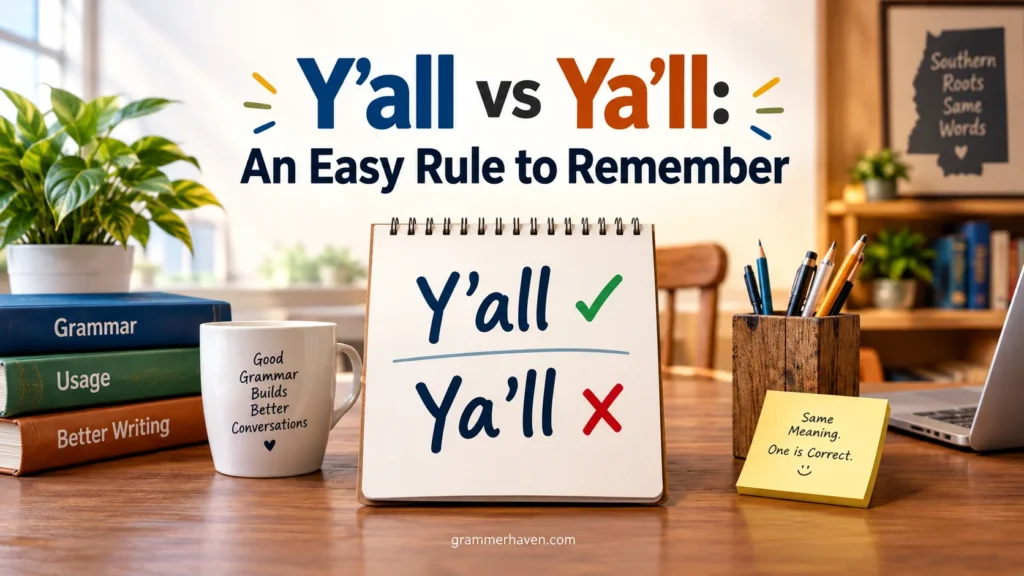
When the spelling starts to look confusing, don’t memorize the word as an isolated unit.
Build it from the original phrase:
YOU ALL
Remove OU from you:
Y’ALL
That’s the whole trick.
You can also remember this sentence:
If you mean “you all,” spell it “y’all.”
The apostrophe belongs after the y.
Never let the pronunciation trick you into moving it to ya’ll.
See also: Donut vs Doughnut: Which Spelling Is Correct?
FAQs:
Is y’all or ya’ll correct?
Y’all is correct. It is the standard contraction of you all. Ya’ll is a common misspelling.
Why is y’all spelled with an apostrophe?
The apostrophe marks letters omitted from you. The contraction changes you all into y’all, with ou removed.
Is y’all a contraction?
Yes. Y’all is a contraction of you all and functions as a pronoun.
What does y’all mean?
Y’all means “you all.” It generally addresses two or more people.
Is y’all grammatically correct?
Yes. Dictionaries recognize y’all as an established pronoun. Merriam-Webster lists it as a variant of you-all.
Is y’all singular or plural?
Its traditional and most common use is plural. It addresses multiple people.
Is y’all formal or informal?
Y’all is generally informal. It’s especially common in conversation and casual writing.
Is yall without an apostrophe correct?
Y’all is the standard spelling. Yall appears in informal digital writing, but it isn’t the preferred form in edited prose.
What is the difference between y’all and you’ll?
Y’all means you all, while you’ll means you will or you shall.
Can y’all be used in professional writing?
It can be used when the tone is intentionally conversational. In highly formal documents, however, you all or all of you may be a better choice.
Where did y’all originate?
The related form you-all has a documented first known use dating to 1631, according to Merriam-Webster. The modern contracted form became strongly associated with Southern U.S. English.
Is y’all only used in the Southern United States?
No. Although it has strong Southern associations, y’all is now used more broadly in American English.
What is the possessive form of y’all?
Possessive usage is less standardized than the basic spelling. Forms such as y’all’s occur in actual usage, but formal writing may benefit from a clearer alternative depending on the sentence.
Is “all y’all” grammatically correct?
All y’all occurs in informal regional English as an emphatic way to address an entire group. It’s a real usage pattern, although it’s more conversational than formal.
Conclusion:
In everyday English, y’all is the correct spelling, while ya’ll is a common misspelling. Y’all is the contraction of you all and works as an informal plural pronoun when addressing two or more people. The apostrophe represents the omitted letters in the contraction. Although the word is strongly associated with Southern U.S. English, its use has spread into texts, social media, casual writing, and everyday speech. Remembering the simple connection between you all and y’all can help you avoid this spelling mistake and write with confidence.